When BLACKPINK's members renewed their group contract with YG Entertainment in December 2023 but did not renew their individual ones, or when TWICE's Jeongyeon left JYP Entertainment in 2026 while the other eight members stayed, international fans often assumed something had gone wrong. Usually nothing had.
These moments are the visible surface of an ordinary, and often misunderstood, piece of paperwork: the K-pop exclusive contract. Understanding how it is built explains far more about who controls a group, who gets paid, and why groups quietly split their business in two.
The short version
- Group and individual contracts are often split, letting solo careers continue independently.
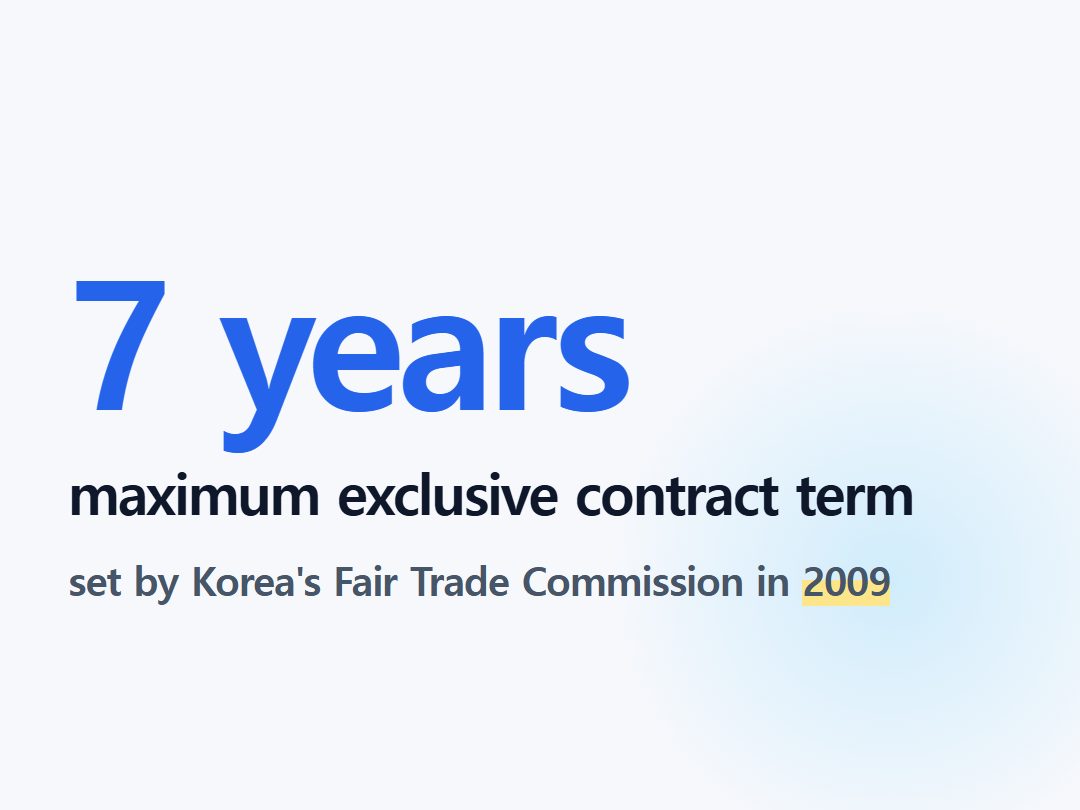
- South Korea caps K-pop exclusive contracts at seven years since 2009.
- New idols often earn little at first while agencies recoup training costs.
What a K-pop exclusive contract actually contains
Every debuting K-pop act signs at least one exclusive contract, called a jeonsok gyeyak (전속계약), with the agency that trained and produced them.
In this "agency system," the company recruits and trains performers for years before debut, then manages their music, schedules, and public image afterward in exchange for a share of earnings.
The exclusive contract is the legal foundation of that relationship: it sets how long the artist is bound to the company, how revenue is divided, and what the company can and cannot require of the artist.
Since 2009, the terms of that relationship have not been left entirely to negotiation. South Korea's Fair Trade Commission (FTC) publishes a "Standard Exclusive Contract Form for Popular Culture Artists," a template agencies are encouraged, though not legally required, to use.
Its best-known provision caps the exclusive contract at seven years, after which the artist can seek termination even if the written term is longer. That single clause has shaped the industry calendar for more than a decade.
Who controls a K-pop group, and who gets paid?
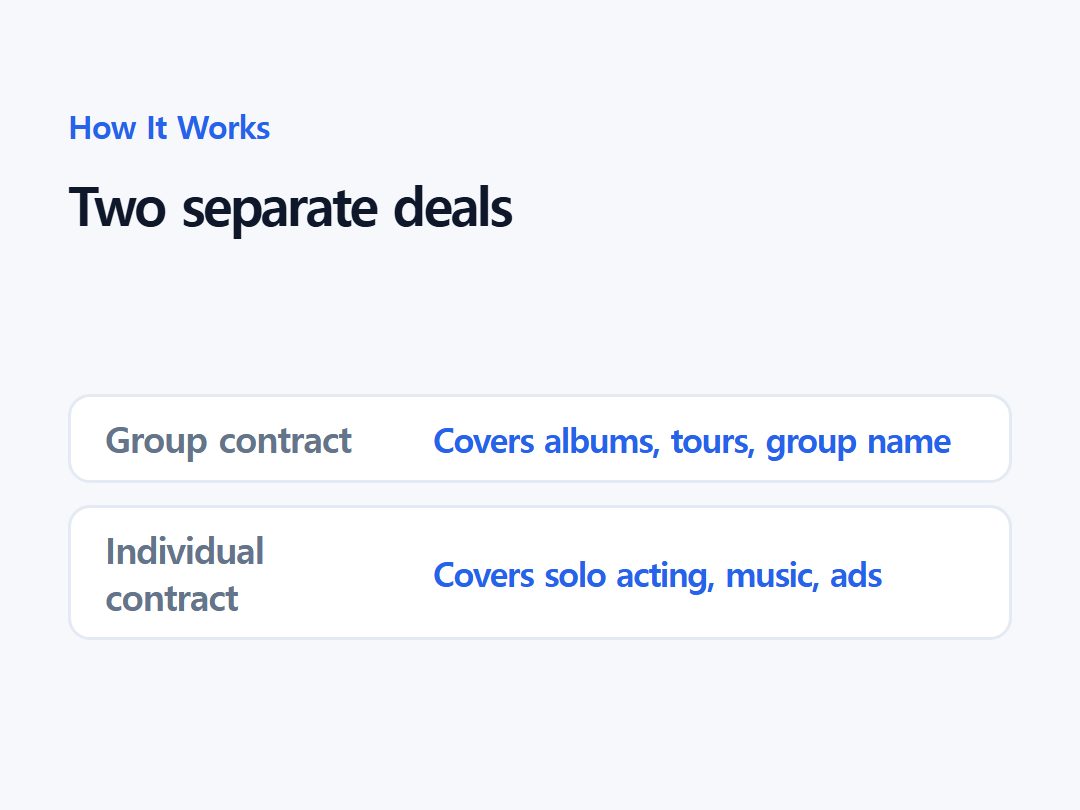
For international fans, the confusing part is usually that a group can seem to break up and stay together at the same time. That happens because many acts today are governed by two separate contracts rather than one.
The first is the group contract, which covers activities the members do together: albums, tours, group content, and the shared trademark of the group's name.
The second is the individual contract, which covers each member's solo work — acting, solo music, brand endorsements, or variety-show appearances outside the group.
Historically, agencies bundled both into a single exclusive contract, but high-profile renewal disputes pushed many companies toward splitting the two, giving members more room to pursue outside projects without dissolving the group itself.
BLACKPINK is the clearest public example of this split. In December 2023, all four members renewed their contract with YG Entertainment for group activities only.
Weeks later, YG announced it would not renew the members' individual contracts, and each member subsequently built her own solo path: Jennie founded the label Odd Atelier, Lisa launched LLOUD, Jisoo started Blissoo, and Rosé signed with YG's sister label The Black Label.
The group itself remained intact under YG; only the solo business moved elsewhere.
A similar structure, though it later grew contentious, applied to EXO members Baekhyun, Chen, and Xiumin, who kept their group contract with SM Entertainment while pursuing solo work as a sub-unit, paying SM a percentage of their individual revenue for the right to use the EXO name.
This split matters because it changes who has leverage. A member unhappy with an agency's handling of solo opportunities can, in principle, renegotiate the individual contract without threatening the group's existence.
It also means a member's departure — like Jeongyeon leaving JYP in 2026 while TWICE continued as an eight-member group — does not automatically end the group's group contract with the label.
The second piece international readers usually miss is how trainees are paid, or not paid, before and immediately after debut.
Being a trainee is unpaid: agencies cover vocal, dance, and language lessons, dorm housing, and, for many companies, styling and medical costs, while a hopeful trains for a debut that is never guaranteed.
Reported spending per trainee varies widely by agency, and industry figures cited in Korean trade reporting put total training costs before a single trainee's debut in the range of hundreds of millions of won, sometimes accumulated over two years or more of training.
That spending is treated as an investment the agency expects to recover.
Once a group debuts and starts earning, the agency typically deducts training and debut-related costs from group revenue before any profit-sharing calculation begins — a practice critics describe as the agency recovering its investment out of the artists' share rather than its own, since the standard split before recoupment is often described as roughly even.
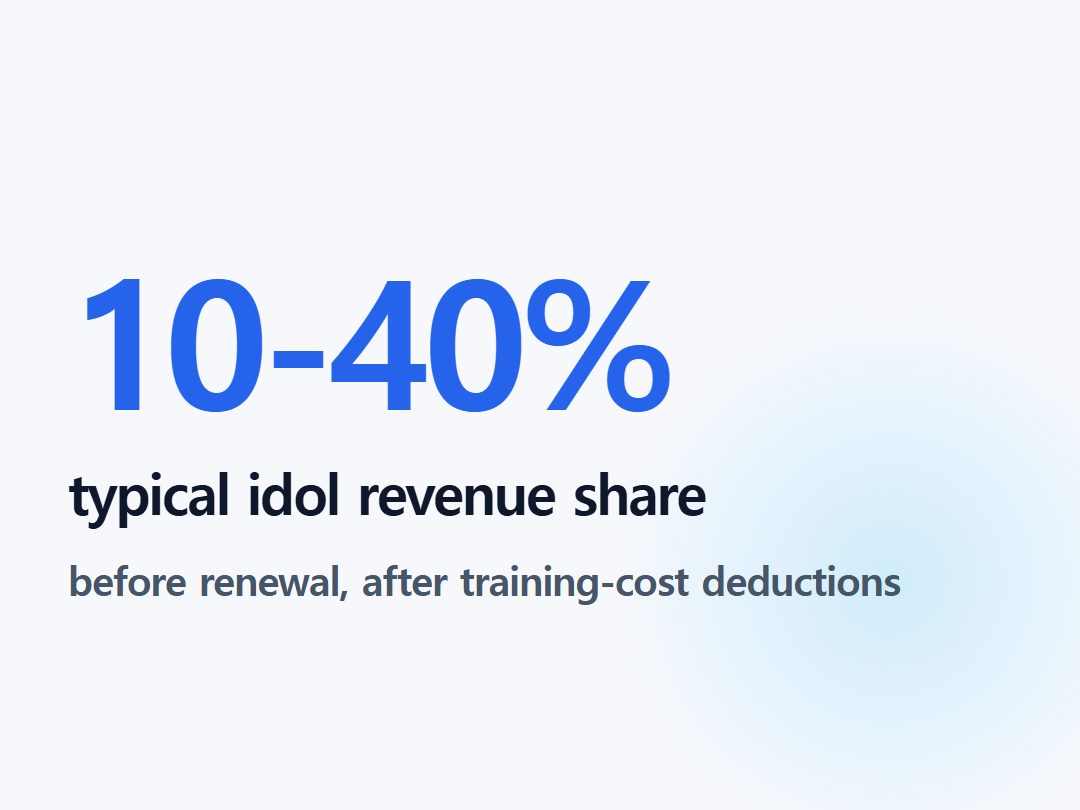
In practice, the share an idol actually keeps depends on unrecovered training debt, the size of the group (revenue from group promotions is typically split among all members before individual amounts are calculated), and how favorable the specific contract terms are; industry accounts describe idol shares ranging from roughly 10 percent up to 40 percent of net revenue in the early years of a contract, rising toward 50 percent or better only for established, successful acts at renewal.
This is why some newly debuted groups report little or no personal income in their first year or two of promotions even while their music charts internationally.
The lawsuits that forced Korea to regulate contracts
The seven-year cap and the standard contract exist because of a specific dispute.
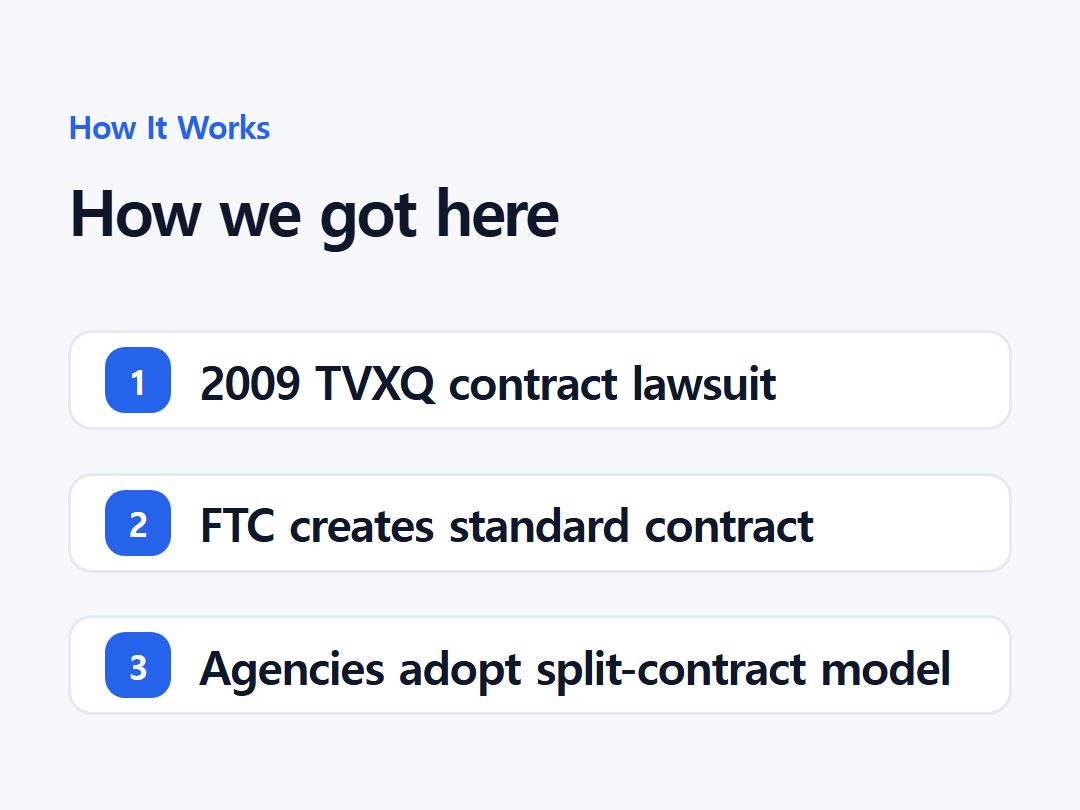
In 2009, three members of TVXQ (also known as DBSK), one of the best-selling boy groups of the 2000s, filed an injunction against SM Entertainment to suspend their exclusive contract, which ran 13 years and could effectively extend past 15 years once mandatory military service was factored in.
The case, alongside similar disputes involving other prominent acts of the period, became part of a broader "slave contract" controversy that drew government attention to how one-sided entertainment contracts had become.
The FTC responded in July 2009 by publishing the standard exclusive contract form, limiting exclusivity to seven years and adding baseline protections around settlement transparency and personal rights.
Because the template was voluntary rather than mandatory, adoption was uneven for years afterward — a lawyer representing former EXO members Kris, Luhan, and Tao noted in a subsequent dispute that their contracts still ran 12 to 13 years, well beyond the standard cap.
The FTC tightened related rules again in 2017 following a dispute involving singer Song Sohee, reducing penalties for artists who exit contracts early.
Settlement transparency became a national talking point again in 2022, when actor-singer Lee Seung-gi accused his former agency, Hook Entertainment, of withholding music royalties for 18 years.
After a lengthy legal fight, a Seoul court ruled in April 2025 that Hook had breached its duty to provide accounting records and ordered further payment, on top of tens of billions of won the agency had already paid.
The case fed directly into legislative proposals, informally called the "Lee Seung-gi law," that would require agencies to give artists detailed annual accounting statements.
Regulators have kept pressure on agencies more broadly, too: in June 2025 the FTC finalized a consent agreement with HYBE, SM, YG, JYP, and Starship over separate subcontracting violations involving smaller production and merchandise vendors.
Unions want change while courts back agencies
The seven-year rule itself is under renewed debate. A newly formed idol labor union has argued the cap should shrink to five years, citing the physical and psychological toll of promotion schedules on performers who are often still teenagers at debut. Agencies have not endorsed the change.
Courts, meanwhile, are still defining the line between an artist's personal rights and an agency's management authority.
In a pair of October and November 2025 rulings involving NewJeans' dispute with Ador and EXO-CBX's dispute with SM, Korean courts sided with the agencies, finding that disagreements over management decisions do not by themselves amount to a rights violation.
Those rulings suggest that even as split-contract and hybrid models spread, exclusive contracts remain legally binding instruments that Korean courts are inclined to enforce as written — leaving future disputes to hinge less on public sentiment and more on the specific terms negotiated into each artist's paperwork.
A timeline of K-pop's contract law milestones
| Date | Event |
|---|---|
| 2009 | FTC publishes standard exclusive contract, capping deals at seven years |
| 2017 | FTC tightens rules after Song Sohee dispute, lowering exit penalties |
| 2022 | Lee Seung-gi accuses Hook Entertainment of withholding 18 years of royalties |
| April 2025 | Seoul court rules Hook Entertainment breached its accounting duty |
| June 2025 | FTC finalizes consent agreement with HYBE, SM, YG, JYP, Starship over subcontracting |
| Oct–Nov 2025 | Courts side with agencies in NewJeans–Ador and EXO-CBX–SM disputes |
Frequently asked
Why did BLACKPINK renew with YG but not as solo artists?
In December 2023 the members renewed only their group contract with YG; weeks later YG chose not to renew their individual contracts, so each member built her own solo path, like Jennie's Odd Atelier or Rosé staying with YG's sister label The Black Label.
How long can a K-pop exclusive contract last?
Since 2009, South Korea's Fair Trade Commission has published a standard contract form capping exclusivity at seven years, though the template is only voluntary for agencies to adopt.
How much money do K-pop idols actually make?
Idol shares typically range from roughly 10 to 40 percent of net revenue in the early years of a contract, rising toward 50 percent or more only once an act is established and renews, after agencies recoup training costs.
Sources
Every factual claim above is traceable. We do not translate articles — we gather facts from multiple outlets and write them ourselves.
- Is the '7-year itch' a thing of the past? — The Korea Herald
- South Korea's FTC Releases New Rules For K-Pop Companies And Subcontractors — CelebrityAccess
- K-pop legal feuds highlight power of contracts as NewJeans, EXO members lose disputes — The Korea Times
- Hook Entertainment pays Lee Seung-gi ₩5billion in dispute over unpaid music profits — NME
- Lee Seung Gi wins lawsuit, Hook Entertainment ordered to pay 581 million won + Lee Seung Gi Act put to public — Asian Junkie
- BLACKPINK members end solo contracts with K-Pop agency YG Entertainment — Music Business Worldwide
- YG Announces BLACKPINK Is Not Renewing Individual Contracts For Solo Activities — Soompi
- Jeongyeon Leaves JYP: What This Means For TWICE — Forbes