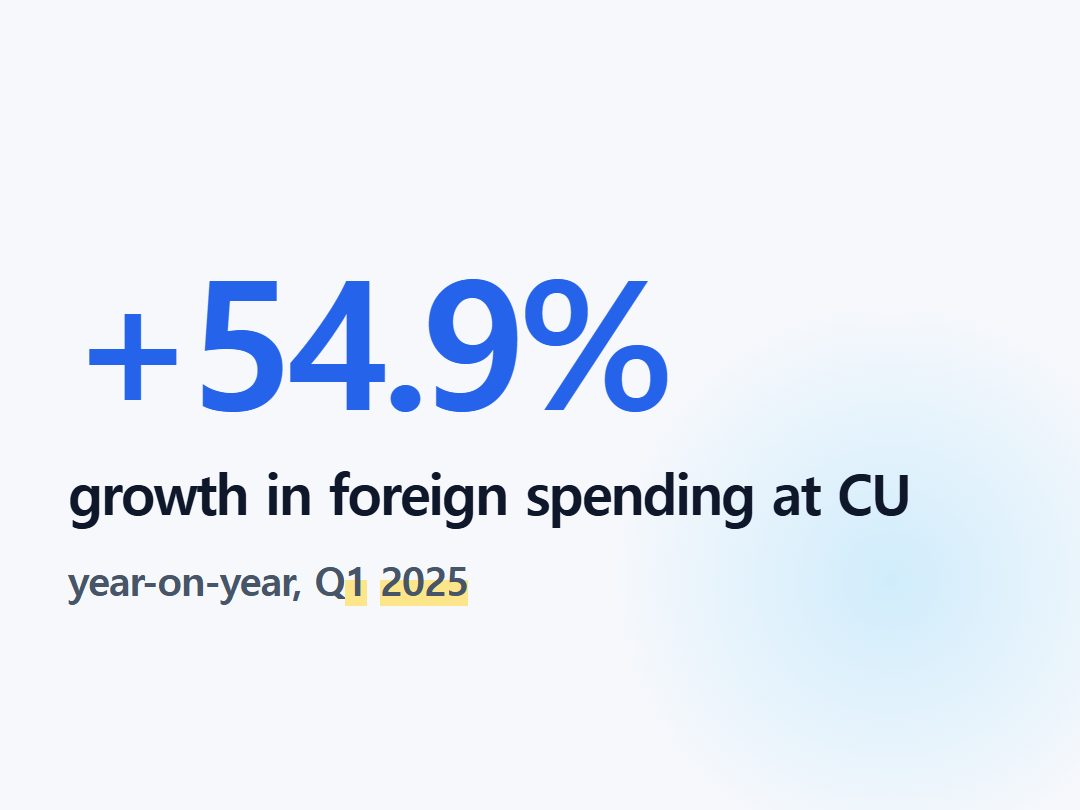
Foreign visitor spending at South Korea's three biggest convenience store chains jumped more than 40% year-on-year in the first quarter of 2025, according to industry data reported by KED Global — CU up 54.9%, GS25 up 50.7%, and 7-Eleven up 40%.
In some coastal tourist areas, the swing has been even sharper: GS25 reported that foreign-card payment revenue at around 100 stores in destinations like Gangneung, Sokcho, Busan's Haeundae and Jeju Island rose 136.9% year-on-year in a single week in July 2025, according to the Korea Herald.
This is not a niche curiosity. For a growing share of travelers, the convenience store — not a restaurant, not a market — is the first stop after landing.
The short version
- Foreign spending at Korea's convenience stores jumped over 40% in early 2025.
- Self-service hot food makes stores function like cheap, judgment-free diners.
- Korea now has more convenience stores per person than Japan or Taiwan.
Why are Korean convenience stores going viral online?
Convenience stores in Korea have quietly become tourist destinations in their own right.
Industry executives quoted by KED Global describe a shift "from group-based shopping at duty-free shops and landmarks to independent travelers influenced by Korean trends on social media." That shift shows up in the receipts: triangle-shaped rice snacks, instant noodles, and a viral "Dubai-style" chocolate bar that CU launched on July 6, 2024 sold out its initial 200,000-unit stock the same day and became the top-selling item among the chain's foreign customers. GS25 and 7-Eleven followed with their own versions.
Some chains have gone further, building stores designed explicitly as attractions rather than shops.
GS25's "Ground Blue 49" in Seoul's Insadong district, which opened in 2024, is a roughly 220-square-meter flagship with a K-Food Station curated from foreign tourist purchase data, a "K Noodle Challenge" station built around the popularity of instant-noodle mukbang (a Korean term for filmed eating broadcasts) videos, and robot-operated pizza and latte machines, according to Korea.net and Asia Business Daily.
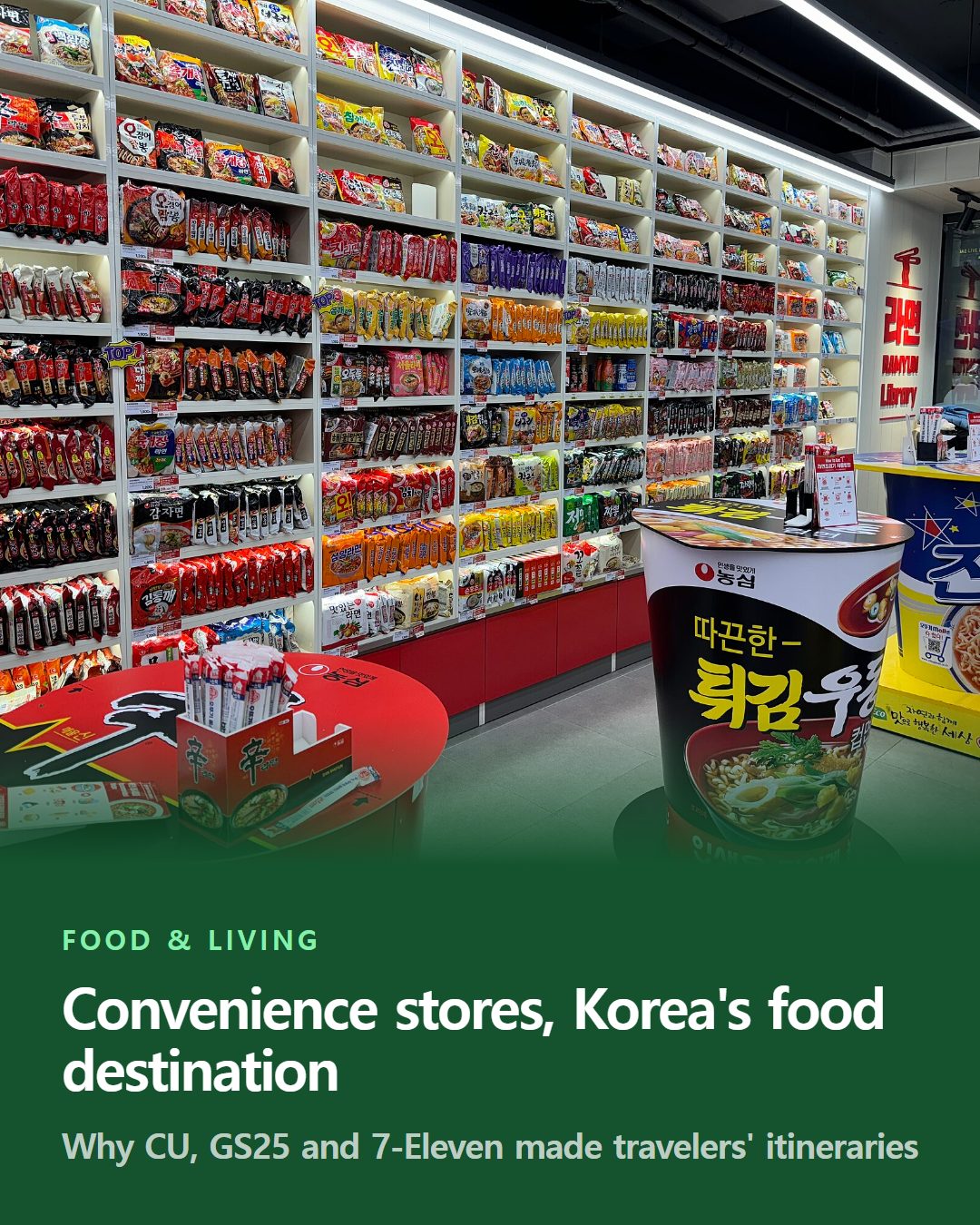
In the Hongdae neighborhood, CU's "Ramyeon Library" stocks more than 225 varieties of instant noodles on floor-to-ceiling shelves for customers to cook and eat on site.
Why do Korean convenience stores double as diners?
To understand why a convenience store chain can function as a tourist destination, it helps to know what Korean convenience stores actually are, because the category means something different here than in most countries.
South Korea now has the highest convenience store density of any country in the world, having overtaken both Japan and Taiwan.
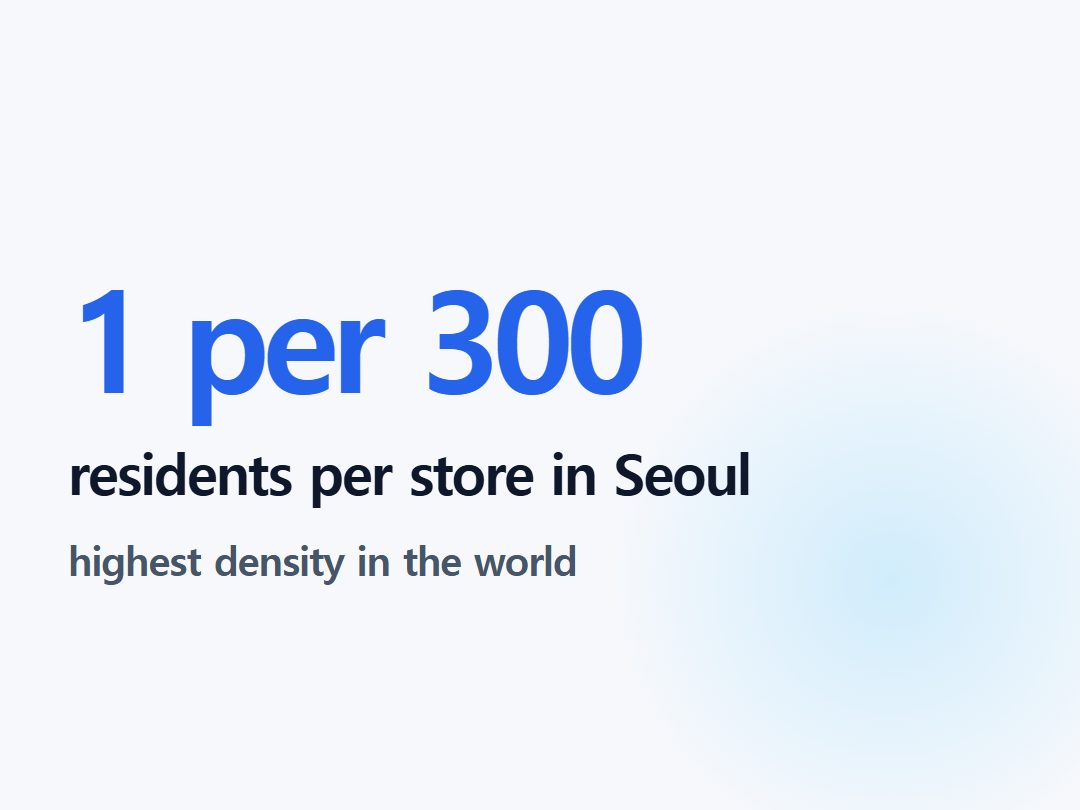
Store counts vary by source and year, but industry estimates put the four major chains — CU, GS25, 7-Eleven, and Emart24 — at over 53,000 locations combined as of late 2025, with Seoul alone averaging roughly one store per 300 residents.
For comparison, Japan, the birthplace of the modern convenience store format, had its own count roughly matched or overtaken by Korea around 2024, even as Japan's store numbers have declined since the COVID-19 pandemic.
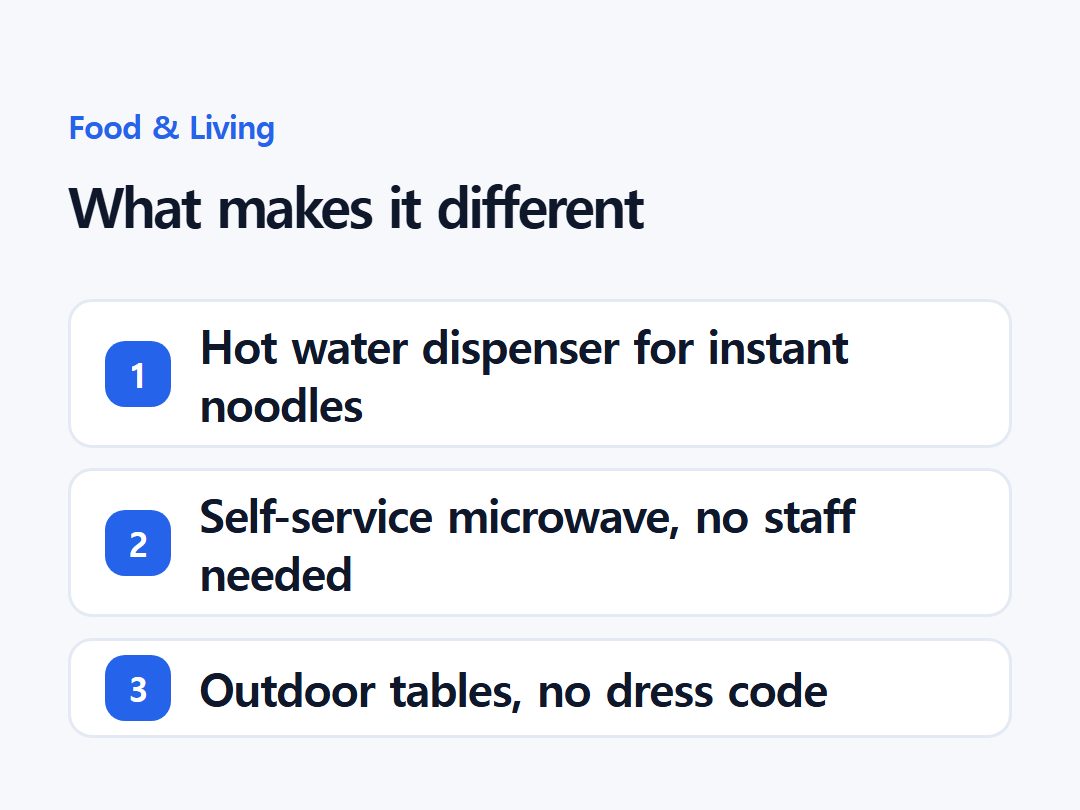
That density alone doesn't explain the appeal. What does is what a Korean convenience store is designed to let you do. Nearly every location has a hot-water dispenser next to a rack of cup noodles, a microwave, and often a small seating area, sometimes with outdoor plastic tables.
The system is entirely self-service: a customer buys an item, then heats or prepares it themselves without asking staff, which is normal and expected as long as the food was purchased in that store.
This turns a convenience store into something closer to a casual, informal diner — a place to sit down and eat a hot meal for the equivalent of a few dollars, at any hour, with no reservation and no dress code.
The food itself has its own internal logic that isn't obvious to a first-time visitor.
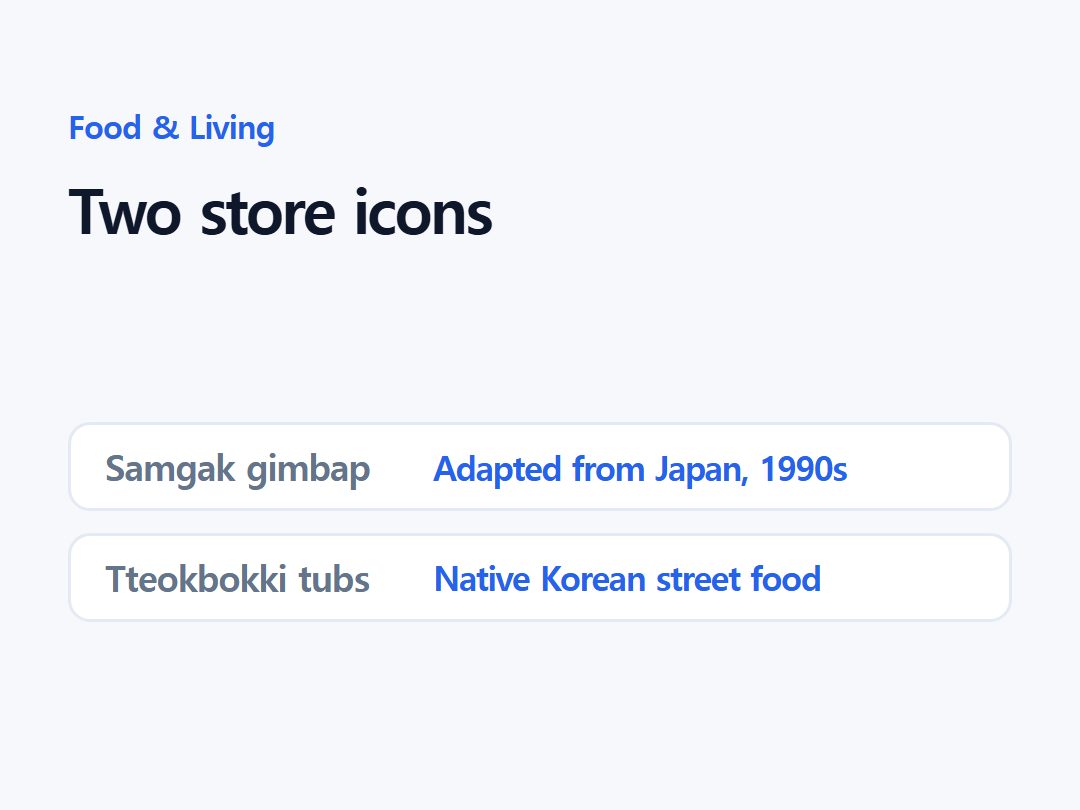
The hero item, samgak gimbap (triangle-shaped rice wrapped in dried seaweed, usually stuffed with tuna mayonnaise, spicy bulgogi beef, or kimchi), is actually an adaptation of the Japanese onigiri, introduced to Korean stores in the 1990s and established as a category leader by the 2000s.
Tteokbokki (spicy stir-fried rice cakes), by contrast, is a native Korean street food that convenience stores reformatted into microwave-ready tubs, moving a dish once sold only by street vendors into a grab-and-go format available nationwide.
Combining store items is also part of the culture: melting a slice of processed cheese into instant noodles, adding a boiled egg or sliced sausage, or dipping a triangle kimbap into ramen broth are common, unwritten customizations rather than official menu items.
There is also a social dimension that outlasts the food itself.
Because the format has no waitstaff, no bill to split, and no expectation of ordering more than one cheap item, it functions as a rare space in Korean society without visible class or age hierarchy — an office worker in a suit and a student in uniform can eat the same instant noodles at adjacent counters without either interaction seeming unusual.
Eating alone, which can carry social stigma in sit-down restaurant settings in Korea, carries none at a convenience store counter.
At night, especially near universities or riverside parks, the outdoor tables outside stores double as an informal, low-cost social space where groups sit with canned drinks and shared snacks.
None of this is arranged for tourists. It is ordinary infrastructure that happens to be legible, affordable, and photogenic — which is precisely why it travels well on social media and why independent travelers now treat a convenience store stop as a fixed part of a Seoul itinerary rather than a fallback option.
How fierce competition since 1989 built today's boom
Convenience stores arrived in Korea relatively late compared to Japan's combini, which pioneered the modern format decades earlier. 7-Eleven entered the Korean market in 1989, and the sector expanded through the 1990s and 2000s as more domestic and international chains launched.
Samgak gimbap's introduction from Japan in the 1990s tracks with this early growth period; by the 2000s it had become a fixture rather than a novelty.
Growth accelerated over the following two decades. South Korea's convenience store count rose from roughly 38,000 in 2018 to over 55,000 by 2024, a period during which Japan's own store count began to contract.
Competition among CU (operated by BGF Retail), GS25 (GS Retail), and 7-Eleven (Korea Seven) intensified into what industry observers describe as a constant product cycle: each chain launches large numbers of new items annually, with underperforming products pulled within weeks, creating a fast-moving private-label food culture that most other countries' convenience stores don't attempt.
CU's collaborations with celebrity chef Baek Jong-won are one example of this product strategy, blending name-brand food credibility with convenience store pricing and availability.
The tourist-facing layer of this culture is more recent, tied to South Korea's post-pandemic reopening and the broader global reach of Korean pop culture, film, and television, much of which prominently features convenience store settings (the 2020 drama Backstreet Rookie was set inside one).
As short-form video content built around Korean food hauls and instant-noodle challenges circulated internationally, chains began adjusting store design and product selection specifically around foreign visitor behavior, exemplified by GS25 curating its Ground Blue 49 K-Food Station using foreign tourist purchase data rather than general sales figures.
Domestic growth is slowing while chains expand abroad
The growth curve is not uniform.
While foreign tourist spending has surged, overall industry revenue growth at Korea's four major chains has slowed sharply on the domestic side — from about 8% in 2023 to roughly 3.9% in 2024 and close to flat in 2025, according to industry data, as the market approaches saturation and inflation erodes real growth.
In response, chains have begun emphasizing fewer, larger-format stores with expanded fresh food sections rather than pure store-count expansion.
At the same time, Korean chains are exporting the model. GS25 has expanded into Vietnam and Mongolia, and CU operates stores in Mongolia, Malaysia, and Kazakhstan, suggesting the companies see the convenience-store-as-food-destination format as a product that can travel beyond Korea's borders.
Whether that international expansion dilutes or reinforces the specifically Korean identity that currently draws tourists to the format at home is still an open question, as is whether foreign visitor spending growth can be sustained once the current wave of social-media-driven novelty settles into routine.
Foreign-card spending growth at Korea's convenience store chains (Q1 2025, year-on-year)
| Chain | Growth |
|---|---|
| CU | 54.9% |
| GS25 | 50.7% |
| 7-Eleven | 40% |
Frequently asked
Why are convenience stores popular with tourists in Korea?
Independent travelers influenced by Korean social media trends now seek out viral items like CU's Dubai-style chocolate bar and attraction-style stores such as GS25's Ground Blue 49 and CU's Ramyeon Library.
How many convenience stores are there in Korea?
Korea's four major chains — CU, GS25, 7-Eleven, and Emart24 — had over 53,000 locations combined as of late 2025, giving the country the highest convenience store density in the world.
Can you eat food at a convenience store in Korea?
Yes — most locations have a hot-water dispenser, microwave, and seating area so customers can heat and eat purchased food on site, self-service, for a few dollars.
Sources
Every factual claim above is traceable. We do not translate articles — we gather facts from multiple outlets and write them ourselves.
- When in S. Korea, it's a ritual: Foreigners make stops at CU, GS25, 7-Eleven — KED Global
- Foreign sales jump 137% at GS25 stores in coastal tourist spots — The Korea Herald
- Convenience store branches evolve into chic cultural venues — Korea.net (Republic of Korea official site)
- GS25 Opens Future Experience Store 'Ground Blue 49' in Insadong — The Asia Business Daily
- South Korea: World's Highest Convenience Store Density — YPA
- Have South Korean Convenience Stores Eclipsed Japan's Combini? — Unseen Japan