The webtoon — a full-color comic read by scrolling straight down a single continuous strip — is now Korea's dominant comics format and a global export, with Naver Webtoon's parent company listed on Nasdaq and its stories feeding Netflix hits like Sweet Home and All of Us Are Dead.
Outside Korea, the format is often assumed to be a smartphone invention, built for swiping. It is not.
The vertical scroll was fixed as the standard well before smartphones existed, on Korean PC web portals in the early-to-mid 2000s, and it emerged from conditions specific to Korea's internet and comics industry at the time.
The short version
- Vertical scrolling was fixed on Korean PC portals years before smartphones existed.
- Weak domestic print manhwa let Korean portals build webtoons from a blank slate.
- WEBTOON Entertainment went public on Nasdaq in 2024, valued around $2.7 billion.
Why do Korean webtoons scroll instead of page?
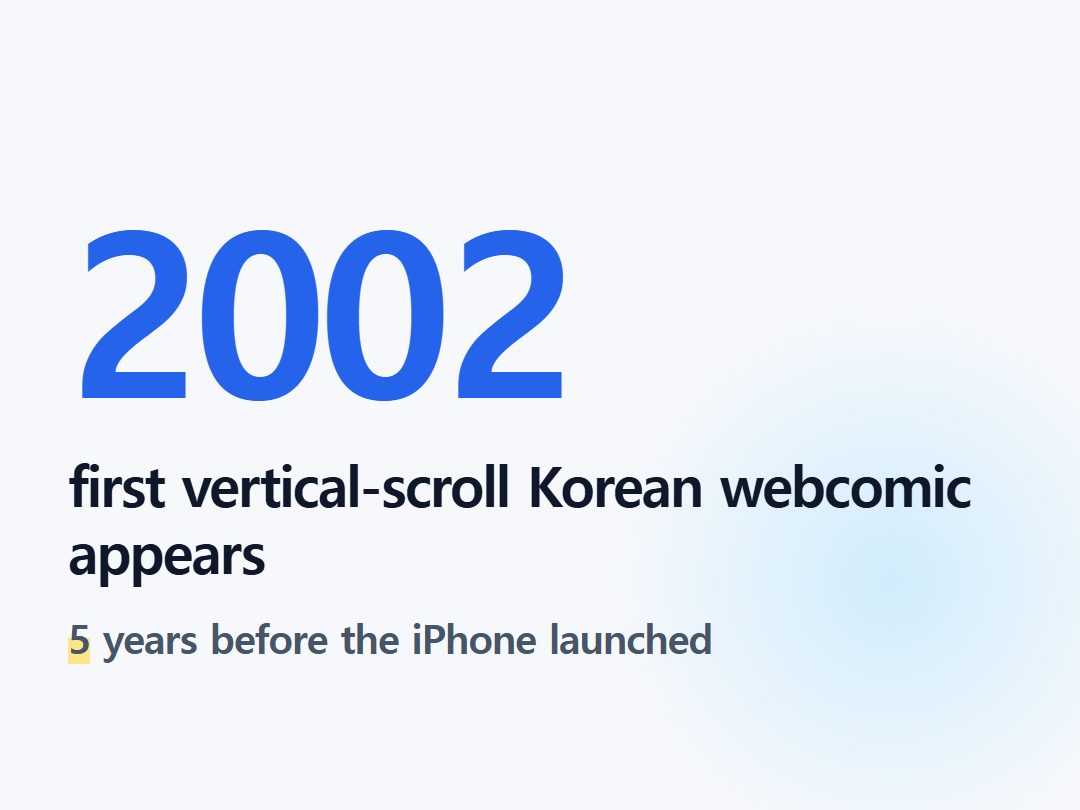
The single most common misconception international readers have about webtoons is that the format was designed for phones. It makes intuitive sense — a tall, narrow strip fits a phone screen, and most people today read webtoons on mobile apps. But the format predates the smartphone era by roughly half a decade.
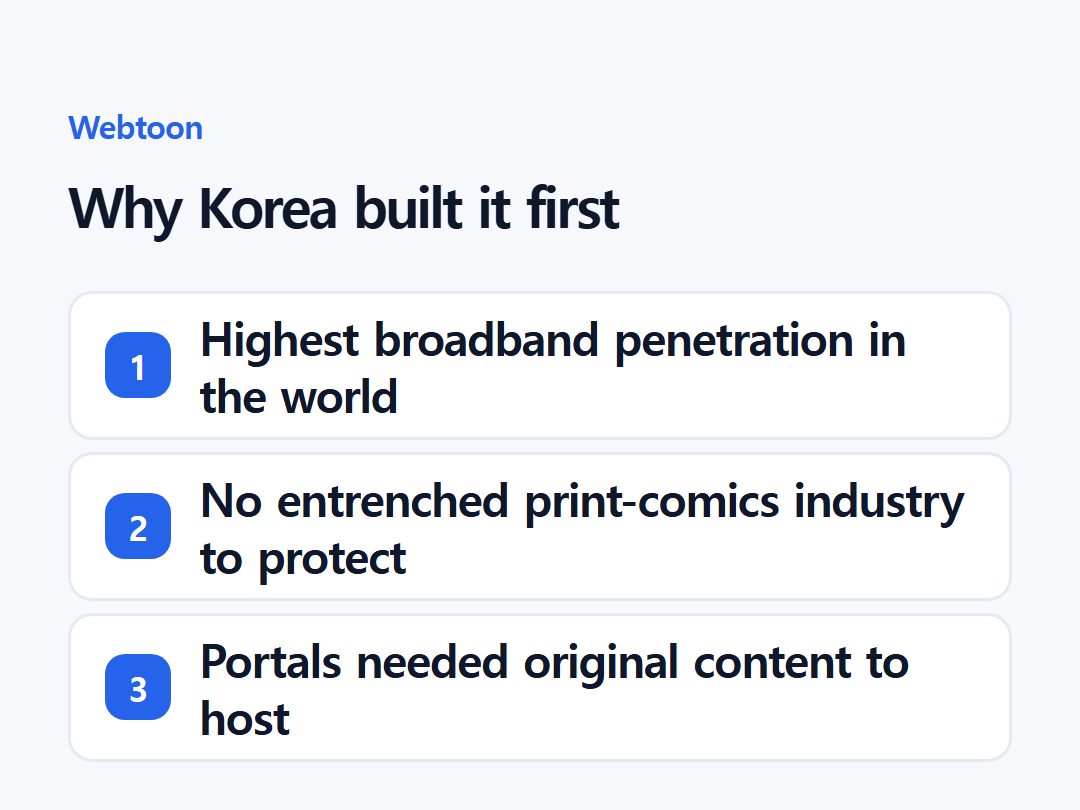
Korea had among the highest broadband penetration rates in the world by the early 2000s, the product of an aggressive, government-backed national broadband rollout through the late 1990s.
That infrastructure meant millions of Koreans were reading and socializing on desktop PC portals — Naver, Daum — years before Apple's iPhone launched in 2007 or before smartphones became mainstream in Korea around 2010.
The first Korean webcomic widely credited with using a genuinely vertical, scroll-based layout was Pape and Popo's Memories, posted by the artist Sim Sŭng-hyŏn on a Daum group blog in 2002. It was built to be read by turning a mouse's scroll wheel on a desktop monitor, not by swiping a touchscreen.
A year later, in 2003, the self-taught artist Kang Full published Love Story on Daum's newly launched webtoon portal — the work most credited with cementing the long vertical strip as the industry's default shape.
It reportedly drew 32 million views and 250,000 reader comments, proof to Korean portals that original, screen-native comics could pull an audience print manhwa (the Korean word for comics, encompassing both print and digital work) never reached.
Naver, now the dominant platform, entered the same year: its comics section had existed since 2000 hosting scanned print manhwa, but it pivoted to original vertical-scroll “webtoons” around June 2004, a push led internally by a junior programmer, Kim Jun-koo, who is now CEO of the platform's global parent company, WEBTOON Entertainment.
Understanding why this format took hold in Korea specifically — and not, say, in Japan, the world's other comics superpower — requires understanding what each country's comics industry looked like going into the digital era.
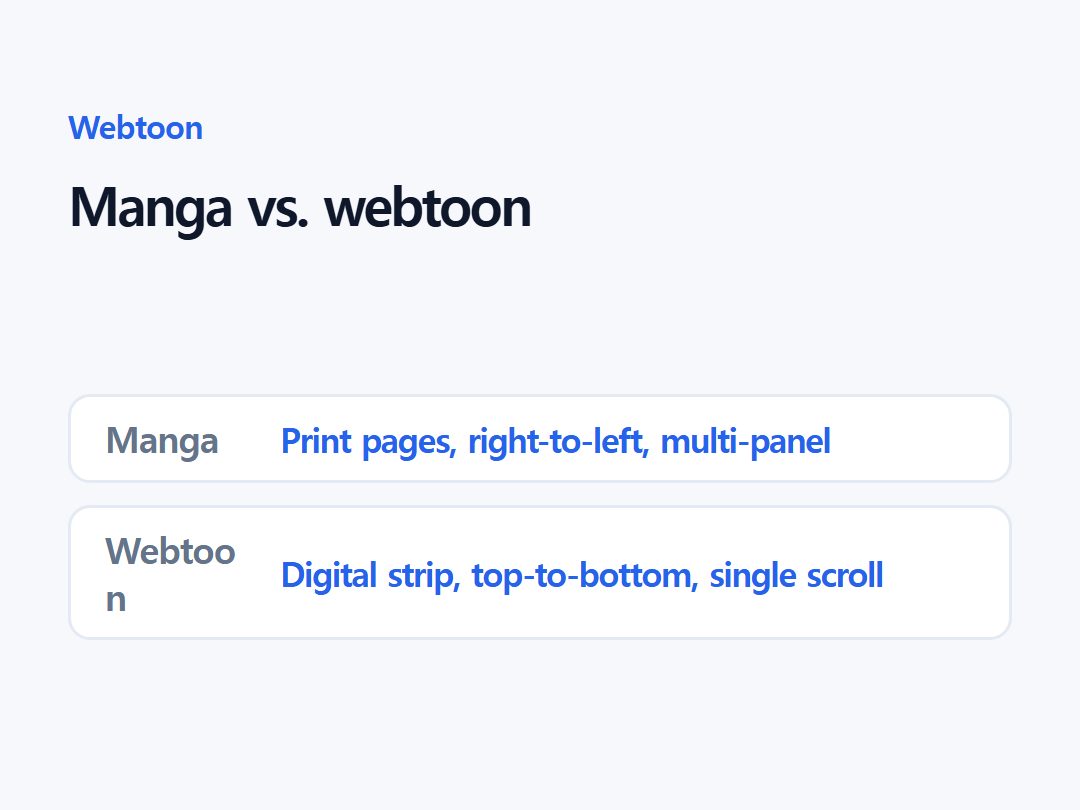
Japanese manga had (and still has) an enormous, deeply entrenched print industry: bound paperback volumes called tankōbon, weekly anthology magazines, a printing and retail infrastructure built over decades.
That industry had every incentive to keep readers buying physical books, and manga's page-turning, multi-panel-per-page layout — usually six to eight panels per page, read right to left — was built for exactly that physical object. Korea's domestic comics industry was comparatively weak.
For decades, Korea imported the large majority of the comics it read, with academic research on the industry noting the country historically sourced over 90 percent of its comics content from Japan.
There was no powerful domestic print-manhwa business standing in the way of the internet portals when they started publishing comics for free online.
Korean creators and platforms were building something closer to a blank slate, so when broadband created an obvious new distribution channel, there was no legacy format or legacy industry pulling them back toward print conventions.
That difference in starting conditions produced two structurally distinct comics formats. Manga panels are composed for a static printed page, where the reader's eye moves across a fixed two-page spread.
Webtoons are composed for continuous vertical motion, with artists arranging single images or short panel sequences — often called “cuts” rather than traditional panels — down an unbroken strip that can run for dozens of screens.
A Japanese manga publishing executive, Baku Hirai of LINE Digital Frontier, put the mismatch bluntly to the Japan Times in 2019: manga “are originally meant to be read in print formats” and “are not necessarily optimized for smartphones,” with text sometimes too small to read comfortably on a phone screen.
That same 2019 reporting noted Korean webtoon titles such as True Beauty and Lookism had climbed to the top of Japan's own digital comics charts — a digital-native Korean format outperforming print-derived Japanese manga inside Japan's own market.
None of this means the format's later fit with smartphones was accidental luck without consequence — it mattered enormously for how fast webtoons scaled globally. But the shape itself, the single vertical strip meant to be scrolled rather than paged through, was locked in on Korean desktop browsers years before any of that mobile growth happened.
From Daum's 2003 launch to a Nasdaq IPO
Daum, not Naver, was first to market with a dedicated webtoon portal, launching one in February 2003; Naver's original-webtoon push followed roughly a year later, in mid-2004.
Naver overtook Daum in the following years partly through a 2006 feature called “Challenge Comics” — later renamed “Webtoon League” — that let any user upload their own vertical-scroll comic for free, functioning as an open talent pipeline that fed the platform a constant stream of new series and let popular amateur work graduate to paid, officially serialized status.
This crowdsourcing model, paired with early smartphone adoption in Korea, let Naver become the dominant platform through the 2010s.
Naver took its webtoon service international in July 2014, launching an English-language app then called LINE Webtoon in the United States and worldwide, offering 42 titles translated or created specifically for English-language readers, drawn from a home library of 520 original Korean series.
By that point, the Korean-language service alone was logging a daily average of 6.2 million unique visitors.
The platform rebranded globally from LINE Webtoon to simply WEBTOON in 2019, expanded into Japan and China starting in 2016, and acquired the fan-fiction platform Wattpad in 2021, folding it into a Los Angeles-headquartered global parent company, WEBTOON Entertainment.
That growth culminated in a Nasdaq listing. WEBTOON Entertainment went public on June 27, 2024, under the ticker WBTN, raising $315 million at $21 a share — the top of its offering range — for an implied valuation of roughly $2.7 billion; shares rose as much as 14 percent on their first trading day.
Naver retained majority voting control after the listing.
According to the company's own regulatory filings, WEBTOON Entertainment reported 170 million monthly active users and roughly $1.35 billion in annual revenue for fiscal year 2024, with Japan alone accounting for close to half of that revenue even as domestic Korean engagement has recently softened.
The format's commercial reach now extends well beyond the comics themselves. Webtoons including Sweet Home, Hellbound, All of Us Are Dead, and Itaewon Class have become some of Netflix and Korean television's highest-profile adaptations, with the vertical-panel artwork frequently serving production teams as a ready-made storyboard.
Can WEBTOON Entertainment turn its growth into profit?
Two open questions define where the format goes from here.
The first is whether WEBTOON Entertainment can convert its global user base into sustained profit rather than growth-stage losses — the company posted a net loss for fiscal 2024 even as adjusted earnings improved sharply, and its stock has traded well below its IPO price at points since listing.
The second is whether the vertical-scroll format itself keeps evolving: Korean webtoon publishers are now experimenting with short, TikTok-style “micro-drama” video adaptations of individual webtoon chapters, a bet that the same scrolling, mobile-native instincts that built the webtoon industry two decades ago can be repurposed again for vertical video.

Two decades of webtoon milestones, year by year
| Year | Milestone |
|---|---|
| 2002 | First vertical-scroll webcomic, Pape and Popo's Memories, posted on a Daum blog |
| 2003 | Kang Full's Love Story launches on Daum's new webtoon portal |
| 2004 | Naver pivots to original vertical-scroll webtoons in June |
| 2006 | Naver launches crowdsourcing feature "Challenge Comics" |
| 2014 | Naver launches LINE Webtoon internationally in the US |
| 2016 | WEBTOON expands into Japan and China |
| 2019 | Platform rebrands globally from LINE Webtoon to WEBTOON |
| 2021 | WEBTOON Entertainment acquires Wattpad |
| 2024 | WEBTOON Entertainment goes public on Nasdaq (WBTN) |
Frequently asked
Were webtoons originally made for smartphones?
No, the vertical-scroll format was locked in on Korean desktop PC portals in the early-to-mid 2000s, years before smartphones existed.
What was the first webtoon?
Pape and Popo's Memories, posted by artist Sim Sŭng-hyŏn on a Daum group blog in 2002, is widely credited as the first genuinely vertical, scroll-based webcomic.
Is WEBTOON Entertainment a public company?
Yes, WEBTOON Entertainment went public on Nasdaq under the ticker WBTN in June 2024, raising $315 million at an implied valuation of roughly $2.7 billion.
Sources
Every factual claim above is traceable. We do not translate articles — we gather facts from multiple outlets and write them ourselves.
- The Webtoon: A New Form for Graphic Narrative — The Comics Journal
- A Brief History of Webtoons — Victoria and Albert Museum
- South Korea's booming 'webtoons' put Japan's print manga on notice — The Japan Times
- Webtoons, Desperately Seeking Viewers: Interactive Creativity in Social Media Platforms and Cultural Appropriation of Global Media Production — Media and Communication (SAGE)
- Popular Mobile Webcomic Service, LINE Webtoon, Debuts in the United States and Worldwide — PR Newswire (official Naver/LINE release)
- South Korea's Naver-backed Webtoon shares jump about 14% in Nasdaq debut — Reuters
- While webtoons gain momentum overseas, in Korea demand wanes — The Korea Herald
- WEBTOON Entertainment Inc. Reports Fourth Quarter and Full Year 2024 Financial Results — WEBTOON Entertainment Investor Relations
- Kang Full — Wikipedia