Ask a Korean high schooler what time school ends and you'll get two different answers. Regular classes are over by mid-afternoon. But the day itself — where a student is expected to be, and what they're expected to be doing — doesn't end for hours after that.
The short version
- Regular classes end by 4 p.m., but hagwon hours set students' real dismissal time.
- Families spent 27.5 trillion won ($19 billion) on private education in 2025.
- Seoul may extend its hagwon curfew from 10 p.m. to midnight in 2026.
That gap is the least understood fact about Korean education for outside readers. It's filled almost entirely by hagwon (학원), private after-school academies that function as a paid, parallel school system running alongside the public one.
Regular classes end around 4 p.m. — the school day doesn't
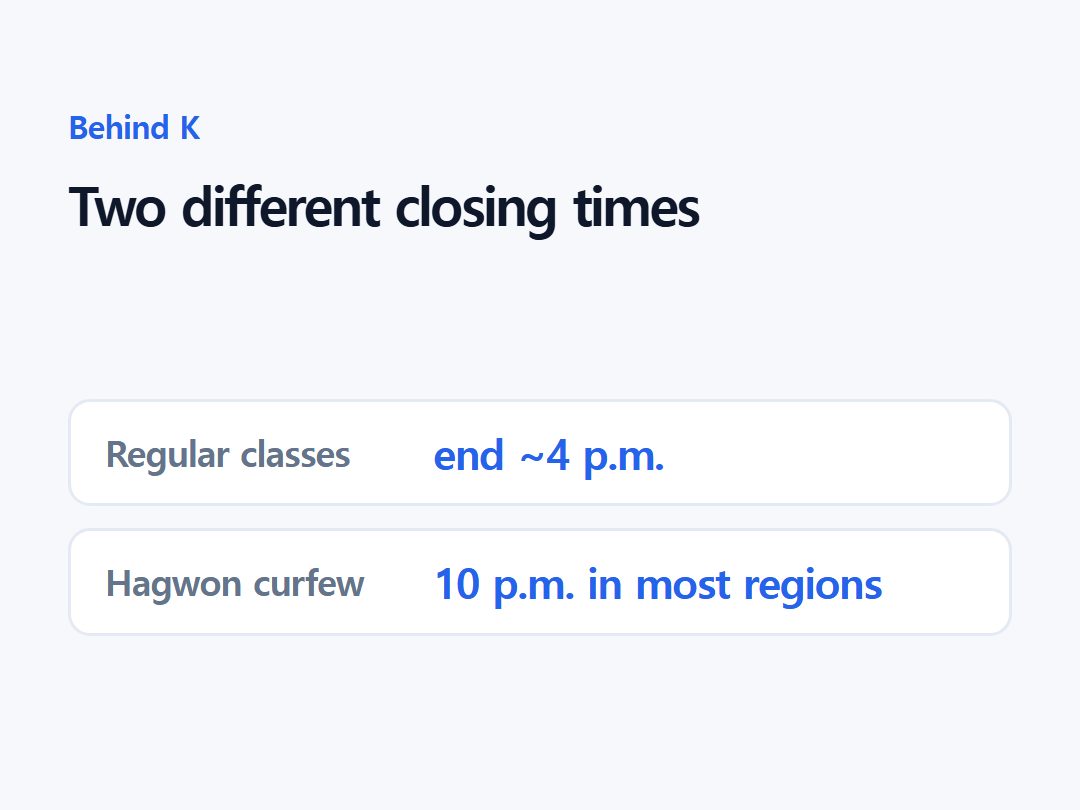
Korean elementary, middle, and high schools generally start between 8 and 9:30 a.m. Official class periods for high schoolers typically wrap up in the mid-afternoon, commonly around 4 p.m., though the exact hour varies by grade and school.
For an international reader, that reads like an ordinary school day. It isn't the day that determines when a Korean teenager actually gets home.
Why hagwon hours are the ones that actually count
A hagwon is not informal tutoring — it's a structured, for-profit business offering classes in math, English, and exam prep on a schedule that functions like a second timetable, timed to start right when regular school lets out.
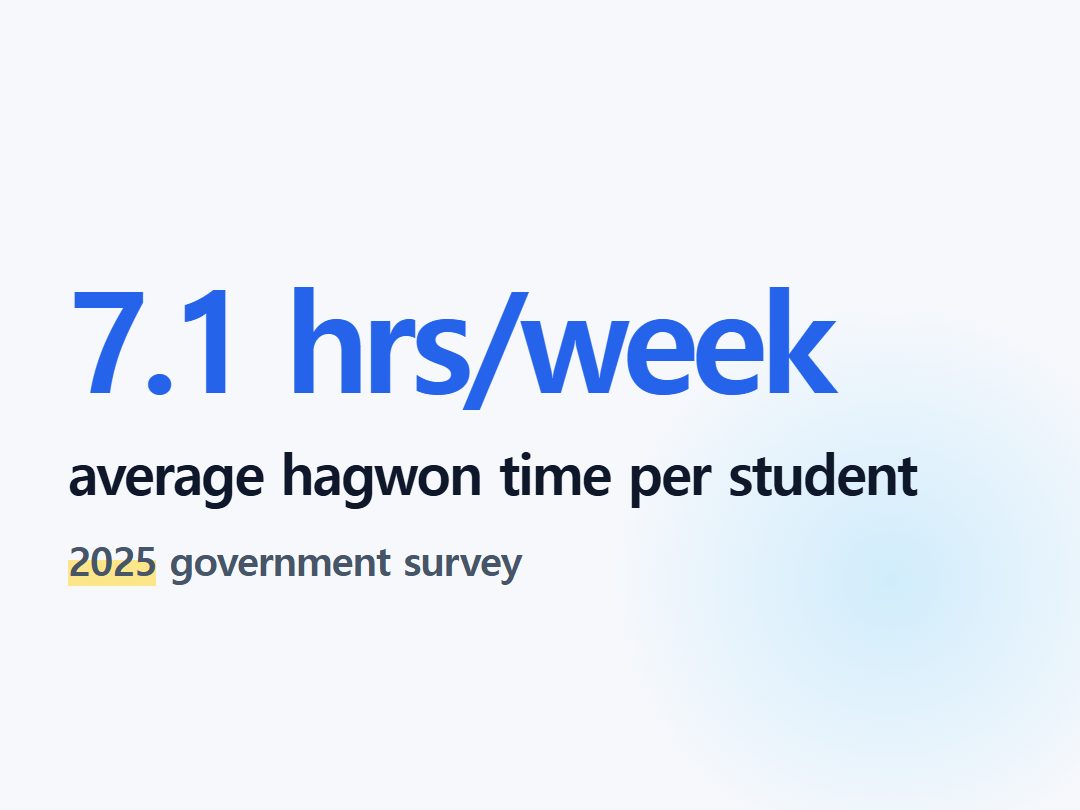
In the most recent government count, 75.7% of all elementary, middle, and high school students were enrolled in at least one hagwon or other private education program in 2025, spending an average of 7.1 hours a week there, according to a joint survey by South Korea's National Data Processing Service and Ministry of Education.
Because hagwon schedules are built to follow the school bell rather than replace it, they — not the classroom — set the real end of a student's day. Ask a parent when their child gets home and the answer is almost never the school's official dismissal time.
The 27.5 trillion won industry built around the after-school gap
Korean families spent a combined 27.5 trillion won (roughly $19 billion) on private education in 2025. That was actually a 5.7% drop from 2024's record 29.2 trillion won, driven mainly by falling participation rather than existing students cutting back.
Participation and hours vary by school level:
- Elementary students: 84.4% participation, 7.4 hours a week
- Middle school students: 73% participation, 7.2 hours a week
- High school students: 63% participation, 6.6 hours a week
High schoolers log slightly fewer paid hagwon hours than younger students — not because they study less overall, but because more of their evening shifts to unpaid, school-based study instead.

Yaja: the unpaid study hour that comes after hagwon, or instead of it
Many high schools also run yaja (야간자율학습, “night self-study”), a supervised evening study hall held inside the school building, separate from hagwon.
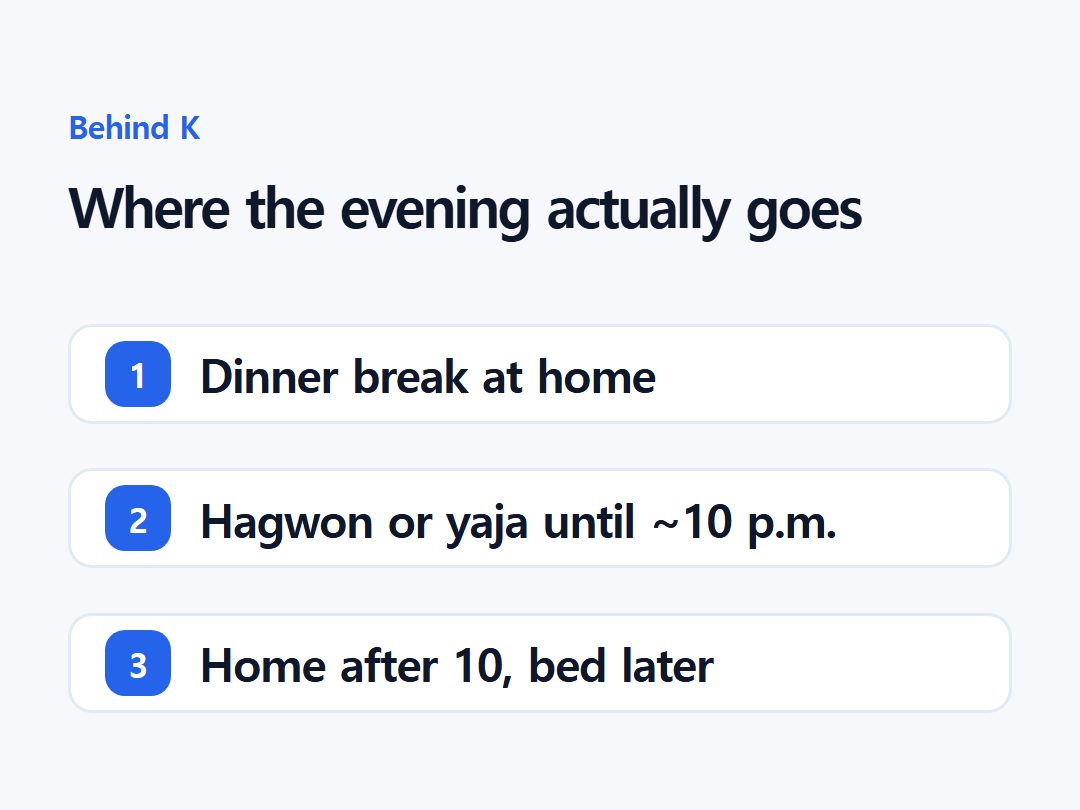
Yaja is officially opt-in at most schools today, though it was mandatory at nearly all of them a generation ago. It typically starts around 6 p.m., after a dinner break, and runs until somewhere between 8 p.m. and 10:30 p.m. depending on the school and region.
A student's evening usually goes one of two ways: hagwon after school, or yaja after school. Some students do both on different nights of the week.
A 2008 law tries to draw the line at 10 p.m.
As hagwon hours kept creeping later, a 2008 legal revision gave city and provincial education offices the authority to cap how late academies can stay open. Seoul had already enforced its own 10 p.m. hagwon curfew since 1996.
Today, Seoul, Gyeonggi, Daegu, and Gwangju all apply a blanket 10 p.m. closing time to hagwon serving students from elementary through high school. Other regions use age-based limits instead — Busan, for instance, lets academies serving high schoolers stay open until 11 p.m.
South Korea's Constitutional Court upheld the curfew system in October 2009 after hagwon operators argued it infringed on students' right to learn. The court found that protecting students' sleep and rest was a legitimate government interest.
Why Seoul is now debating pushing that curfew to midnight
The 10 p.m. line isn't settled. In 2026, the Seoul Metropolitan Council introduced an ordinance to extend the high-school hagwon curfew from 10 p.m. to midnight, citing “equity” with regions that already allow later hours.
Opponents, including groups that filed a formal petition against the ordinance, argue Korean teenagers already sleep less and study more than nearly any OECD peer group, and that pushing the curfew later would deepen that trade-off rather than fix it.
Korean teens have studied far more than OECD peers for years
The gap between Korea and the rest of the OECD isn't new. A National Youth Policy Institute study, still widely cited by Korean outlets, found that Korean youth aged 15 to 24 studied an average of 49.43 hours a week, against an OECD average of 33.92 hours — a difference of about 15 hours.
Spread across weekdays, that works out to roughly 7 hours 50 minutes of study a day, compared with around 5 hours for peers in countries like Finland, Sweden, Japan, Germany, and the United States.
More study time hasn't translated into a proportional test-score edge. In the 2003 OECD PISA comparison, Finnish 15-year-olds — who studied less than half as many hours as their Korean counterparts — still outscored them in math.
What gets traded away: sleep, and increasingly, attention in class
The cost researchers point to most consistently is sleep. Korean students have repeatedly ranked among the least-rested in OECD-linked surveys, and a 2026 analysis found that 27.3% of Korean students admitted they “tend to sleep” during class, based on a 2023 Ministry of Education survey — a sign the extended day is starting to eat into classroom time itself.
The United Nations Committee on the Rights of the Child has flagged the same pattern repeatedly, stating it remains “deeply concerned about the excessive academic burden, accompanied by sleep deprivation and high levels of stress” among Korean children.
In May 2026, Ahn Chang-ho, chair of Korea's National Human Rights Commission, warned that early competitive education — now starting as young as age four — was “a serious violation of children’s rights,” citing UNICEF data showing Korean children rank 4th among 36 OECD and EU countries in academic achievement, but only 28th in physical health and 34th in mental health.
How a decades-old exam culture became a scheduling habit
None of this is new. Mandatory, school-run night study running from early morning to as late as midnight was common in the 1980s and 1990s, well before hagwon reached their current scale.
What changed is the mix. As the 2008 curfew law and shifting norms made yaja optional and trimmed its hours in most regions, hagwon absorbed more of the evening instead. The total time commitment held roughly steady — it just moved from the school building to a private academy down the street.
What is still unresolved
Whether Seoul's proposed midnight curfew passes remains undecided, and other provinces are watching closely, since a change in Korea's largest city tends to pressure neighboring Gyeonggi Province to follow.
It's also unclear whether 2025's dip in private education spending marks a genuine cultural shift or simply reflects South Korea's shrinking student population — officials who ran the survey attributed the decline mainly to fewer students entering the system, not to enrolled students spending less time or money.
For now, the basic shape of the day hasn't changed: a bell that ends class in the afternoon, and a much later, unofficial one that actually sends a student home.
Hagwon participation and weekly hours by school level (2025)
| School Level | Participation | Weekly Hours |
|---|---|---|
| Elementary | 84.4% | 7.4 hours |
| Middle school | 73% | 7.2 hours |
| High school | 63% | 6.6 hours |
Frequently asked
What time does school end for Korean students?
Regular classes typically end around 4 p.m., but hagwon and yaja often keep students out until 10 p.m. or later.
What is a hagwon?
A hagwon is a private, for-profit after-school academy offering classes in subjects like math and English, timed to start right when regular school lets out.
Is there a curfew on hagwon hours in Korea?
Yes — Seoul, Gyeonggi, Daegu, and Gwangju enforce a 10 p.m. closing time for hagwon, though Seoul is debating extending it to midnight in 2026.
Sources
Every factual claim above is traceable. We do not translate articles — we gather facts from multiple outlets and write them ourselves.
- 2025년 초중고 사교육비조사 결과 — Korea Policy Briefing (Ministry of Education / National Data Processing Service)
- Hagwon Curfew to Be Set at 10 p.m. — The Korea Times
- Ordinance to extend hagwon hours in Seoul sparks debate over regulating cram schools — Korea JoongAng Daily
- Korea's early education frenzy puts children's rights at risk, human rights chief warns — The Korea Times
- Private education in South Korea - statistics & facts — Statista
- Korean Teenagers Study 8 Hours a Day — The Korea Times
- Sleeping Students, Widening Gaps: Korea Tops World Only in Attendance — Seoul Economic Daily
- Experts of the Committee on the Rights of the Child discuss the protection of rights in schools with the Republic of Korea — OHCHR