
A K-pop group can top the Billboard 200 while its members are still, on paper, in debt to their own agency. That is not a metaphor. It is how Korean idol contracts are built, through a settlement system that pays back years of training costs before it pays the people who trained.
The short version
- Idols can owe their agency money even after a hit debut.
- Training costs get billed back from earnings before members see profit.
- Idols aren't legal employees, so no minimum wage applies while in debt.
International fans often assume a debut means a paycheck. In Korea, debut usually starts the opposite process: the moment an agency begins billing years of unpaid training against a group's future earnings.
Debut opens the ledger, it doesn't close it
Idols sign an exclusive contract with the agency (기획사) that recruited and trained them — a company that scouts mostly teenagers, then houses and coaches them for years before they ever perform publicly. Trainees are not paid a salary during this period.
Lessons, dorm housing, and styling are covered by the agency and tracked as costs against that specific trainee. This differs from a Western record deal, where an artist typically receives an advance against future royalties: the K-pop trainee usually receives no cash at all until debut, only the promise that training will one day be recouped from group income.
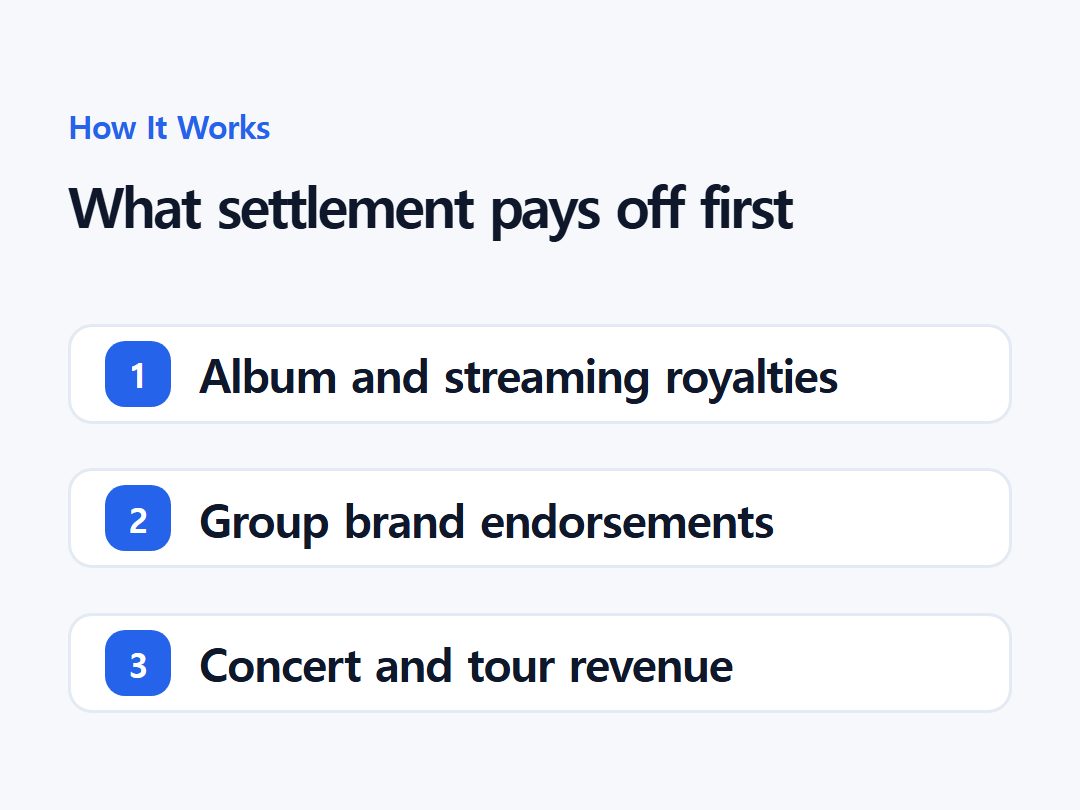
When a group finally debuts, those costs do not disappear. They become the first claim on the group's income, a process Korean industry insiders call jeongsan (정산), or settlement. Several revenue streams typically get pooled and run through this same recoupment before members see a personal share:
- Physical album sales and streaming royalties
- Group brand endorsements and sponsorships
- Concert, tour, and fan-meeting revenue
Regulation shortened contracts, not the debt they contain
South Korea's Fair Trade Commission has intervened in this system before, capping standard exclusive contracts at seven years since 2009 after a wave of "slave contract" lawsuits. That reform limited how long an agency could hold an artist. It did not restructure how training costs get billed back.
Settlement accounting was tightened again in 2017, and a new standard trainee contract took effect in January 2026 with clearer disclosure rules. But the basic mechanic — costs recovered from earnings before any profit-sharing begins — remains standard practice across agencies large and small.
What one idol's court-tested settlement looked like
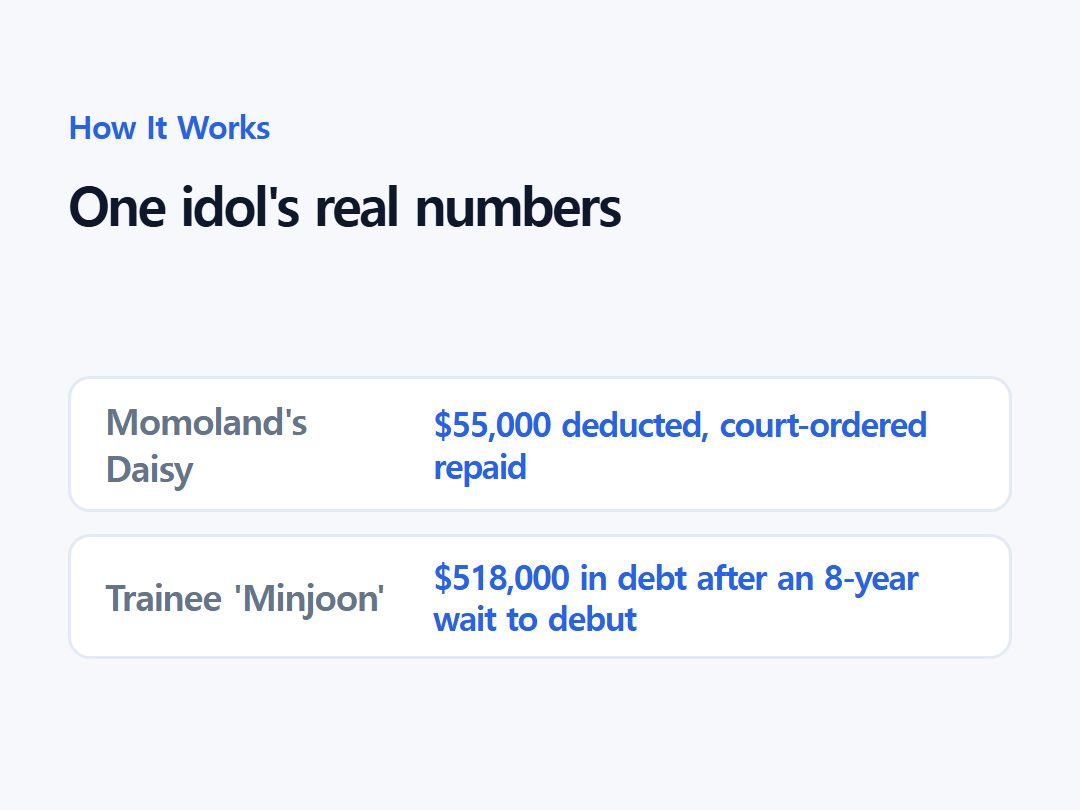
Public, verified numbers on real settlements are rare. Former Momoland member Daisy provided one of the few. She said MLD Entertainment deducted about 66 million won (roughly $55,000) from her earnings, billing her one-tenth of the 660 million won production cost of the survival show that cast the group.
Those costs were incurred months before she had even signed her contract. Daisy sued, and a Korean court ordered MLD Entertainment to pay back the withheld earnings, though the agency appealed. The case became public mainly because it reached a courtroom — most settlement disputes never do.
Eight years of training can end in a bill, not a debut
Debt in this system does not require a hit, or even a debut. A trainee identified in Korean press only as Minjoon spent eight years at one agency after being told he would debut quickly, according to reporting by Kyunghyang Shinmun. He left with 600 million won (about $518,000) in recorded debt.
By his account, he received formal vocal or dance training only rarely. A large share of the fees billed to him were tied to motivational lectures the company's CEO gave trainees and then charged back to their accounts.
His case is extreme, but it shows the debt accrues whether or not an agency delivers what it promised. A trainee has no separate income and no salary in the meantime, so there is no way to challenge a bill except by staying in the system longer.
Solo checks move on different terms than group checks
Not all of an idol's income passes through the same settlement. Group earnings run through the recoupment process above; individual work — acting, solo music, brand deals, variety-show fees — is often governed by separate terms negotiated apart from the group contract.
Agencies tend to treat solo income this way because, by the time a member is booking outside acting or endorsement work, the group's original training debt has often already been substantially recovered through group promotions. The dispute between SM Entertainment and EXO's Baekhyun, Xiumin, and Chen, performing as the sub-unit CBX, shows how contentious those separate terms can still get.
Under a 2023 agreement, the trio pays SM 10 percent of revenue from their individual activities to keep using the EXO name. SM says that fee still applies; the members argue SM never honored a promised 5.5 percent distribution fee on their album and music sales.
As of late 2025, the two sides had failed court-ordered mediation over roughly 600 million won ($430,000) in dispute. The specific percentages matter less than what the fight shows: years after debut, at a major agency, single-digit percentage points are still being litigated because they decide take-home pay.
The company's side of the ledger explains the debt
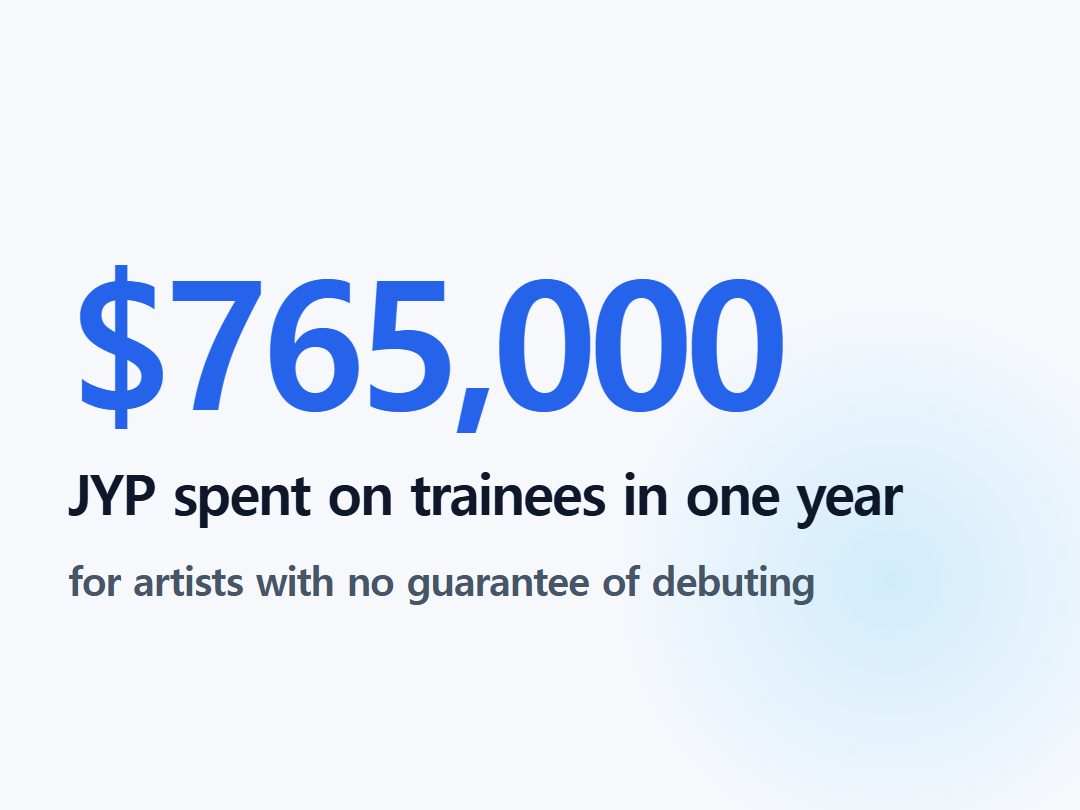
Agencies frame this spending as ordinary business risk, and the scale is real. JYP Entertainment's 2025 business filing, reported by The Korea Times, disclosed 1.12 billion won (about $765,000) spent on trainee development in a single year — up nearly 30 percent from the year before.
Company officials told the paper that agencies typically keep around 20 trainees at a time. Spread across a group that size, JYP's outlay works out to millions of won per trainee each month in lessons alone, for people with no guarantee of ever debuting — the loss side of the math agencies cite when defending recoupment.
A chart hit still splits many ways before it reaches a member
Even a clean-earning, established group does not turn a hit directly into member pay. HYBE's 2023 results illustrate why: the company reported record revenue of 2.18 trillion won ($1.67 billion), with album sales, 44.6 percent of that total, as the largest single category ahead of concerts, streaming, and merchandise.
Concert revenue that year reached 359.1 billion won and merchandise sales another 325.6 billion won — sizable totals that still pass through the same layers of production, marketing, distribution, and overhead before any split with artists is calculated.
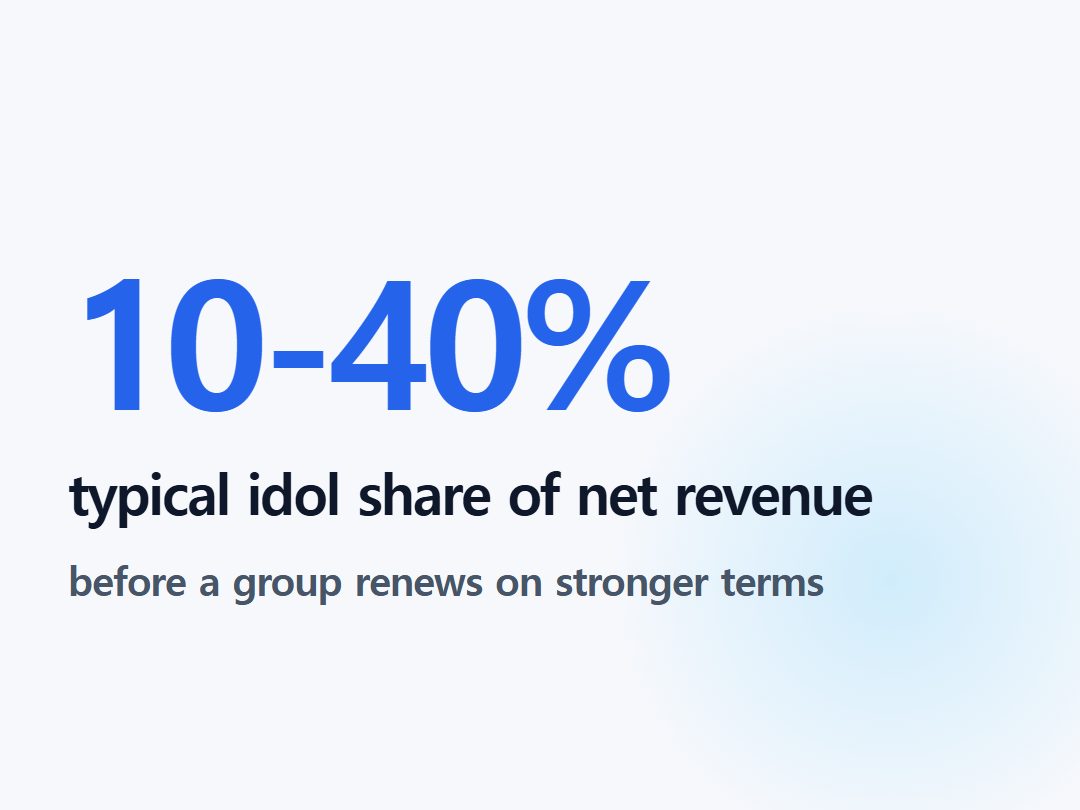
Industry accounts describe the resulting artist share as ranging roughly from 10 to 40 percent of net revenue for a newer act, rising only once a group renews on stronger terms. A large number at the company level and a modest one at the member level describe the same revenue, seen from opposite ends of the settlement.
Idols still are not legally 'workers,' so the numbers stay private
Because idols sign revenue-sharing contracts rather than employment contracts, Korean labor law has never settled whether they count as employees entitled to standard protections. Without employee status, there is no minimum-wage floor to fall back on while a group's settlement debt is still being paid down.
That ambiguity resurfaced in 2025, when former Teen Top member Bang Min-soo tried to organize Korea's first K-pop idol labor union, seeking minimum income guarantees and access to national insurance programs.
About ten idols initially expressed interest, but the formal filing listed only two members, and Bang withdrew the registration in May 2026 after repeated requests from labor officials for proof of idols' employee status.
South Korea's Supreme Court has suggested performers could qualify as workers depending on the substance of their relationship with an agency, but no case has settled the question for idols specifically.
Until that changes, settlement accounting remains a private matter between an artist and their agency, disclosed publicly only when a dispute like Daisy's or CBX's ends up in court. That is largely why what international fans know about idol pay still comes from lawsuits rather than paychecks.
Idol settlement disputes made public
| Case | Agency | Amount in dispute | Outcome |
|---|---|---|---|
| Daisy (Momoland) | MLD Entertainment | 66 million won (~$55,000) | Court ordered agency to repay withheld earnings; agency appealed |
| Minjoon (trainee) | Unnamed agency | 600 million won (~$518,000) | Left after 8 years in debt, without a proper debut |
| CBX (EXO sub-unit) | SM Entertainment | ~600 million won (~$430,000) | Court-ordered mediation failed as of late 2025 |
Frequently asked
Why do K-pop idols owe their agency money after debuting?
Agencies front years of training, housing, and styling costs, then recoup them from the group's income through a process called jeongsan (settlement) before members get a personal share.
How much debt can a K-pop trainee end up with?
One trainee identified only as Minjoon left his agency with 600 million won (about $518,000) in recorded debt after eight years without a proper debut, per Kyunghyang Shinmun.
Are K-pop idols legally considered employees of their agency?
No — idols sign revenue-sharing contracts rather than employment contracts, so Korean labor law has never settled whether they qualify as employees entitled to protections like minimum wage.
Sources
Every factual claim above is traceable. We do not translate articles — we gather facts from multiple outlets and write them ourselves.
- SM Entertainment, EXO-CBX fail to reach settlement in first court mediation, second round set for October — The Korea Herald
- SM Entertainment Stock Falls Despite Legal Victory Over EXO-CBX Members — Forbes
- MLD Entertainment Ordered By Court To Pay Former MOMOLAND Member Daisy Unpaid Earnings + Agency Files Appeal — Soompi
- [The Dark Side of K-Pop] They Said I Could Debut Right Away, But... Left with 600 Million Won of Debt, Depression, and a Bunch of Lawsuits After 8 Years as a Trainee — Kyunghyang Shinmun
- Why teen K-pop trainee numbers are dropping despite greater investment — The Korea Times
- K-pop's Record Revenue: HYBE Earnings Show Album Sales, NewJeans and Seventeen Fueled 2023 Growth — Billboard
- One idol tried to unionize K-pop. Almost no one followed. — Korea JoongAng Daily
- K-pop idols to form Korea's first labor union, could launch by end of year — The Korea Times
- Is the '7-year itch' a thing of the past? — The Korea Herald