A single K-pop album at a Seoul record store costs somewhere between 15,000 and 30,000 won — roughly $11 to $22. That is inexpensive by international physical-media standards, and cheap for something marketed as a limited collector's object.
The short version
- A basic K-pop album costs $11 to $22, but fans buy several copies.
- Photocards are random, and a single rare one has resold for $1,700+.
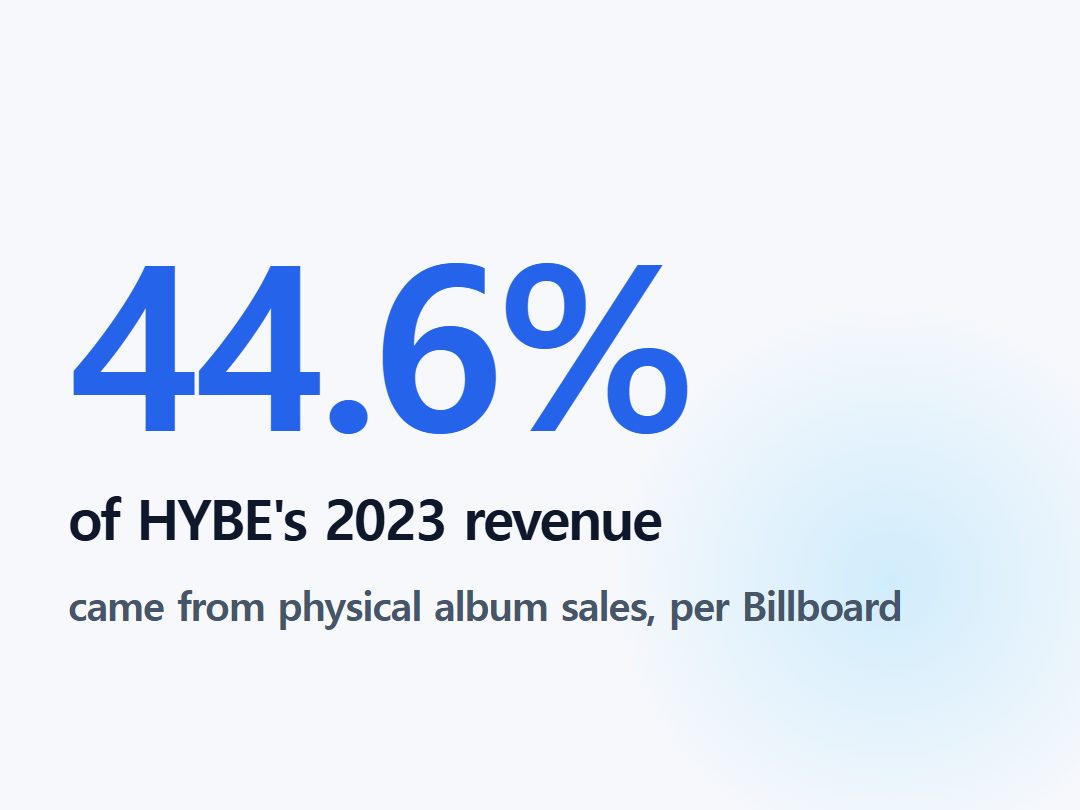
- Physical sales make up 44.6% of HYBE's revenue, far more than streaming.
The real cost of a K-pop release rarely shows up on that price tag. It shows up once a fan discovers the album comes in five, six, or ten different versions, and buys several of them chasing one member's photocard.
This piece breaks down what a K-pop album actually contains, what it costs an agency to make, and where the money — and the plastic — ends up after fans pay.
A 20,000-won box holds a CD nobody needs to play
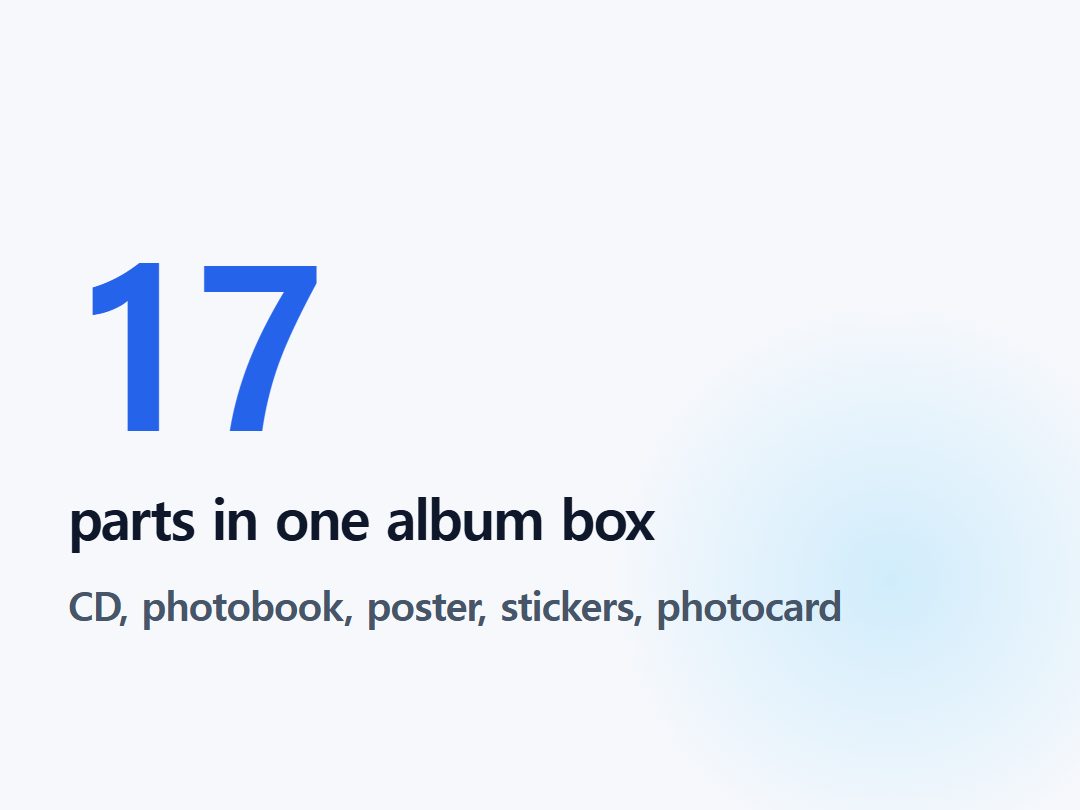
A standard K-pop album is rarely just a disc. Industry reporting on album design counts as many as 17 separate components in one package — outer plastic wrap, photobook, CD case, poster, postcard set, sticker sheet, and one or more photocards.
Most fans never play the CD. Music has moved to streaming, so the disc mainly functions as proof of purchase; the actual product is everything printed and glossy around it.
- A photobook of studio photos, one per member
- A folded poster or postcard set
- One or more random photocards — small, trading-card-sized portraits
Recording and video budgets are spent before a single album ships
Before any album reaches a shelf, the agency — the Korean term for the company that trains, manages, and produces an idol, closer to a label-plus-manager than a Western record label — has already spent on production that has nothing to do with the physical package.
Recording and producing a three-song mini-album costs roughly 27 million won (about $23,600), according to a cost breakdown reported by Koreaboo. Music videos add far more: a single video runs about 150 million won (about $131,000), and shooting videos for half the tracks on a six-track mini-album, plus a jacket photo shoot, adds up to roughly 470 million won (about $410,000).
Promoting a comeback — the term Korean fans use for a new release cycle from a group that has already made its official debut — costs about 500 million won (about $437,000) more, covering choreography, backup dancers, and stage outfits across six weeks of promotion.
Why one song comes in five different covers
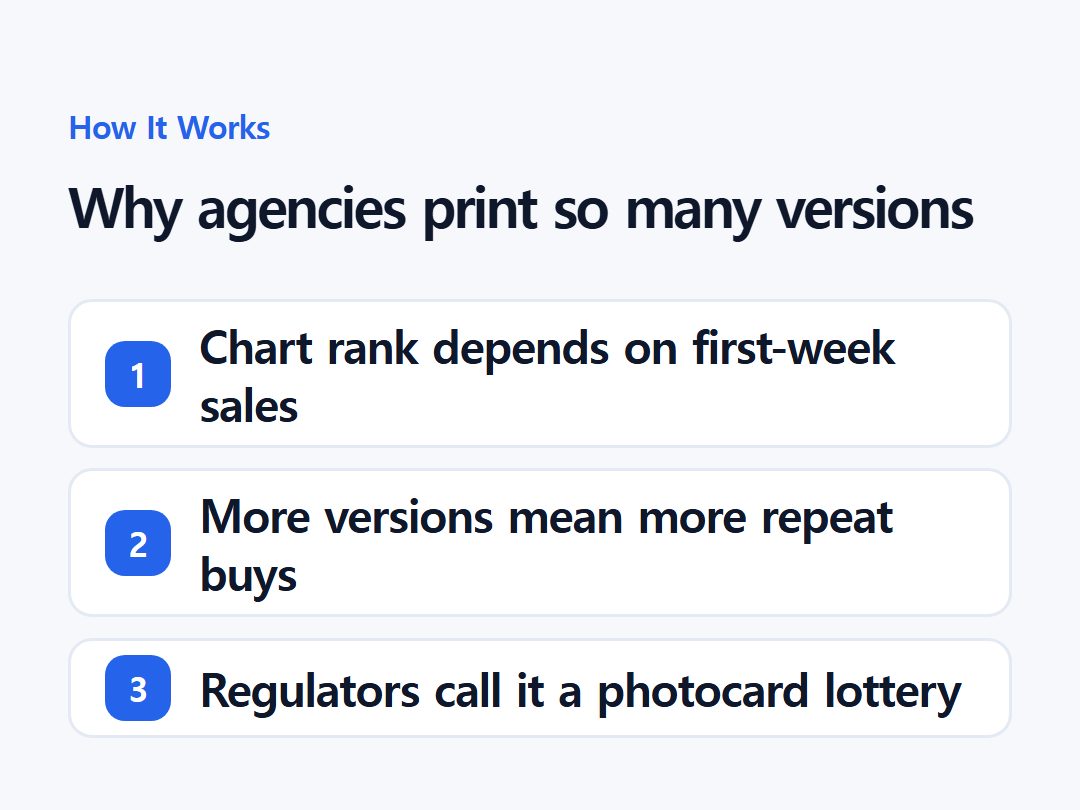
The same tracklist gets repackaged into multiple versions — different cover concepts, different photobooks, sometimes just a different box color. Girls' Generation once released ten versions of a single album, one per member plus a group edition; BTS's Love Yourself: Her shipped in four.
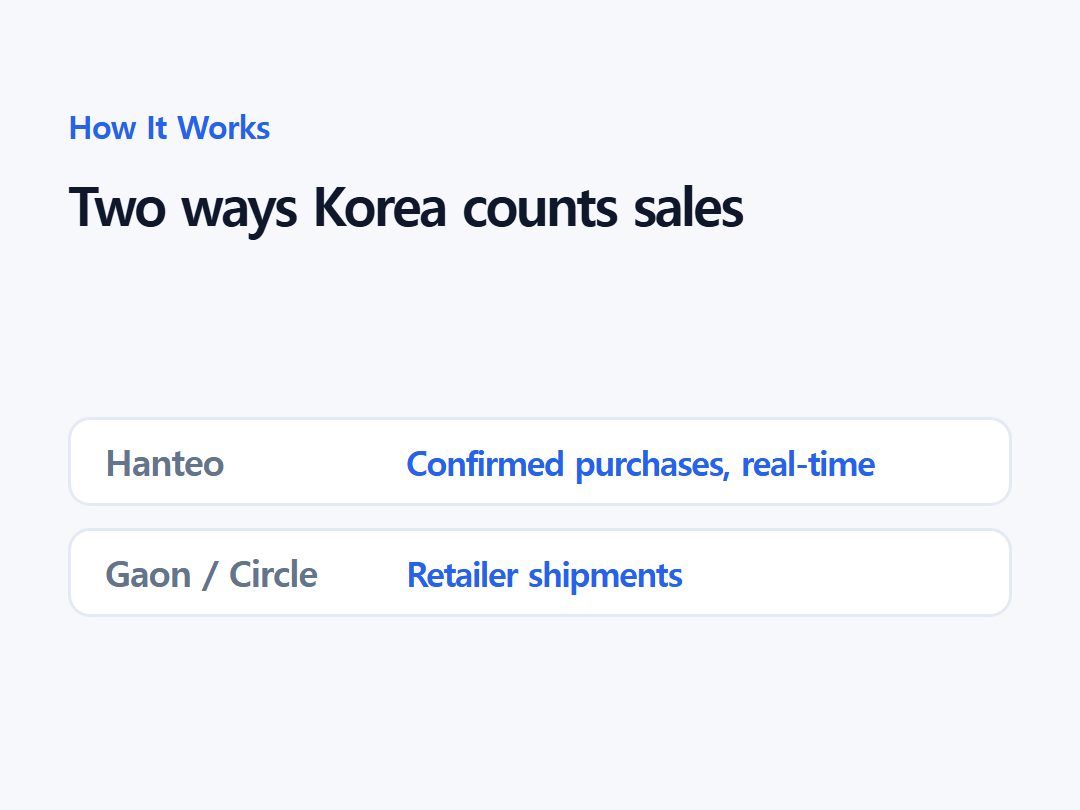
This is a chart strategy as much as a design choice. Two systems track Korean album sales differently, and the difference matters for how agencies plan releases.
| Chart | What it counts |
|---|---|
| Hanteo | Confirmed individual purchases, tracked in real time |
| Gaon / Circle | Retailer shipments, including unsold stock |
A group's first-week sales figure — how many albums move before the promotional cycle ends — decides which acts get more broadcast slots and award nominations. More versions mean more chances for a loyal fan to buy again: Stray Kids' 2024 release Karma sold roughly 3 million copies in its first week, spread across five separate designs.
The photocard, not the CD, is what fans are actually buying
Each album typically includes one to three random photocards pulled from a much larger set. NCT albums have shipped with as many as 50 different photocard designs in circulation at once, according to Korean regulatory reporting — and a fan who wants a specific member has no way to choose; the card is decided by chance at checkout.
Scarcity is layered on top of that randomness. Pre-order bonuses, 'lucky draw' cards tied to a small print run, and cards handed out only at in-person fan events each create a separate, smaller pool that resale markets track closely.
The gap between a common pull and a rare one can be enormous. A limited-edition Jungkook card was reported to have resold for nearly $1,700, with some listings climbing toward $5,000, according to allkpop's coverage of a government investigation into the practice.
Regulators called the whole system a lottery, not a purchase
In August 2023, South Korea's Fair Trade Commission opened an investigation into SM Entertainment, YG Entertainment, and JYP Entertainment — HYBE was added later — over how photocards were produced and sold. Investigators suspected some companies were adjusting production numbers of specific cards to manufacture artificial rarity.
The legal term used was 'tie-in sale': requiring a consumer to buy one product for a chance at a different one they actually want, which Korean fair-trade law treats as anticompetitive. The probe also examined whether unboxing livestreams — fans filming themselves opening albums to reveal the photocard inside — function like a gambling-style pack opening.
The issue resurfaced in October 2024, when lawmakers questioned agency executives again in a National Assembly audit, this time over 'album bulk-buying' — wholesalers required to purchase set quantities to inflate reported sales. One executive said the companies had accepted the earlier Fair Trade Commission's recommendations for improvement.
Streaming pays artists directly; a physical album pays the agency first
This is where the confusion usually starts for readers outside Korea. A stream on Spotify pays a small, direct royalty. A 20,000-won album sale works differently — the agency collects the full retail price first, then deducts production, distribution, and marketing costs before anything counts as profit to split.
Physical sales dominate the ledger. At HYBE, album sales from Korean artists nearly doubled to 43.6 million units in 2023 and made up 44.6% of total revenue, up from 31.1% the year before, according to the company's earnings reported by Billboard. Digital streaming made up only about 13% of HYBE's 2023 revenue.
Streaming royalties are growing but still small by comparison. Spotify said royalties paid to Korean artists passed 180 billion won (about $138 million) as of September 2024 — a 780% increase since 2017, but still a fraction of what physical sales generate, according to CNBC.
Why the agency owns the masters and keeps the largest cut
Unlike a Western record label, a Korean agency typically also functions as an artist's manager, vocal and dance trainer, and stylist — and it usually owns the master recordings outright.
That ownership structure is why the agency, not the artist, keeps the largest share of what an album sale generates. The per-unit amount that eventually reaches an artist is calculated only after production, distribution, and promotional costs — the kind detailed above — are deducted first.
The plastic bill nobody puts on the price tag
The multiple-version model has an environmental cost that shows up nowhere in the checkout price. SM Entertainment's plastic output rose from 400 tons in 2022 to 647 tons in 2024; HYBE's rose from 729 tons to 1,405 tons over roughly the same period, according to Korean government waste data reported by the Korea Times.
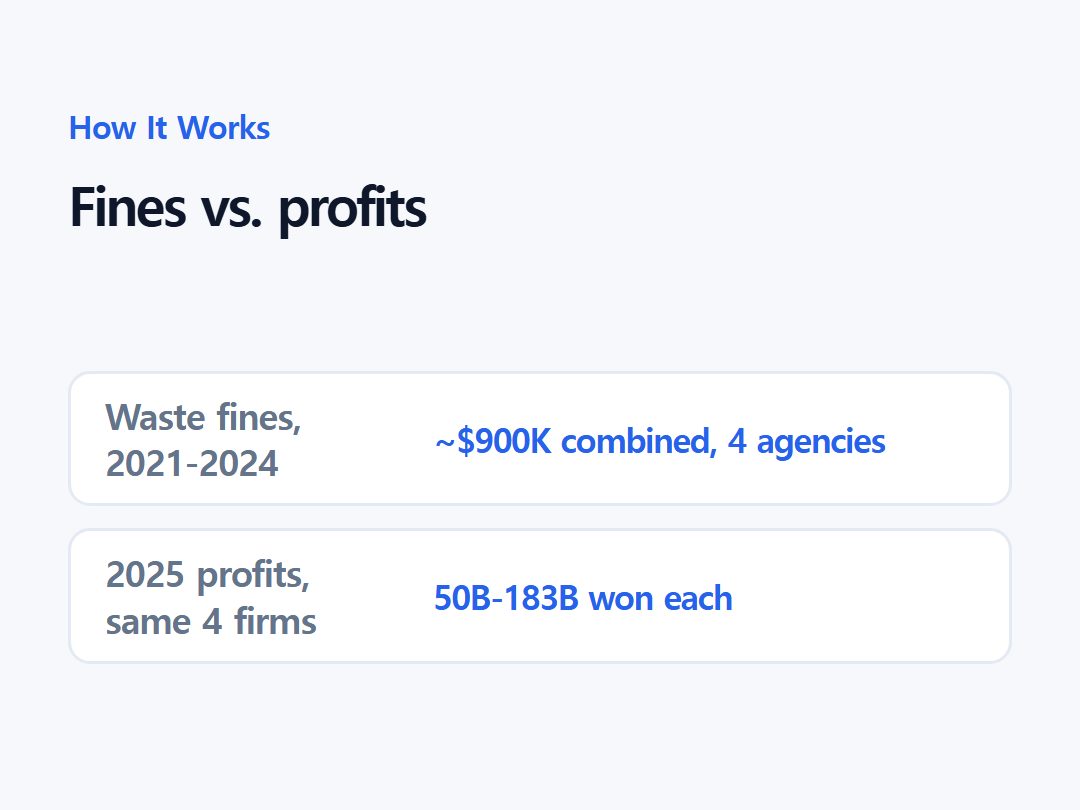
Combined, South Korea's four largest agencies produced an estimated 6,667 tons of plastic in album packaging — roughly the weight of 4,445 midsize cars. The fines those companies paid for that waste between 2021 and 2024 totaled a combined 1.2 billion won (about $900,000), a fraction of the 2025 operating profits the same four companies reported, ranging from about 50 billion to 183 billion won each.
A Hanyang University culture researcher told the Korea Times that marketing physical albums as 'eco-friendly' while still driving excessive purchases misses the actual problem.
A QR code that quietly replaces the plastic — for some artists
A partial fix already exists. 'Smart albums,' sold under names like Weverse Albums, ship as a small card with a QR code instead of a disc; scanning it unlocks a digital photobook and the songs inside an app. Korean chart operators classify it as its own format, alongside CD, tape, and USB releases.
j-hope's 2022 solo release Jack in the Box used this format exclusively, skipping a CD altogether. Sales of smart albums still count fully toward both major Korean charts, so the format doesn't cost an artist chart position the way skipping a plastic album once would have.
Adoption is still uneven. Most major groups release a smart album as one option alongside several plastic versions, rather than replacing them — the format cuts packaging, but it doesn't remove the incentive to buy multiple copies for different photocards.
What the photocard investigation still hasn't changed
The most fan-facing incentive to keep buying physical copies remains largely untouched: fansign lottery entry. A fansign is a small in-person meet-and-greet where a limited number of winners are drawn from fans who bought a qualifying album — the more copies purchased, the better the odds.
A review of 625 fansign events found that only 9.7% accepted a smart album as valid entry, while 78.4% required a physical CD purchase, according to the Korea Times' reporting on the National Assembly findings. That gap keeps the plastic-heavy model economically necessary even as agencies promote digital alternatives.
The Fair Trade Commission's 2023 findings on photocard production numbers have not been made fully public, and no agency has been formally fined over the tie-in sale allegations as of this writing. Whether wholesaler bulk-buying gets regulated separately from photocard randomization remains an open question.
Pre-release production costs for a K-pop mini-album
| Cost item | Amount (KRW) | Amount (USD) |
|---|---|---|
| Recording a 3-song mini-album | 27 million won | $23,600 |
| One music video | 150 million won | $131,000 |
| MVs for half the tracks + jacket shoot (6-track album) | 470 million won | $410,000 |
| Comeback promotion (6 weeks) | 500 million won | $437,000 |
Frequently asked
Why do K-pop albums have so many different versions?
Multiple covers and photobooks push up first-week sales on charts like Hanteo, since each version gives a fan another reason to buy again — Stray Kids' Karma sold roughly 3 million copies spread across five designs.
Why are K-pop photocards so expensive?
Each album includes only one to three random photocards pulled from a much larger set — as many as 50 designs for some NCT albums — so rare pulls get resold for huge markups, with one Jungkook card reportedly reaching nearly $1,700.
Do K-pop idols get paid directly from album sales?
The agency collects the full retail price first and deducts production, distribution, and marketing costs before any profit is split, and because it typically owns the master recordings, it keeps the largest share.
Sources
Every factual claim above is traceable. We do not translate articles — we gather facts from multiple outlets and write them ourselves.
- K-pop greenwashing betrayal: 6,667 tons of plastic waste driven by merchandising — The Korea Times
- K-pop albums dominate physical album sales ranking. Why? — The Korea Herald
- Fair Trade Commission investigate SME/YGE/JYPE over idol photocards, might crackdown on K-pop gacha — Asian Junkie
- Fair Trade Commission Investigates Major Entertainment Companies Over Random Photo Card Sales Scheme to Boost Album Revenue — allkpop
- K-pop agencies questioned over unfair album and merchandise practices in National Assembly audit — allkpop
- HYBE Earnings: NewJeans, Seventeen Album Sales Help Grow 2023 Revenue — Billboard
- K-pop is more popular than ever, but that isn't helping agency stock prices — CNBC
- Invasion of 'smart' albums — The Korea Times
- It Costs Over $1,000,000 USD To Debut A K-Pop Group, Here's The Breakdown — Koreaboo