International readers scroll through Korean webtoons for free, or pay a few coins to read the next chapter early.
Few know what happens on the other side of that transaction: a three-part pay structure — episode fees, a recoupable advance, and a revenue share tied to how impatient readers are — layered on top of a punishing weekly deadline.
That system, not any single scandal, is why some webtoon artists earn six figures and others quietly burn out.
The short version
- Korea's webtoon industry made $1.3 billion in 2022, up 16.8%.
- Most contracts deduct advances from artists' pay first, shifting risk to them.
- Platform revenue rose 36.8% in 2022 while artist income fell 20.3 million won.
Why are webtoon contracts under scrutiny now?
There is no single news event here. This is how the industry has always worked, refined over two decades of platform competition between Naver Webtoon and Kakao Webtoon.
But the system has been under active scrutiny: South Korea's Ministry of Culture, Sports and Tourism rewrote its standard webtoon contract in June 2024 to force clearer disclosure of how pay is calculated, and in November 2025 the WEBTOON Creators Union publicly accused Naver Webtoon of unpaid revision work and lopsided overseas revenue splits — allegations the company said it would review.
Both are useful entry points into a pay structure most international fans have never had explained to them.
Industry growth doesn't reach artists evenly
The Korean webtoon industry generated 1.83 trillion won (roughly $1.3 billion) in 2022, according to a joint survey by the Ministry of Culture, Sports and Tourism and the Korea Creative Content Agency (KOCCA) — up 16.8% from the year before. But that growth is not evenly shared, and understanding why requires knowing three Korean-specific terms.
The three-part pay structure
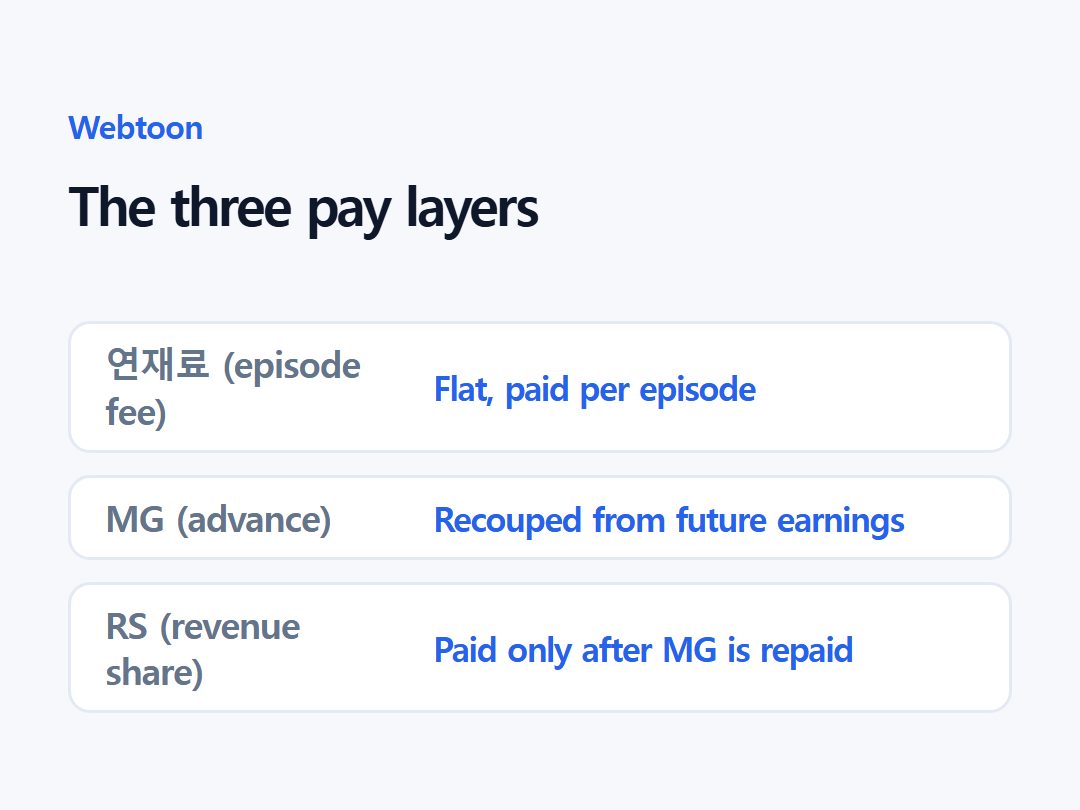
연재료 (yeonjaeryo), or episode fee, is a flat payment an artist receives for each episode delivered, regardless of how it performs. It functions like a salary floor.
Layered on top of it is the MG (Minimum Guarantee), an advance the platform or content provider (CP, the studio or agency that manages a series) pays the artist before revenue comes in. The MG is not free money — it is recouped from the artist's share of future earnings before the artist sees another won.
Only after the MG is paid off does RS (Revenue Share) kick in, splitting whatever the series earns between the platform, the CP, and the artist under a pre-agreed ratio.
The order of operations matters more than it sounds.
Korean industry explainers describe two competing methods: 선차감 (pre-deduction), where the MG is subtracted from total revenue before the platform's own cut is calculated, and 후차감 (post-deduction), where the artist's revenue share is calculated first and the MG is then subtracted from the artist's portion alone.
In one commonly cited example — 100 million won in revenue, a 10 million won MG, and a 50/50 split — the post-deduction method leaves the artist with 5 million won less than the pre-deduction method would.
Most contracts now use post-deduction, which effectively shifts more of the financial risk of an underperforming series onto the artist rather than the platform.
The preview-payment paradox
Most Korean webtoons are free to read on a delay. Platforms make money through 미리보기 (“preview”) payments — known internationally as Fast Pass — where readers spend coins to unlock the next episode before its scheduled free release. It is a pay-to-skip-the-wait model, not a pay-per-view model.
That distinction creates a real paradox: a series can rack up huge free readership and still generate modest income for its artist, because RS is calculated from coin purchases, not raw traffic.
Popularity converts to pay only when readers are impatient enough to spend money to avoid waiting, which is a much narrower behavior than simply reading.
Where the overseas money goes
해외 판권 (overseas licensing) — the sale of translation and distribution rights to international platforms, plus adaptation rights for drama, film, and games — has become one of the industry's fastest-growing revenue lines as Naver and Kakao expand globally. It is also the least transparent.
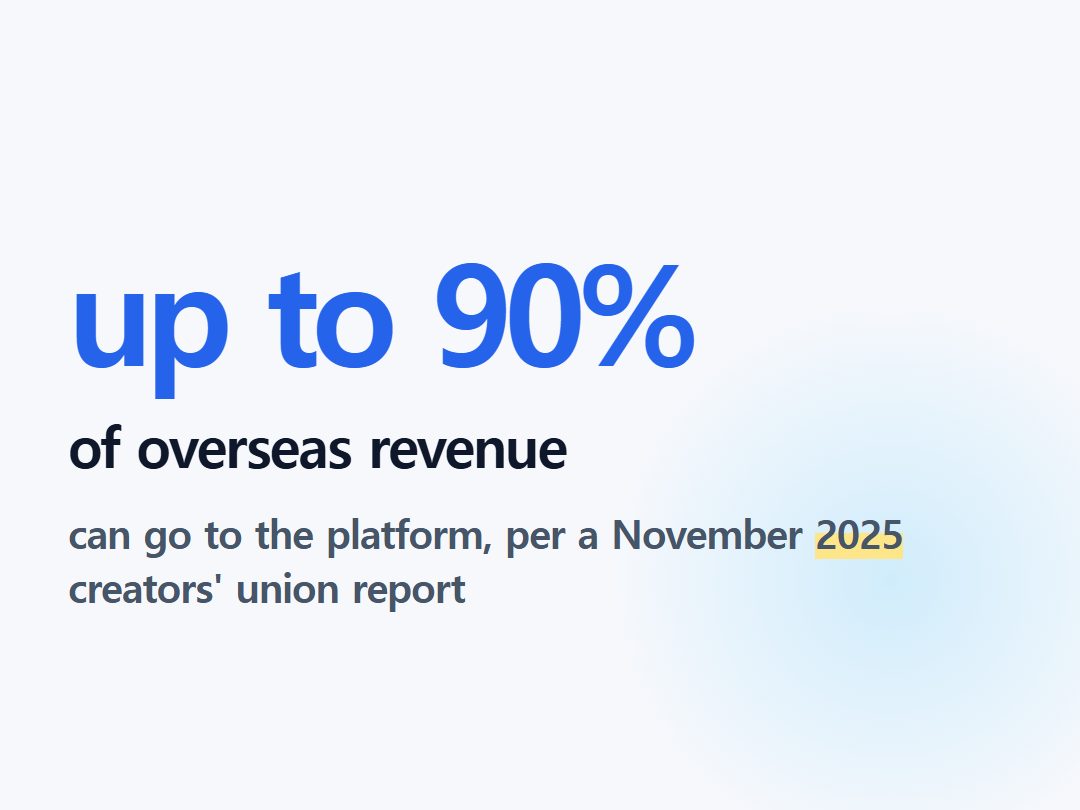
In its November 2025 report, the WEBTOON Creators Union quoted a serialized creator saying Naver “takes up to 90% of overseas revenue — sometimes 70% at best,” with little disclosure of how rankings, promotion, or ad spending affect what an artist actually receives.
Webtoon Entertainment (the Nasdaq-listed parent of Naver Webtoon's global business) has separately said it is shifting toward direct investment in adaptations rather than pure licensing, including a $100 million IP fund with Naver — a move that could change how adaptation revenue is shared, though specific artist-facing terms have not been made public.
A deadline that never lets up
Print-era Korean cartoonists (manhwa artists) worked on varied schedules — weekly, biweekly, monthly. Nearly all webtoons now run on a strict weekly upload, because platform algorithms and reader habits reward consistency.
A 2021 study by the Korean Institute of Labor Safety and Health, presented at a 2023 National Assembly forum, found webtoon artists work an average of 9.9 hours a day, rising to 11.8 hours on the day before a deadline, while typically producing 70 or more panels per episode.
Because episode fees are paid per delivered chapter and RS depends on maintaining a readership base, missing a week has direct financial consequences — an incentive structure researchers linked to reported physical and mental health strain.
Many webtoon artists are also legally classified as independent business operators rather than employees, which complicates access to protections like Korea's artist employment insurance scheme, even where it technically applies.
Growth for platforms, not always for artists
The clearest evidence that the system doesn't distribute gains evenly is in KOCCA's own numbers.
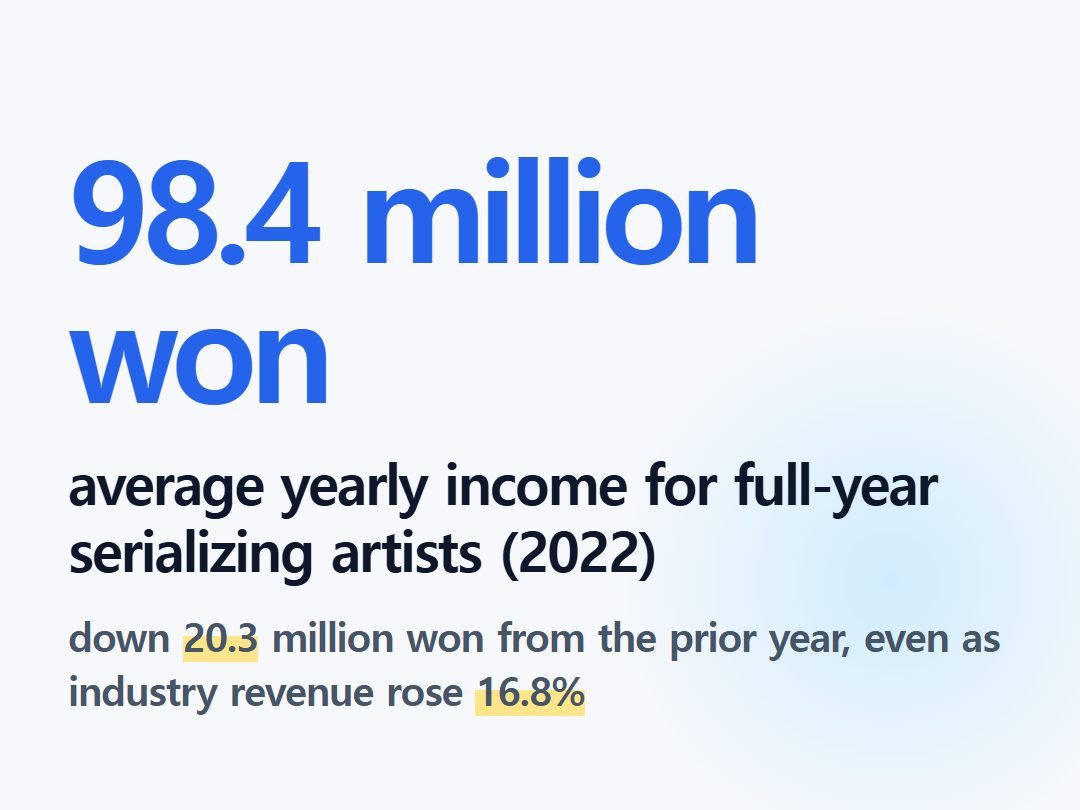
In 2022, webtoon platform companies' revenue rose 36.8% to 1.13 trillion won, while artists who serialized continuously for a full year averaged 98.4 million won in annual income (about $73,000) — down 20.3 million won from the previous year.
The ministry attributed the individual decline to easing pandemic-era webtoon usage and intensifying competition among a growing pool of artists, even as total industry revenue kept climbing.
From free traffic driver to regulated industry
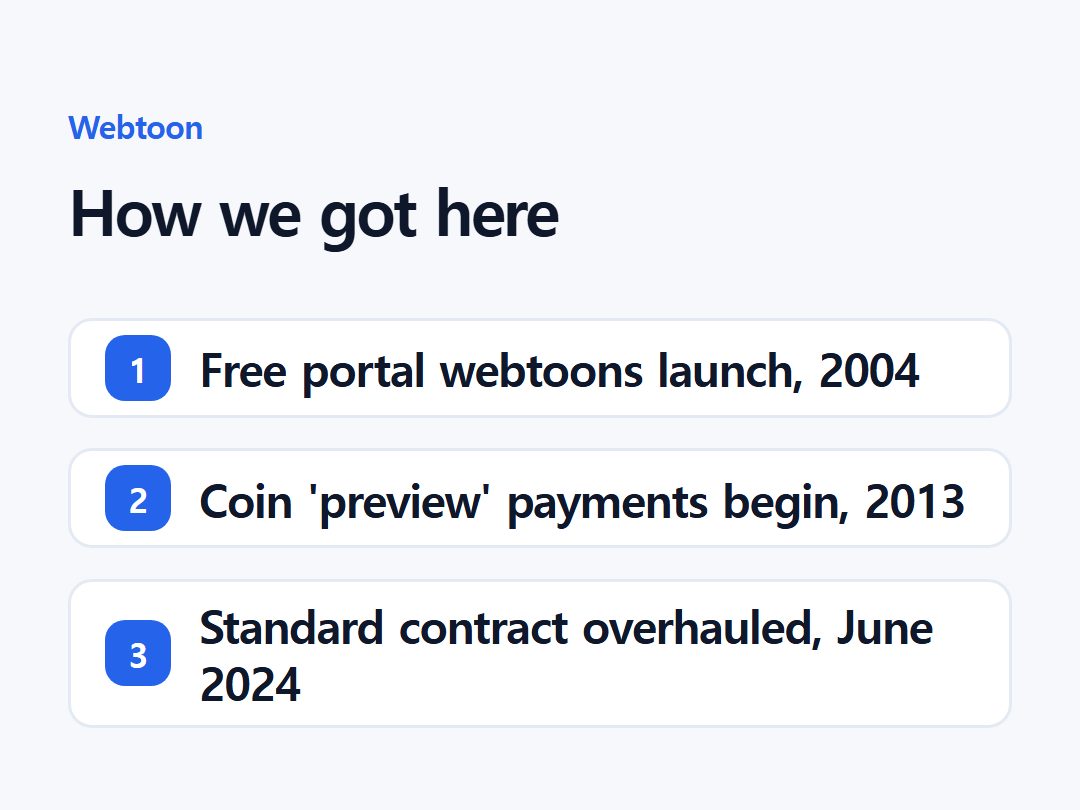
Naver launched a free webtoon service in 2004, using serialized comics to drive traffic to its portal rather than to sell them directly — the strip-scrolling format itself was designed for mobile phone screens rather than print pages.
Monetization came later: around 2013, platforms introduced coin-based “preview” payments, letting the free-to-read model coexist with a paid early-access option.
Global expansion followed, with LINE Webtoon launching internationally in 2014 and the platform later formalizing an “Originals” (contracted, paid) and “Canvas” (open, ad-revenue-eligible) tier system for English-language creators around 2019–2020 — a structure that mirrors the domestic Korean path from 도전만화 (Challenge Comics) to 정식연재 (official serialization).
As the industry scaled, complaints about contract opacity grew alongside it. South Korea's Fair Trade Commission corrected unfair clauses — particularly around secondary-copyright and MG-repayment terms — across 26 webtoon platform operators in 2018, and again reviewed and revised terms industry-wide in 2024.
The Ministry of Culture's standard contract, revised most substantially in June 2024, now requires settlement statements to disclose gross revenue, unit coin pricing, cost breakdowns, and net revenue, and guarantees artists two rest episodes for every 50 episodes serialized.
None of this is legally mandatory, however — KOCCA's 2022 survey found only 48.7% of artists used the standard contract as-is or with modifications, versus 81.9% of companies.
Will new rules actually protect artists?
Three things remain unresolved. First, whether the government follows through on 2026 proposals to stop platforms from converting an artist's un-recouped MG into personal debt when a series underperforms.
Second, whether Naver Webtoon acts on its November 2025 pledge to review the practices the Creators Union raised, including unpaid contest-revision work and overseas revenue splits — the company said only that it would “strive to make improvements” if the claims proved factual after review.
Third, as Webtoon Entertainment pushes further into direct production and adaptation financing rather than simple licensing, it remains unclear whether that shift will translate into better-defined, better-disclosed terms for the artists whose work is being adapted — or simply move the same opacity into a new revenue line.
The three-part webtoon pay structure
| Stage | Term | What it means |
|---|---|---|
| 1 | 연재료 (yeonjaeryo) — episode fee | Flat payment per episode delivered, regardless of performance |
| 2 | MG (Minimum Guarantee) | Advance paid before revenue comes in; recouped from the artist's future earnings |
| 3 | RS (Revenue Share) | Split between platform, CP, and artist — kicks in only after the MG is paid off |
Frequently asked
How much do Korean webtoon artists actually earn?
Artists who serialized continuously for a full year averaged 98.4 million won (about $73,000) in 2022, though that was down 20.3 million won from the previous year.
What is MG in webtoons?
MG stands for Minimum Guarantee — an advance the platform or CP pays an artist before revenue comes in, which is then recouped from the artist's future earnings before RS kicks in.
Why do free webtoons make money if no one pays to read them?
Platforms earn mainly through 미리보기 ("preview"/Fast Pass) payments, where readers spend coins to unlock the next episode early, so revenue share is calculated from those coin purchases rather than raw free readership.
Sources
Every factual claim above is traceable. We do not translate articles — we gather facts from multiple outlets and write them ourselves.
- Webtoon plans and standard contract clauses on episode fees, MG, and revenue share — Postype (Toonyz)
- Unpaid Labor Allegations Cast Shadow Over Naver WEBTOON's Market Dominance — Anime News Network
- Notice: Originals creator payment structure (episode fees and revenue threshold) — WEBTOON
- What is Fast Pass? — WEBTOON Support
- Monthly Coin Premium is becoming WEBTOON Premium — WEBTOON Support
- 웹툰플랫폼 사업자의 계약서상 불공정약관조항 시정 (Fair Trade Commission corrects unfair webtoon platform contract clauses) — Korea Policy Briefing
- '웹툰 만화 분야 표준계약서' 이렇게 달라집니다 (How the standard webtoon contract is changing) — Korea Policy Briefing
- 한국 웹툰 산업 매출액 1조8290억 역대 최대... 작가 연평균 수입은 감소 (Webtoon industry revenue hits record 1.83 trillion won as artist average income falls) — Segye Ilbo
- 웹툰 산업 성장 역대 최대 작가 1인 수입은 감소 (Webtoon industry growth hits record as per-artist income falls) — Korea.kr (K-Gonggam)
- 웹툰작가들의 노동환경 실태와 건강문제 (Working conditions and health of webtoon artists, 2023 National Assembly forum materials) — Korean Institute of Labor Safety and Health (KILSH)
- Building a Creator Economy for Comic Artists: English-Language WEBTOON Creator Payments Surpass $27 Million Since 2020 — Business Wire