International visitors to Korea sometimes notice something odd: deodorant aisles in Korean drugstores are small, and many Korean friends say they simply don't use it. Clips repeating this observation circulate regularly on social media, usually framed as a strange cultural quirk or a tolerance for body odor that would be unacceptable elsewhere.
The short version
- A single ABCC11 gene mutation decides whether underarm sweat can smell.
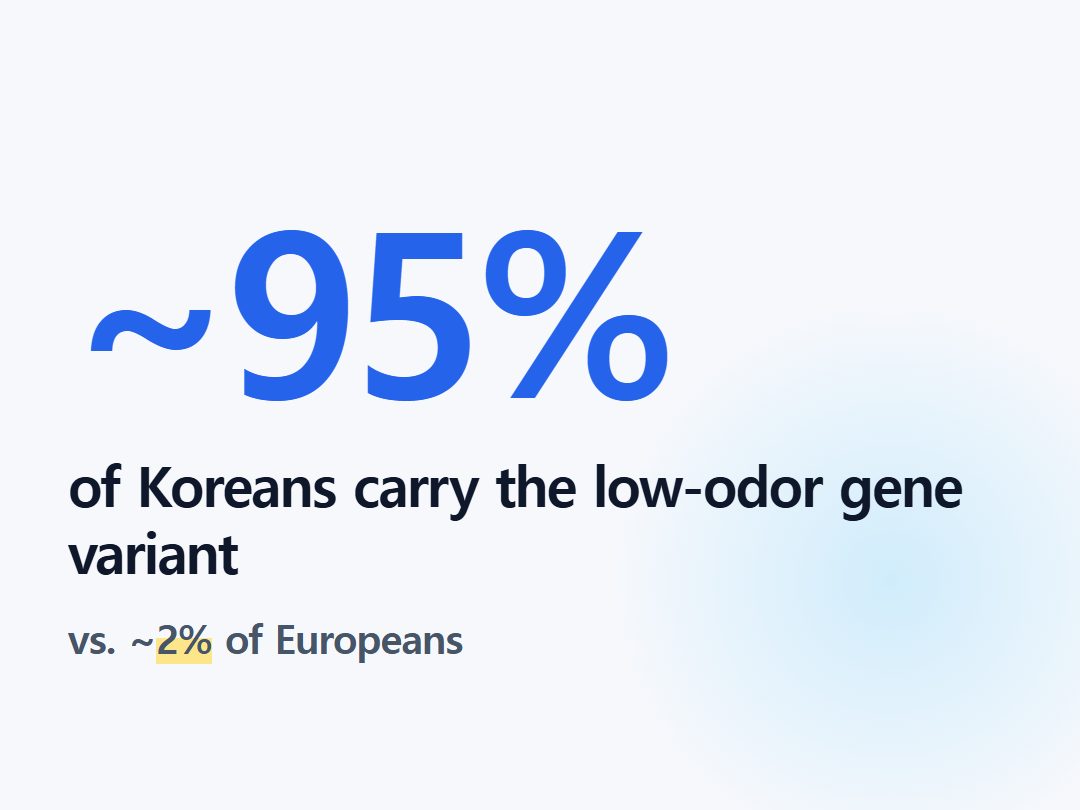
- About 95% of Koreans carry the low-odor variant, versus 2% of Europeans.
- Low-odor gene carriers are nearly five times more likely to skip deodorant.
Stated that bluntly, the claim is an overreach — some Koreans do sweat and do smell, and plenty use deodorant anyway. But the underlying idea has a real genetic basis, and it happens to be one of the more thoroughly documented findings in human population genetics, traced to a single, specific mutation.
A single gene decides whether your sweat can smell at all
The gene is called ABCC11. It codes for a transport protein that pumps certain organic compounds out of cells in the apocrine glands — the sweat glands concentrated under the arms, distinct from the eccrine glands that produce ordinary, odorless sweat elsewhere on the body.
In most people, this pump works normally, and those compounds reach the skin surface, where naturally occurring skin bacteria break them down into short-chain fatty acids — the actual molecules responsible for what we recognize as body odor. Take away the raw material, and the bacteria have nothing to metabolize.
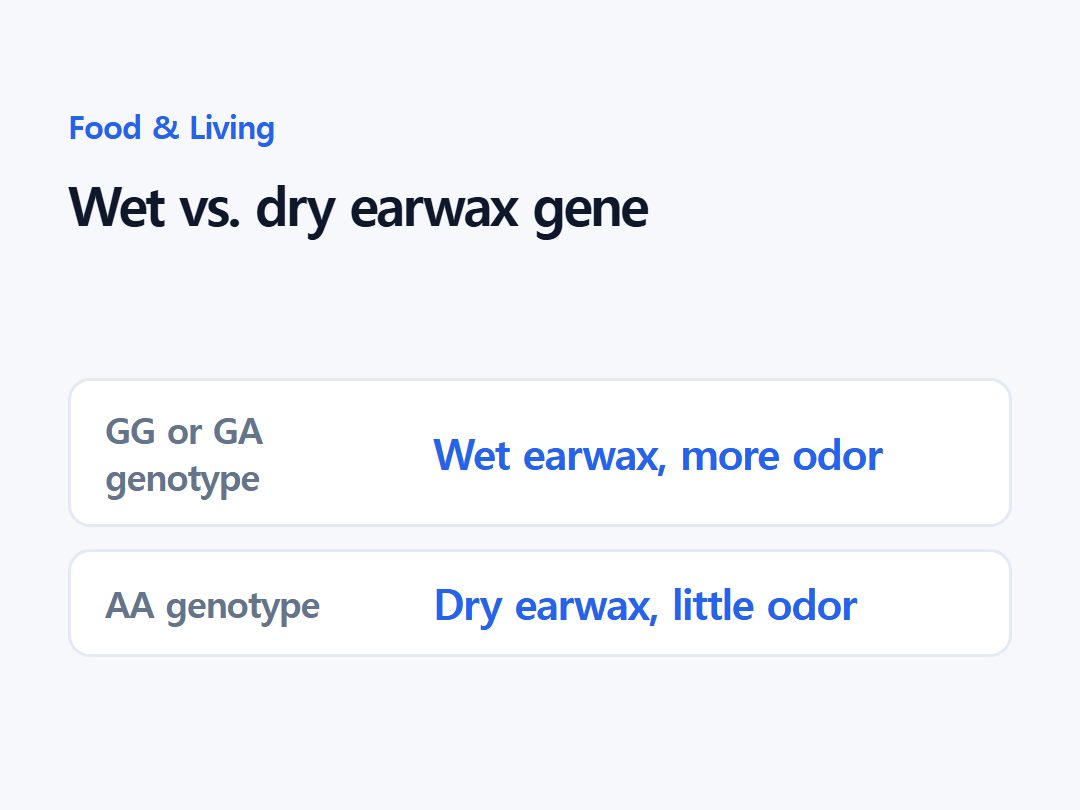
A single mutation in ABCC11 — a change at one specific point in the DNA, catalogued as rs17822931 — breaks that pump. People with two copies of the mutated version, an "AA" genotype, secrete far less of the raw material bacteria need. Less raw material means little to no odor, regardless of how much a person actually sweats.
Korea has one of the lowest rates of the "odor" gene in the world
This mutation is not evenly distributed across humanity. A 2009 genetics study in Japan found that only 35.4% of the general population carried the odor-producing version of the gene, compared with over 95% in people of European or African descent (Nakano et al., 2009).
Korea sits even further along that spectrum. Population surveys cited in the same research literature put the odor-associated genotype at roughly 5% in Korea, versus about 15% in Japan and 10% among Han Chinese. In practice, that means a large majority of Koreans carry two copies of the low-odor variant — a genetic reality, not a hygiene habit.
- ~95% of Koreans: low-odor (AA) genotype
- ~85% of Japanese: low-odor genotype
- ~2% of Europeans: low-odor genotype
These numbers come from earwax-type surveys rather than direct genotyping of every population, since the two traits are controlled by the identical DNA variant and researchers have long used the visible earwax trait as a proxy. Either way, the direction and scale of the gap between East Asia and Europe is consistent across every study that has measured it.
The discovery that started with earwax, not armpits
The ABCC11 connection wasn't found by studying armpits first. It came from a simpler, more visible trait: earwax. Earwax comes in two textures — a sticky, amber "wet" type common in Europe and Africa, and a dry, flaky type common across East Asia.
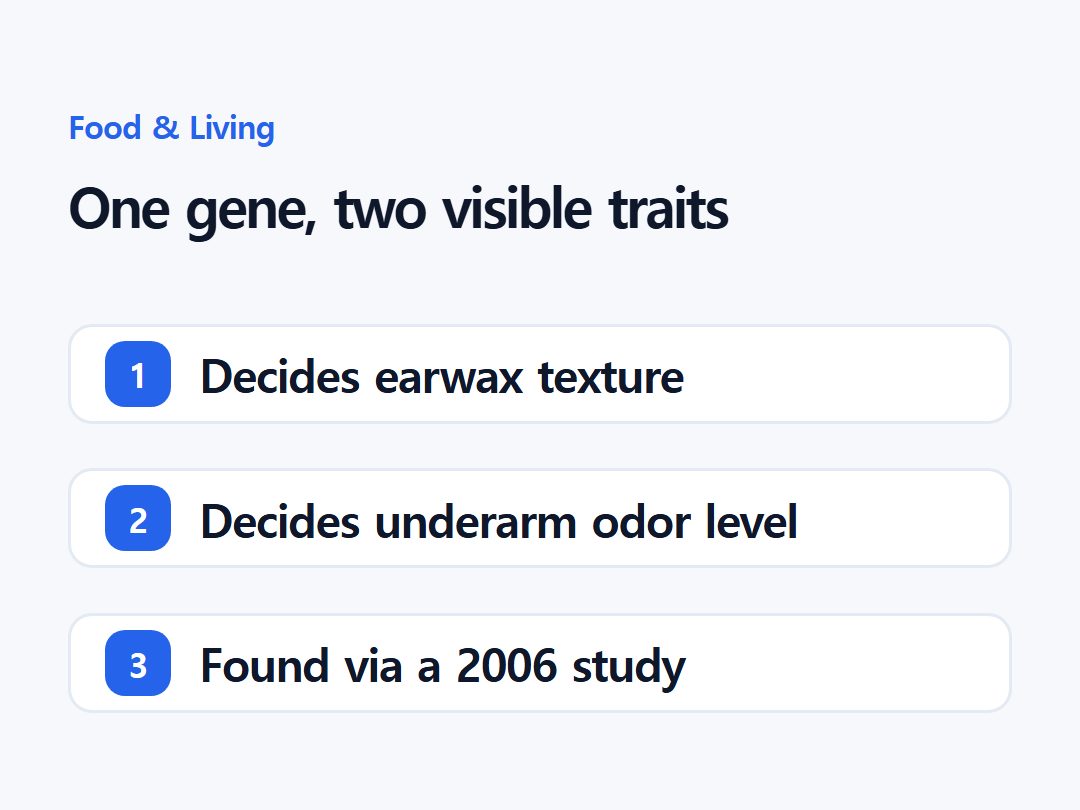
In 2006, a team led by geneticist Koh-ichiro Yoshiura showed that the same single DNA change controls both traits at once. People with the AA genotype have dry earwax and low body odor; people with at least one working copy of the gene have wet earwax and normal odor.
It was notable at the time as one of the first cases where a single, simple DNA variant was shown to determine a visible human trait (Yoshiura et al., 2006, Nature Genetics).
Genotype predicts deodorant shopping habits, not just body chemistry
The gene doesn't just correlate with body chemistry — it measurably predicts behavior. A 2013 study of roughly 17,000 people in the UK's ALSPAC cohort compared ABCC11 genotype against self-reported deodorant use.
The statistical association was strong: people with the low-odor AA genotype were almost five times more likely to report never using deodorant, or using it only rarely, compared with people carrying the odor-producing version (Rodriguez et al., 2013). The researchers framed this as a case where genetics quietly shapes an everyday consumer habit most people assume is purely cultural.
Non-odorous does not mean unwashed
It's worth separating two different things the myth tends to blur together: not producing underarm odor, and not needing to wash or manage body odor from other sources. ABCC11 specifically affects apocrine sweat gland secretions under the arms — it has no bearing on foot odor, breath, or general hygiene.
The same 2013 study also found the link isn't absolute in either direction. Nearly 78% of genetically non-odorous people in the study still used deodorant anyway, likely out of habit or social expectation, while a small share of genetically odorous people used none at all. Genotype shifts the odds; it doesn't dictate individual choices.
The other five percent: when it becomes a medical condition
For the minority of Koreans who do carry the odor-producing gene variant, underarm odor can be more than a minor issue. In clinical terms it's called axillary osmidrosis, and it is strongly linked to the same genotype: one Japanese clinical study found 98.7% of osmidrosis patients carried the odor-producing version of ABCC11, compared with 35.4% of the general population (Nakano et al., 2009).
Because the trait is genetically rare in East Asia, people who do have it can feel more visibly out of step with those around them than someone with the same condition would in a population where it's the norm.
That social asymmetry is part of why treatment options in Korea range from prescription antiperspirants to outpatient procedures that remove or reduce the sweat glands involved, distinct from cosmetic surgery for appearance.
Doctors treating the condition generally start with the least invasive option and escalate only if odor persists, since the underlying cause — a working copy of ABCC11 — cannot itself be changed, only its physical consequences managed.
A mutation that may have helped ancestors survive the cold
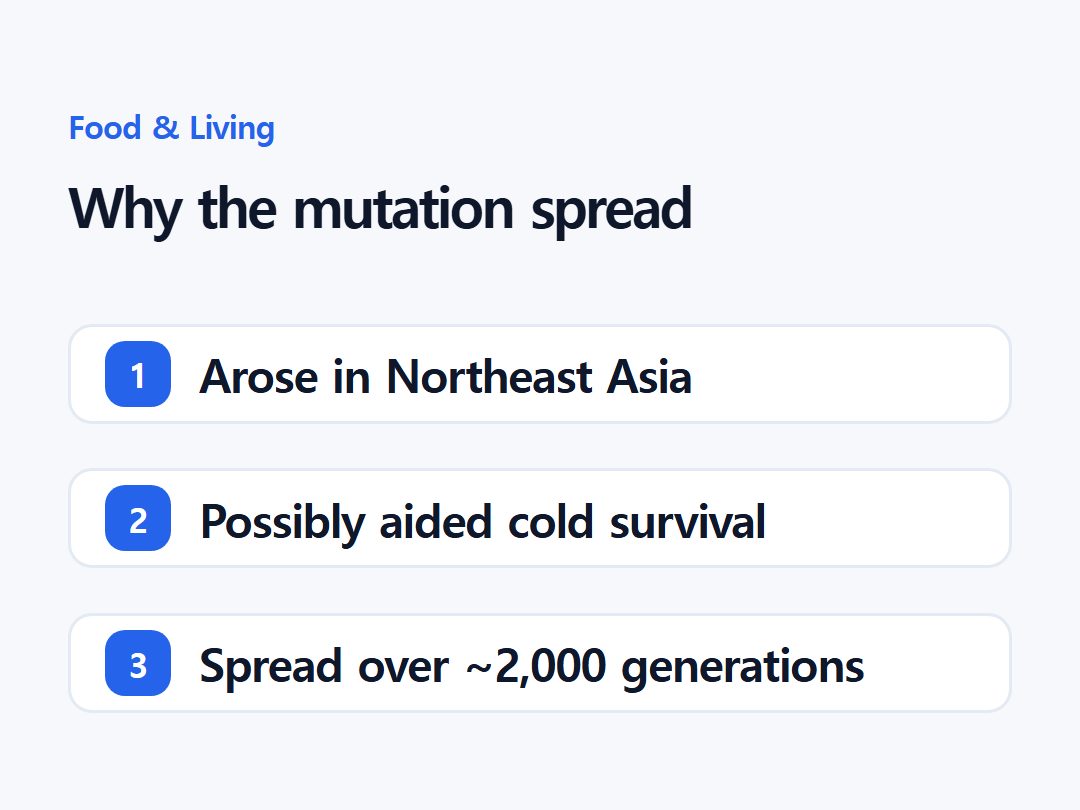
Why did this variant become so common in Korea and not, say, Nigeria or Norway? Researchers have proposed a climate-adaptation explanation. A 2011 analysis in Molecular Biology and Evolution estimated the mutation arose in Northeast Asia roughly 2,000 generations ago and then spread under active natural selection (Ohashi et al., 2011).
The same gene family affects sweat gland activity more broadly, and the researchers suggested that reduced sweating could have offered a survival advantage in cold climates by helping the body retain heat. The frequency of the variant today still tracks a rough gradient — higher at higher latitudes, lower near the equator — which is consistent with, though not final proof of, that theory.
What genetics can't fully explain
The science here is unusually solid for a topic that circulates online as folk wisdom, but it doesn't answer everything. Genotype explains why odor production differs by population on average; it says less about diet, gut bacteria, or environmental factors that researchers suspect also influence individual body odor at the margins.
It also doesn't fully explain modern behavior. Deodorant use in Korea has been rising for reasons that have nothing to do with genetics — global beauty marketing, K-pop grooming culture, and increased travel and exposure to international norms. A gene discovered through earwax in 2006 still shapes a personal-care aisle in 2026, but it no longer works alone.
Share of population with the low-odor (AA) ABCC11 genotype
| Population | Low-odor genotype share |
|---|---|
| Koreans | ~95% |
| Japanese | ~85% |
| Europeans | ~2% |
Frequently asked
Why don't some Koreans use deodorant?
A large majority of Koreans carry two copies of the low-odor ABCC11 gene variant, so their apocrine sweat lacks the raw compounds skin bacteria need to produce odor.
Is skipping deodorant genetic or just a cultural habit?
It has a real genetic basis: a single mutation in the ABCC11 gene (rs17822931) determines whether underarm sweat contains the compounds bacteria break down into odor.
What is axillary osmidrosis?
It's the clinical term for underarm odor in people who carry the odor-producing version of ABCC11; treatment ranges from prescription antiperspirants to outpatient procedures that reduce the sweat glands involved.
Sources
Every factual claim above is traceable. We do not translate articles — we gather facts from multiple outlets and write them ourselves.
- A SNP in the ABCC11 gene is the determinant of human earwax type — Nature Genetics
- A strong association of axillary osmidrosis with the wet earwax type determined by genotyping of the ABCC11 gene — BMC Genetics
- Dependence of Deodorant Usage on ABCC11 Genotype: Scope for Personalized Genetics in Personal Hygiene — Journal of Investigative Dermatology
- Diagnosis of Human Axillary Osmidrosis by Genotyping of the Human ABCC11 Gene: Clinical Practice and Basic Scientific Evidence — BioMed Research International
- Impact of Natural Selection on an ABCC11 SNP Determining Earwax Type — Molecular Biology and Evolution
- APOCRINE GLAND SECRETION, VARIATION IN — Entry #117800 — OMIM (Online Mendelian Inheritance in Man)


