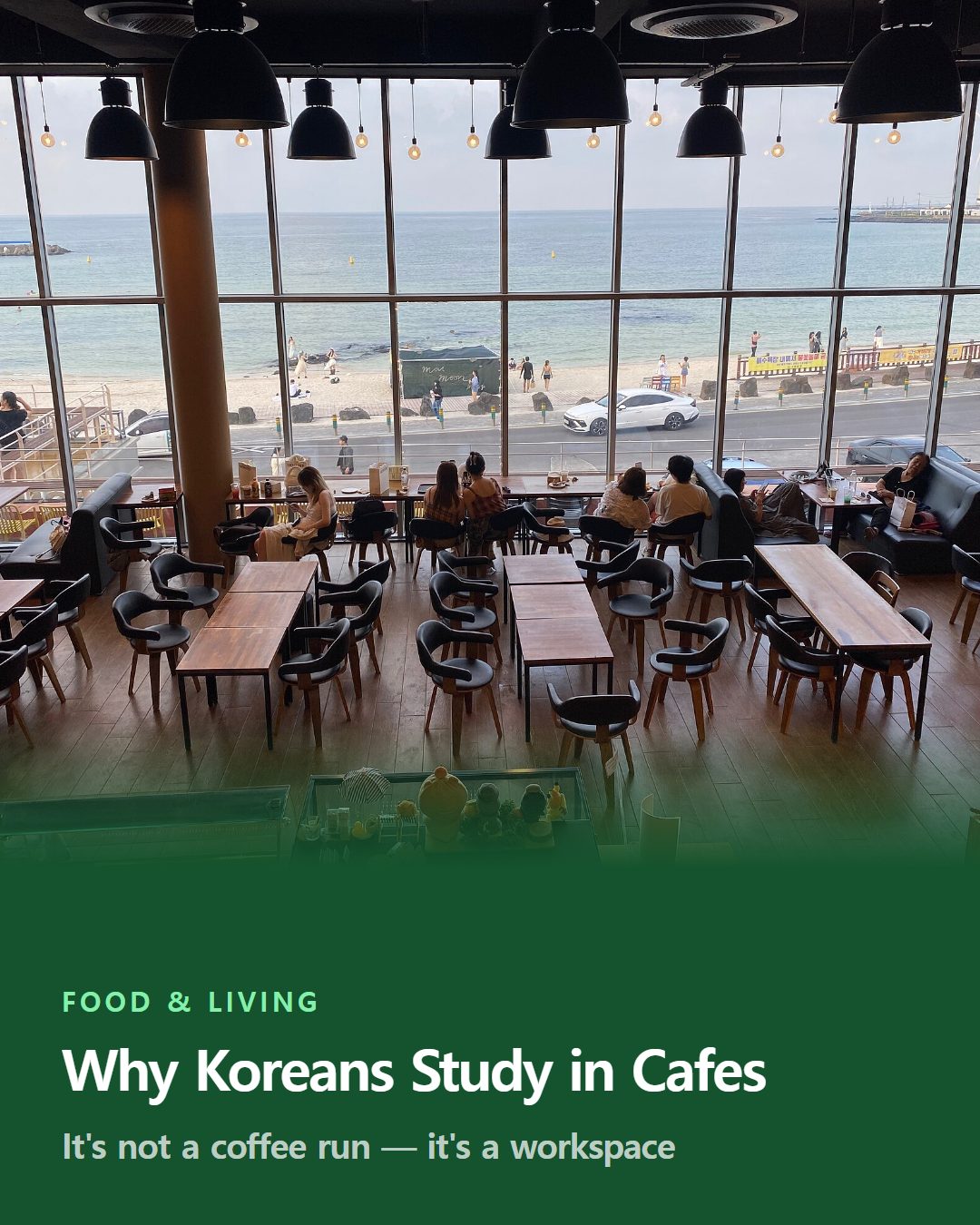
If you have watched more than a handful of K-dramas, you have probably noticed how much of the plot seems to happen in coffee shops. Confessions, breakups, business meetings, group study sessions, first dates — a huge share of Korean visual media treats the cafe as a default set. This is not a filming shortcut.
It reflects a real, distinctive pattern in how Koreans use cafes, one that has its own name: 카공족 (ka-gong-jok), roughly "the cafe-study tribe," people who treat a coffee shop as a place to work or study for hours at a stretch.
The short version
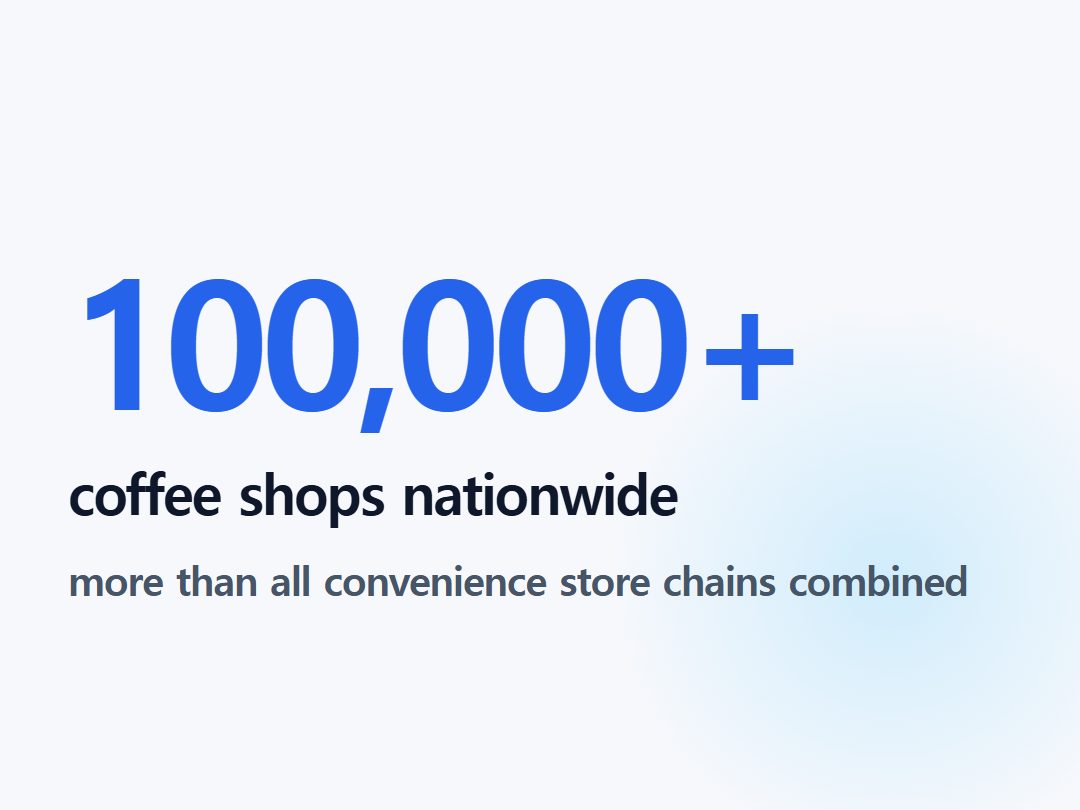
- South Korea has over 100,000 cafes, more than its four top convenience chains combined.
- Starbucks now discourages long-stay laptop setups while Twosome Place builds dedicated study zones.
- Small one-room apartments push many Koreans to study and meet in cafes instead.
In 2025, this habit became visible as an actual point of friction in the industry.
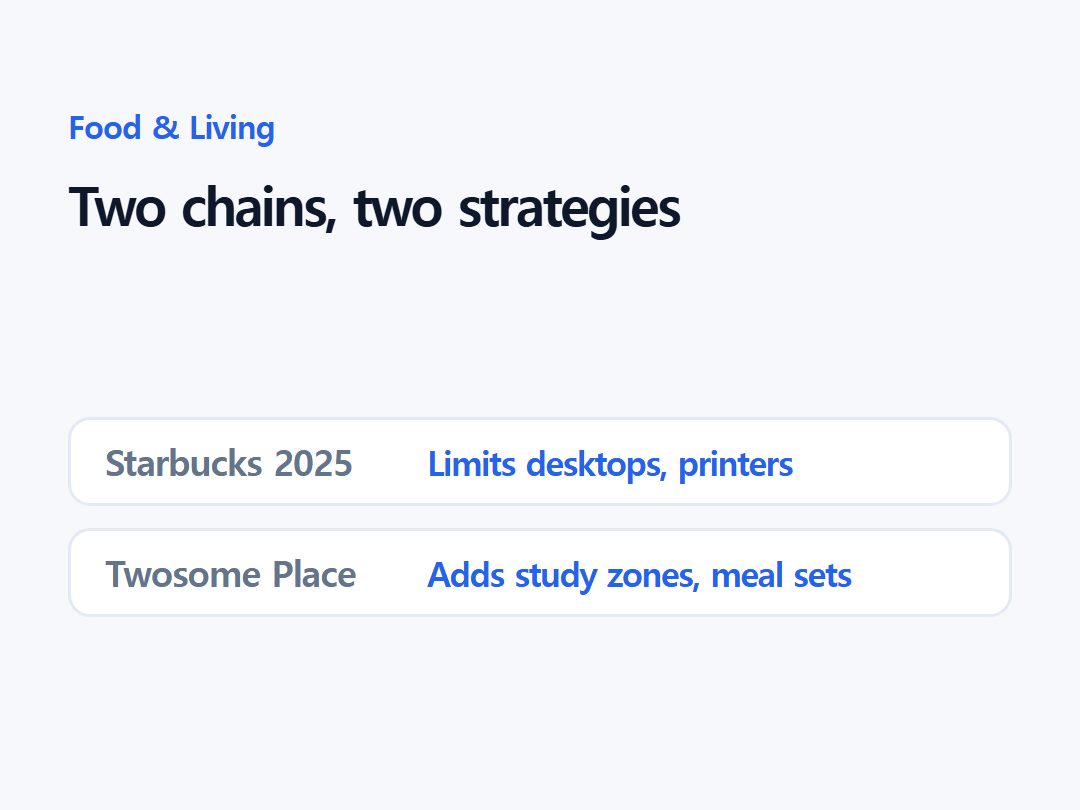
Starbucks Korea introduced internal guidelines discouraging customers from setting up desktop monitors, printers, desk partitions, and multiple power strips at their tables, and asked long-staying customers to be willing to share larger seating with others.
Competing chain Twosome Place moved in the opposite direction, building dedicated study zones and expanding meal-style menu items — the chain reported that sales of its sandwich-and-Americano combo sets rose about 30 percent year-on-year in the first seven months of 2025. Two major coffee chains, one industry, two opposite bets on the same behavior.
Why does Korea have so many cafes?
To an outsider, a rule about laptops and printers in a coffee shop might look trivial. But it sits on top of a set of habits and structural conditions that are genuinely unusual by international standards, and that explain a lot about everyday life in Korea.
Korea has an extraordinary number of cafes. According to Statistics Korea, the number of registered coffee shops nationwide passed 100,000 for the first time at the end of 2022 — up from roughly 51,000 in 2016, meaning the count nearly doubled in six years.
That is more outlets than the four major convenience store chains (CU, GS25, 7-Eleven, and Emart24) have combined. Seoul alone has more than 18,000 cafes, a level of density that analysts and travel writers regularly describe as higher than New York, Tokyo, or Seattle relative to population.
On a per-capita basis, South Korea is frequently cited as having the highest cafe density of any country in the world.
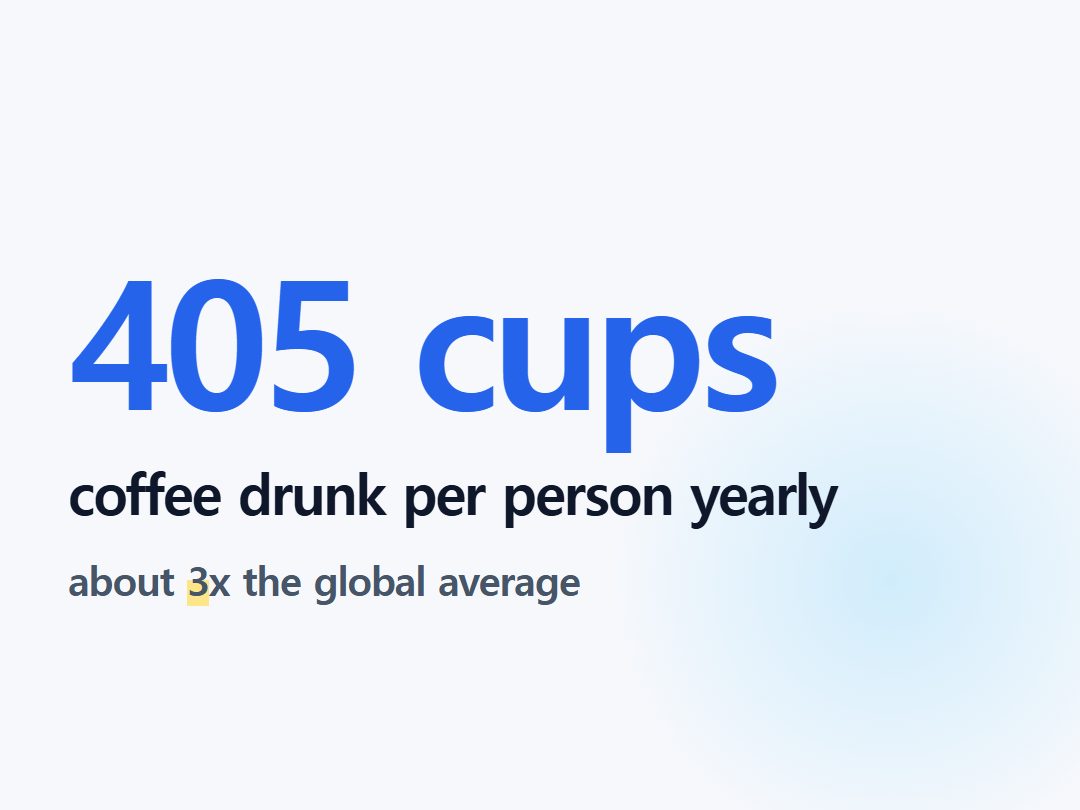
Coffee consumption backs this up. South Koreans drink an estimated 405 cups of coffee per person per year — roughly three times the global average — placing the country near the very top of world rankings, behind only a handful of European nations.
The domestic coffee market was worth an estimated 17 trillion won (about 13 billion USD) in 2025, making up close to a third of the entire beverage market, ahead of soft drinks, tea, and juice combined.
The reason so many cafes can coexist is that they are not just selling coffee — they are renting out space and time. This idea traces back to sociologist Ray Oldenburg's concept of the "third place": somewhere that is neither home nor work, where people can sit without an agenda.
When Starbucks entered Korea in 1999, it imported this model directly, and it landed on fertile ground.
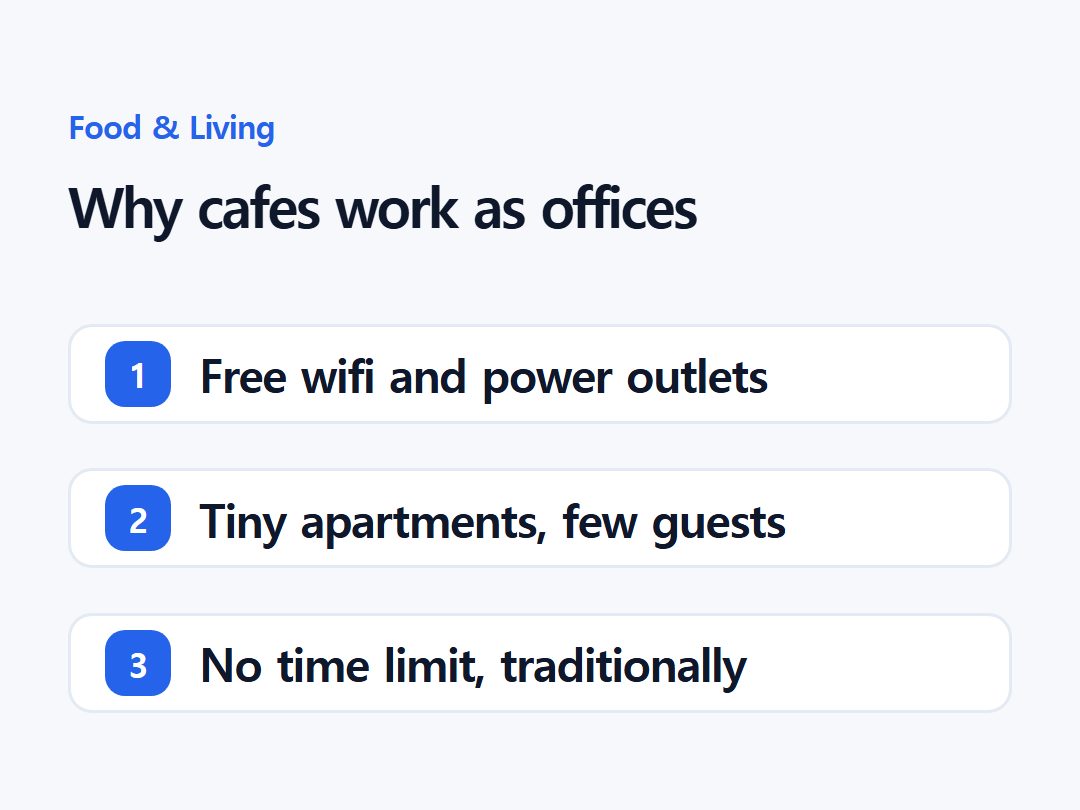
Unlike Korea's traditional coffee houses of the era, Starbucks did not pressure customers to leave quickly, offered free wifi and outlets, and was designed to be comfortable sitting alone — something that was, at the time, a genuinely new option in Korean public space.
That mattered because of a separate structural fact: a large share of Koreans, particularly students and young workers, live in small, single-room apartments known as officetels or one-rooms (원룸). These spaces are usually too small and too private to comfortably host friends, study groups, or client meetings.
Cafes filled that gap. A 2020 survey of Korean university students by the Korea Economic Daily found that 63 percent studied in a cafe at least once a week — not as an occasional treat, but as a routine substitute for a home desk, a library seat, or a meeting room.
This is also why cafes are everywhere in Korean dramas. Screenwriters use them for the same reason real people do: a cafe is a neutral, semi-private space where two characters can plausibly sit close together for an extended, uninterrupted conversation without needing a reason.
The 2007 drama Coffee Prince, built entirely around a fictional coffee shop, is often cited as an early example that cemented the cafe as a default romantic and dramatic setting in Korean television — after it aired, cafe brands leaned further into partnerships with dramas and films for exposure.
Decades later, the pattern is now so consistent that international viewers notice it as a genre convention, even if they don't know the everyday habit behind it.
From smoky dabangs to Starbucks-style cafes
Korea's relationship with the coffee shop did not start with Starbucks. The country's first Western-style cafe opened in Seoul in 1902, and by the mid-20th century a distinct institution called the dabang (다방) — literally "tea room" — had become a fixture of Korean cities.
Dabangs were meeting spots for writers, businesspeople, and couples on dates; by 1992 there were an estimated 45,000 of them nationwide.
But dabangs were also associated, by the 1980s and 1990s, with an older, smokier, more transactional image, including a notorious subset of "ticket dabangs" tied to illicit services — a reputation that pushed younger, image-conscious Koreans away from the format entirely.
Starbucks' arrival in 1999, with its first store near Ewha Womans University in Seoul, offered something dabangs did not: a bright, brand-consistent space designed for solo use, free of the older cafe's social baggage, with lines reportedly out the door in its opening months.
Within a few years, other domestic and international chains — Twosome Place, Ediya, A Twosome, Hollys — expanded the same model nationwide, competing partly on coffee and partly on how comfortable and spacious their seating was.
That competition, sustained over two decades, is a direct cause of today's cafe density: with entry costs for opening a coffee shop relatively low and demand for study- and work-friendly space consistently high, supply kept expanding to meet it, even as the industry itself became more competitive — Seoul data shows only about 52 percent of coffee shop storefronts stay open past three years.
Will Korea's cafe boom keep growing?
The tension that surfaced at Starbucks Korea in 2025 has not been resolved industry-wide, and it is unlikely to be.
Individual chains are now visibly experimenting with opposite strategies: some are tightening rules around long-stay customers with laptops and equipment, while others are leaning further into the cafe-as-workspace model with dedicated study zones, all-day seating, and meal-sized menu items meant to convert long stays into higher spending per visit.
A newer category of hybrid "study cafe" brands — charging a flat daily fee for unlimited time and coffee, positioned between a regular cafe and a formal study room (스터디카페) — has also been growing as a direct answer to this friction.
Whether Korea's cafe density keeps climbing is itself an open question. Coffee shop numbers grew rapidly through the early 2020s, but oversaturation and rising commercial rents mean roughly half of new coffee shops in Seoul do not survive past three years.
For now, though, the underlying habit that makes a coffee shop double as a study hall, an office, and a meeting room shows no sign of disappearing — which means the cafe will likely keep showing up as a K-drama set for the foreseeable future.
Starbucks cracks down while Twosome leans in
| Chain | Strategy | Detail |
|---|---|---|
| Starbucks Korea | Discourages long-stay office setups | Restricts monitors, printers, and power strips; asks customers to share large tables |
| Twosome Place | Leans into cafe-as-workspace | Built dedicated study zones; combo meal sales up ~30% YoY |
Frequently asked
What does 카공족 (ka-gong-jok) mean?
It refers to people who treat a coffee shop as a place to study or work for hours at a stretch, a widely recognized habit in Korea.
Why does Korea have so many cafes?
Registered coffee shops passed 100,000 in 2022, partly because small officetel and one-room apartments push students and workers to use cafes as substitute offices and study spaces.
Why do K-dramas always show scenes in cafes?
Cafes are neutral, semi-private spaces where characters can talk at length without a stated reason, a convention often traced to the 2007 drama Coffee Prince.
Sources
Every factual claim above is traceable. We do not translate articles — we gather facts from multiple outlets and write them ourselves.
- 전국 커피전문점 수 처음으로 10만 개 돌파‥편의점보다 많아 — MBC News
- "이제 카페에서도 눈치 봐야?"…카공족에 웃는 투썸 vs 용단 내린 스타벅스 — Daum News
- 카공족 - 나무위키 — Namu Wiki
- 일상이 된 기호식품, 식지 않는 한국인의 커피 사랑 — Hankyung Magazine
- South Korea Cafe Industry Statistics | 2026 Edition — WifiTalents
- Korea Coffee Industry 2026: Inside the $13B Cafe Nation Disrupting Starbucks — Seoulz
- [MORNING CALM TALES] Korea's 1990s coffee revolution — The Korea Times
- The History Of Dabang: The Original Korean Coffee House — Creatrip
- Coffee in South Korea — Wikipedia
- Why K-Dramas Love Cafe Scenes So Much — Coffee Lovers 101