Watch enough Korean drama or K-pop content with subtitles and you will notice a pattern: a character says "오빠" (oppa) or "형" (hyung) mid-sentence, and the English text quietly turns it into the other character's first name, or drops it into a generic "hey." The word disappears, but it was never filler.
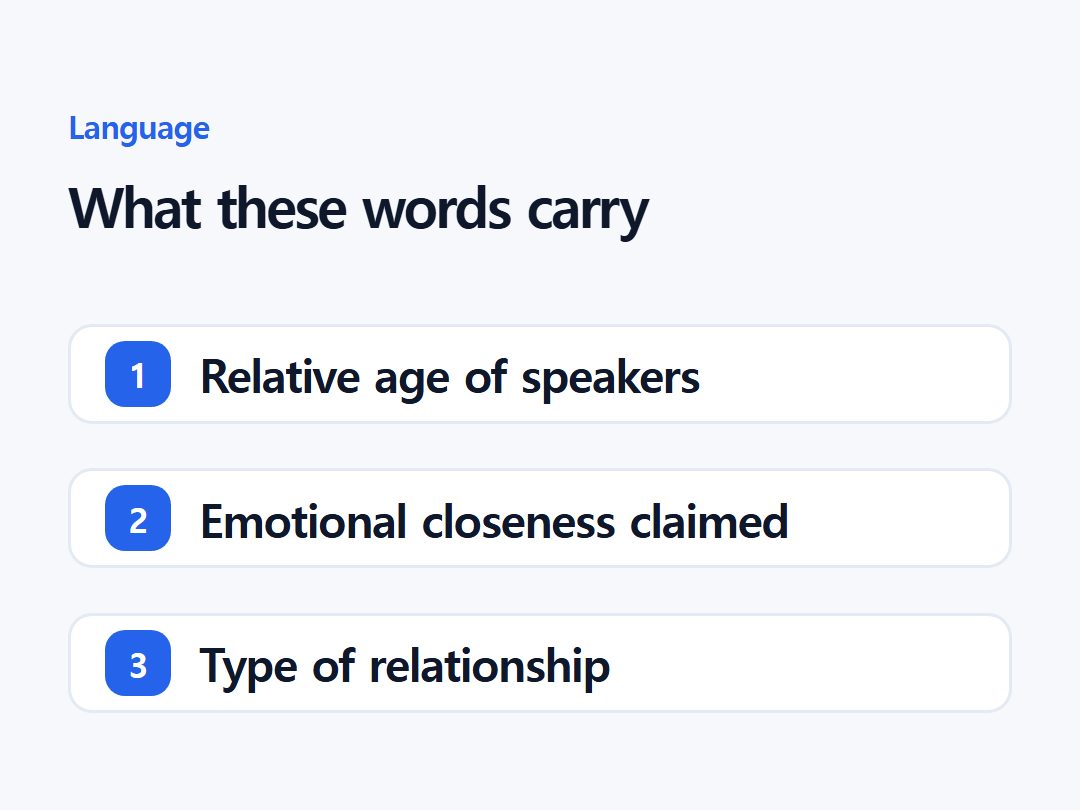
Oppa, unnie, hyung and noona are Korean terms of address — words people use instead of a name — and each one encodes information a name cannot: who is older, how close the speakers are, and what kind of relationship is being claimed in that moment.
The short version
- Oppa, hyung, unnie, noona encode age, gender and closeness — English names erase all three.
- Netflix subtitled Sang-woo's offer of hyung as just "Call me Sang-woo," losing the meaning.
- Oxford added oppa, noona, unni in 2021; hyung followed only in 2025.
This is not one bad translation waiting to be fixed. It is a structural gap between two languages, and it resurfaces every time Korean film, television or music crosses into English.
The clearest public case arrived with Netflix's Squid Game in 2021, when a bilingual comedian's viral criticism of the English captions set off a debate among professional translators, subtitlers and linguists about what gets lost in translation — and honorifics were at the center of it.
Why can't English capture what hyung means?
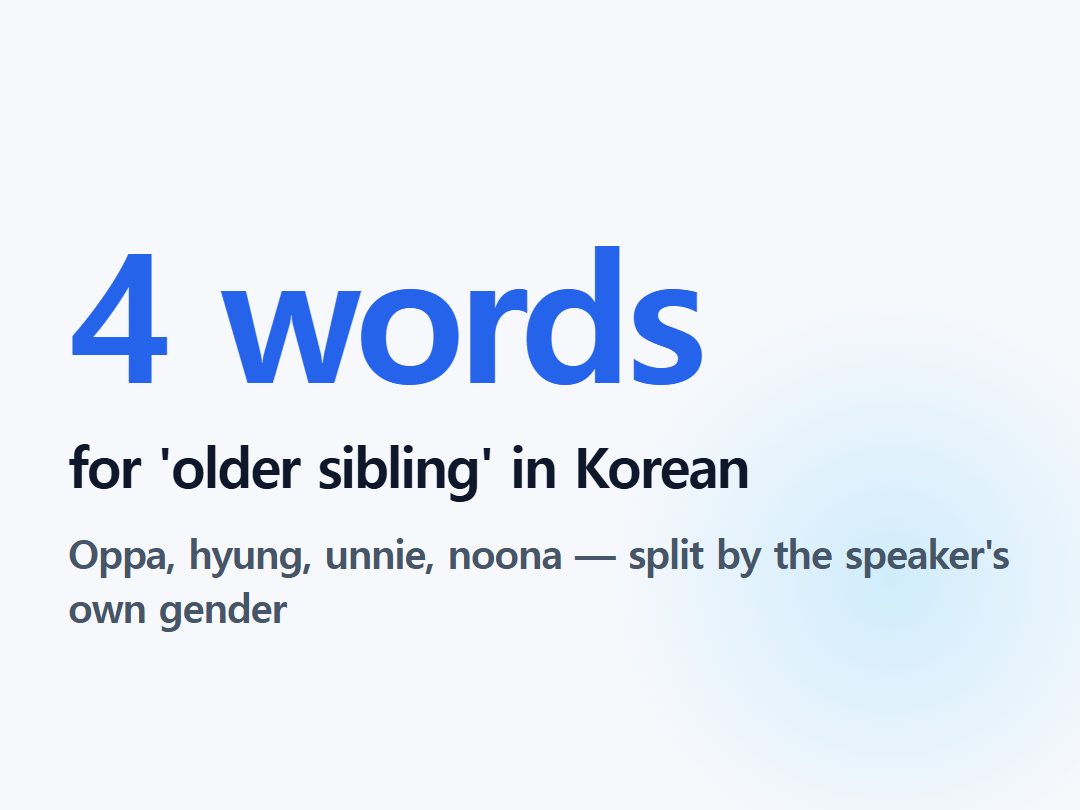
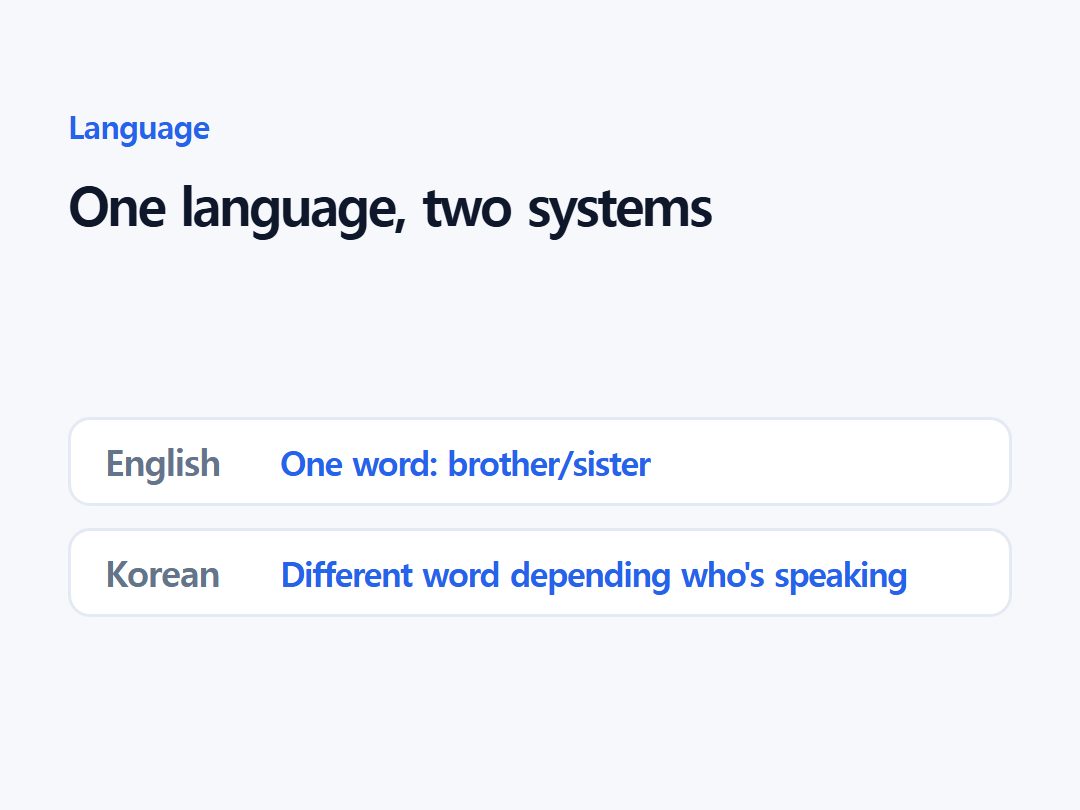
English has one word for an older male sibling: "brother." Korean has at least two, and which one a speaker uses depends first on the speaker's own gender, not just the age of the other person. A younger woman calls an older brother, or a close older male friend, oppa.
A younger man in the exact same relationship calls him hyung. For older sisters, the split runs the other way: a younger woman says unnie (also spelled unni); a younger man says noona. Four words, one English translation, and the difference is not dialect or formality — it is baked into the grammar of who is speaking.
None of these terms are limited to blood relatives. Koreans routinely use them for close friends, teammates, senior colleagues, and, in fan culture, for idols and actors admired from a distance. This reflects a broader habit: in South Korea, people largely avoid using a given name across an age gap, even a small one.
Age is one of the first things Koreans ask a new acquaintance, not out of nosiness but because Korean speech itself changes shape depending on who is older — verb endings and sentence-final particles shift between formal and casual registers, and even a one-year difference can flip which register applies.
Calling someone hyung or noona instead of using a formal title is itself a small act of closeness: it says I am placing you in my circle.
That is exactly the moment Squid Game hinges on in one of its most-discussed exchanges. Sang-woo, a Korean former businessman, tells Ali, a Pakistani migrant worker who has been addressing him formally, that he can drop the formality and call him hyung instead.
According to Macquarie University linguist Jinhyun Cho, writing in The Conversation, the moment is a small but real gesture of trust and equality — Ali is being invited into the kind of relationship reserved for people who are not strangers.
Netflix's English subtitles rendered the line simply as "Call me Sang-woo," collapsing an offer of intimacy into a line about a name.
Viewers reading only the English text had no way to register that this was a turning point in the two characters' relationship, which made Ali's subsequent betrayal by Sang-woo land differently for audiences who caught the honorific and those who did not.
The wider subtitle debate around Squid Game became public when comedian and podcast host Youngmi Mayer, who is fluent in Korean, posted TikTok videos in October 2021 arguing that the English captions had sanded down the show's dialogue, drawing more than ten million views, according to NBC News.
Translation professionals pushed back on parts of her critique while agreeing on the underlying constraint: subtitles are typically capped at two lines of text on screen, fewer characters than a tweet, so translators are routinely forced to paraphrase or cut.
Honorifics, which carry meaning through social relationship rather than through information a viewer strictly needs to follow the plot, are often the first thing sacrificed.
Streaming platforms are aware of the problem in principle, if not fully solved in practice.
Netflix's own Korean Timed Text Style Guide, published for its translator network, instructs that the choice between formal and informal speech "should be decided after considering several factors such as context, relationship, era," and explicitly warns against defaulting to assumptions based on gender or age alone — for example, assuming a wife must speak formally simply because her husband speaks casually to her.
The guide shows the industry has thought carefully about register. What it does not offer is a fixed rule for oppa, hyung, unnie or noona themselves, because there isn't a clean English equivalent to reach for.
Translators are left making a judgment call, scene by scene, and the flattest, safest option — a first name — usually wins.
How Confucian speech rules became global vocabulary
The habit of addressing people by relationship rather than by name traces back to Confucian social structures that shaped Korean society for centuries, where age and status determined how people spoke to one another.
That hierarchy was formalized into the modern Korean language during the 20th century, when linguists standardized a system of speech levels running from highly formal to casual, and it survived Korea's rapid modernization largely intact.
The terms themselves — oppa, hyung, unnie, noona — started as family vocabulary and expanded outward to cover friendships, workplaces and, eventually, fandom.
That last expansion is what carried the words out of Korea.
As hallyu, the Korean Wave of film, television and music, grew through the 2000s and 2010s, international fans absorbed K-pop and K-drama content that was saturated with these terms of address, often used loosely and affectionately toward celebrities rather than strictly by the traditional family or friendship rules.
English-language institutions began registering the shift.
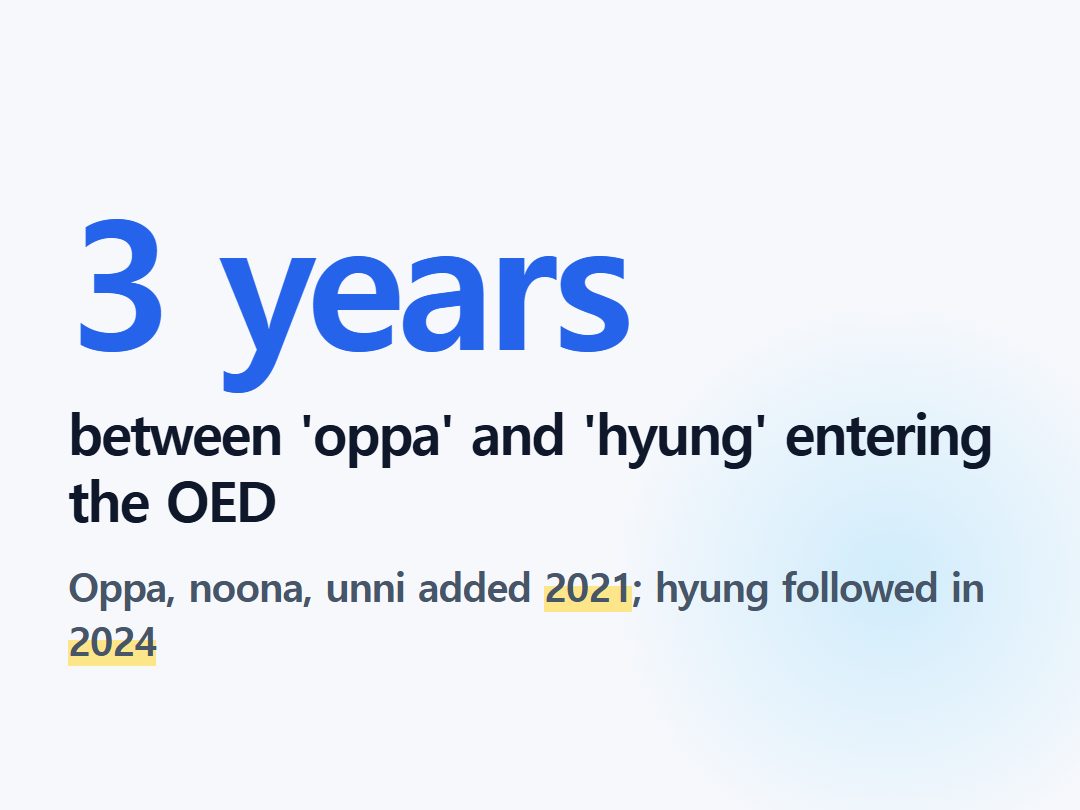
In its September 2021 update, the Oxford English Dictionary added oppa, noona and unni as new English entries, alongside other Korean loanwords such as hallyu, mukbang and K-drama, describing the addition as evidence of the Korean Wave's reach into the English language itself. Hyung did not make that round.
It took until the dictionary's next Korean-focused update, reported by The Korea Times in January 2025, for hyung to be added alongside words like dalgona, noraebang and maknae — a three-year gap between the female-speaker term and its male-speaker counterpart entering the same dictionary.
Parasite's 2020 Oscar wins and Squid Game's 2021 global run accelerated all of this at once, pulling far larger English-speaking audiences into subtitled Korean content than had ever watched it before.
Viewers who had no background in Korean were suddenly encountering honorifics constantly, and the subtitle choices translators had long made quietly, for a smaller audience, were now visible to millions of people simultaneously — some of whom noticed what was missing.
Viewers are learning to hear these words
The underlying tension is not close to resolved. Subtitle space constraints have not changed even as the volume of Korean content on global streaming platforms keeps growing, so the pressure to flatten honorifics into names will not disappear on its own.
Netflix and other platforms periodically revise their style guides, but as the existing Korean guide shows, published guidance still leaves the hardest calls — how to render a single loaded word like hyung — to individual translators working under time pressure.
What is shifting is audience literacy. A growing share of international viewers now recognize oppa, unnie, hyung and noona on sound alone, which gives some translators room to leave the term untranslated in situations where the audience can be expected to understand it, rather than substituting a name.
Dictionary recognition is likely to keep expanding in the same direction it has moved since 2021, with more Korean relational vocabulary plausibly following hyung into English-language reference works as hallyu's audience keeps growing. None of this closes the translation gap.
It does mean the words themselves — rather than their flattened English stand-ins — are increasingly part of how international audiences talk about the shows and music they watch.
Four terms, one English word
| Term | Used by | Refers to |
|---|---|---|
| Oppa | Younger woman | Older brother or close older male friend |
| Hyung | Younger man | Older brother or close older male friend |
| Unnie | Younger woman | Older sister or close older female friend |
| Noona | Younger man | Older sister or close older female friend |
Frequently asked
What does oppa mean in Korean?
Oppa is what a younger woman calls an older brother, or a close older male friend, and it signals both the speaker's gender and a claim of closeness rather than just age.
What's the difference between oppa, hyung, unnie and noona?
All four mean roughly "older sibling," but which word applies depends on the speaker's own gender: women say oppa or unnie, men say hyung or noona, for older brothers and sisters respectively.
Why did Squid Game's subtitles cut honorifics like hyung?
Subtitles are typically capped at two lines of text on screen, so translators often sacrifice honorifics first, as when Sang-woo's offer to Ali of being called hyung was rendered in English simply as "Call me Sang-woo."
Sources
Every factual claim above is traceable. We do not translate articles — we gather facts from multiple outlets and write them ourselves.
- September 2021 update — Oxford English Dictionary
- From 'dalgona' to 'hyung,' Oxford English Dictionary welcomes 8 new Korean words — The Korea Times
- Squid Game and the 'untranslatable': the debate around subtitles explained — The Conversation
- Translators, experts weigh in on 'Squid Game' subtitle debate — NBC News
- Korean Timed Text Style Guide — Netflix Partner Help Center