Korean dramas made for streaming look different from the shows that aired on terrestrial channels a decade ago. Squid Game, Hellbound, My Name, and Sweet Home show stabbings, executions, and body horror that KBS, MBC, and SBS dramas never carried. The difference is not a change in directing style. It is which law each show falls under.
The short version
- Streaming platforms have self-rated their own violence since May 2023.
- Netflix isn't a legal broadcaster, so Korea's broadcast regulator can't touch it.
- 33% of Netflix Korea's catalog carries the strictest 19+ rating.
Terrestrial broadcasters answer to South Korea's Broadcasting Act. Streaming platforms answer to a separate law built originally for home video — one that, since 2023, lets a platform like Netflix rate its own violence before anyone outside the company sees the footage.
Two laws, two referees
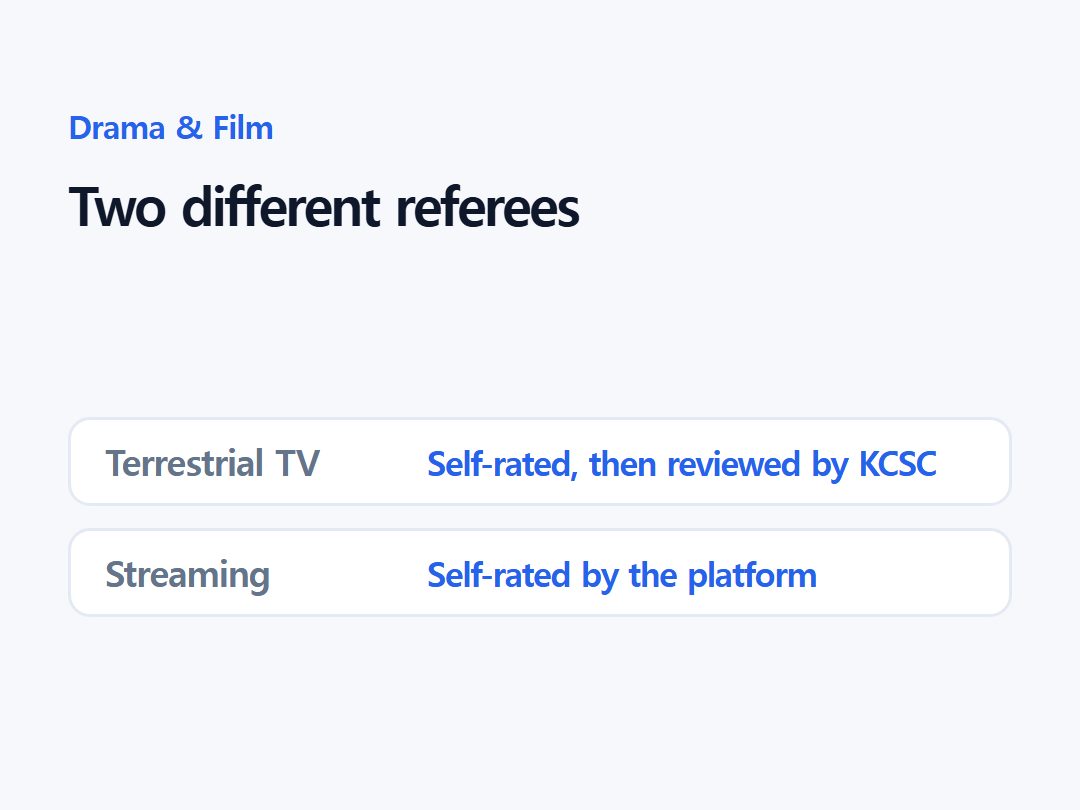
Terrestrial TV runs on the Broadcasting Act (방송법). Broadcasters assign their own age rating first, but the Korea Communications Standards Commission (KCSC) — the state broadcast regulator — reviews programs after they air and can sanction a network for going too far.
Streaming video falls under a different law, the Promotion of Motion Pictures and Video Products Act (영비법), which historically treated a Netflix series the way it treated a DVD. Violence, sex, and language in streaming titles are graded by the Korea Media Rating Board (KMRB, 영상물등급위원회) — a body with no connection to the KCSC.
Terrestrial ratings run on a four-tier scale: 7, 12, 15, and 19. A 12+ program may include "frightening elements, moderate violence, and mild blood." Only a 19+ program may show graphic violence and disturbing content — and even then, within limits the KCSC sets in advance, not after a global audience has already streamed it.
Why "self-rating" changed everything in 2023
Until 2023, every new streaming title still needed a pre-release rating from the KMRB, and that review could take up to two weeks — a delay that clashed with platforms wanting to launch a show worldwide on a single day.
As platforms expanded their original slates, the number of Korean video titles needing a rating jumped from roughly 4,300 in 2015 to more than 16,000 in 2021. The backlog became a genuine bottleneck for day-and-date global releases.
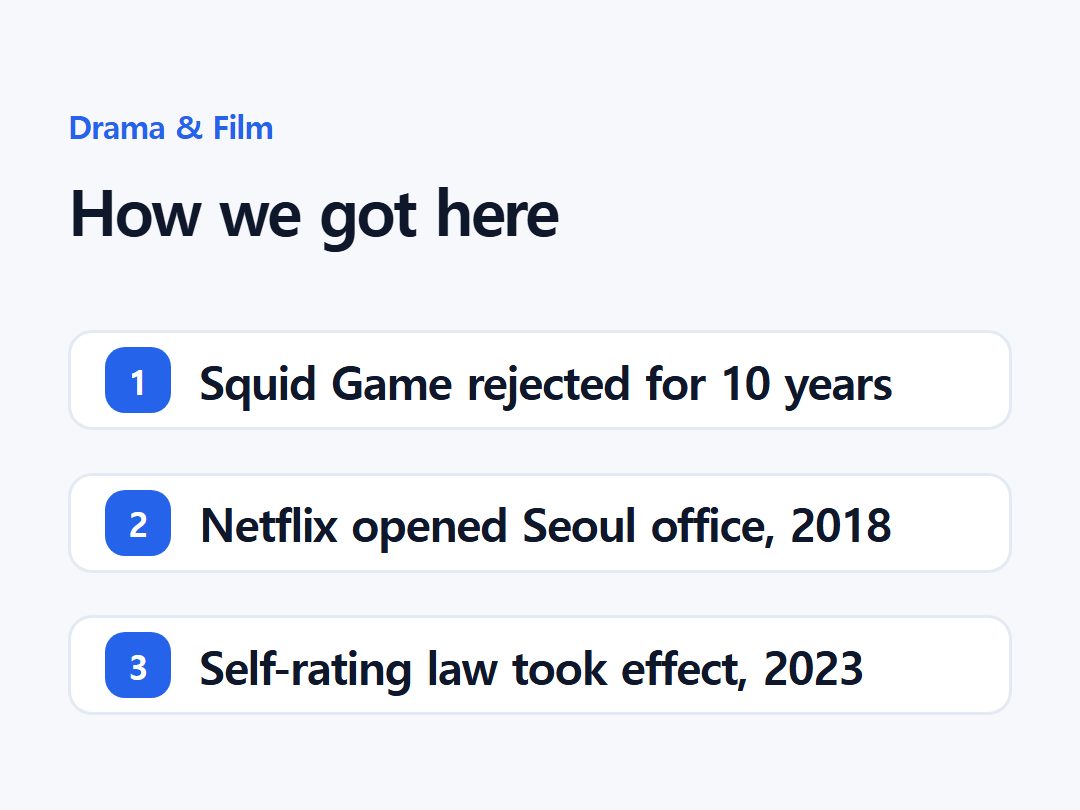
The video ratings law was amended on September 27, 2022, with implementing rules finalized on March 28, 2023. That let the Ministry of Culture, Sports and Tourism designate "self-rating classification operators."
The KMRB named its first seven platforms, Netflix among them, on May 31, 2023. From that date, designated platforms could grade their own shows without waiting for outside sign-off, for every tier except the highest, theatrical-only "restricted" rating.
The rule that never reaches streaming at all
The deeper gap has nothing to do with speed. The specific restrictions on how graphically a network may show violence, self-harm, or explicit language live inside the Broadcasting Act, which covers only licensed broadcasters.
Streaming platforms operate under the Telecommunications Business Act for their service and the video ratings law for content classification. Neither law incorporates the KCSC's broadcast-content standards.
A viewer can file a complaint with the KCSC about a terrestrial drama's violence. The identical complaint about a Netflix drama has no legal basis for KCSC review, because Netflix was never a broadcaster under Korean law.
One-third of Netflix Korea's catalog is age-restricted
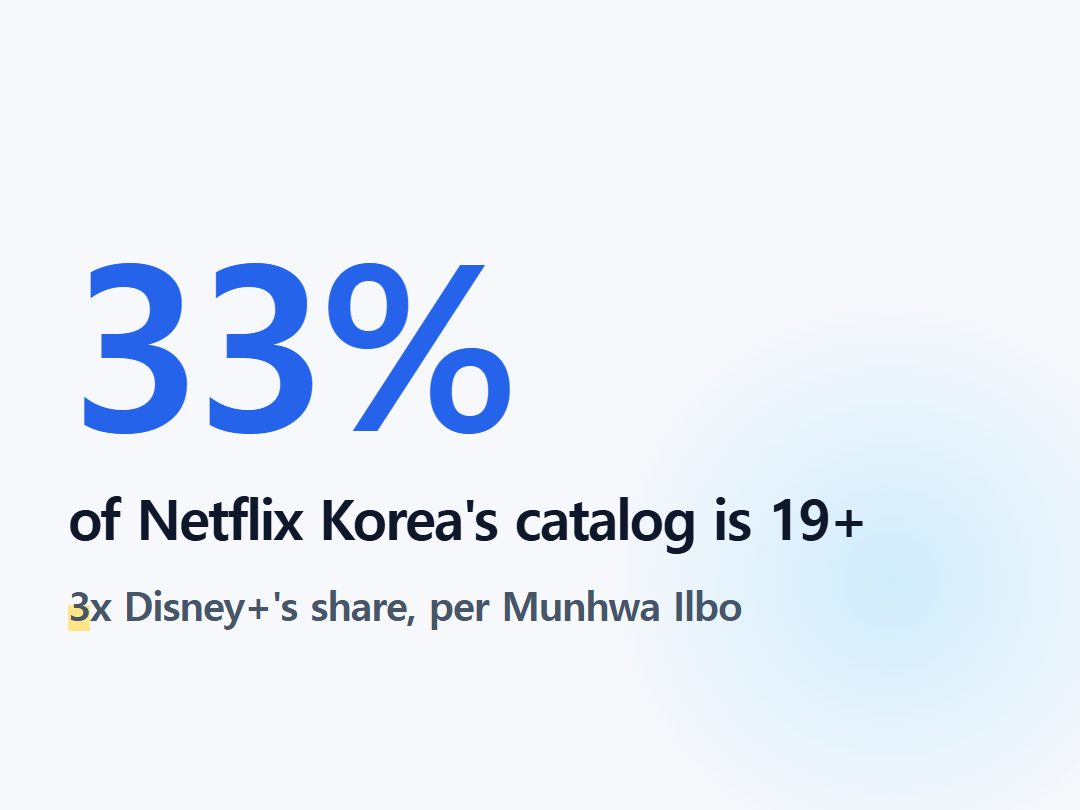
A 2022 Munhwa Ilbo analysis of KMRB rating data found that 33% of Netflix Korea's 544 titles carried the 19+ restricted rating — roughly three times Disney+'s 9% and Tving's 12% across comparable catalogs. Add the 15+ tier, and 70% of Netflix's Korean library was rated for teenagers or older.
Several of the platform's biggest global hits sit inside that 19+ bracket:
- All of Us Are Dead
- Kingdom
- Sweet Home
- Hellbound
Two other originals extend the pattern. D.P. (2021) depicts violent hazing inside the Korean military, a subject terrestrial dramas have historically softened or avoided. My Name (2021) follows an undercover police officer through gang killings staged with a level of explicit gore a network crime drama would not carry.
What the ratings board actually wrote about Hellbound
The KMRB gave Hellbound its 19+ rating on November 7, 2021, and its published rationale was specific rather than vague. The board wrote that "physical violence and killing depicted specifically and continuously," combined with audiovisual fear that was "stimulating and directly depicted," made the series unsuitable for minors.
That level of sustained, graphic violence is exactly what the KMRB's own classification standard flags for a 12+ drama, even when only implied. A terrestrial drama attempting the same content would be stopped by its own network's pre-broadcast review long before air.
A script Korean broadcasters rejected for a decade
Squid Game creator Hwang Dong-hyuk wrote the story in 2009 and could not get it made for ten years. Producers rejected it on similar grounds each time:
- "too grotesque" for Korean television
- "too unrealistic" for a mainstream audience
- "too Korean" to travel internationally
Hwang later said the project could only be made once Netflix backed it, because broadcast-adjacent investors would have been "so worried" about the violence. Netflix opened a Seoul office in 2018 and committed to Korean-language originals; its first, Kingdom, arrived in 2019 as a zombie period drama carrying gore that a historical sageuk on KBS would not.
Same platform, two rating symbols
The two-track system is visible on Netflix's own interface. Extraordinary Attorney Woo aired on cable network ENA before it streamed, so Netflix displays its original broadcast age rating. Squid Game never aired on a licensed channel, so it carries a KMRB streaming rating instead — a different symbol, assigned under a different law, on the same platform.
What terrestrial dramas still cannot do
None of this changed broadcast television. KBS, MBC, and SBS still operate under the Broadcasting Act's post-review system, and the KCSC can still act against a network drama for explicit violence in a way it structurally cannot against a streaming title.
Culture critic Jeong Deok-hyun described the resulting split bluntly in 2022: Netflix, as an adult-focused subscription platform, is "comparatively free with the level of expressions" compared to a family-oriented service like Disney+ — and, by extension, compared to a terrestrial network answering to a general audience.
Korea isn't the only regulator chasing this gap
Netflix already adjusts how a title is rated market by market, using an internal system that weighs violence, language, and sexual content differently depending on the country it streams in. South Korea's two-law split is a local, unusually explicit version of a wider problem.
In the UK, media regulator Ofcom has pushed to apply the same Broadcasting Code content standards that already bind the BBC and ITV to Netflix and Disney+. The pressure in both countries points the same direction: streaming grew up outside broadcast law, and regulators are still working out how, or whether, to pull it back in.
What is still unresolved
Self-rating comes with a check, on paper. The KMRB can review a platform's self-assigned rating after release and reclassify it if the board judges a show should have carried a stricter tier. In practice, that review is reactive, not preventive — a title's most violent scenes reach viewers before any correction happens.
A 2022 KMRB survey found 64.8% of respondents worried about unregulated streaming content's effect on teenagers, a concern that predates and outlasts the 2023 reform. The board's authority over streaming also stops at content classification; it has no equivalent to the KCSC's power to sanction a broadcaster's programming choices.
That leaves a structural asymmetry international viewers rarely see explained: two Korean regulators, two separate laws, and one medium — streaming — built from the start to answer to the more permissive one.
Two laws, one industry
| Terrestrial TV (KBS/MBC/SBS) | Streaming (Netflix, etc.) | |
|---|---|---|
| Governing law | Broadcasting Act (방송법) | Promotion of Motion Pictures and Video Products Act (영비법) |
| Regulator | Korea Communications Standards Commission (KCSC) | Korea Media Rating Board (KMRB) |
| Review timing | Post-broadcast review; can sanction the network | Self-rating since 2023; KMRB review only after release |
| Rating tiers | 7, 12, 15, 19 | Same tiers, minus the theatrical-only 'restricted' rating |
Frequently asked
Why is Squid Game so much more violent than Korean TV dramas?
Squid Game streams under the video ratings law, not the Broadcasting Act, so the KCSC has no authority over it — creator Hwang Dong-hyuk said broadcast-adjacent investors rejected the script for a decade over its violence.
Does Netflix Korea rate its own shows now?
Yes — since May 31, 2023, the KMRB has let designated platforms including Netflix self-rate their content instead of waiting for outside pre-release review, for every tier except the theatrical-only 'restricted' rating.
What percentage of Netflix Korea's shows are rated 19+?
A 2022 Munhwa Ilbo analysis found 33% of Netflix Korea's 544 titles carried the 19+ restricted rating, roughly three times Disney+'s 9%.
Sources
Every factual claim above is traceable. We do not translate articles — we gather facts from multiple outlets and write them ourselves.
- [Feature] Local audiences conflicted over sensational Netflix Korean originals — The Korea Herald
- [팩트체크]톱10 절반이 청불… 넷플릭스, 18금 타고 날았다? — Munhwa Ilbo
- 공포 스릴러 넷플릭스 드라마 '지옥', 청소년관람불가 등급 확정 — Insight
- OTT 자체등급분류제도 시행으로 인한 전망과 시사점 — Shin & Kim
- OTT에 맡긴 등급분류, '청불' 기준 관건 — PD저널
- Rejected for 10 Years: How 'Squid Game' Creator Turned a Decade of Failure Into Global Success — Yahoo Entertainment