South Korea runs one of the stricter television censorship regimes in East Asia. Every drama on a licensed channel is reviewed for an age rating before it airs, that rating decides what time slot the show can occupy, and broadcasters get formally sanctioned when they go too far.
The short version
- Streaming shows like Squid Game were never reviewed by Korea's broadcast regulator.
- Broadcast TV pushes adult-rated content to a narrow window after 10 p.m.
- Since 2023, streaming platforms rate their own shows with almost no ceiling.
Yet some of the most violent television on the planet right now is Korean: Squid Game, Sweet Home, The Glory. The contradiction dissolves once you separate two systems that international viewers usually treat as one — broadcast television and streaming.
Terrestrial TV still answers to a regulator that watches before air
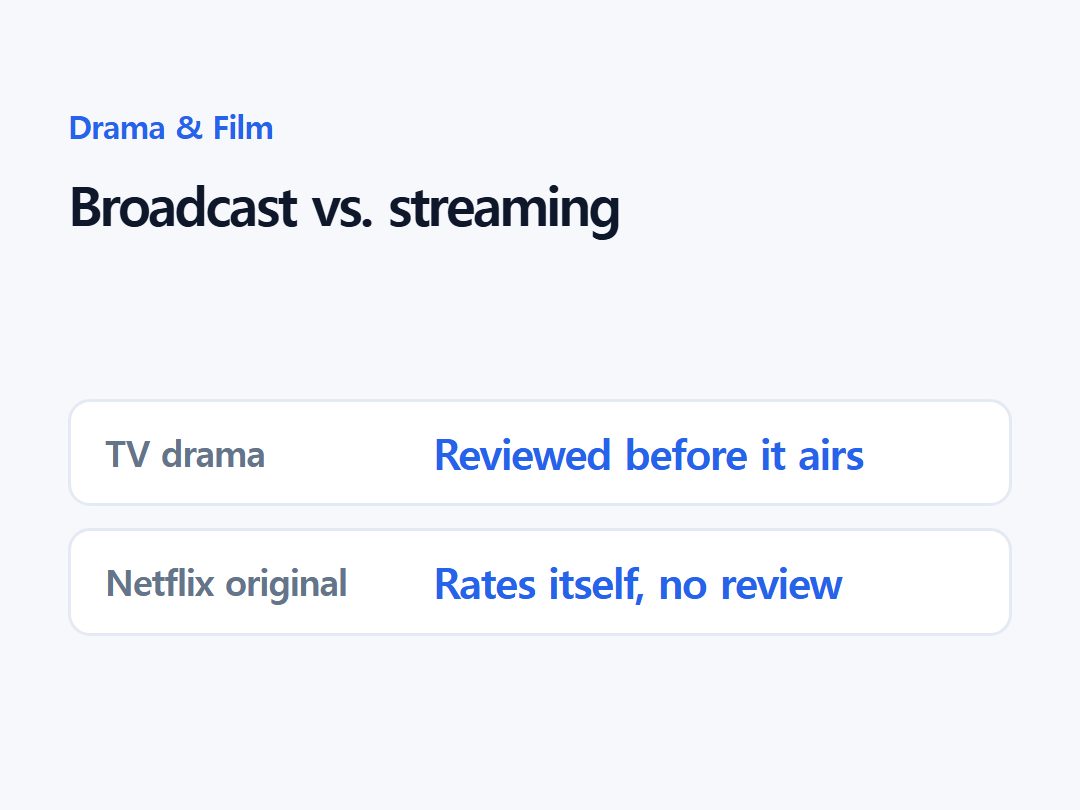
Every drama on KBS, MBC, SBS, or a cable channel goes through prior review by South Korea's broadcast standards agency — known until October 2025 as the Korea Communications Standards Commission (KCSC), now renamed the Broadcasting Media Communications Standards Commission.
The agency assigns an age rating based on theme, violence, language, and sexual content. If a show exceeds what its rating allows once it airs, the agency can issue an on-air correction, a formal warning, or a fine — penalties serious enough that they count against a broadcaster's official evaluation score.
This applies to cable drama channels too, not only KBS, MBC, and SBS. Since 2009, cable operators have faced tighter scrutiny of what they air.
That is one reason a movie already rated 19-and-up for theaters can still show up mosaic-blurred when it later runs on a cable channel. The film rating and the broadcast rating are decided by two different bodies with different tolerances.
What the five ratings actually allow on screen
Broadcast content is sorted into five tiers, each defined by how much violence, blood, and sexual content it can show:
- All ages — mild language only, no vulgarity, violence kept deliberately tame.
- 7 and up — slightly stronger violence and language, occasional romance.
- 12 and up — moderate, clearly fictionalized violence, mild blood, some sexual content.
- 15 and up — strong violence and visible gore; the tier most primetime dramas carry.
- 19 and up — graphic violence and disturbing content, but still bound by the broadcast-hour rule below.
A 15-rated drama is where most of what international viewers know as a “typical” K-drama sits — romance, workplace conflict, the occasional fight scene shot to avoid lingering on blood.
Adult-rated shows can't air until after 10 p.m.
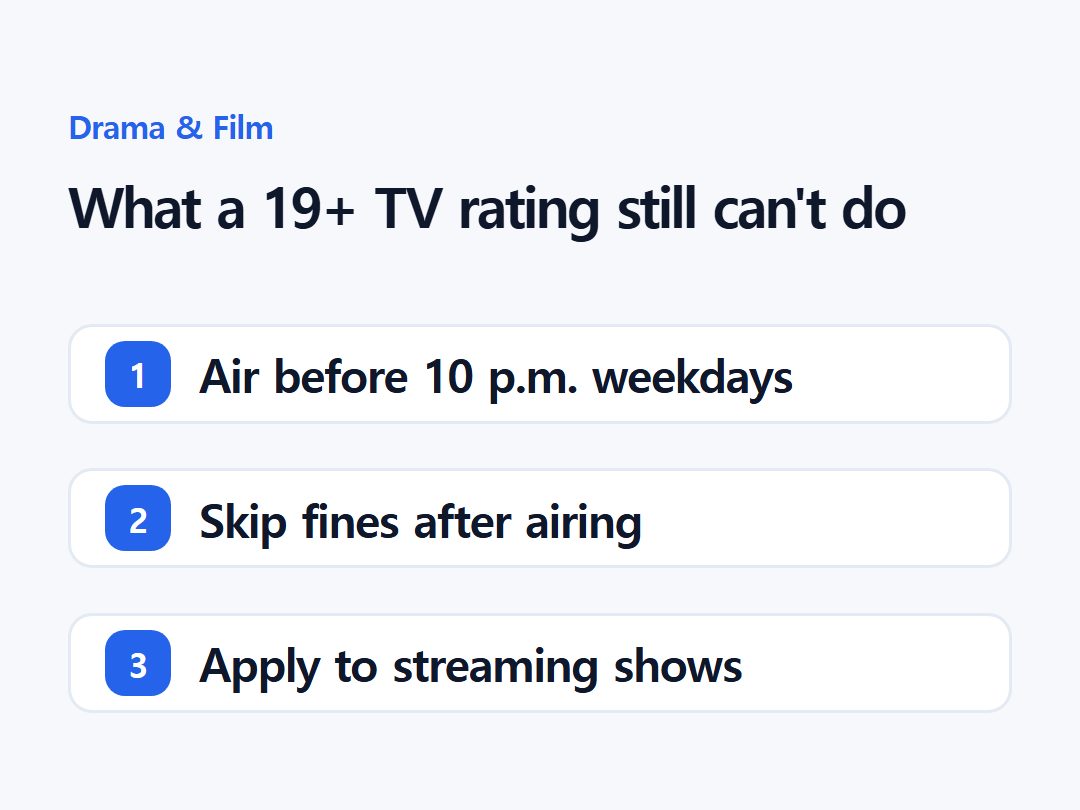
Even a 19-rated program cannot run whenever a broadcaster likes. Regulation bars adult-rated content from airing between 7 and 9 a.m. and again from 1 p.m. to 10 p.m. on weekdays — the hours regulators define as when children are most likely watching.
That pushes the most graphic terrestrial content into a narrow late-night window, after 10 p.m. On weekends and holidays, the protected window runs even longer, from 7 a.m. to 10 p.m.
Adult channels feel this rule even more directly. Because every program on a dedicated adult channel already carries the 19-and-up rating, the entire channel effectively has to go dark, or switch to non-rated content, from around 6 p.m. until 10 p.m. — regardless of what the network would rather be showing during peak viewing hours.
The dramas the world calls violent were never submitted for this review
None of the rules above apply to Squid Game, Sweet Home, Kingdom, or The Glory. All four are streaming originals, and a streaming platform is not a “broadcaster” under Korean law — so the regulator that governs KBS, MBC, and SBS never reviews them before release.
Journalist Regina Kim, who covers Korean entertainment, has noted that broadcast dramas still avoid graphic violence and nudity because of Broadcasting Act rules the regulator enforces, while streaming giants like Netflix and Disney+ aren't bound by any of those rules in what a Korean series can show.
That gap is why the genres now driving Korea's global reputation for violence — zombie survival, revenge thrillers, dystopian horror — are almost entirely a streaming-era phenomenon. Kingdom, Netflix's first Korean original, opened with a premise built around a zombie plague that terrestrial censors would likely have forced to be softened.
The same split explains why a series like The Glory, which depicts school violence in unflinching detail, could exist at all. Its writer has said the bullying scenes drew on real incidents reported in Korean media.
That is the kind of sustained, graphic content a terrestrial network would have had to break into short, softened segments across a nightly broadcast slot rather than release as a binge-ready season.
Streaming platforms rate their own shows, with almost no ceiling
Streaming is not unregulated — it just answers to a different law and a different agency. Since April 2023, an amended Act on the Promotion of Motion Pictures and Video Products lets registered online platforms assign their own content ratings and report them afterward to the Korea Media Rating Board, instead of seeking approval first.
The change followed years of backlog at the ratings board. Annual video-rating applications roughly doubled between 2017 and 2021 as OTT catalogs grew, and processing times stretched out enough that some titles were still waiting for a rating days before their scheduled release.
By the end of May 2023, the board had approved seven platforms, including major international services, to self-classify their own catalogs.
The only tier a platform cannot self-assign is “limited screening,” reserved for content the board would otherwise ban outright. Everything below that — including the adults-only rating Netflix gave Squid Game — is the platform's own call, made with no pre-release review and no broadcast-hour restriction.
| Terrestrial & cable TV | Streaming platforms |
|---|---|
| Reviewed and rated before broadcast | Rated by the platform itself |
| 19+ content barred from daytime hours | No broadcast-hour restriction |
| Regulator can fine or sanction after airing | Regulator can only override a rating it judges too lenient |
From martial-law censors to a five-tier ratings board
Korea's instinct to police broadcast content predates democracy. Under martial law in 1972, the Park Chung-hee government required stations to submit programming for review both before and after airing, and censorship tightened further through the 1980s under Chun Doo-hwan.
Direct state control eased only after the 1987 democratic transition and a new 1990 Broadcasting Act that restructured how stations were licensed. Korea did not adopt an age-rating model until 2000, starting with four tiers.
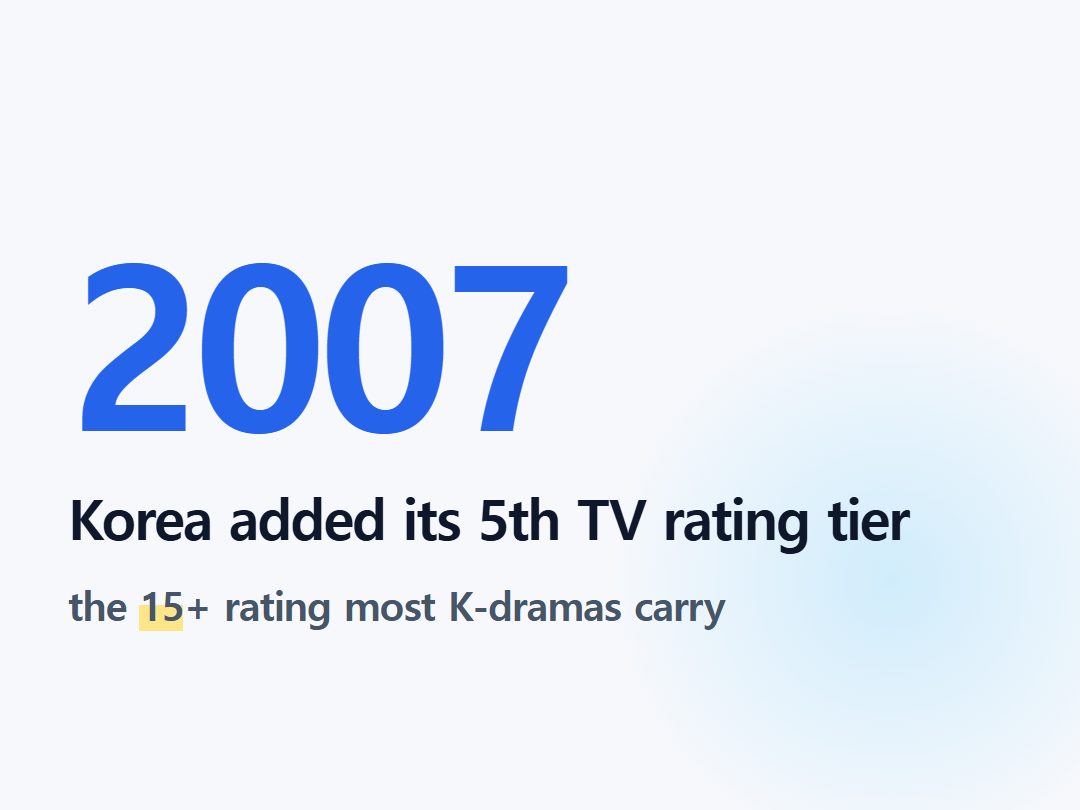
The current five-tier system, including the 15-and-up category, arrived in 2007. The regulator itself was created in 2008, merging older ethics and standards bodies into one commission.
Regulators still fine terrestrial channels for pushing violence too far
The line terrestrial dramas cannot cross keeps moving, and broadcasters keep testing it. In the first half of 2019, SBS drew seven formal legal sanctions — more than any other network — largely for drama scenes regulators judged too violent or sexual for their assigned rating.
At the time, one commissioner publicly argued that terrestrial dramas had grown more graphic than dramas airing on cable, even though terrestrial channels hold a public broadcasting license and are supposed to hold themselves to a higher standard.
Separately, a long-running daily drama received a formal warning after regulators found it repeatedly aired sensational content during hours meant to protect younger viewers, despite earlier sanctions for the same pattern.
Cases like these are why terrestrial dramas, even at their most intense, still look restrained next to a streaming original.
The censor got a new name in 2025, not new powers
In October 2025, the KCSC was formally dissolved and replaced by the Broadcasting Media Communications Standards Commission, part of a wider restructuring of Korea's media regulators under the Lee Jae-myung government. Its review criteria and its job did not change — only its name and, on paper, its institutional standing, since its chair is now subject to a legislative confirmation hearing.
What remains unresolved is whether Korea's two-track system — tight prior review for broadcast, after-the-fact self-rating for streaming — holds as viewing keeps shifting toward platforms. The gap between what a Korean drama can show on KBS and what it can show on Netflix is not a loophole regulators are rushing to close. So far, it is simply how the law is written.
Korea's five broadcast ratings, from mildest to most graphic
| Rating | What it allows |
|---|---|
| All ages | Mild language only, no vulgarity, violence kept deliberately tame |
| 7 and up | Slightly stronger violence and language, occasional romance |
| 12 and up | Moderate, clearly fictionalized violence, mild blood, some sexual content |
| 15 and up | Strong violence and visible gore; most primetime dramas' tier |
| 19 and up | Graphic violence and disturbing content, still bound by broadcast-hour rule |
Frequently asked
Why isn't Squid Game censored like other Korean dramas?
Squid Game is a Netflix original, and a streaming platform isn't a "broadcaster" under Korean law, so the regulator that reviews KBS, MBC, and SBS never reviews it before release.
What does a 19+ rating mean for Korean TV shows?
It allows graphic violence and disturbing content, but the show still can't air between 7-9 a.m. or 1 p.m.-10 p.m. on weekdays, pushing it into a late-night slot.
Can Netflix shows in Korea have any rating restrictions at all?
Yes — approved platforms can self-assign any rating except 'limited screening,' which is reserved for content Korea's ratings board would otherwise ban outright.
Sources
Every factual claim above is traceable. We do not translate articles — we gather facts from multiple outlets and write them ourselves.
- Korean Drama Fans Say Streaming Has Changed The Shows — HuffPost
- Govt. pushes for self-rating system for online streaming releases — The Korea Herald
- Korea Communications Standards Commission — Wikipedia
- Korea Media Rating Board — Wikipedia
- 지상파는 선정·폭력적 드라마, 종편은 '객관성 위반' 제재 많아 — PD Journal
- 청소년관람불가등급 '오징어 게임' 청불이어야 하나요? — Kookje Shinmun
- '방통위 폐지법' 통과‥"필리버스터 중단하자" — MBC News