
A Korean drama that once needed sixteen hour-long episodes to tell its story now often does the job in eight or ten. Netflix's The Trauma Code and JTBC's Beyond the Bar both wrapped in 2025 at roughly half the length that would have been standard a decade ago — and they were not exceptions. They were the new default.
The short version
- Korean dramas now run 8 to 12 episodes instead of sixteen.
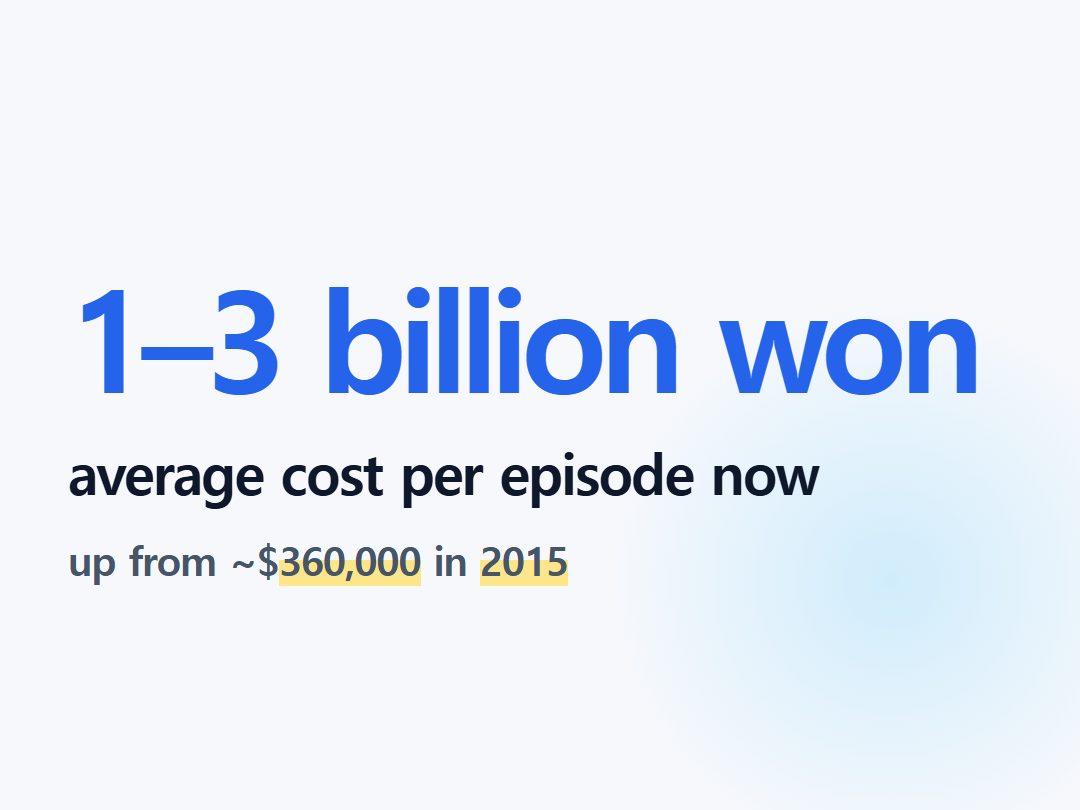
- Per-episode costs jumped from $360,000 in 2015 to 3 billion won today.
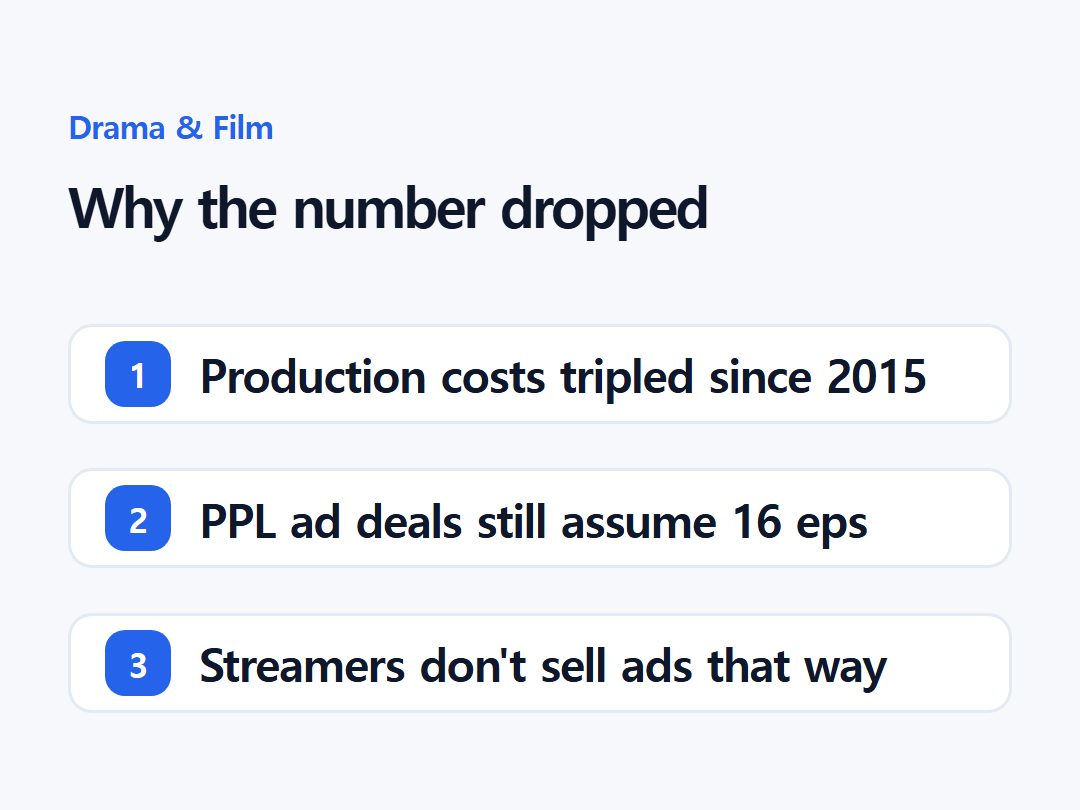
- Broadcast PPL deals assume 16 episodes, straining shorter runs.
This is not a creative fashion. It traces back to what a single episode now costs to make, who is paying for it, and a decades-old advertising rule that assumed sixteen episodes would always exist.
A drama that used to run sixteen hours now often runs eight
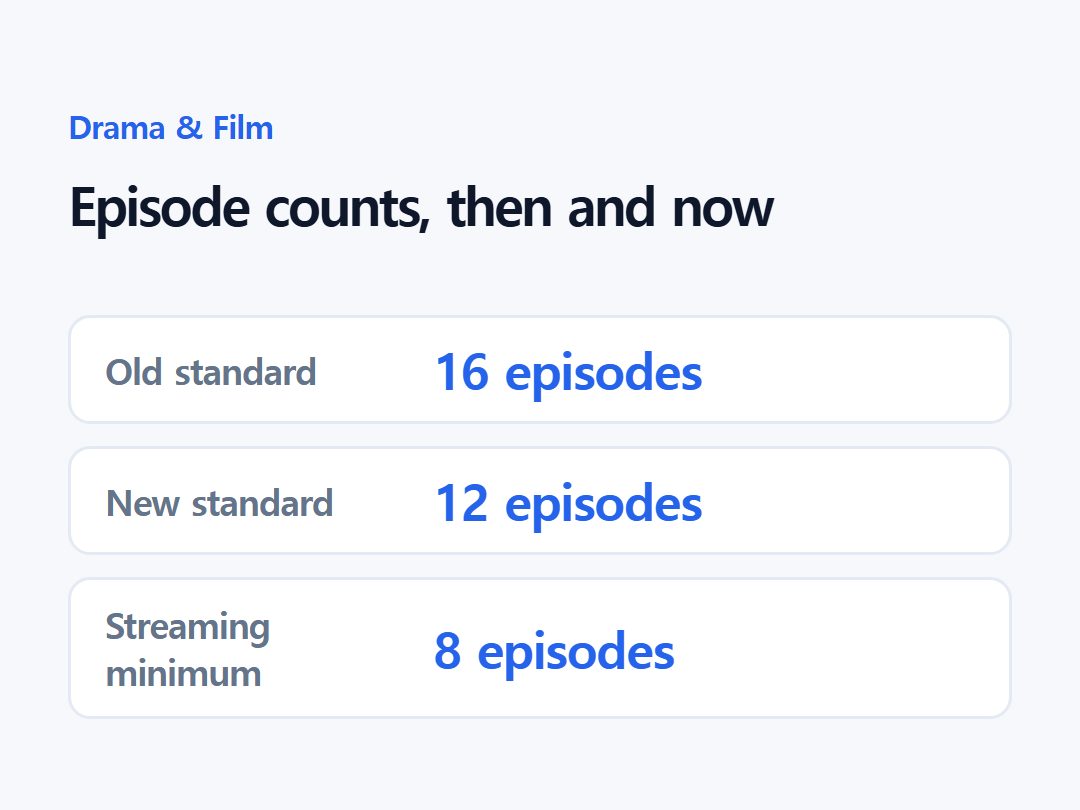
Until a few years ago, the question was never whether a Korean series would run sixteen episodes — it was assumed. That assumption is gone. Recent releases show how far the number has fallen:
- The Trauma Code (Netflix) — planned as 10 episodes, cut to 8
- Weak Hero Class 2 — 8 episodes
- Good Girl Boo Semi — 10 episodes
- Motel California, Love Scout, Unmasked (Disney+) — 12 episodes each
- Beyond the Bar (JTBC) — 12 episodes
Even MBC, a broadcaster with no streaming-era excuse to experiment, finished its drama Wonderful World at 14 episodes rather than 16. Twelve episodes has effectively become the new industry floor, with eight to ten common for streaming originals.
Where the number sixteen actually came from
The 16-episode miniseries — a Korean broadcast term for a limited-run drama, as opposed to the 100-plus-episode daily or weekend dramas that also air on Korean TV — is a product of the late 1980s. MBC created the format for its Monday-Tuesday and Wednesday-Thursday primetime slots, and KBS followed in 1988.
Episode counts had already been falling for decades before this recent shift: dramas that once ran 24 or 20 episodes gradually settled at 16, which held as the industry norm for roughly thirty years. Sixteen was never an artistic ideal. It was a scheduling convenience that outlived its original purpose once streaming removed the schedule.
The production budget that used to stretch across sixteen episodes
In 2015, the year before Netflix entered Korea, a single episode cost around $360,000 to produce on average. By 2020, average per-episode costs had risen to roughly 500 million won. Today, a typical episode runs about 1 billion won, and the most ambitious productions exceed 3 billion won per episode.
| Period | Average cost per episode |
|---|---|
| 2015 (pre-Netflix Korea) | ~$360,000 |
| 2020 | ~500 million won |
| 2025–2026 | 1–3 billion won |
Some individual productions illustrate the scale. Squid Game's second and third seasons together cost roughly 100 billion won; Gyeongseong Creature's two seasons cost about 70 billion won; When Life Gives You Tangerines cost around 60 billion won.
Fewer episodes, at this cost level, is simply the difference between a project getting greenlit or not.
Cast fees have climbed just as fast as production budgets. Supporting actors working outside Netflix projects now reportedly command 300 to 400 million won per episode, on top of whatever the lead cast is paid — a cost that scales directly with how many episodes get made.
Netflix's spending built the ceiling — and then lowered it
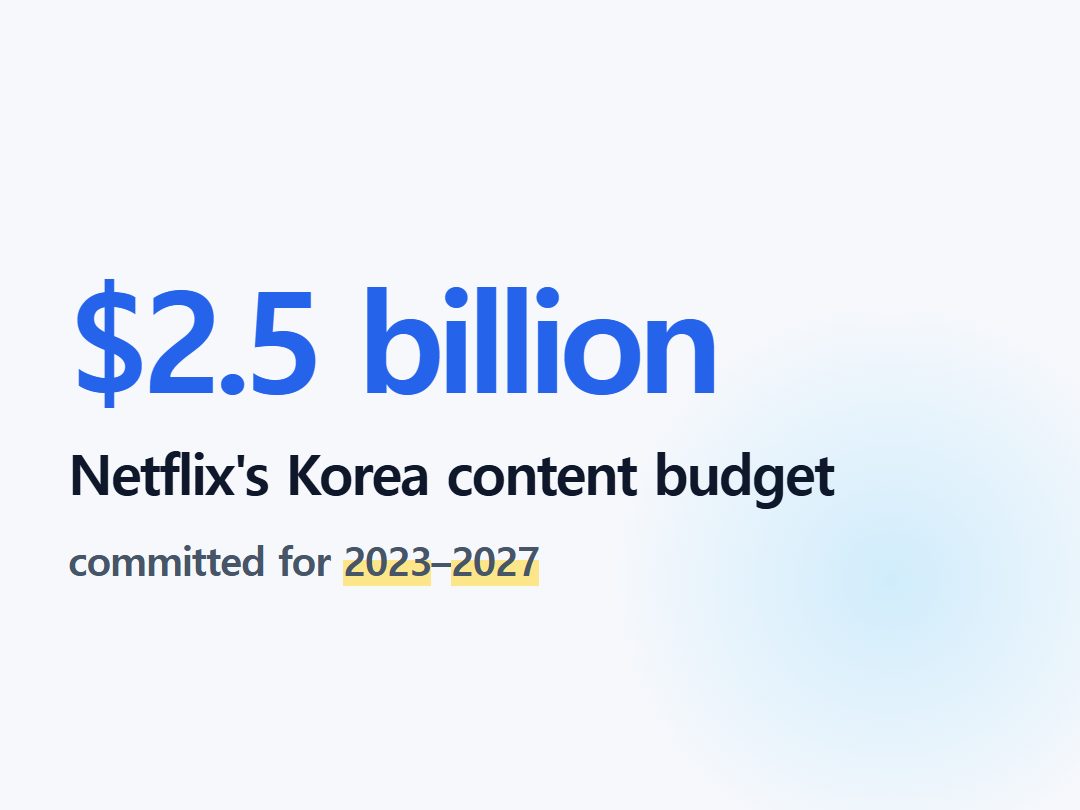
Netflix committed $2.5 billion (about 3.49 trillion won) to Korean content for 2023 through 2027, a scale no domestic broadcaster can match. That investment pushed per-episode budgets into the billions in the first place, as competing productions bid up star salaries and production values to Netflix-comparable levels.
Kingdom (2019) and then Squid Game (2021) had already proved a Korean series could become a genuine global hit, which only accelerated the spending race.
The number of dramas entering production has fallen as a result: from 141 in 2022 to about 123 in 2023 and roughly 100 in 2024. Netflix itself pulled back on Korean spending after a weaker 2024, redirecting some of its budget toward lower-cost markets such as Japan. Shorter, tighter series are one of the few ways left to keep a project's total cost manageable without simply making fewer of them.
An advertising contract most viewers never see
Korean broadcast dramas are not just funded by licensing fees — they carry PPL, or product placement, and those contracts are historically priced around a 16-episode run. Advertisers pay for a set number of product appearances calculated against that baseline.
When a drama shrinks to 12 or 10 episodes, the same number of product placements has to be compressed into fewer hours of screen time, which is awkward for both the brand and the story. Streaming originals mostly sidestep this problem, since platforms like Netflix don't sell PPL the way broadcast networks do — one more reason streaming dramas have led the shift toward shorter runs.
Shorter seasons cost broadcasters more, not less
It would seem logical that a shorter drama costs a network less overall. In practice, broadcasters still have to fill the same number of programming hours across a year, which means more separate dramas need to be commissioned to cover the same airtime that one 16-episode series used to fill.
Pop culture critic Ha Jae-geun has described the shrinking episode count as one symptom of a broader upheaval, as streaming and broadcast television compete for the same audience and the industry tests multiple formats rather than settling on one.
That instability is also why hit franchises such as Squid Game and Sweet Home have moved toward multi-season structures instead of single long runs.
Viewers are split between relief and disappointment
Reaction to the shorter format is genuinely divided. Some viewers welcome tighter pacing, arguing that long-running dramas used to pad their middle episodes with filler scenes that slowed the story down.
Others feel shortchanged. When Beyond the Bar ended its 12-episode run in September 2025, fans criticized the finale for leaving plotlines unresolved, with some directly asking why the show couldn't have had a full 16-episode run with a happier ending instead.
Networks have started compensating with extended cuts and previously unaired scenes released after a series finishes airing, though this remains an informal fix rather than a return to longer seasons.
Do hit dramas ever get their episodes back?
Not usually. Even a breakout success doesn't reset a show's episode count once it has aired, since the budget and shooting schedule were locked in before production began. The workaround has been supplementary content: extended versions, bonus scenes, or a confirmed second season rather than additional episodes bolted onto the first.
That pattern suggests the industry sees shorter seasons as permanent rather than a temporary cost-cutting measure to be reversed once conditions improve.
What the industry still hasn't decided
Nobody in the industry claims 12 episodes is the final number. Some producers argue that season-based storytelling, borrowed directly from Western streaming, will eventually replace the miniseries model entirely, with hit stories continuing across multiple shorter seasons rather than one long one.
Whether Korean broadcasters can survive commissioning more, shorter dramas to fill the same airtime is also unresolved, as is whether PPL contracts will ever be restructured around the new, smaller episode counts instead of the old 16-episode baseline. For now, the industry is adjusting the length of the story before it has agreed on why.
Recent Korean drama episode counts
| Drama | Episodes |
|---|---|
| The Trauma Code (Netflix) | 8 (planned as 10, cut to 8) |
| Weak Hero Class 2 | 8 |
| Good Girl Boo Semi | 10 |
| Motel California, Love Scout, Unmasked (Disney+) | 12 each |
| Beyond the Bar (JTBC) | 12 |
| Wonderful World (MBC) | 14 |
Frequently asked
Why are Korean dramas getting shorter?
Rising production costs, Netflix's spending race, and the end of a broadcast scheduling convenience have made 8-to-12-episode runs the new default instead of the old 16-episode format.
Why were Korean dramas always 16 episodes?
MBC created the 16-episode miniseries format in the late 1980s for its primetime slots, and it held as the industry norm for roughly thirty years.
Do hit Korean dramas ever get more episodes added?
Not usually — a show's episode count is locked in before production, so successes get extended cuts, bonus scenes, or a second season instead of extra episodes.
Sources
Every factual claim above is traceable. We do not translate articles — we gather facts from multiple outlets and write them ourselves.
- K-dramas shift to shorter seasons as 16-episode format fades — The Korea Times
- Why K-Dramas Are Releasing Fewer Episodes Than Before — Korea.net
- For K-dramas, Netflix is a rose with a thorn delivering massive audiences, rising production costs — Korea JoongAng Daily
- Netflix Cuts Korean Drama Budgets and Actor Salaries After 2024 Flop, Shifts Focus to Cheaper Markets — CTOL Digital Solutions
- 16부작→12부작→10부작…더 짧아지는 '미니시리즈', 중요한 것은 바로 [MD포커스] — MyDaily
- "Why not give 16 eps with happy endings": 12 episode trend in Kdrama sparks disappointment amidst Beyond the Bar success — Sportskeeda
- Shorter K-Dramas? Disney+ Explains Why Its Shows Are Less Than 16 Episodes — Cosmopolitan Philippines