On the August 12, 2026 episode of KBS2's long-running parenting show The Return of Superman, actor Shim Hyung-tak explained, on camera, why his toddler son Haru cannot leave the house without a hairpin: even after repeated haircuts, the boy's hair is thick enough that it falls into his eyes without one.
The same episode followed the pair on a trip to Seongsu-dong, a fashion-forward Seoul neighborhood, where a crowd gathered around Haru mid-errand as people recognized an 18-month-old on sight, the way they might a celebrity.
Later, Haru worked his way through a bowl of pyongyang naengmyeon (cold buckwheat noodles), impressing the show's cast by serving himself a refill after watching his father do it once. None of this is dramatic by television standards.
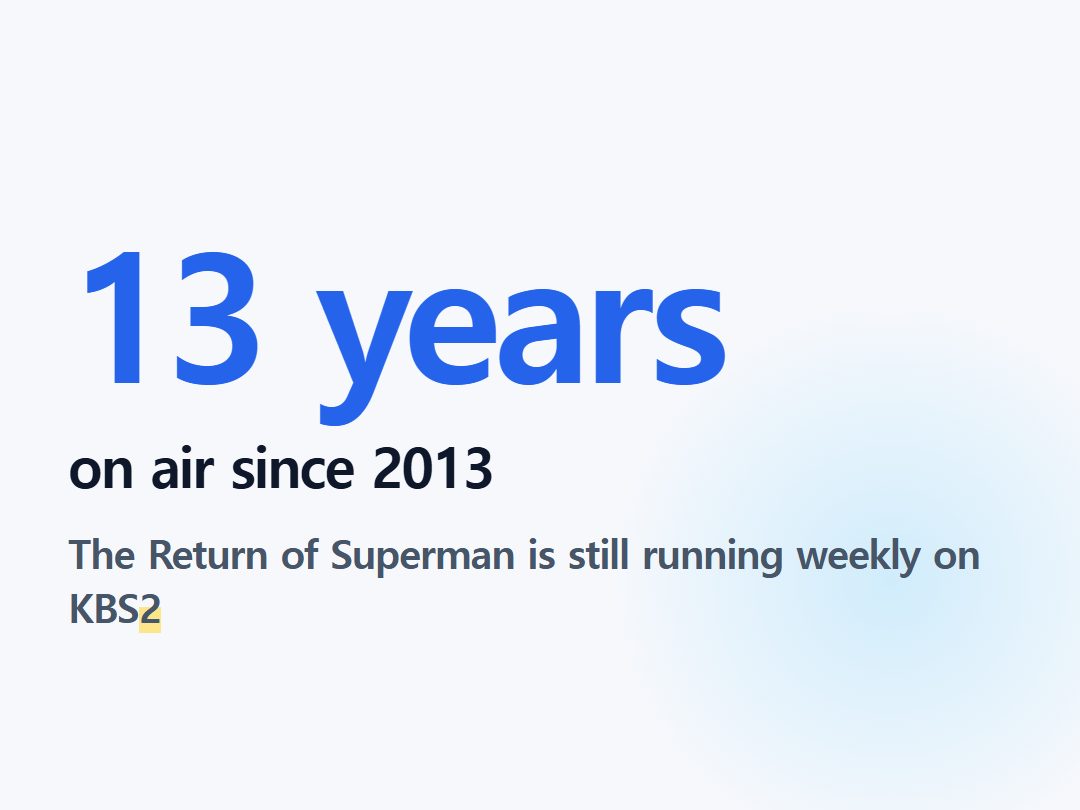
That is, in part, the point: The Return of Superman has spent close to 13 years turning ordinary days with celebrity dads and their children into some of Korean television's most consistently watched programming, and Haru is its newest breakout.
The short version
- A toddler's hairpin went viral because he draws idol-level crowds in Korea.
- The Return of Superman has run this pattern for nearly 13 years across 600 episodes.
- Haru and dad Shim Hyung-tak won a Rookie Award after six months on air.
Why do toddlers on this show get idol-level fame?
English-language coverage of Korean variety television tends to circle the same handful of shows: Running Man, Single's Inferno, I Live Alone — formats built for viral clips and international streaming. The Return of Superman, despite being one of Korea's longest-running and most-awarded reality programs, rarely gets the same treatment, partly because its appeal doesn't compress into a single dramatic clip.
It's cumulative. Viewers who have followed the show for years are watching children they've seen since birth grow up in real time, a different kind of engagement than a survival competition or dating show generates.
That cumulative effect explains why a toddler's hairpin, or a first bowl of noodles, can genuinely be news in Korea. Local outlets covered Haru's Seongsu-dong outing, his hairpin habit, and his noodle-eating in separate stories inside a single week — not because any of it was surprising, but because a meaningful share of the audience wanted the update.
It also explains a phenomenon with no close Western equivalent: toddlers on the show routinely draw what Korean media call, quite literally, "idol-level" fandom.
An idol, in Korean pop culture, is a performer — almost always a singer — who trains for years inside an entertainment agency before debuting, then cultivates a devoted, highly visible fan base.
When outlets say a one-year-old is getting "idol-level" attention, they mean the same crowd behavior minus the training: strangers recognizing a child on the street, waiting to see them, reacting to their outfit.
Haru's red hat and oversized windbreaker made headlines the same week as his hairpin, covered with the same seriousness an idol's stylist choices usually get.
The Return of Superman didn't invent this pattern; it has just run it longer than any other show. Since its original 2013 cast, the program has repeatedly turned toddlers into recognizable public figures.
Choo Sarang, daughter of mixed martial artist Choo Sung-hoon, became one of Korea's most photographed children before she could speak fluent Korean. Ki Rohee, daughter of actor Ki Tae-young and former S.E.S. member Eugene, drew a similar following as an infant.
A baby named Kim Eun-woo became briefly famous simply for being named after K-pop idol Cha Eun-woo — and then met him, twice, on the show. None of these children asked for the exposure. All of them got it, because the format makes children, not their famous parents, the emotional center of every episode.
Shim Hyung-tak himself is also worth explaining to an international audience, because his fame doesn't map neatly onto a single category.
He's a working actor with two decades of credits — a 2012 KBS family drama that peaked at a 47.6 percent audience share, a lead role in the first entry of tvN's food drama franchise Let's Eat in 2013, a 2019 romantic comedy that won him an Excellence Award at the Korea Culture and Entertainment Awards — but for years he's been better known in Korea for something else: an open, self-deprecating obsession with the Japanese cartoon character Doraemon, thorough enough that fans nickname him "Shim-taku." He has said the character comforted him after being ostracized in school.
That fandom is also, by his own account, how he met his wife: Japanese national Saya Hirai, whom he met while filming in Japan in 2019 and married in 2023. Their son Haru, born January 15, 2025, joined him on The Return of Superman roughly six months later, and the ratings noticed.
The episode featuring Haru's television debut helped push the show's nationwide rating to 3.7 percent, and by December 2025 the father-son pair had won the Rookie Award in the reality category at the KBS Entertainment Awards, presented on stage by Yoo Jae-suk, with Haru just 11 months old at the time.

From a 2013 holiday special to an award-winning institution
The Return of Superman began as a three-episode Chuseok holiday special in September 2013 — Chuseok being Korea's autumn harvest holiday, roughly comparable to Thanksgiving, when broadcasters typically run special programming — with fathers Lee Hwi-jae, Choo Sung-hoon, and Jang Hyun-sung.
The premise was simple and has barely changed since: a celebrity father cares for his child alone for 48 hours while the mother leaves home to rest, and cameras follow what happens.
KBS made it a permanent Sunday-night program the following month, and it has aired continuously ever since, across more than 600 episodes and multiple full cast turnovers.
The show has picked up formal recognition beyond ratings. It won a Popularity Award for its child cast at the 2018 KBS Entertainment Awards and a Best Icon Award for its children the following year.
It has also received a presidential citation, awarded at a government event marking the country's Population Day, an acknowledgment of the show's association with family and childcare themes at a time when Korea's low birth rate is a recurring national concern.
In 2026, it was named the country's most influential "observational entertainment" program — the label Korean broadcasters use for unscripted shows built around watching real behavior rather than competition or games — at that year's Brand Customer Loyalty Awards.
Casts and hosts have rotated over the years — actress Choi Ji-woo and comedian Ahn Young-mi anchored the show's narration for a stretch beginning in mid-2024, with comedian Kim Jong-min taking over hosting duties in late 2025 — but the underlying format, and its ability to turn toddlers into minor celebrities, has stayed constant.
Shim Hyung-tak and Haru are simply the latest pairing to benefit from it, joining a cast lineup built around documenting a child's first everything: first haircut, first solid food, first time recognized by a stranger.

What's next for Haru and his father?
Haru's storyline is, by definition, ongoing: the show is filming him in real time, and recent episodes have tracked milestones as routine as his first haircut and as physical as horseback riding and swimming lessons, each treated by Korean entertainment outlets as its own small event.
Whether that level of coverage is sustainable, or whether Haru's popularity plateaus the way some past cast members' has, is a question the show has answered differently for different children over 13 years.
Some, like Choo Sarang, have stayed in the public eye well past their time on the program; others have faded from coverage once their families left the cast.
There's also a broader question hanging over Shim Hyung-tak's own career. He is set to return to scripted acting in a 2026 drama after a five-year gap, which means the show that made his son a household name is, for now, also the more visible part of his own public work.
How he balances the two — an actor rebuilding a résumé, and a father whose toddler draws bigger crowds than he does — is likely to be its own small story line for Korean entertainment media in the months ahead.

Toddlers who became public figures on The Return of Superman
| Child | Parent(s) | Claim to fame |
|---|---|---|
| Choo Sarang | Choo Sung-hoon (MMA fighter) | One of Korea's most photographed children before she could speak fluent Korean |
| Ki Rohee | Ki Tae-young (actor) and Eugene (former S.E.S. member) | Drew a similar idol-level following as an infant |
| Kim Eun-woo | Not specified in coverage | Became briefly famous for sharing a name with idol Cha Eun-woo, then met him twice on the show |
| Haru | Shim Hyung-tak (actor) and Saya Hirai | Won the Rookie Award in the reality category at 11 months old |
Frequently asked
Who is Haru from The Return of Superman?
Haru is the 18-month-old son of actor Shim Hyung-tak and his wife Saya Hirai, and he joined the KBS show about six months after his January 15, 2025 birth.
Why does Haru wear a hairpin?
Even after repeated haircuts, his hair is thick enough that it falls into his eyes without one, according to Shim Hyung-tak.
What is The Return of Superman?
It's a KBS2 reality show, running since a 2013 Chuseok special, that follows celebrity fathers caring for their children alone for 48 hours while the mother rests.
Sources
Every factual claim above is traceable. We do not translate articles — we gather facts from multiple outlets and write them ourselves.
- '슈돌' 심형탁 "아들 하루 머리핀 없으면 안 돼"…남다른 머리숱 — Daum (News1)
- '슈돌' 심형탁, 子 하루 아이돌급 인기에 깜짝…성수동 나들이 [RE:TV] — News1
- '심형탁子' 하루, 평양냉면 얼마나 맛있었으면…"그릇 들고 드링킹" ('슈돌') — Chosun Ilbo
- '심형탁 子' 하루, 평양냉면에 푹 빠졌다…"스스로 리필 처음 봐" — iMBC
- 심형탁 아들 하루, 성수동서 아이돌급 인기... "인파 꽉 찼더라" — Insight
- 대통령 표창까지 받았다…13년째 대국민 사랑→여전한 인기 자랑 중인 韓 예능 — TV Report
- Shim Hyung-tak's son Haru, at 16 months old, even mastered horseback riding — STARNEWS (English)
- Shim Hyung-tak's son Haru turns 18 months old? Even Kwak Beom was surprised by his underwater kicking skills — STARNEWS (English)
- 심형탁, 11개월 子 하루와 '신인상' 수상…"♥사야와 아들 덕분" [2025 KBS 연예대상] — MyDaily
- Shim Hyung-tak — Wikipedia