Korean streaming platforms and broadcasters have quietly changed how they decide what to make into a drama.
Instead of starting with an original script, a growing share of Korean television now starts with a webtoon — a free, vertical-scroll digital comic designed to be read by swiping down a phone screen rather than turning printed pages.
Through 2025 and 2026, that shift became visible in production credits themselves: Naver Webtoon's in-house studio, Studio N, is producing the Disney+ series Remarried Empress and the Tving series The Legendary Cook, while Netflix's medical drama The Trauma Code: Heroes on Call was developed from a Naver web novel.
Kakao Entertainment produced MBC's Crushology 101 directly from its own webtoon library and co-produced the Netflix series Rats.
The short version
- Naver and Kakao now produce webtoon adaptations in-house instead of licensing them out.
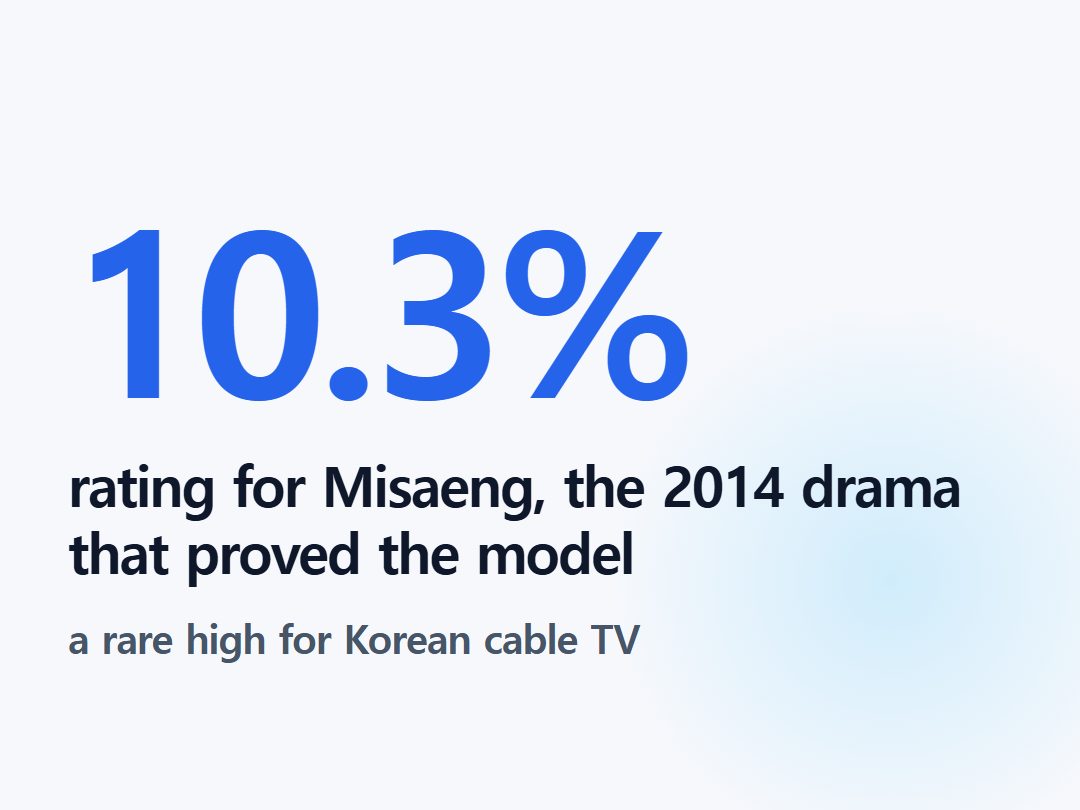
- Misaeng (2014) proved webtoons could become hit dramas, drawing a 10.3% rating.
- Hit dramas send readers back to the source webtoon, sometimes boosting views 100-fold.
Korean trade reporting from February 2026 describes this as more than a string of coincidences: platforms increasingly decline to license their strongest webtoon titles to outside production companies at all, choosing instead to develop, cast, and shoot in-house. The companies that own Korea's biggest comic libraries are becoming television and streaming studios in their own right.
Why do webtoons make such a safe bet?
For readers outside Korea, the easiest way to understand this shift is a term the Korean content industry has used since the 1990s: OSMU, or "one source, multi-use." The idea is to take a single story and extract value from it across as many formats as possible — comic, novel, drama, film, game — rather than treating each medium as a one-off product.
Webtoons turned out to be an unusually good starting point for OSMU, for reasons that are structural rather than accidental.
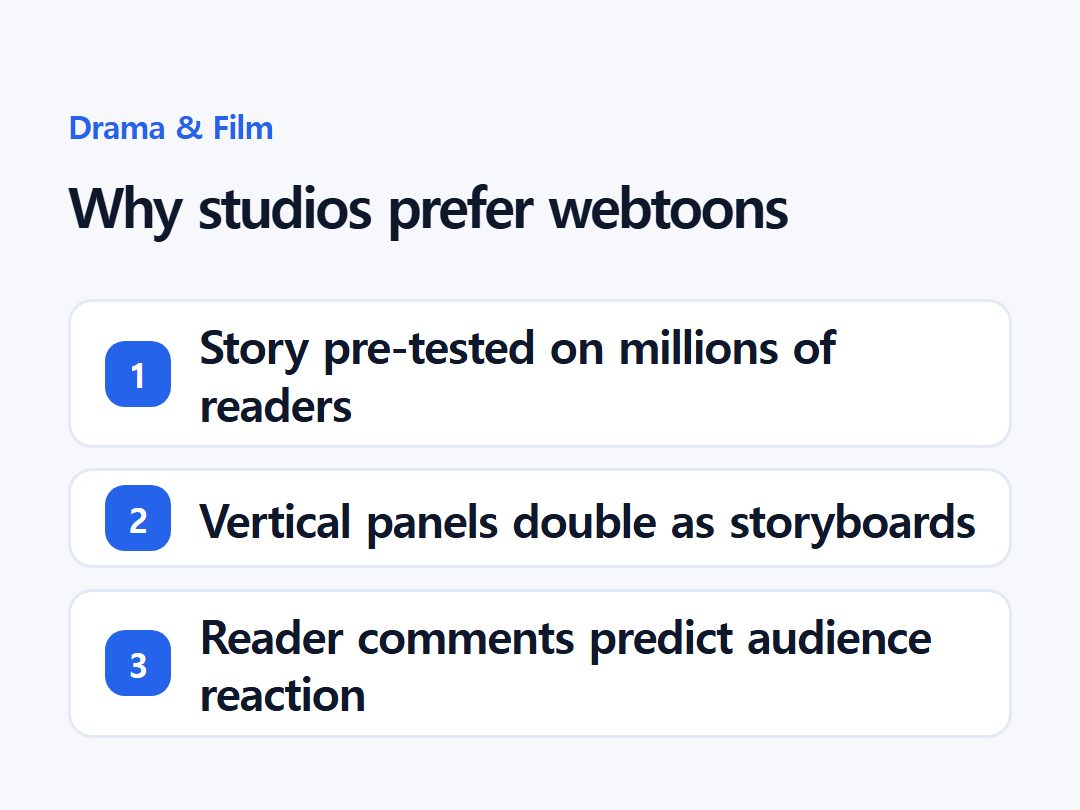
The first is economics. A webtoon arrives at a production company already finished: characters are designed, settings are drawn, and the story has an ending.
Licensing an existing webtoon is typically cheaper than commissioning an original screenplay from nothing, and because the artwork is already sequential and panel-based, it functions as a rough storyboard, cutting down the pre-production work a director and art department would otherwise start from zero.
The second is risk reduction through data.
Naver Webtoon and Kakao Entertainment do not have to guess whether a story will resonate — they can watch the numbers for millions of readers in real time: view counts, star ratings, comment volume, and how often readers reread earlier chapters once a drama adaptation is announced.
That built-in, trackable fandom functions as a completed market-research phase that a brand-new script simply cannot offer.
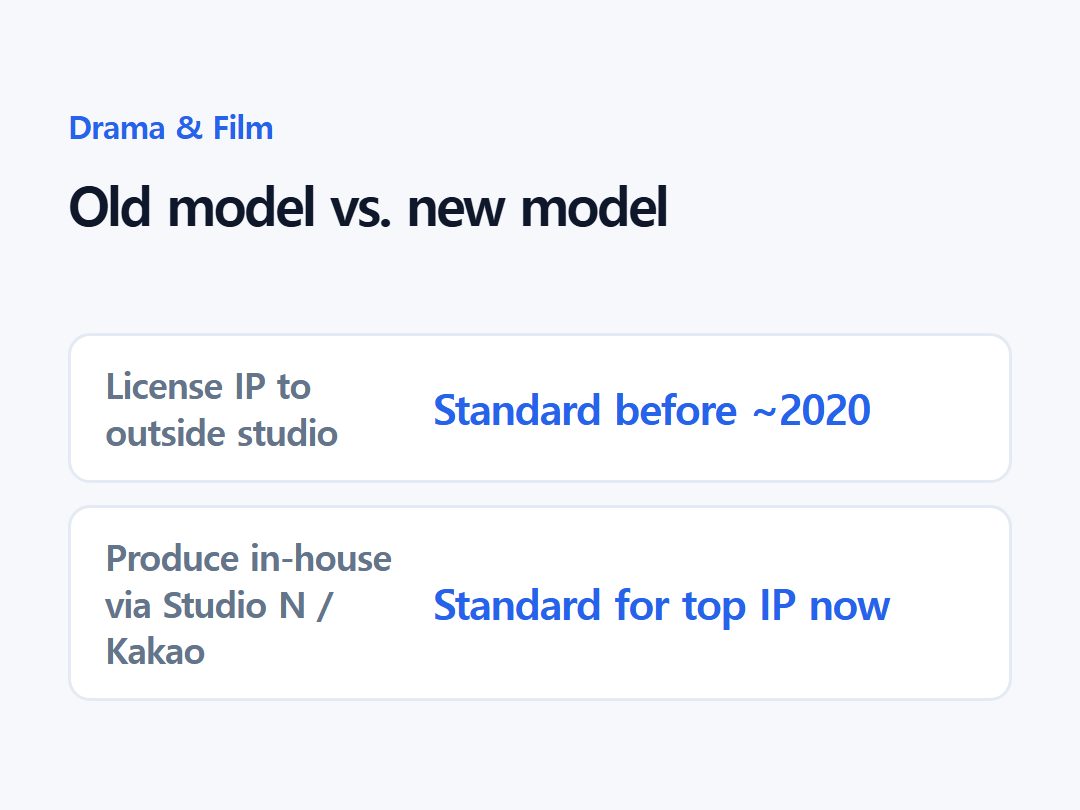
The third, and most recent, development is that platforms have stopped licensing out their best titles and started keeping them. Through the early 2020s, Naver Webtoon and Kakao Entertainment mostly sold adaptation rights to broadcasters and outside production companies and let them run the show.
Naver Webtoon's production subsidiary, Studio N, now develops flagship titles in-house rather than handing them to an outside studio, and Kakao Entertainment has done the same with dramas produced directly by the company that owns the source webtoon.
Korean trade reporting describes the logic bluntly: the bigger and more commercially certain a webtoon IP is, the less likely its owner is to transfer adaptation rights to anyone else.
One industry source summarized the direction as platforms positioning themselves as full studios, with the line between "the company that distributes the comic" and "the company that makes the show" disappearing.
There is also a reverse effect that gives platforms an added incentive to keep control of adaptations rather than license them away: a hit drama sends readers back to the original webtoon or web novel, generating a second wave of revenue on the platform itself.
Korean industry reporting has documented individual cases where a drama's broadcast triggered sharp short-term spikes in the source material's readership — in one case a web novel's downloads rose roughly 147-fold, and in another a webtoon's views rose roughly tenfold, within about two weeks of the drama's premiere.
A 2025 industry survey on content IP transactions found that when audiences seek out the original webtoon after watching an adaptation, about 38 percent are driven by curiosity about how the drama differs from the source, while about 35 percent were already fans of the webtoon beforehand.
When the webtoon platform also owns the drama, it captures both the production profits and this readership rebound; when it only licenses the rights away, it keeps a flat licensing fee and hands that second wave to whichever broadcaster or streamer is airing the show.
Finally, this fits what a global streaming platform actually needs, which is not occasional hits but constant volume.
Netflix, Disney+, and Korea's own domestic streamer Tving all need a steady stream of new series to hold subscribers, and Korea's webtoon libraries — thousands of completed, reader-ranked stories spanning every genre — function as a pre-vetted development slate.
That is one reason a Korean-owned webtoon can end up as a Disney+ original, a Netflix global hit, or a domestic cable drama with roughly equal ease: the underlying IP was never built for a single platform in the first place.
How Misaeng and Sweet Home built the model
Korea's webtoon industry is itself a product of the country's early and near-total shift to mobile internet use in the 2000s, when portals such as Naver and Daum began publishing free, vertically scrolling comics designed to be read one-handed during a commute rather than bought in print.
That format — cheap to distribute and free for readers, with platforms monetizing through ads and later paid early-access chapters — built large, highly engaged readerships years before Korean television took serious interest in adapting them.
The moment usually credited with proving the drama-adaptation model was Misaeng: Incomplete Life, a workplace drama that aired on the cable channel tvN in late 2014, based on a webtoon of the same name by Yoon Tae-ho about a former professional Go player struggling through a corporate internship.
The webtoon had already passed roughly a billion cumulative page views on Daum before the show aired.
The drama drew a 10.3 percent rating — an unusually high number for Korean cable, which reaches far fewer households than the terrestrial networks — and became enough of a cultural touchstone that its characters entered everyday conversation as shorthand for office archetypes.
It demonstrated that a webtoon's built-in audience could translate directly into drama viewership, giving broadcasters a template to repeat.
Hits through the rest of the 2010s reinforced the pattern, with cable networks JTBC and tvN turning popular Kakao and Naver webtoons into some of their best-performing original dramas.
But the turning point for how much money and international attention the model could attract was Netflix's entry. Sweet Home, released in December 2020 and based on a Naver webtoon, became the first Korean series to enter Netflix's U.S. Top 10.
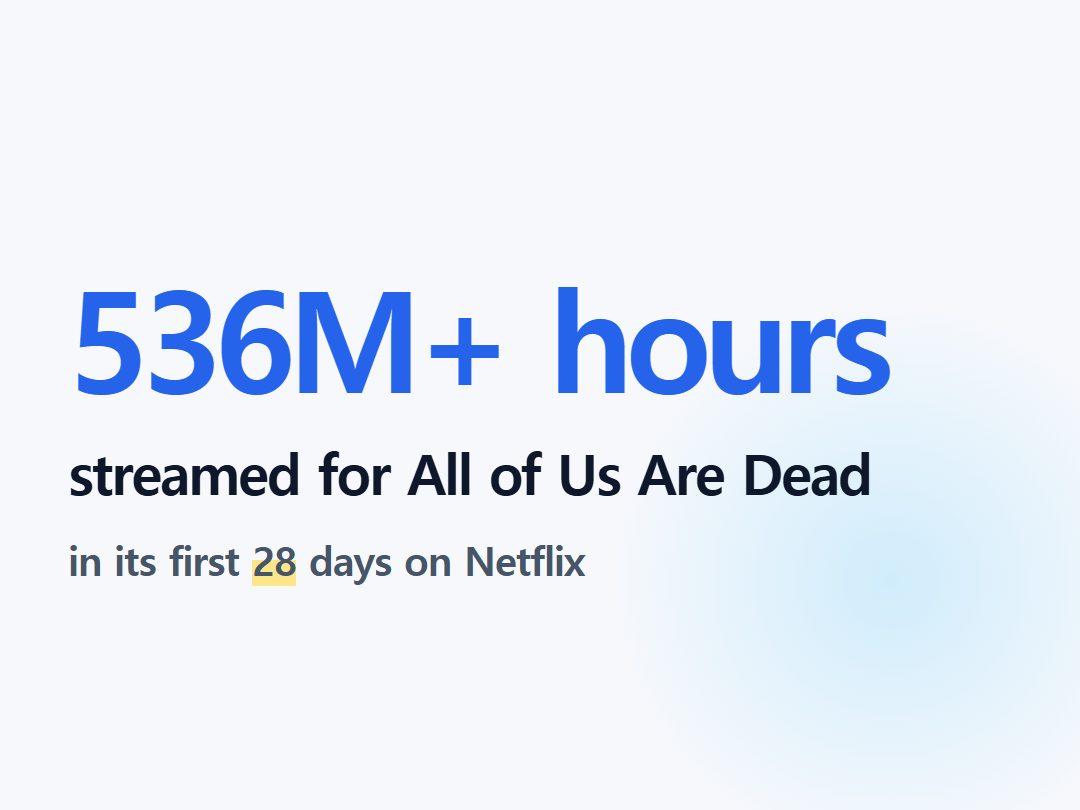
Its 2022 spin-off in the same shared universe, All of Us Are Dead, streamed more than 536 million hours worldwide within its first 28 days and topped Netflix's non-English-language chart in dozens of countries, ranking it among the platform's most-watched non-English series at the time — a scale of global return that licensing fees alone could never have generated for a Korean broadcaster working on its own.
That scale of proven demand is what pushed Naver Webtoon and Kakao Entertainment to stop treating adaptation as a side business and start building their own production arms, culminating in the in-house strategy now visible across their 2025–2026 slates.
Micro-dramas and overseas licensing are next up
2026 is shaping up as a dense year for the pipeline, with Disney+'s Remarried Empress — led by Shin Min-ah and Ju Ji-hoon and based on a long-running webtoon — positioned as a test of whether a platform-produced, big-budget fantasy adaptation can travel internationally the way Netflix's horror titles did.
Whether Studio N and Kakao Entertainment can sustain quality while producing at volume, rather than selectively licensing their best titles to specialist outside studios, remains an open question: in-house production concentrates profit, but it also concentrates the risk if a title underperforms.
A newer format worth watching is the webtoon-based micro-drama: two-to-five-minute vertical video episodes built for TikTok, YouTube Shorts, and Instagram Reels, adapting individual webtoon chapters rather than full story arcs.
Korean companies are moving into a space so far dominated by Chinese platforms, betting that Korea's existing webtoon library gives them a production and storytelling advantage.
Also worth watching is the export of the adaptation model itself, as Korean webtoon IP begins to be licensed for locally produced, non-Korean adaptations in other markets — a sign that the webtoon-to-drama pipeline may stop being a purely Korean phenomenon and become a format Korea exports alongside the stories themselves.
Milestones in the webtoon-to-drama pipeline
| Year | Drama | Webtoon source | Milestone |
|---|---|---|---|
| 2014 | Misaeng: Incomplete Life | Yoon Tae-ho's webtoon (~1 billion page views on Daum) | 10.3% rating; first drama to prove the adaptation model |
| 2020 | Sweet Home | Naver webtoon | First Korean series to enter Netflix's U.S. Top 10 |
| 2022 | All of Us Are Dead | Same shared universe as Sweet Home | 536 million hours streamed in 28 days; topped Netflix's non-English chart |
Frequently asked
Why are so many K-dramas based on webtoons?
Webtoons arrive pre-finished with designed characters, drawn settings, and a completed story, and their reader data — view counts, ratings, and comments — functions as built-in market research, making them cheaper and less risky than an original script.
What does OSMU mean in Korean entertainment?
OSMU stands for 'one source, multi-use,' a strategy the Korean content industry has used since the 1990s to extract value from one story across comics, novels, dramas, films, and games.
What was the first webtoon-based K-drama to become a global Netflix hit?
Sweet Home (2020), based on a Naver webtoon, was the first Korean series to enter Netflix's U.S. Top 10, and its 2022 spin-off All of Us Are Dead streamed more than 536 million hours worldwide in its first 28 days.
Sources
Every factual claim above is traceable. We do not translate articles — we gather facts from multiple outlets and write them ourselves.
- Webtoon platforms venture into K-drama production — The Korea Times
- "Boundary Between Distribution and Production Is Collapsing"...Webtoon Platforms Dive Directly Into Video Production — The Asia Business Daily
- Misaeng: Incomplete Life — Wikipedia
- 'All of Us Are Dead' tops Netflix weekly viewership chart for 3rd week — The Korea Times
- 'All of Us Are Dead' makes strong debut on global charts — Philippine News Agency
- Most-watched Netflix shows in first 28 days since release — Statista
- Korean Webtoons as an Original Source of Intellectual Property for K-Dramas — Flow Journal (University of Texas at Austin)