Scroll through K-pop news in any given week and a headline like "aespa confirms comeback for October" or "NCT 127's comeback tops the charts" will show up.
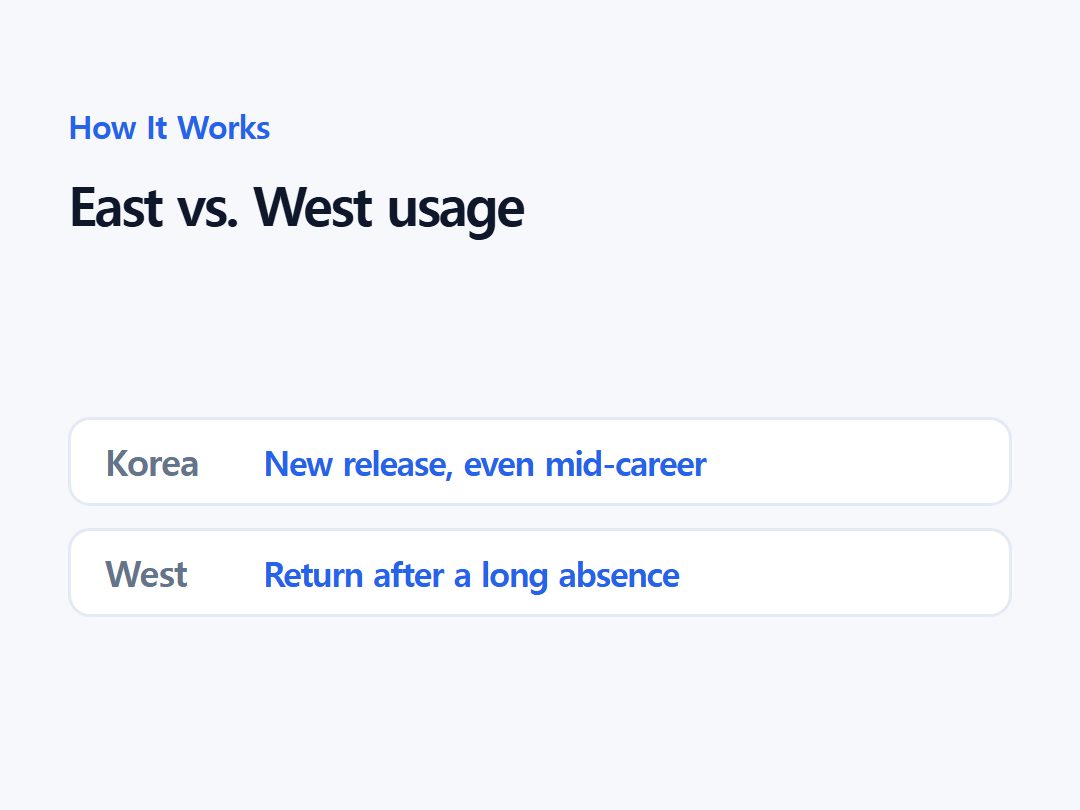
To a reader used to Western pop coverage, "comeback" implies an artist returning after retiring, breaking up, or vanishing from the public eye — a Whitney Houston Grammy moment, a boxer re-entering the ring after injury. In K-pop, the word means something else.
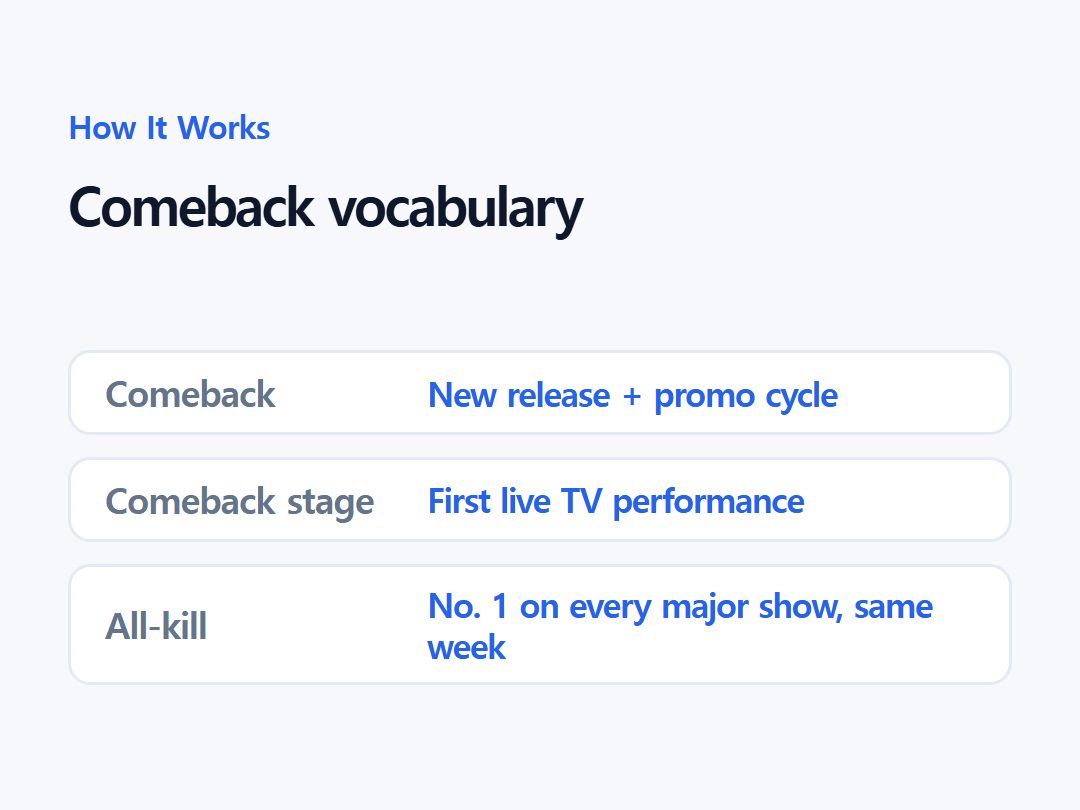
A comeback is simply a new release cycle by an act that never left. A group can have two, three, even four comebacks in a single year without ever pausing activity in between, and the term applies equally to a full album, a mini-album (called an EP in the West), or even a single.
The short version
- A comeback is just a new release cycle, not a return from hiatus.
- Promotion periods run two to four weeks with nightly music-show performances.
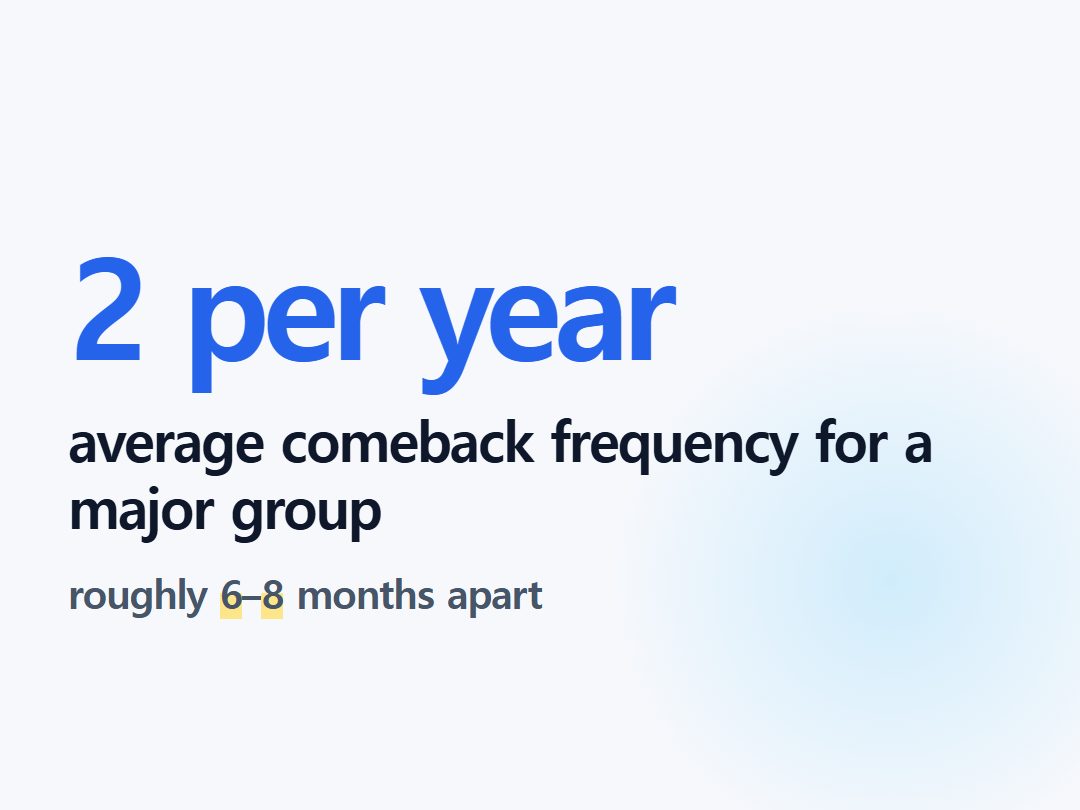
- Successful groups average two comebacks a year, spaced six to eight months apart.
Why do fans protest a slow comeback pace?
The mismatch matters because "comeback" is not slang or a marketing flourish in the K-pop industry — it is the basic unit that the business runs on, and it behaves nothing like a Western album cycle. A comeback is a coordinated, multi-week rollout, not a single release date.
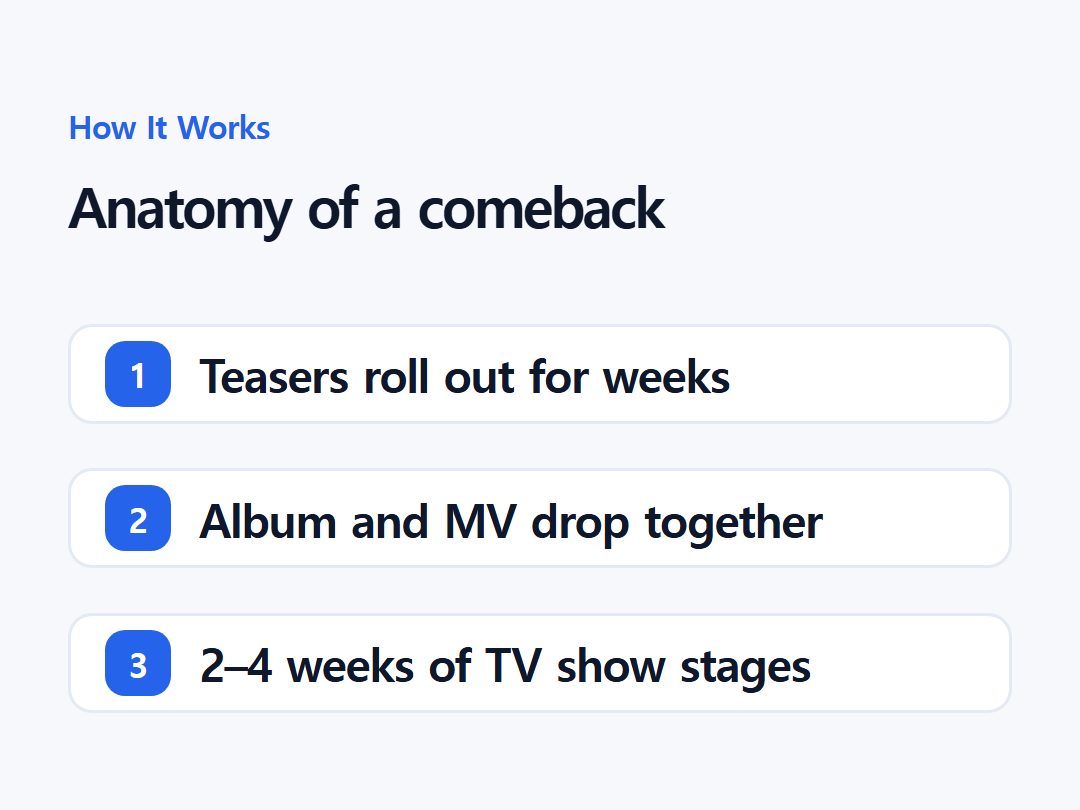
It typically opens with a teaser schedule posted on social media weeks in advance, followed by concept photos, a tracklist reveal, and a music video teaser.
Release day usually brings the album and the music video out simultaneously, sometimes alongside a livestreamed "comeback showcase" where members explain the concept.
What follows is the part outsiders miss entirely: a promotion period, typically two to four weeks, in which the group performs the same lead single — the "title track" — night after night on South Korea's weekly televised music shows, while other songs on the album ("b-sides") are rarely performed live at all.
Those shows are themselves a K-pop-specific institution. Five of them currently anchor the weekly cycle: KBS's Music Bank, MBC's Show! Music Core, SBS's Inkigayo, Mnet's M Countdown, and MBC M's Show Champion.
Unlike a talk show or awards special, each one exists purely for competitive performance — acts appear back to back and are ranked against each other using a weekly scoring formula that blends digital sales and streaming, physical album sales, broadcast points, and fan voting, with the exact weighting differing slightly by show.
Whichever song scores highest wins that week's trophy.
Sweeping the top spot on every major show in the same week has its own term: an "all-kill." This is separate from a Daesang, the grand prize awarded once a year at ceremonies such as the Golden Disk Awards or Seoul Music Awards for a whole year's output — a weekly music-show trophy and an annual Daesang measure completely different things.
One distinction is worth spelling out because it trips up newcomers: a comeback is not the same as a debut. A group's very first release, however heavily promoted, is called a debut, not a comeback — the term only applies once an act has already released music at least once before.
That is also why a rookie group's second release, even if it arrives just a few months after debut with no gap at all, gets labeled a comeback. The word is tracking "a subsequent release by an existing act," not any particular amount of time away.
The comeback window is also when most of a group's revenue-generating fan activity is concentrated. Physical album sales, which in Korea are driven heavily by collectible packaging and randomized photocards, spike in the release week and taper off afterward.
Streaming pushes, hashtag campaigns, and fan-organized "voting parties" for the music shows are all timed to the same two-to-four-week window, because that is the period when a song is actually eligible to win.
Once the promotion period ends, the group typically moves on to other content — variety show appearances, reality series, solo schedules — until the next comeback begins the cycle again. This is why the size of the gap between comebacks is treated as a serious metric inside fandoms, not a minor scheduling detail.
A successful major group typically manages around two comebacks a year, spaced roughly six to eight months apart, though the range varies widely: some acts release three or four times a year, others once.
Fans track comeback frequency closely because a longer-than-expected gap is widely read as a sign that an agency is under-investing in an act, and the clearest documented example is BLACKPINK.
In December 2019, fans organized a protest truck outside YG Entertainment's Seoul headquarters listing demands that explicitly included "at least two comebacks a year," alongside requests for member solo releases and award-show appearances. A near-identical truck returned in May 2020 with the same core demand.
The pattern recurred again in June 2025, when fans parked another truck outside YG ahead of a single release, arguing the promotion plan fell short of a full comeback rollout.
None of this was about the group breaking up or a member leaving — it was entirely about the pace and scale of new-music promotion, which is exactly what "comeback" refers to in industry usage.
That a fandom would organize a public protest over release timing alone is difficult to make sense of without understanding what the word is actually tracking.
How 1990s idol agencies invented the comeback cycle
The term's current meaning is tied to how the modern idol system was built.
Agencies such as SM Entertainment, YG Entertainment, and JYP Entertainment, founded in the mid-1990s, structured their business around tightly managed, trainee-based release cycles rather than the looser album-then-tour rhythm common in Western pop — the same agency system that controls when a comeback happens also controls how idols are recruited, trained, and contracted for years before debut.
Weekly televised chart shows gave that release structure a stage: SBS's Inkigayo traces back to a chart program that first aired in 1991 and was revived in its current form in 1998, while MBC's Show! Music Core launched in 2005 with its own ranking system.
Because success in this ecosystem is measured week by week on live broadcast rather than primarily through monthly album charts the way US pop is, each new release needed its own promotional unit — a comeback — with its own teaser rollout, its own title track, and its own run of weekly show appearances.
As international interest in K-pop grew through the 2010s, English-language outlets and fan communities adopted the Korean term as-is rather than translating it, which is why global coverage now uses "comeback" the Korean-industry way by default, even though it reads oddly to readers who only know the Western sense of the word.
Is the nonstop comeback schedule wearing idols down?
The comeback-frequency norm shows no sign of slowing, and if anything the competition for the limited weekly slots on these five shows is intensifying as more groups debut each year.
Fan pressure over pacing also remains an active flashpoint rather than a settled issue — the 2025 BLACKPINK protest truck shows fans are still willing to publicly confront agencies over what counts as an adequate comeback rollout.
Separately, there is ongoing industry discussion about the toll that compressed promotion periods, with idols often making multiple broadcast appearances a day for weeks at a stretch, take on performers, though no agency has signaled it plans to change the underlying cycle.
For international readers, the more immediate takeaway is simpler: the next time a headline says a group is "coming back," it almost certainly does not mean they went anywhere.
Anatomy of a comeback rollout
| Stage | What happens |
|---|---|
| Weeks before release | Teaser schedule posted on social media |
| Pre-release | Concept photos, tracklist reveal, music video teaser |
| Release day | Album and music video released simultaneously; sometimes a livestreamed comeback showcase |
| Promotion period (2-4 weeks) | Title track performed on weekly TV music shows; b-sides rarely performed live |
Frequently asked
What does 'comeback' mean in K-pop?
It's simply a new release cycle by an act that never left, not a return after retiring or breaking up.
How long does a K-pop comeback promotion last?
Typically two to four weeks, during which the group performs the title track nightly on weekly TV music shows.
What's the difference between a comeback and a debut in K-pop?
A debut is a group's first-ever release; a comeback is any release after that, even if it arrives just months later.
Sources
Every factual claim above is traceable. We do not translate articles — we gather facts from multiple outlets and write them ourselves.
- Blackpink Fans Demand Better Promotion From YG Entertainment — Forbes
- Blackpink Fans Protest YG Entertainment, Alleging Lack of Promoting Act — Billboard
- BLACKPINK fans park a protest truck at YG Entertainment headquarters days before the DEADLINE Tour — Music Mundial
- Music programs of South Korea — Wikipedia
- K-pop Music Show Scoring Explained: Win Analysis — Sources K-pop
- What "Comeback" Means in K-Pop (and Common Misconceptions) — K-Pop Atlas