"Jjimjilbang" translates loosely to "heated room," which undersells what one actually is. Walk into any of the thousands scattered across Korean cities and you won't find a spa with a front desk and appointment times.
You'll find a windowless, multi-floor building where three generations of one family shower, sweat, eat dinner, watch television, and fall asleep in the same open room — often a few feet from strangers doing the same thing.
The short version
- Jjimjilbang and mokyoktang are different businesses — one just bathes, one you sleep in.
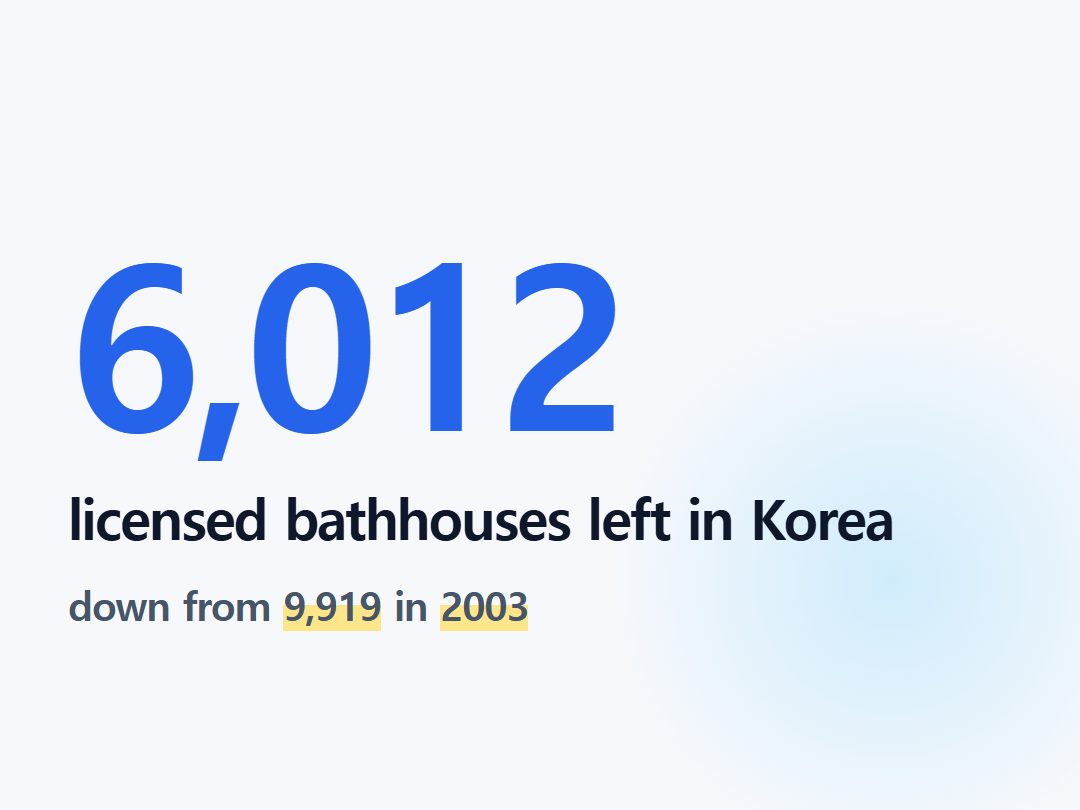
- Korea's bathhouse count dropped from 9,919 in 2003 to 6,012 by 2022.
- The all-in-one jjimjilbang format only took shape in the 1990s.
A jjimjilbang is not a bathhouse with extra steps
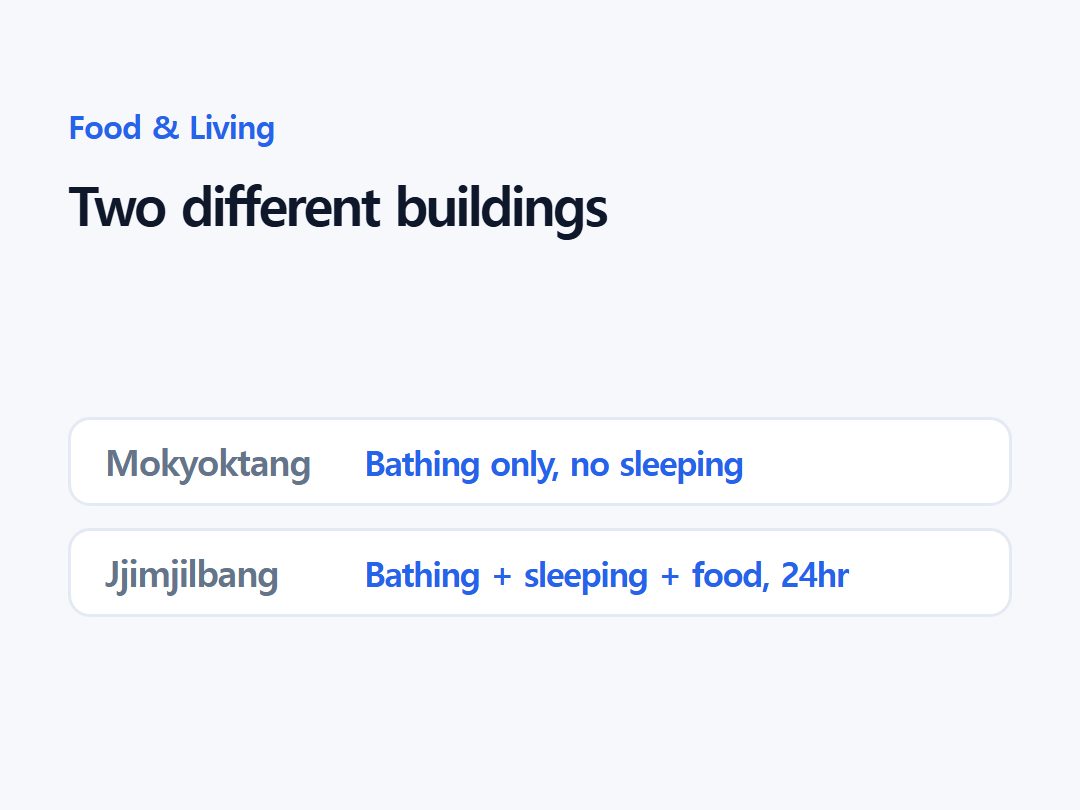
International coverage tends to use "jjimjilbang" and "Korean bathhouse" interchangeably, but Koreans treat them as two different businesses. A mokyoktang (목욕탕) is a plain, gender-separated wet bathhouse: showers, hot tubs, nothing else. A jjimjilbang adds an entire second building's worth of function on top of that.
- Mokyoktang: bathing only, no sleeping area, entry around ₩5,000–8,000, not open 24 hours
- Jjimjilbang: bathing floor plus a clothed common area with kiln saunas, heated sleeping floors, and a snack bar, entry around ₩10,000–16,000, usually open around the clock
Getting this wrong is the single most common mistake foreign visitors make — arriving at a bare-bones mokyoktang expecting a sleepover, or showing up to a jjimjilbang in swimwear when the common floor requires the cotton uniform provided at check-in.
One building, two completely different rulebooks
Inside a jjimjilbang, the bathing floor and the common floor operate on opposite logic. The bathing floor is strictly single-sex and nude — men's and women's sides are physically separate, with no exceptions once a child is past about age seven.
Above or beside it sits the common floor, which is mixed-gender and fully clothed in the matching shorts and T-shirt handed out at the entrance. This is where the actual jjimjilbang experience happens: themed kiln rooms (jade, salt, charcoal, sometimes ice), open lounges, and a TV corner.
The entry sequence reinforces the split before you even reach either floor. Shoes come off first and go into a locker near the door, and that key gets traded at the counter for a second locker key covering clothes and belongings. Only after that swap do guests walk through doors marked separately for men and women.
Why a family can lose an entire Saturday in here
This is the part the "sauna" framing misses entirely. A jjimjilbang isn't a stop on the way to somewhere else — for many Korean families, it is the destination for the day.
Grandparents nap on the heated floor while parents eat at the on-site food stalls and kids run between kiln rooms. The same visit can include a meal, a nap, a TV drama rerun, and a bath, which is why jjimjilbang trips are typically measured in hours, not the twenty minutes a Western sauna visit implies.
Each generation tends to have its own reason to stick around.
- Grandparents treat the heated floor as a low-cost nap and hot compress in one
- Teenagers head for the PC room or karaoke booth tucked into an upper floor
- Parents get a stretch of hours where food, rest, and childcare are all handled under one roof
It functions less like a spa and more like a combined community center, cafeteria, and living room that happens to also have hot water — which is precisely the piece of context missing when the word gets translated flatly as "sauna."

The overnight stay nobody designed on purpose
Because jjimjilbang stay open all night and charge a fraction of a hotel room, sleeping there has become its own informal category of Korean life. Office workers who miss the last subway train, or who drank too late to face a commute home, treat the heated floor as a fallback bed.
Budget travelers, both domestic and foreign, use the same logic on purpose: for the price of one hotel night, a jjimjilbang offers a bath, a meal, and a place to sleep, which is why backpacker guides list them as a legitimate lodging option in cities where hotel prices spike.
The same format has already reached Los Angeles and New York
This is worth explaining to an international audience for a reason beyond curiosity: versions of the same building have already crossed the Pacific. Korean-style spa chains have opened across major U.S. cities including Los Angeles, New York, Chicago, Atlanta, San Francisco, Dallas, and Las Vegas, borrowing the jjimjilbang's kiln rooms and communal bathing floors.
Some have picked up celebrity clientele along the way — outlets have reported visits from Kim Kardashian, Demi Moore, and Jessica Alba at Korean-style spas in the Los Angeles area. What those visitors experience, even inside an American strip mall, is a direct export of the mokyoktang-plus-common-floor model described above.
A 15th-century medicine room turned into a strip-mall spa
The jjimjilbang's steam-room ancestor, the hanjeungmak, is far older than the buildings themselves. The first written record of one appears in the Annals of King Sejong in the 15th century, describing a dome-shaped kiln sauna that Buddhist monks operated for medicinal sweating — and Joseon-era records already mandated separate men's and women's sauna sessions by 1429.
Public bathhouses came later and for different reasons: an 1888 hygiene proposal to King Gojong, followed by Japanese colonial-era bathhouses modeled on the Japanese sento, spread the mogyoktang format nationwide through the 20th century.
The all-in-one jjimjilbang — sleeping cubbies, restaurants, the works — is a much more recent invention. It took its current sprawling shape in the 1990s, when Korea's real-estate boom pushed overnight hotel stays out of reach for many working travelers and jjimjilbang operators expanded their bathhouses to fill that gap.
The scrub, the eggs, and the towel shaped like sheep ears
Three rituals show up in almost every jjimjilbang, and each has a specific, traceable origin rather than being generic "spa culture."
The scrub has its own etiquette: a customer usually soaks for 20 to 30 minutes first so the skin softens, then pays a separate fee — typically ₩20,000 to ₩35,000 — for a technician to work through the whole body with the abrasive mitt.
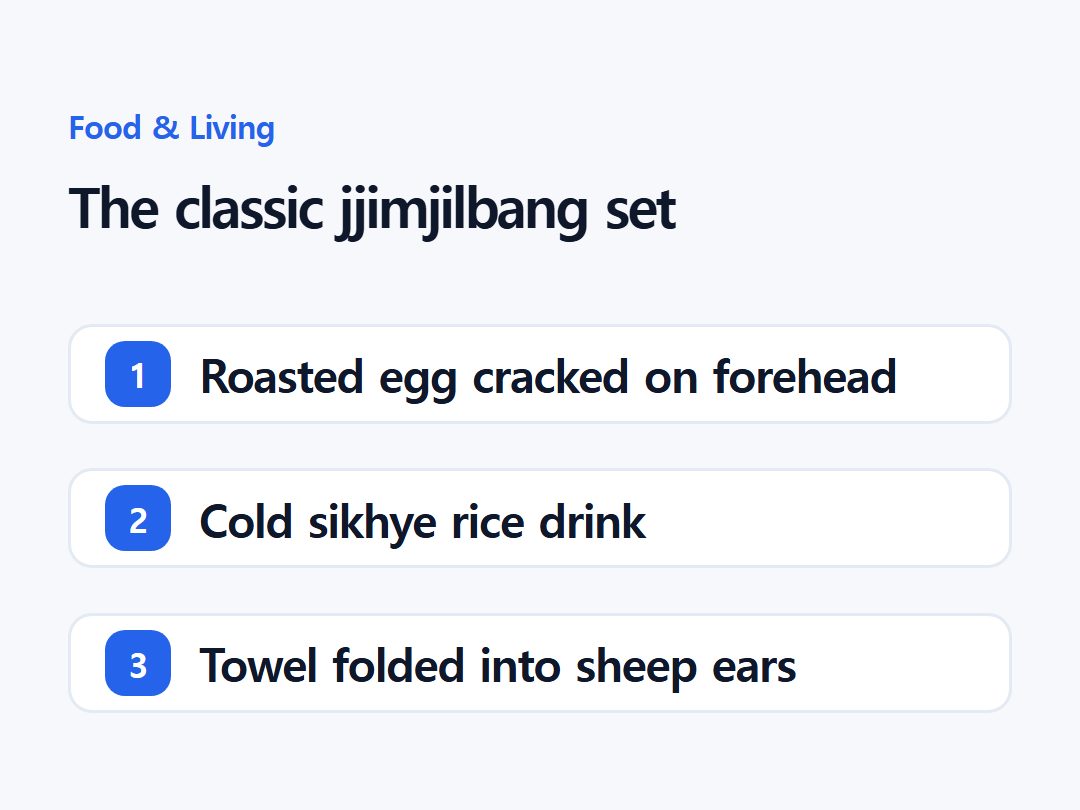
- The full-body scrub (세신) uses a rough mitt called an "Italy towel," invented from Italian viscose rayon fabric in 1960s Busan and patented by Kim Pil-gon between 1966 and 1969
- The roasted egg, cooked directly in the sauna's heat and traditionally cracked open on the forehead, paired with cold sikhye, a sweet fermented rice drink
- The sheep-ears towel — a small towel rolled and folded into two horn shapes on the head — existed before television but became a nationwide visual shorthand for jjimjilbang after the 2005 drama "My Name Is Kim Sam-soon" showed its lead character wearing one
Korea has quietly closed a third of its bathhouses since 2003
The jjimjilbang boom has a less-told second half: the underlying bathhouse industry has been shrinking for two decades. Licensed bathhouses nationwide peaked at 9,919 in 2003, fell below 8,800 by 2008, and stood at 6,012 by 2022 — a drop of nearly 40%.
Seoul's decline is sharper still: of 3,885 bathhouses ever licensed in the capital, only 704 remained operating as of the most recent count, an 81.9% closure rate. Roughly 730 of the nationwide closures happened during the pandemic years alone.
The main driver isn't a loss of interest in jjimjilbang culture specifically. It's that home bathrooms became standard in newer Korean apartments, removing the original reason — no hot water at home — that filled neighborhood bathhouses in the first place, while rising commercial rents finished off many smaller operators.
What a foreign visitor still can't predict
Two things remain inconsistent even for people who visit regularly. There is no national law on tattoos — some jjimjilbang turn away visibly tattooed guests, others don't, and the rule changes by individual facility rather than by region, with newer venues generally more relaxed.
The larger open question is generational: as home bathrooms keep spreading and the bathhouse count keeps falling, it's unresolved whether the jjimjilbang's role as an all-day family gathering space survives as a mainstream habit, or narrows into an occasional nostalgia trip and a tourist attraction.
Either way, the building worth explaining is not really a sauna. It grew out of two specific gaps — no hot water at home, no cheap hotel nearby — and both of those gaps are actively closing.
Mokyoktang vs. jjimjilbang
| Feature | Mokyoktang (목욕탕) | Jjimjilbang |
|---|---|---|
| What it offers | Bathing only, no sleeping area | Bathing floor plus clothed common area with kiln saunas, heated sleeping floors, snack bar |
| Entry price | ₩5,000–8,000 | ₩10,000–16,000 |
| Hours | Not open 24 hours | Usually open around the clock |
Frequently asked
What's the difference between a jjimjilbang and a mokyoktang?
A mokyoktang is a plain, gender-separated wet bathhouse for showers and hot tubs only, while a jjimjilbang adds a mixed-gender, clothed common floor with kiln saunas, heated sleeping floors, and a snack bar, usually open around the clock.
Can you sleep overnight at a jjimjilbang?
Yes — jjimjilbang stay open all night, so commuters who miss the last subway and budget travelers alike use the heated common floor as a cheap place to sleep instead of booking a hotel room.
Do jjimjilbang allow tattoos?
There's no national law on tattoos; some jjimjilbang turn away visibly tattooed guests and others don't, with the policy set by each individual facility and newer venues generally more relaxed.
Sources
Every factual claim above is traceable. We do not translate articles — we gather facts from multiple outlets and write them ourselves.
- Korean Spa and Jjimjilbang Decoded: What Every Foreign Resident Should Know — Seoulstart
- What is a Jjimjilbang? Korean sauna and spa explained — South China Morning Post
- About Jjimjilbang and sauna bathing culture in South Korea — OIVA
- The History of Korean Spas and Their Modern Rise — Spa World Houston
- Korean Sauna (Jjimjilbang): The Spa Complex with Everything — Leisurequip
- Jjimjilbang 101: Beginner's Guide to Visiting a Korean Spa — Traverse Blog
- Korean Towel Sheep Head (양머리) — Randomwire


