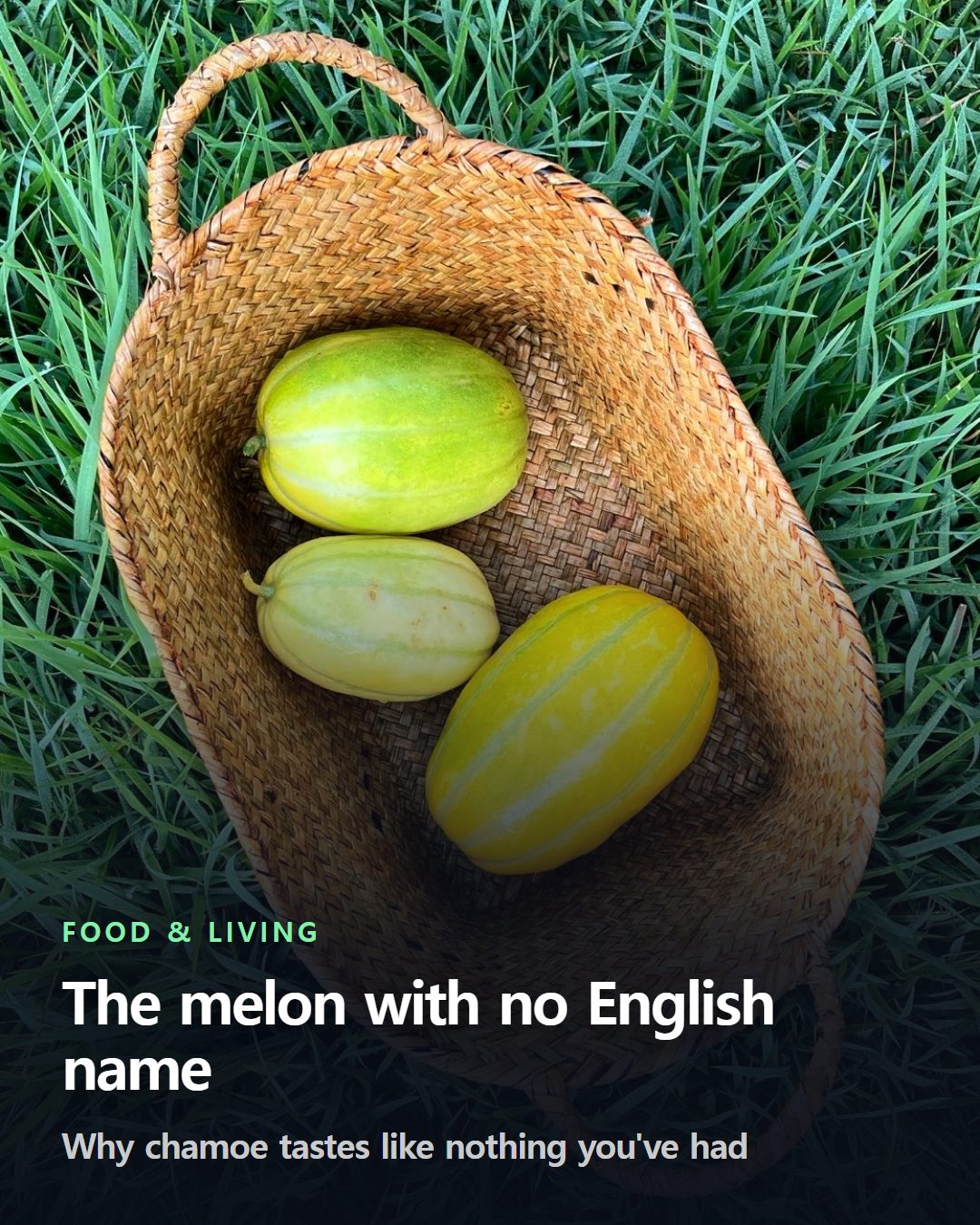
Bite into a chamoe for the first time and most people reach for three different fruits to describe it — honeydew, banana, cucumber — because English simply does not have a direct comparison ready. That is not a failure of translation. The fruit sits in an odd spot on the melon family tree that Western supermarkets never stocked.
The short version
- Chamoe is genetically closer to cucumber than to Western dessert melons.
- Breeding since 1957 nearly doubled sweetness, from 7–8 Brix to 14–17 Brix.
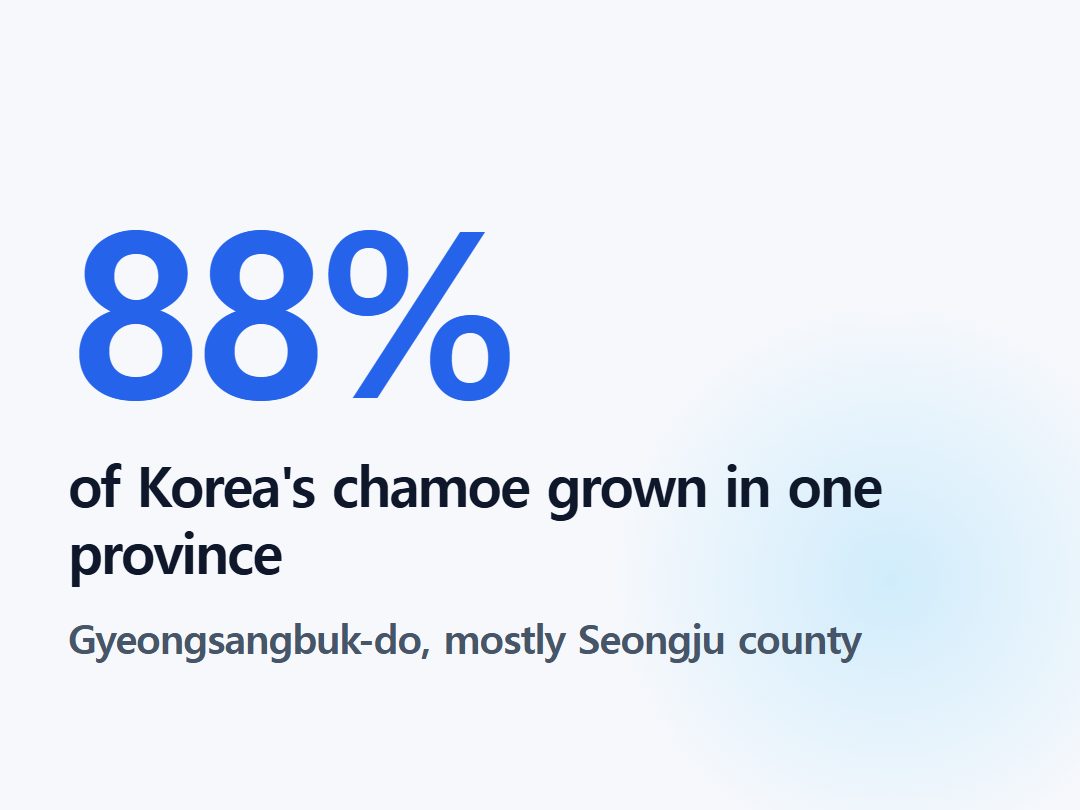
- Gyeongsangbuk-do province grows about 88% of Korea's chamoe.
Chamoe (참외) is Korea's default summer melon: pale yellow, oblong, faintly ridged with white stripes, sold by the box at every corner market from June through August. In Korea it needs no introduction. Outside Korea, it usually needs several.
The gap is not just unfamiliarity. Chamoe was bred for decades toward a texture and sweetness that Western fruit markets never selected for, and that history is why it tastes the way it does.

A melon that tastes like three fruits and belongs to none of them
Most tasting notes converge on the same description: mildly sweet, faintly floral, with the crunch of a cucumber rather than the soft give of a cantaloupe. The flesh is described as a cross of honeydew, banana, and cucumber — never fully any one of them.
What stands out most is texture. Chamoe is crisper than a cantaloupe but not as crisp as a raw cucumber, and it stays that way even when fully ripe, because Korean breeders selected for a clean, watery snap rather than the soft, perfumed flesh Western melon buyers expect.
The skin itself is part of the appeal. It is thin enough that Koreans usually eat chamoe unpeeled, cut into wedges rather than scooped with a spoon — closer to how a cucumber is handled than how a cantaloupe is served.
Same species as cantaloupe, on a completely different branch
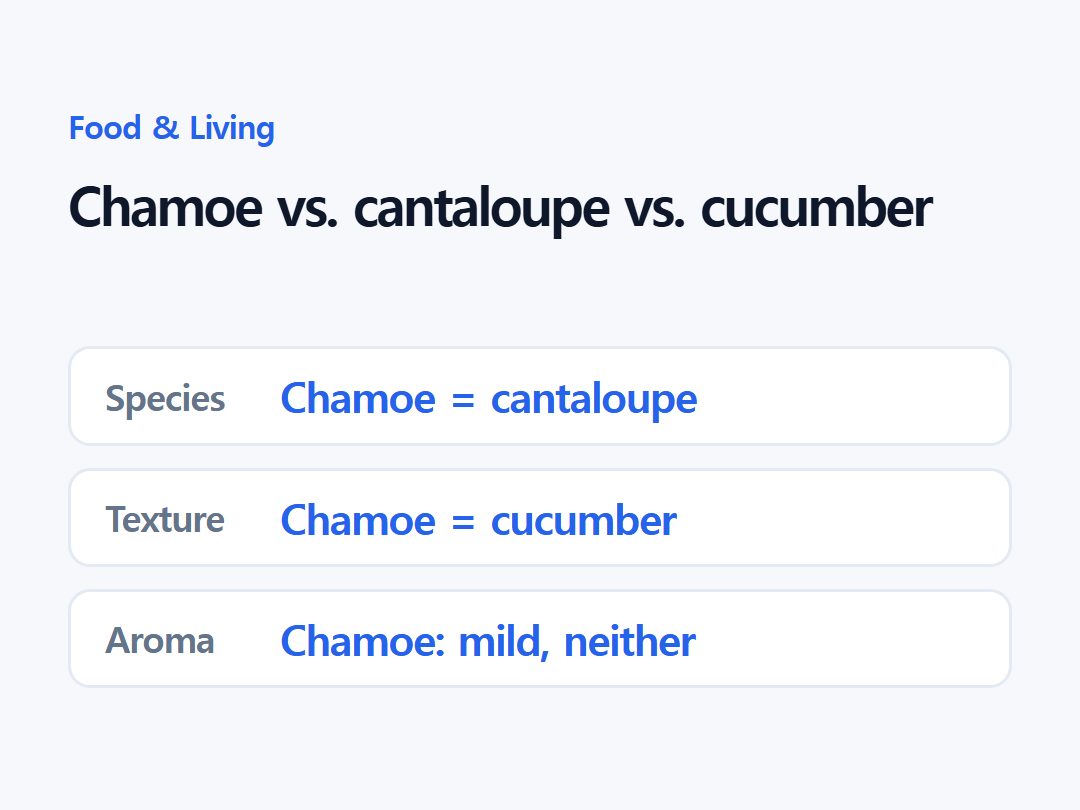
Chamoe, cantaloupe, and honeydew are all technically the same species, Cucumis melo. What separates them is the variety group: cantaloupe and honeydew belong to groups bred for soft, musky dessert flesh, while chamoe belongs to var. makuwa, a group bred in East Asia for a firm, mild, cucumber-like bite.
That relationship is baked into the name. "Cham" means "true" and "oe" is an old word for cucumber-type gourds — so chamoe translates roughly to "true cucumber-melon," and botanically it really is closer to cucumber than to the melons in a Western fruit bowl.
That is also why a simple side-by-side comparison with cantaloupe can mislead. The two share a species name, but decades of separate breeding pushed them toward opposite goals — one toward aroma and softness, the other toward crunch and restraint.
| Chamoe | Cantaloupe | Cucumber | |
|---|---|---|---|
| Species | Cucumis melo | Cucumis melo | Cucumis sativus |
| Texture | Crisp, watery | Soft, juicy | Crisp, watery |
| Aroma | Mild, faintly floral | Strong, musky | Almost none |
The part most first-timers throw away is the best part
Cut a chamoe open and the seeds sit in a soft, pale core called taejwa (태좌) — the placenta-like tissue that holds them. Koreans consider this the sweetest, most aromatic part of the fruit, not a part to discard.
Unlike the tough seed cavity of a cantaloupe, chamoe's seeds and taejwa are tender enough to eat whole. Skipping it is not wrong, but it means missing the part of the fruit bred hardest for flavor.
This is also why chamoe is rarely turned into juice or smoothies the way Western melons are. Koreans mostly eat it fresh, by hand, within a day or two of buying it — a texture-first fruit rather than a blending ingredient.
The fruit was barely sweet before 1957
Older Korean chamoe varieties were not particularly sweet by today's standard. Heirloom types grown before the mid-20th century measured roughly 7–8 Brix, a sugar-content scale on which a ripe tomato already sits around 12–14 Brix.
Modern chamoe is the result of a short, deliberate breeding push:
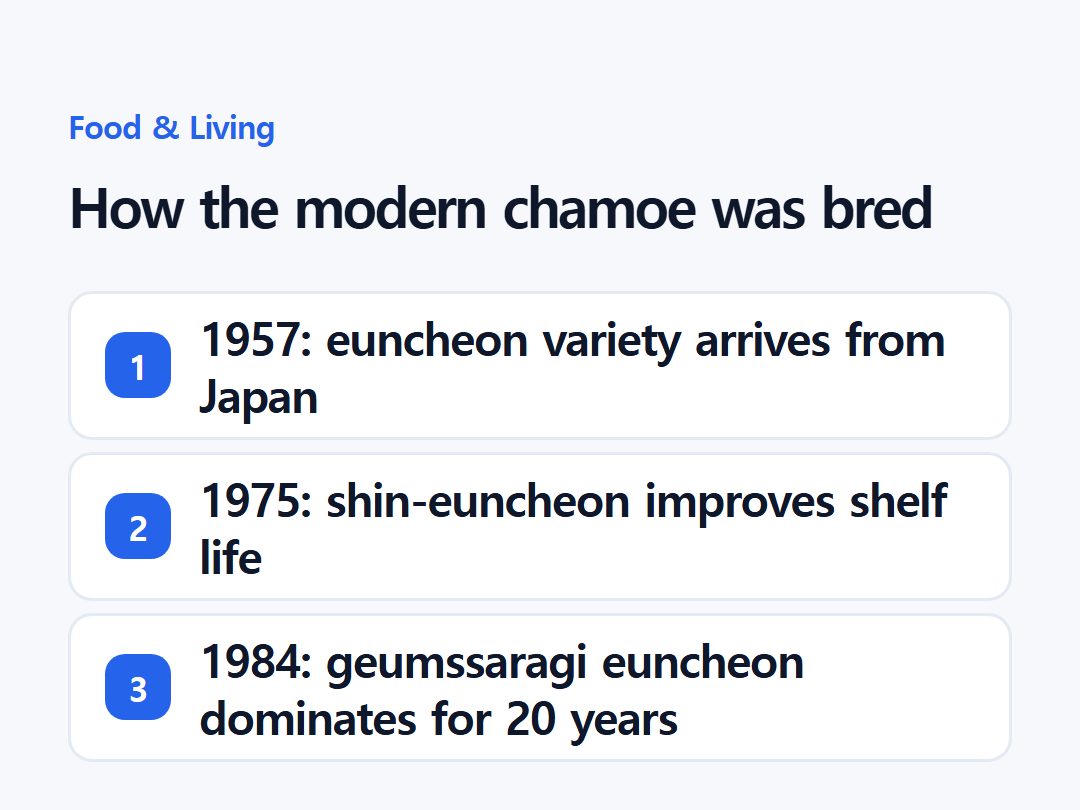
- 1957 — the euncheon variety, developed in Japan's Toyama Prefecture, introduced to Korea
- 1975 — Joongang Seeds released shin-euncheon, refining shelf life and appearance
- 1984 — Hungnong Seeds released geumssaragi euncheon, which held over 70% market share for two decades
That breeding line pushed sweetness from roughly 7–8 Brix to today's 14–17 Brix, while deliberately keeping the crisp bite Korean consumers preferred over a softer, more fragrant melon.
One province grows nearly all of it
Gyeongsangbuk-do province accounts for about 85% of the country's chamoe-growing area and 88% of national production, according to a regional cultural record maintained by the Academy of Korean Studies. Within that province, Seongju county alone is widely cited as producing the majority of the national crop.
The geography explains the concentration. Silty loam plains along the Nakdong River drain well while holding nutrients, irrigation flows down from Gayasan Mountain, and a sharp swing between daytime and nighttime temperatures concentrates sugar in the fruit as it ripens.
Most of that harvest now comes from greenhouses rather than open fields. Growers use rainproof plastic tunnels to control soil moisture, and some cooperatives have added AI-powered grading machines that photograph each melon from multiple angles to sort them by sugar content and skin quality before they ever reach a market.
From a Goryeo celadon vase to a supermarket staple
Melons resembling chamoe reached the Korean peninsula from northern China during or before the Three Kingdoms period (57 BC–668 AD), and cultivation was already common by the Unified Silla era that followed.
The fruit's popularity by the Goryeo dynasty is preserved in stone — or rather, celadon. A melon-shaped celadon bottle from that period, designated South Korea's National Treasure No. 94, is shaped directly after the fruit, a sign of how established chamoe already was as a summer staple centuries before modern breeding changed its taste.
What changed after 1957 was not whether Koreans ate chamoe, but which chamoe they ate. Centuries of cultivation had already made the fruit a fixture; the breeding era simply rewrote its flavor to match a more specific national preference.
Exports are climbing, but the fruit still doesn't travel well
Chamoe exports to Japan reached $1.055 million and 271 tons last year, up 31.4% in value and 39% in volume year-on-year, according to Seoul Economic Daily. Roughly 400 Japanese stores, including AEON, Don Quijote, and Makiya, now stock it under dedicated sales counters.
Vietnam opened as a market more recently, following a phytosanitary agreement that reportedly took 17 years to finalize between the two governments. But the fundamental problem remains unchanged: chamoe is best eaten within about a week of harvest, which limits how far it can realistically ship.
Smaller volumes have also reached Singapore and Australia, but Japan remains the anchor market by a wide margin — proximity, not just taste, decides where chamoe can currently travel.
Where international readers can actually find it
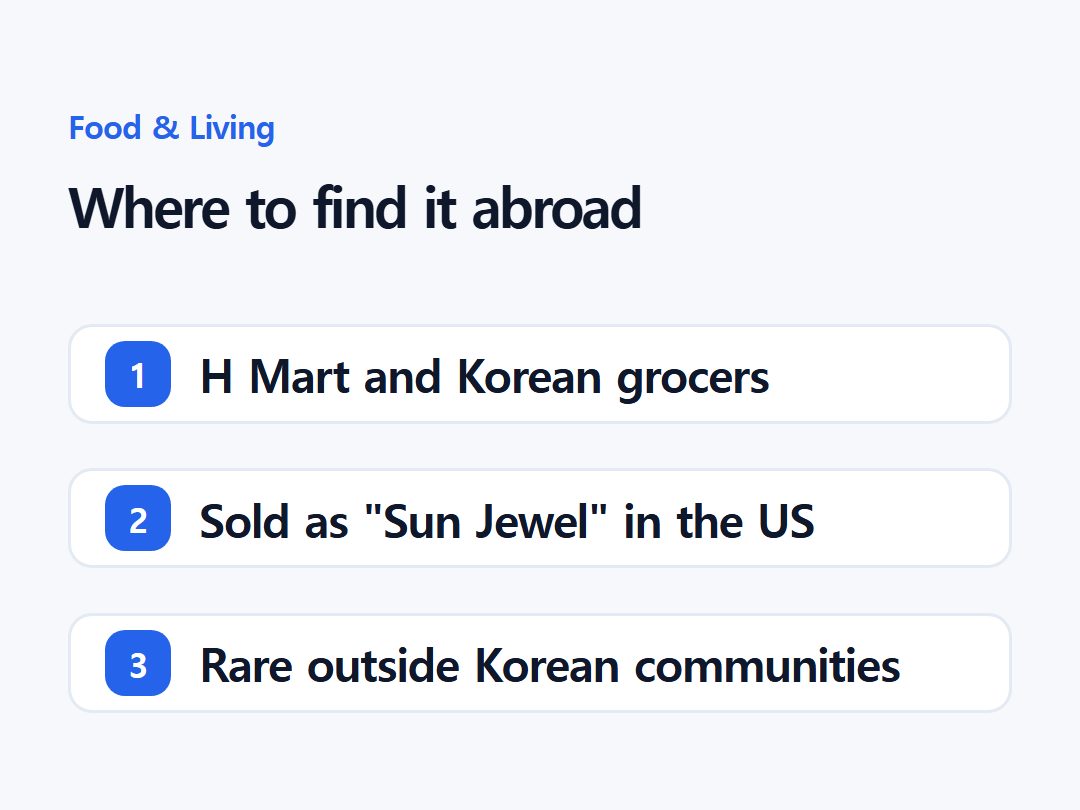
Outside Korea and Japan, chamoe is mostly a Korean-grocery item rather than a mainstream produce-aisle fruit. In the United States, it shows up seasonally at H Mart and similar Korean or pan-Asian supermarket chains, sometimes labeled "Korean melon," "Sun Jewel," or "oriental melon."
It rarely appears in general grocery chains outside areas with large Korean communities, and when it does turn up through specialty importers, the price premium reflects both its short shelf life and the distance it has traveled.
Will chamoe ever sit next to cantaloupe in Western supermarkets?
Export volumes are growing fast in percentage terms but still small in absolute terms compared to domestic consumption, which remains concentrated almost entirely inside Korea. Whether that changes depends less on demand than on whether breeders can extend shelf life without sacrificing the crisp texture the fruit is bred around.
Until then, chamoe stays what it has largely been outside Korea for decades: a fruit international visitors discover in person, describe as some combination of honeydew, banana, and cucumber, and then have to explain that it has no single Western name to fall back on.
Korea's chamoe breeding timeline (1957–1984)
| Year | Development |
|---|---|
| 1957 | Euncheon variety, developed in Japan's Toyama Prefecture, introduced to Korea |
| 1975 | Joongang Seeds released shin-euncheon, refining shelf life and appearance |
| 1984 | Hungnong Seeds released geumssaragi euncheon, which held over 70% market share for two decades |
Frequently asked
What does chamoe taste like compared to cantaloupe?
Chamoe is milder and less musky than cantaloupe, with a crisp, watery cucumber-like crunch instead of cantaloupe's soft, juicy flesh.
Can you eat chamoe seeds?
Yes — the seeds and the surrounding taejwa (태좌) tissue are tender enough to eat and are considered the sweetest, most aromatic part of the fruit.
Where can I buy chamoe outside Korea?
It shows up seasonally at Korean grocery chains like H Mart, often labeled 'Korean melon,' 'Sun Jewel,' or 'oriental melon,' and is also exported to Japan, Vietnam, Singapore, and Australia.
Sources
Every factual claim above is traceable. We do not translate articles — we gather facts from multiple outlets and write them ourselves.
- Korean Melons Information and Facts — Specialty Produce
- Korean Melon (Chamoe) — Taste Korean Food
- The Season for Korean Melon CHAMOE — Morning Calm (Korean Air)
- Korean Chamoe Melon Gains Popularity in Japan as Exports Surge 30% Annually — Seoul Economic Daily
- Carotenoid Biosynthesis in Oriental Melon (Cucumis melo L. var. makuwa) — NCBI PMC
- 참외 하면 성주 참외 (Digital Seongju Encyclopedia) — Academy of Korean Studies
- What Is Chamoe? The Korean Melon That Tastes Like Honeydew and Cucumber — Stories of Korea
- K-Melon Rises: How Korea's Chamoe Is Poised for Global Fruit Fame — Breeze in Busan


