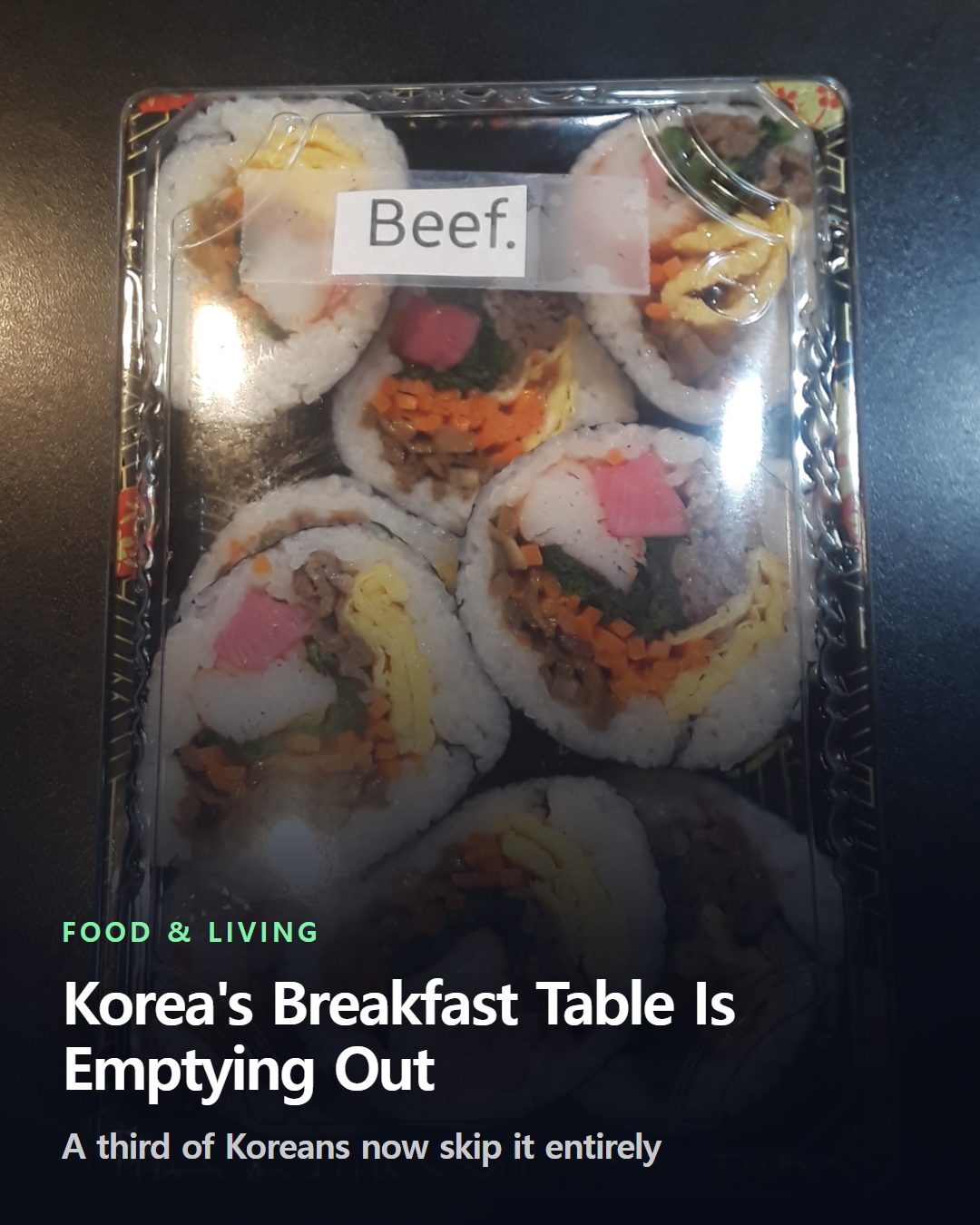
A third of Koreans now skip breakfast entirely, according to government health data released in 2025. At the same time, the country's per-capita rice consumption has fallen to its lowest point since records began in 1963.
The short version
- One in three Koreans skips breakfast; two-thirds of women in their 20s do.
- Rice consumption hit a record low in 2024, half of 1994's level.
- Convenience stores now sell breakfast gimbap while small gimbap shops close.
Both numbers point to the same shift: the bap-guk-banchan breakfast — rice, soup, and a handful of side dishes — that international visitors picture when they think of Korean food is no longer a daily habit for most working-age Koreans. It has become closer to a weekend ritual, or a memory of a grandparent's kitchen.
Rice, soup, and three side dishes — the baseline, not a special occasion
A traditional Korean breakfast is built from three parts: bap (steamed rice), guk or jjigae (a hot soup or stew, commonly doenjang jjigae, a fermented soybean paste stew), and banchan — small shared side dishes such as kimchi, seasoned vegetables, and grilled fish.
The format has royal-court roots. In the Joseon dynasty (1392–1897), a king's morning table could carry a dozen side dishes; a modern household settles for three to five, usually prepared in batches over the weekend.
Everyone gets their own bowl of rice and soup, but the banchan sit in the middle of the table and are shared with chopsticks. This is the meal most Korea travel guides still describe as typical — even though, as the numbers below show, fewer Koreans eat it that way each morning.
One in three Koreans now skip breakfast entirely
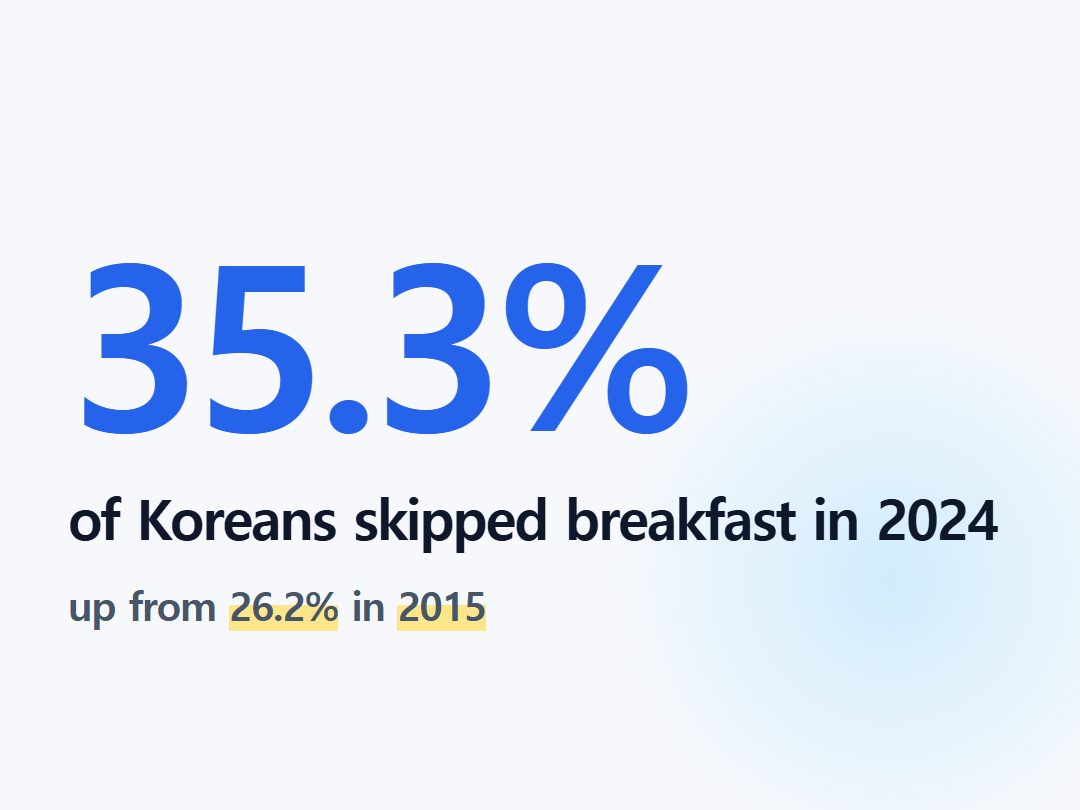
The Korea Disease Control and Prevention Agency's 2024 National Health and Nutrition Examination Survey found that 35.3% of Koreans aged one and older ate no breakfast at all — up from 26.2% in 2015, a rise of 9.1 percentage points in a decade.
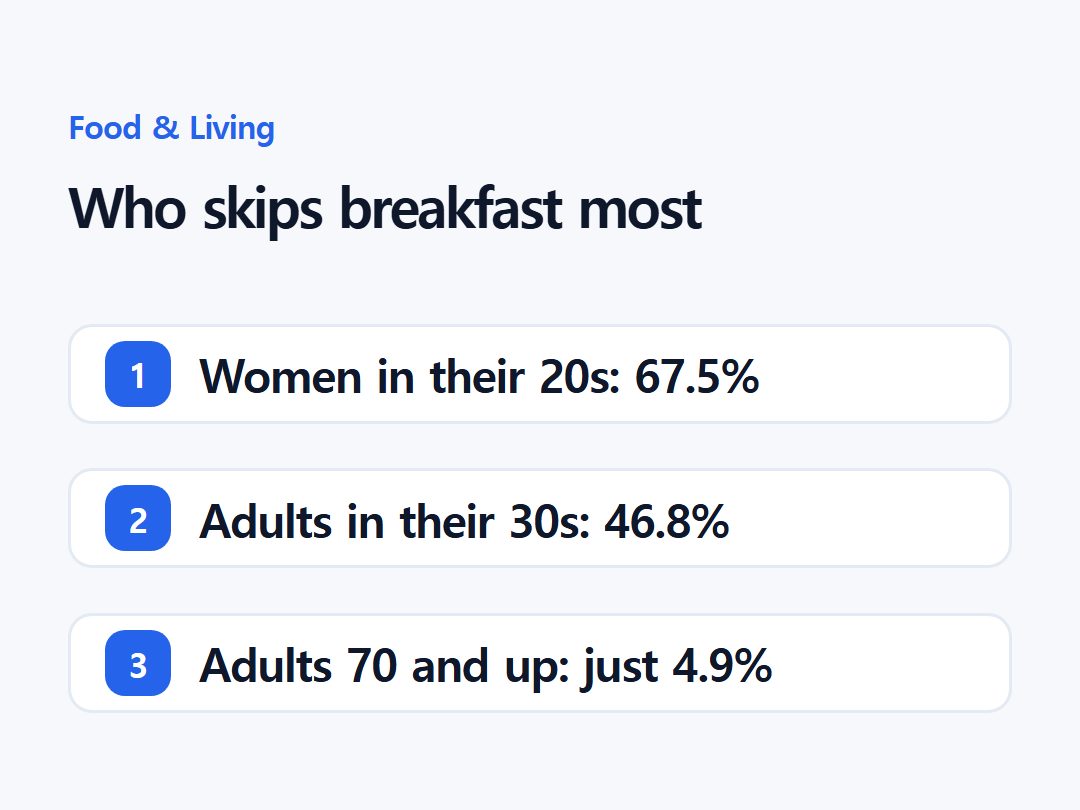
The rate is not evenly spread. It climbs sharply with youth and falls just as sharply with age:
- Age 70 and up: 4.9% skip breakfast
- Age 50s: 25.3%
- Teens: 35.5%
- Age 40s: 39.1%
- Age 30s: 46.8%
- Age 20s: 62.1%, and women in their 20s: 67.5% — barely a third eat breakfast regularly
Why people in their 20s are skipping breakfast most of all
A separate survey of 1,131 Korean adults, published through the Korea Citation Index, asked breakfast-skippers why. Lack of time was the top reason, cited by 44.9% of respondents, followed by habit (22.5%) and simply having no appetite in the morning (15.6%).
That lines up with who is skipping most. Unmarried adults skipped breakfast at nearly double the rate of married ones — 56.6% versus 32.1% — in the same survey. Living alone removes the household routine, and often the parent, that a shared morning meal used to depend on.
A rice-soup-banchan breakfast is also labor-intensive relative to almost any other meal. Soup has to be made or reheated, rice needs a cooker, and banchan need to be prepped in advance. For someone commuting alone before 8 a.m., none of that survives a 7 a.m. alarm.
Skipping breakfast in everyday use also does not always mean eating nothing. For many people it means replacing a cooked meal with coffee, or with a piece of bread eaten standing up — not the sit-down meal the survey question has in mind.
Meat overtook rice on the Korean table in 2022
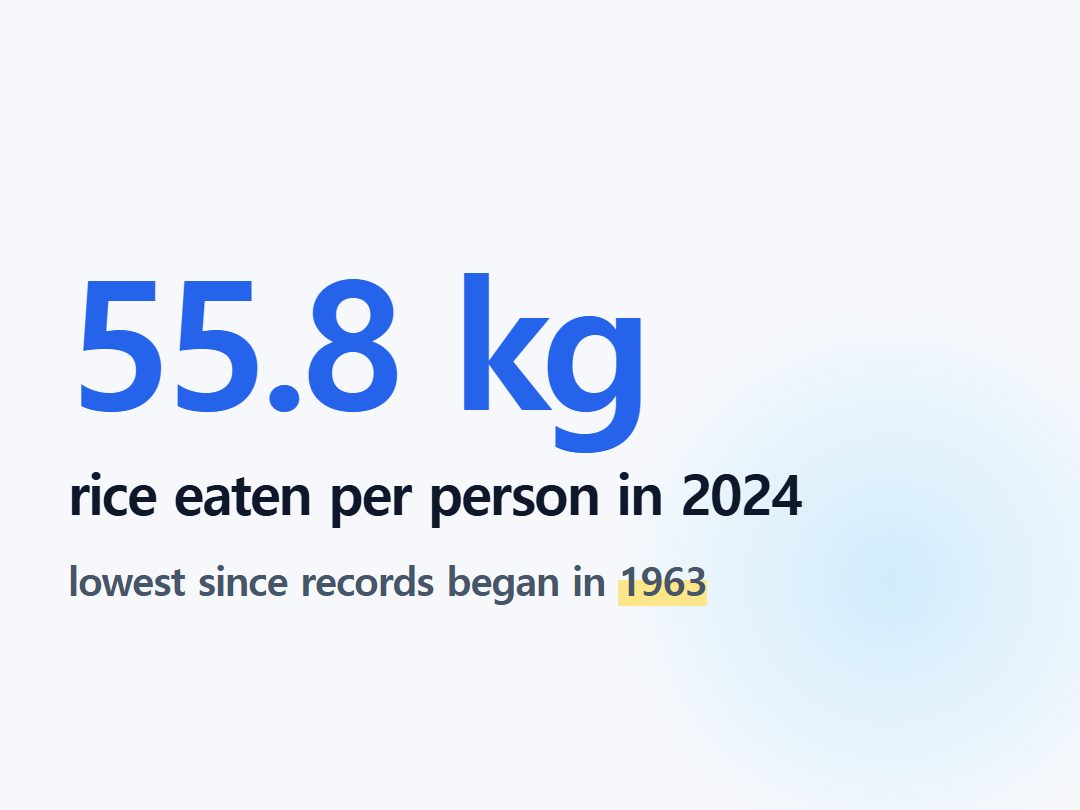
Statistics Korea's annual grain consumption survey put per-capita rice consumption at 55.8 kilograms in 2024 — a record low since the agency began tracking the figure in 1963, and roughly half of what Koreans ate in 1994. Daily rice intake now averages about 152.9 grams, close to a single packet of instant rice.
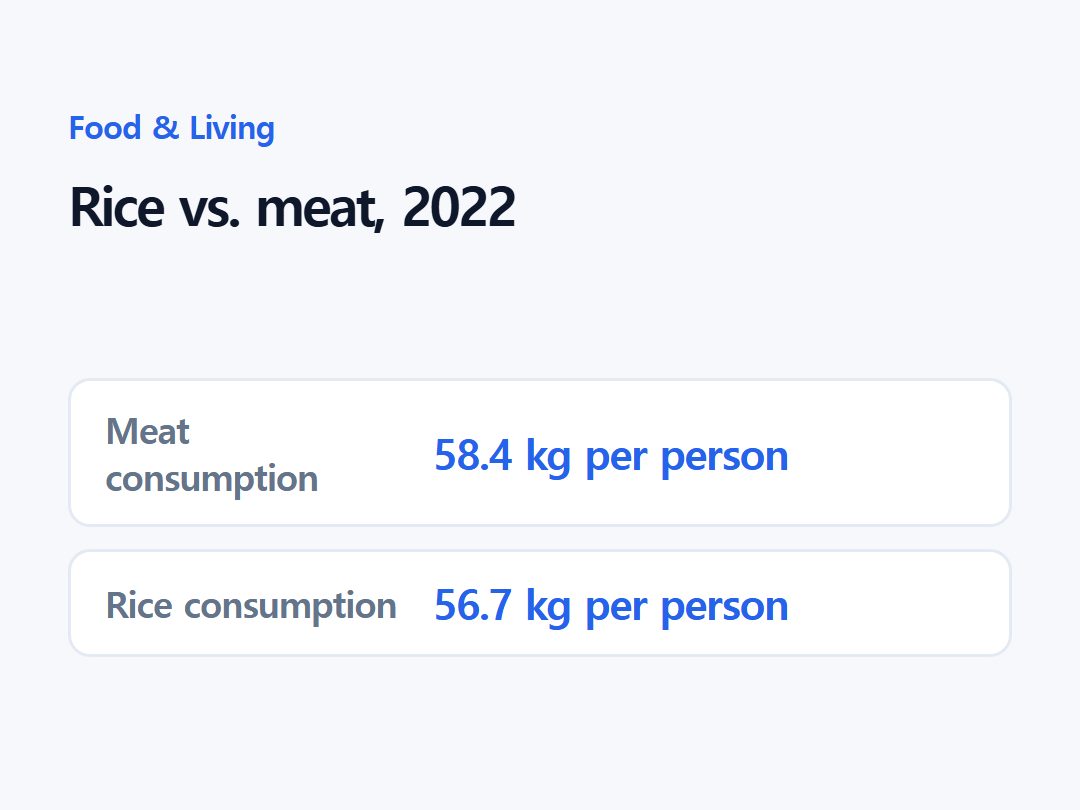
Meat consumption crossed rice consumption for the first time in 2022: per-capita pork, beef, and chicken consumption reached 58.4 kilograms that year against rice's 56.7 kilograms — a reversal that would have been unthinkable a generation ago, when rice was the point of a meal and everything else was a side dish to it.
Convenience stores didn't create the trend — they captured it
Convenience store chains read the skipping data as a market, not a crisis. GS25 launched Milbox25 in December 2021, a corporate breakfast subscription that delivers boxed meals — gimbap (rice and fillings rolled in dried seaweed), sandwiches, salads — to offices before the workday starts.
The service's revenue grew sixfold in the first half of 2023 alone and twentyfold since its 2022 launch year, now serving 962 client organizations. Growth by sector over the past year: office contracts up 33%, government offices up 44%, and schools up 57%.
Individually, chains report that gimbap, boxed lunches, and sandwiches make up a rising share of what they sell between 6 and 10 a.m. — a slot operators now plan product launches around, instead of treating it as leftover morning traffic.
Gimbap shops are closing even as gimbap sales rise
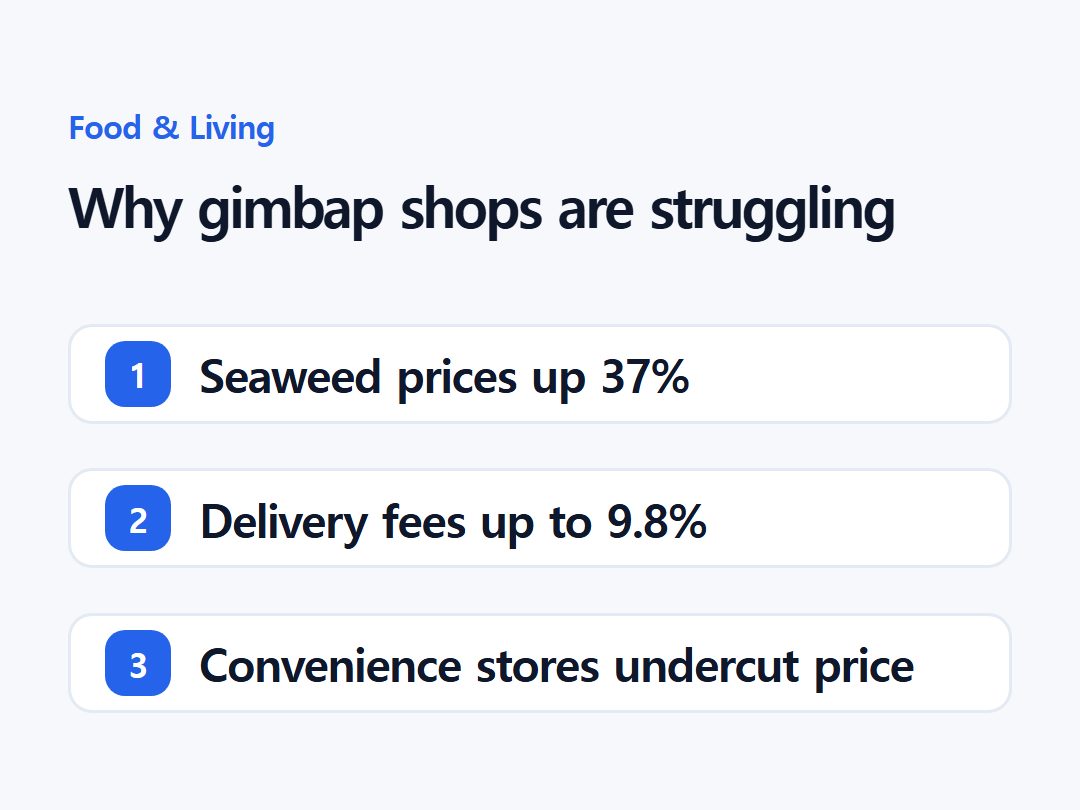
The paradox is that sit-down gimbap restaurants are struggling while gimbap itself is more popular than ever. Statistics Korea counted 46,639 gimbap restaurants in 2022, down 4.6% from 48,898 the year before.
Three cost pressures are squeezing independent shops at once:
- Dried seaweed prices rose 37%, from 990 to 1,360 won per unit
- Delivery-app commissions climbed from 6.8% to 9.8% of each order
- Chinese burdock root, a common filling, spiked to roughly 5,000 won per kilogram
The average price of a roll of gimbap rose 8.4% year-on-year to 3,485 won, and some restaurants now require minimum delivery orders of 20,000–30,000 won just to cover platform fees. Convenience store versions, made at industrial scale without the overhead of a storefront, undercut small operators on price even as their own ingredient costs rise.
Healthy convenience is now its own category
The newest twist is that convenience-store breakfast is being marketed as an upgrade, not a compromise. GS25 introduced two high-protein gimbap varieties and a low-sugar triangle gimbap in 2026, built around roughly 15 grams of protein per item.
The three products sold a combined 2.5 million units in their first three months, and gimbap and triangle-gimbap sales overall rose 25% year-on-year between late April and late July 2026. Protein-drink sales at GS25 overtook the chain's long-standing top seller, banana-flavored milk, for the first time in the first half of 2026.
What hasn't disappeared
None of this means rice is gone from Korean mornings. The 70-and-over generation still skips breakfast at under 5%, and weekend or holiday meals still tend to default to the full bap-guk-banchan format when there is time to cook.
Nutrition researchers who study the data also caution against reading it as total abandonment. For many people, the traditional table hasn't vanished so much as compressed — into rice with a single soup, into porridge, or into a convenience-store gimbap eaten at a desk. These are modern substitutes for the same basic idea, not proof that rice itself has disappeared.
The question still open
What the survey data cannot show is whether this is a life-stage pattern or a permanent generational shift. Korea's 70-plus generation eats breakfast at the highest rate in the country, but they were in their 20s once too.
No published dataset yet lets anyone check whether today's 30-somethings skip breakfast less often than they did in their 20s, or whether the habit simply carries forward as people age, marry, and have children of their own to feed.
Also unresolved is what happens to small gimbap shops if convenience chains keep gaining share of a morning market that is not shrinking, just relocating. The number of people skipping breakfast entirely is rising, but the number of people eating something for breakfast is not obviously falling — it is increasingly being served from a different counter, by a different business, at a different price.
Breakfast-skipping rate by age group (2024 KDCA survey)
| Age Group | Skip Breakfast Rate |
|---|---|
| 70 and up | 4.9% |
| 50s | 25.3% |
| Teens | 35.5% |
| 40s | 39.1% |
| 30s | 46.8% |
| 20s | 62.1% |
| Women in 20s | 67.5% |
Frequently asked
Why are so many Koreans skipping breakfast?
In a survey of breakfast-skippers, 44.9% cited lack of time, 22.5% cited habit, and 15.6% said they simply had no appetite in the morning. Unmarried adults skip breakfast at nearly double the rate of married ones (56.6% vs. 32.1%).
What does a traditional Korean breakfast include?
It's built from bap (steamed rice), guk or jjigae (a hot soup or stew, often doenjang jjigae), and banchan — shared side dishes like kimchi, seasoned vegetables, and grilled fish.
Do Korean convenience stores sell breakfast?
Yes — GS25 launched a corporate breakfast subscription called Milbox25 in December 2021 delivering gimbap, sandwiches, and salads to offices, and its revenue grew twentyfold since launch, now serving 962 client organizations.
Sources
Every factual claim above is traceable. We do not translate articles — we gather facts from multiple outlets and write them ourselves.
- 한국인 35% 아침 식사 걸러…20대 여성은 3명 중 2명 — SBS Biz
- 1인당 쌀 소비량 30년 만에 반토막…하루 '즉석밥 1개' 아래로 — Kyunghyang Shinmun
- Gimbap shops hit by rising costs, booming convenience stores — The Korea Times
- GS25 기업 조식 정기구독 서비스 '밀박스25' 매출 6배 뛰었다 — Financial News
- 간식 구독 기업 늘었다…GS25, B2B 식음 솔루션 사업 20배 성장 — ZDNet Korea
- GS25, '고단백 김밥' 통했다…누적 판매량 150만개 돌파 — ZDNet Korea
- '건강 한 끼'가 대세…GS25 고단백 김밥·저당 삼각김밥 흥행 — Ezy Economy
- 일부 성인에서 라이프스타일에 따른 아침 결식률과 아침결식자의 결식 원인 및 식행동에 관한 조사 — Korea Citation Index (KCI)
- A Traditional Korean Breakfast Features A Variety Of Savory Side Dishes — Tasting Table


