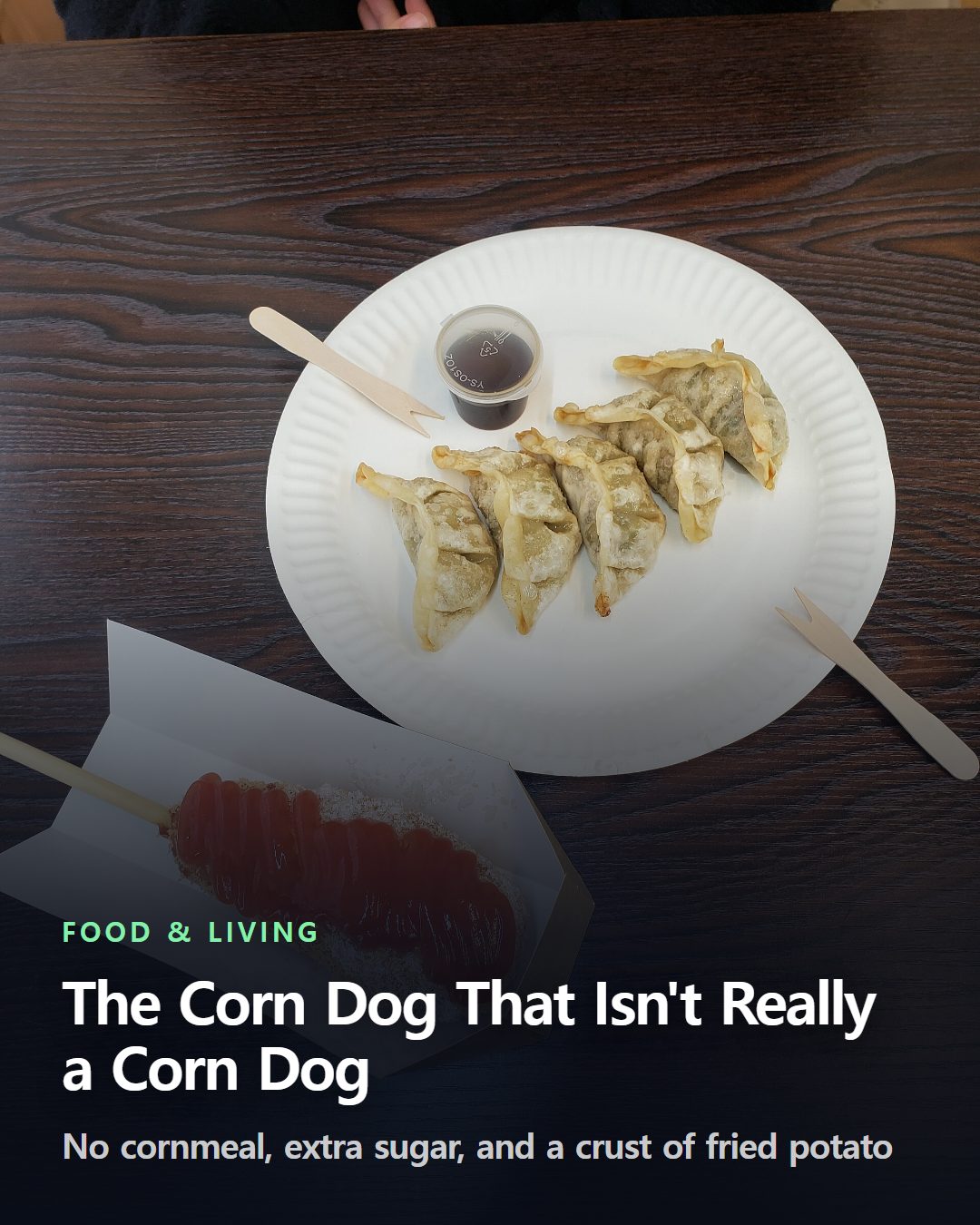
Tourists in Seoul or Busan often stop cold at a street cart labeled "corn dog." What arrives is a stick coated in crunchy diced potato or crushed ramen noodles, dusted in sugar, drizzled with ketchup and mustard, and pulling a rope of melted cheese when bitten. It bears almost no resemblance to the cornmeal-battered dog on a stick sold at an American state fair.
The short version
- Korean corn dogs use yeasted dough, not cornmeal batter, despite the name.
- Myungrang Hotdog's 2016 Busan opening sparked today's franchise-driven corn dog boom.
- A 2021 TikTok video, not the food itself, triggered the US craze.
That gap between the name and the object is not an accident. It comes from a batter swap, a 1990s trick for using up fried potato scraps, and a 2016 franchise race that turned a decades-old street snack into one of Korea's most exported foods.
The corn in the name never made it into the batter
American corn dogs are named for their batter: a cornmeal dough that fries into a dense, slightly gritty shell. Korean corn dogs mostly skip corn entirely.
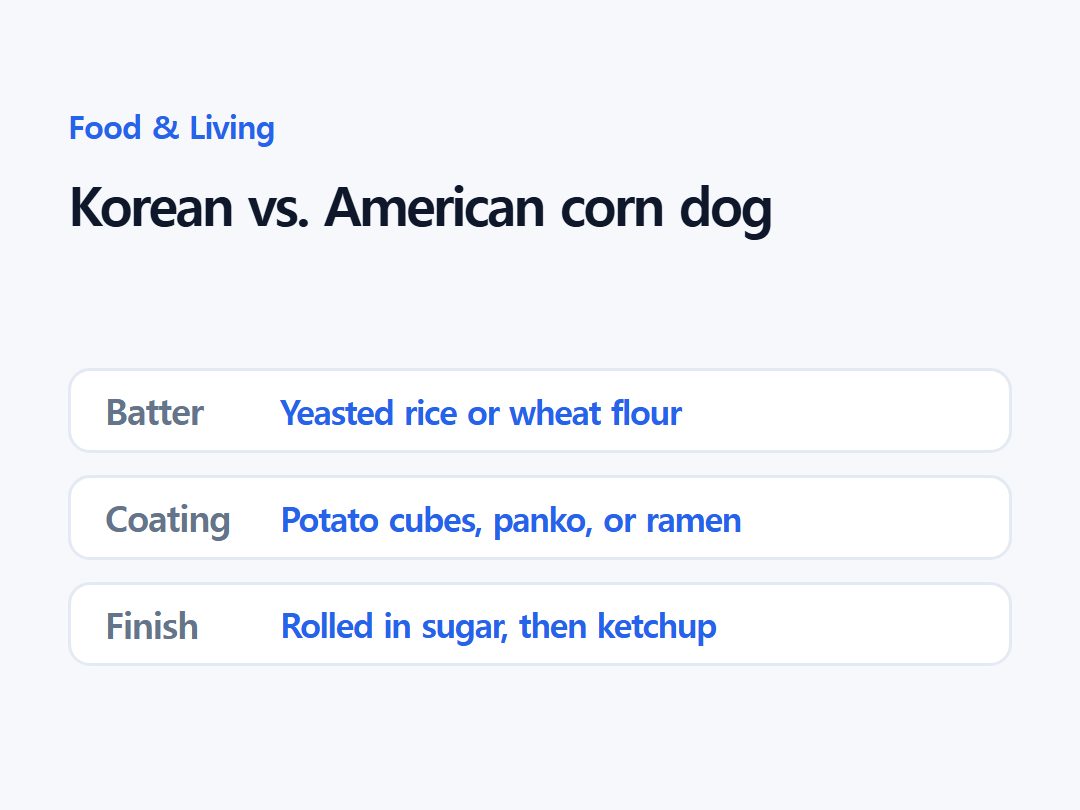
Most vendors and franchises use a yeasted dough made from wheat or rice flour, left to rise before frying. The result is softer and chewier, closer to fried bread than to cornbread, with a more neutral flavor that carries whatever coating goes on top.
| Feature | American corn dog | Korean corn dog |
|---|---|---|
| Batter | Cornmeal | Yeasted rice or wheat flour |
| Texture | Dense, slightly gritty | Soft, chewy, bread-like |
| Typical coating | None | Potato cubes, panko, or crushed ramen |
| Finish | Ketchup and mustard | Sugar plus ketchup and mustard |
Potato cubes turned a snack into "the ugly hot dog"
The most recognizable Korean version presses small cubes of par-boiled potato onto the dough before frying, so the stick comes out lumpy and studded with fries. It's often called gamja hotdog (potato hot dog).
Locals gave it an unflattering nickname long before it went viral: motnani hotdogeu, roughly "the ugly hot dog," for its uneven, bumpy crust. The name stuck even as the snack became one of the most photographed foods in Korean street food guides.
Sugar, ketchup, and mustard go on while it's still hot
After frying, the stick is drained for a few seconds, then rolled in granulated sugar while the surface is still hot enough for it to stick. Ketchup and mustard are added on top of the sugar, not instead of it.
A single bite is built to hit sweet, salty, and savory at once. That layering is specific to the Korean version; American corn dogs are rarely sold with a sugar coating at all.

The cheese pull is the point, not a bonus
Many stalls stuff the sausage core with mozzarella, or replace part of the sausage with a solid block of cheese, so that pulling the stick apart stretches a long, visible cheese strand.
That stretch became a signature shot in Korean food vlogging and mukbang — a genre of video, largely native to Korea, built around watching someone eat, usually a large or visually striking meal.
A corn dog that stretches on camera photographs and films better than one that doesn't, which is part of why the cheese version spread so fast once smartphones and social apps became the main way people discovered street food.
Hot dogs arrived with the U.S. military, corn dogs came later
Sausages entered the Korean diet through American military bases after the 1950–53 Korean War, where surplus U.S. rations shaped dishes still eaten today, including budae-jjigae ("army base stew"), a spicy hot pot built around Spam and hot dogs.
Corn dogs on a stick showed up separately, as a street food in the 1980s, sold from carts near subway stations, schools, and rest stops — decades after hot dogs themselves had already become familiar.
Before it had one name, it had five
Because vendors sold the snack informally for years before any brand claimed it, Korean corn dogs accumulated a pile of regional nicknames rather than one settled name:
- Mandeukee — after a popular 1960s doll, for the snack's round shape
- Motnanee / motnani — "ugly," for the lumpy potato coating
- Dokkebi — "goblin," a folkloric nickname for the same lumpy look
- Gamja or yetnal — "potato" or "old-fashioned," depending on the stall
One Busan market stall started a franchise race
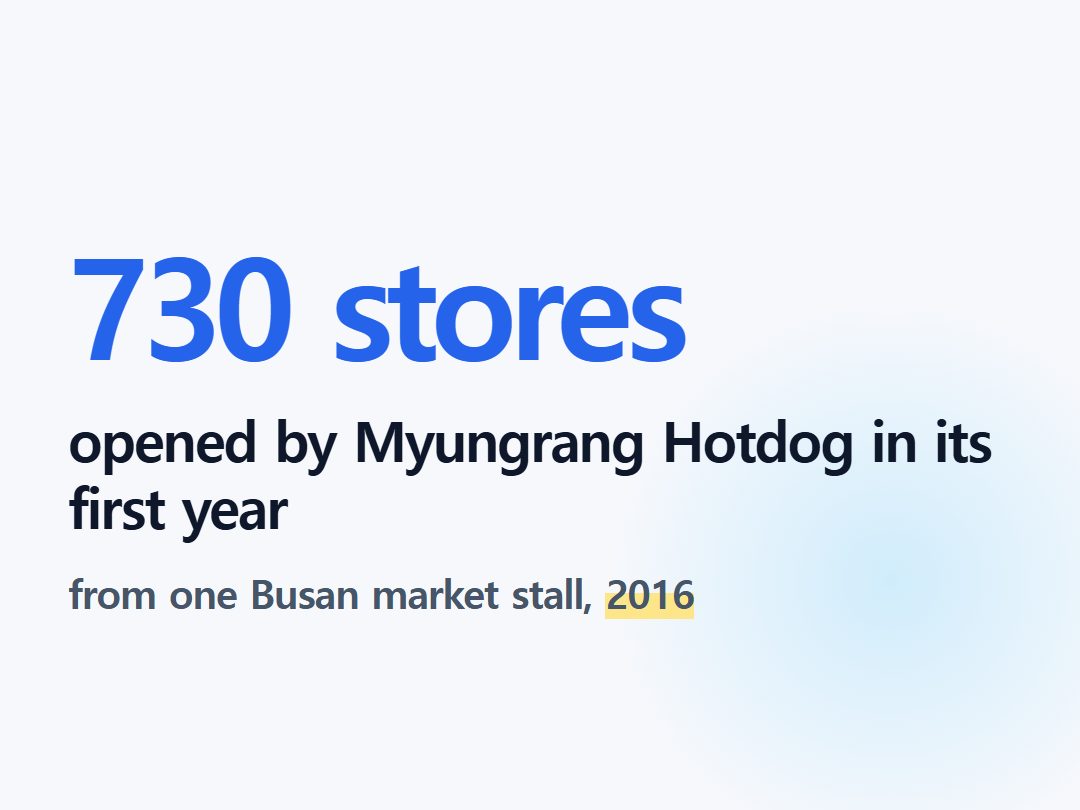
The current wave traces to a single brand. Myungrang Hotdog opened its first location in a market near Pusan National University in Busan in July 2016, selling a rice-batter corn dog cooked to order rather than pre-fried and reheated — a change from how most street vendors had worked for decades.
According to Korean franchise trade coverage, Myungrang opened roughly 730 outlets in its first year, reportedly the fastest store rollout in Korean franchise history, and passed its 1,000th location by September 2018. The company's own materials cite more than 650 shops and over 80 million corn dogs sold across seven countries since.
A TikTok video did what a decade of exports could not
Korean corn dogs had already reached the United States in small numbers before 2021 — Myungrang began its U.S. rollout in Georgia in 2018 — but the snack was still a niche curiosity outside Korean-American neighborhoods.
That changed in June and July 2021, when creator @dee.045 posted taste-test videos of the cheese-pull version that drew millions of views. The hashtag #koreancorndog has since passed 600 million views on TikTok.
The New York chain Two Hands opened its first U.S. store in Manhattan's East Village that same spring, then a second location in Soho within weeks, and had more than ten outlets across New York, Arizona, California, and Texas by that summer.
The trend outlasted the hype
Viral food trends usually fade once the novelty wears off in major coastal cities. This one kept spreading instead: Two Hands opened in West Little Rock, Arkansas, in 2023, and other chains have since landed in markets like suburban Michigan and Phoenix.
That pattern — a franchise-driven expansion into secondary U.S. cities years after the original TikTok spike — is closer to how a fast-food category grows than how a single-season food fad usually behaves.
There is no single "authentic" recipe
Unlike dishes with a codified regional origin, the Korean corn dog never had one inventor or one fixed formula. Batter ratios, coatings, and sausage-to-cheese ratios differ by stall and by franchise, and new versions — squid-ink batter, Hot Cheetos coating, crushed ramen crust — keep getting added without displacing the older ones.
There's also an unresolved question of framing: because the core ingredients (the sausage, the concept of frying on a stick) arrived via American military supply chains, some food writers treat the snack as an adapted import rather than a traditional Korean food, even though the rice batter, potato coating, and sugar finish are Korean innovations with no American equivalent.
Common questions about Korean corn dogs
Is it always made with rice flour? Not exclusively — many recipes and franchises use wheat flour or a wheat-rice blend; rice flour is common but not universal.
Why is it rolled in sugar? The sugar is added immediately after frying, while the surface is still hot enough to make it stick, producing the sweet-salty-savory combination that distinguishes it from the plain American version.
Where did the potato-cube version come from? It dates to the 1990s, when vendors began pressing cubed potato onto the dough before frying, giving the snack its lumpy texture and the "ugly hot dog" nickname.
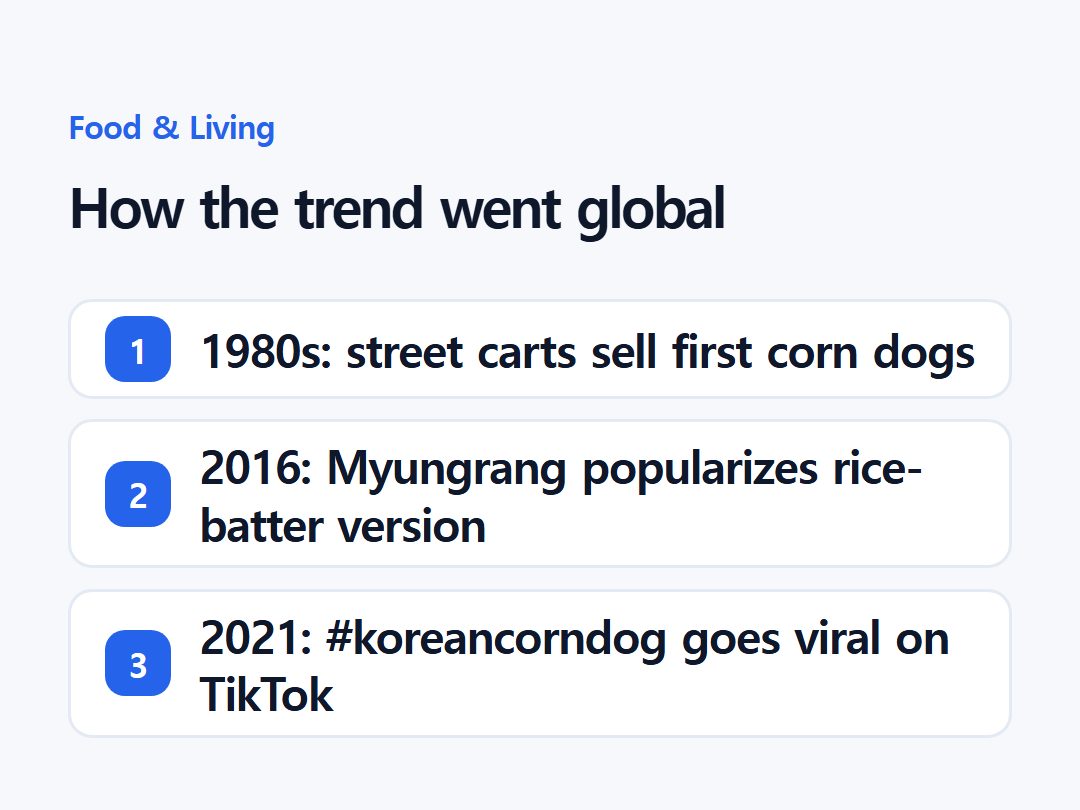
Timeline: from Busan street stall to US franchise boom
| Year | Event |
|---|---|
| 1980s | Sold as street food from carts near subway stations, schools, and rest stops |
| 1990s | Vendors start pressing cubed potato onto the dough, creating the "ugly hot dog" |
| July 2016 | Myungrang Hotdog opens its first store in a Busan market |
| 2018 | Myungrang begins its U.S. rollout in Georgia; passes 1,000 locations by September |
| 2021 | TikTok creator @dee.045's videos help #koreancorndog pass 600 million views |
| 2023 | Two Hands opens in West Little Rock, Arkansas, showing the trend spreading past coastal cities |
Frequently asked
Why do Korean corn dogs taste sweet?
Vendors roll the fried stick in sugar right after frying, while it's still hot enough to stick, then add ketchup and mustard on top.
What is a Korean corn dog made of?
Most use a yeasted wheat or rice flour dough coated in diced potato, panko, or crushed ramen, rather than the cornmeal batter used in American corn dogs.
When did Korean corn dogs go viral in the US?
The cheese-pull version took off in June and July 2021 after creator @dee.045 posted taste-test videos on TikTok, and #koreancorndog has since passed 600 million views.
Sources
Every factual claim above is traceable. We do not translate articles — we gather facts from multiple outlets and write them ourselves.
- What Exactly Is A Korean Corn Dog? — The Daily Meal
- Korean Vs American Corn Dogs: What's The Difference? — Food Republic
- Ultimate Korean Corn Dog Guide 2026 — Edible LA
- Everything You Need to Know About Gamja Hot Dogs, or Korean Corn Dogs — Bokksu Market
- The History of Korean Corn Dogs: From Korea to America — Ugly Donuts & Corn Dogs
- Myungrang Hotdog - Korea's famous franchise of Corn Dog — Look at Korea
- About Us — Myungrang Hotdog UK
- Korean corn dogs are, frankly, a hit from N.Y. to Kansas — NBC News
- These Korean corn dogs are all the rave this summer — Time Out New York
- Korean-style corn dog chain Two Hands coming to West Little Rock — Arkansas Times


