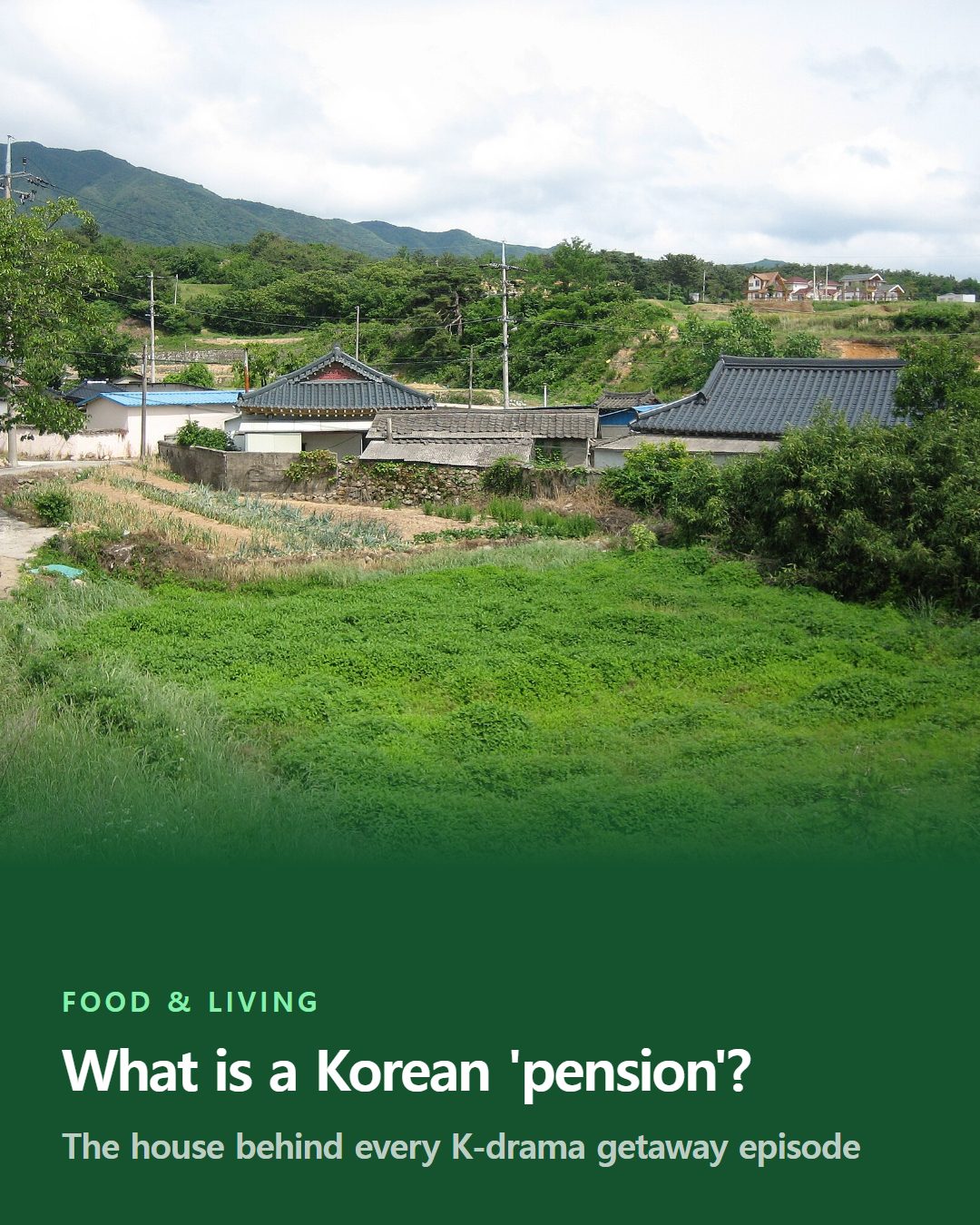
A Korean drama's vacation episode nearly always ends the same way: the whole cast piles into a countryside house with a wraparound deck, a fire pit, and a kitchen big enough for everyone to cook together. That house is called a pension (펜션), and it is not a mistranslated hotel or a generic cabin. It is its own accommodation category, built for a specific kind of Korean trip.
The short version
- A pension is Korea's family-sized countryside rental, priced per unit, not per guest.
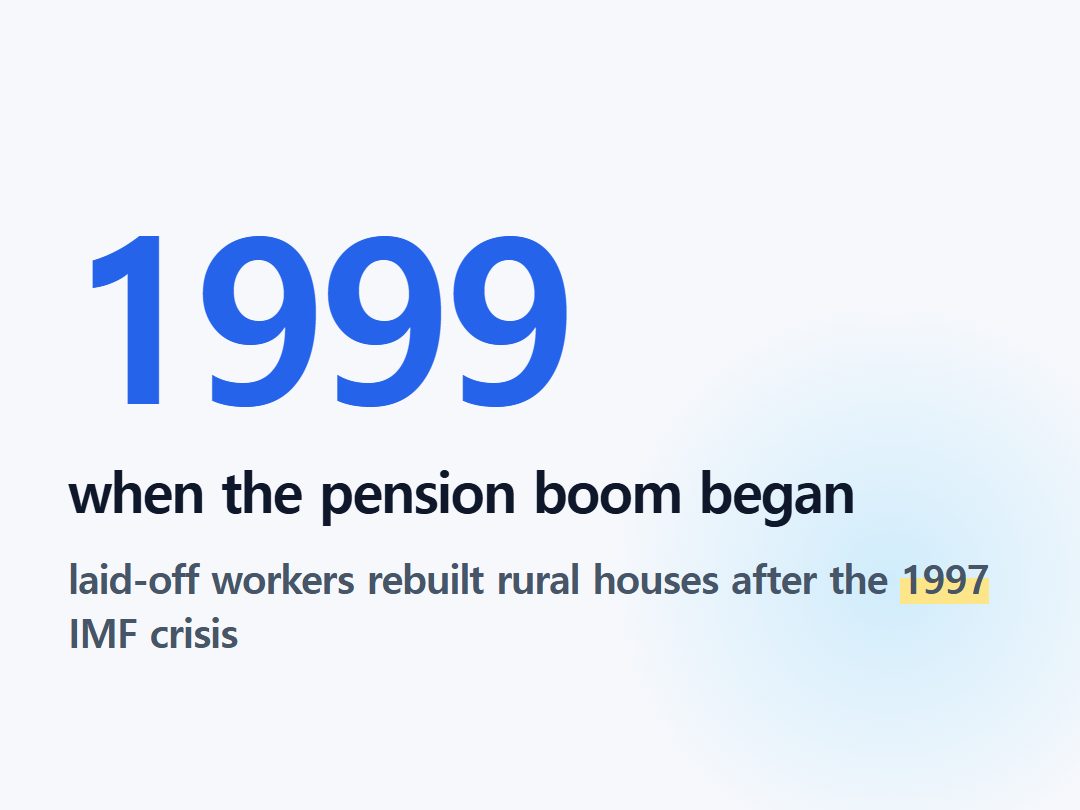
- The name comes from severance pensions IMF-crisis workers used to build them in 1999.
- Anyone can call a building a pension — the name carries no legal certification.
International viewers tend to read past the word, assuming it means guesthouse in general. Korean viewers read it as a signal: family trip, work retreat, ensemble drama, reality show. The pension tells the audience what kind of story is about to happen, before a single line of dialogue explains it.
It is a trope common enough that Korean viewers barely register it, the way American audiences don't register a diner scene as a choice.
A whole house, rented by the room count, not by the guest
A hotel charges per person, per night, for a room you sleep in. A pension charges per building or per unit, regardless of how many people fill it.
That single difference explains most of what makes a pension a pension: a private kitchen for cooking your own meals, a bathroom that is not shared with strangers down the hall, and often a heated ondol floor — the traditional Korean underfloor heating system still used in many rooms designed for sleeping on a mat rather than in a bed.
A group of six friends splitting one pension unit pays a fraction of what six separate hotel rooms would cost. That math, more than any aesthetic, is the entire business model.
Pension, minbak, or guesthouse: who each one is actually for
Korea has three overlapping rural lodging words, and international travel sites often use them interchangeably. They are not the same audience.
- Minbak — a spare room in someone's home, the oldest and cheapest option, still common near beaches and mountains.
- Guesthouse — skews heavily toward foreign backpackers and solo travelers, often clustered near tourist districts.
- Pension — built for domestic families and friend groups, and still the single largest lodging category Korean travelers themselves choose.
The categories blur in practice — many rural minbak simply brand themselves as pensions to sound more upscale — but the target guest rarely does.
The name is a pun on a retirement fund, not a French inn
The word did travel from continental Europe, where a pension describes a small family-run inn, often one offering meals alongside a room. But Korean usage layered a second meaning on top.
펜션 is also the ordinary Korean word for a retirement pension — the lump-sum or monthly payout someone receives after leaving a job. That overlap is not a coincidence. It is the origin story.
Built by laid-off office workers after the 1997 crisis
In 1997, South Korea entered a severe currency and debt crisis and accepted an emergency loan from the International Monetary Fund (IMF), a period Koreans still refer to simply as the IMF crisis. Mass layoffs followed, and hundreds of thousands of workers left companies with a lump-sum severance payout instead of a job to go back to.
Starting around 1999, architects began marketing a specific idea to those newly unemployed and retired workers: buy a rural plot, build a small Western-style lodge, and rent it to weekend travelers from the city. Many used their severance and retirement money to do exactly that.
The buildings that resulted came to be called by the same word as the money that built them, and the label stuck even as the original retiree-owners were gradually joined by professional operators.
One roof, two different Korean regulations
A building that looks like a pension can legally fall under either of two separate systems, and most guests never notice the difference.
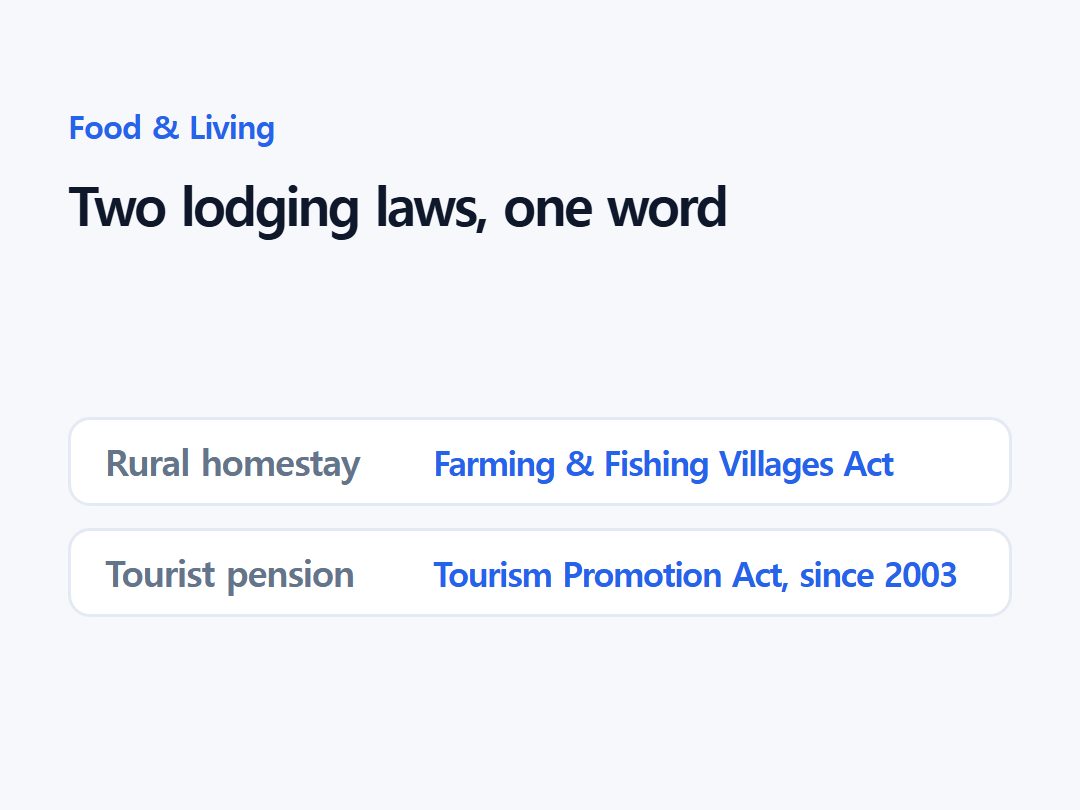
- Rural homestay (농어촌민박), regulated under the Farming and Fishing Villages Improvement Act, open only to residents of a rural area who have lived there at least six months, in a house under 230 square meters.
- Tourist pension business (관광펜션업), regulated under the Tourism Promotion Act since 2003, a separate certification that requires a building permit review and local government sign-off — but in exchange unlocks government tourism-development loans.
A rural homestay operator can apply to also be certified as a tourist pension. Plenty never bother, since the word pension itself carries no legal requirement on its own.
Why the ensemble cast always lands at a pension
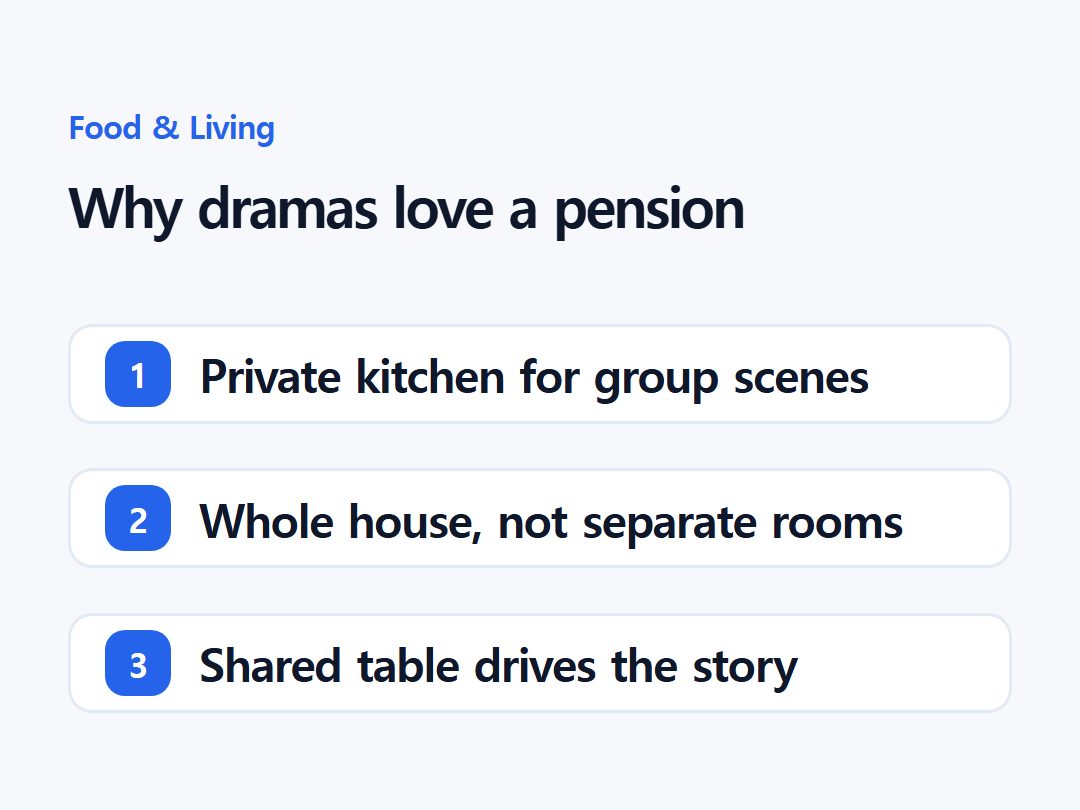
Production logic reinforces the cultural one. Renting one pension gives a full cast a single private space with a shared kitchen and living room, instead of scattering actors across separate hotel rooms with no natural place to film group scenes.
That is also why Korean variety shows lean on the same format so heavily. Group-trip programs such as House on Wheels, Korean Hostel in Spain, and Reckless but Happy are built entirely around a cast sharing one lodging, cooking together, and talking late into the night.
Drama productions borrow the same trick for bonus content — a camping or pension special between seasons, the way Hospital Playlist released one to bridge its two runs. It gives fans the cast's off-screen chemistry in a setting a hotel simply cannot stage.
Most of these properties never appear on international booking platforms at all — they are listed only on Korean apps like Naver Map and Kakao Map. That is a large part of why the trope is invisible abroad: the buildings international viewers are watching on screen are, for practical purposes, unbookable and unsearchable from outside Korea.
What a night actually costs
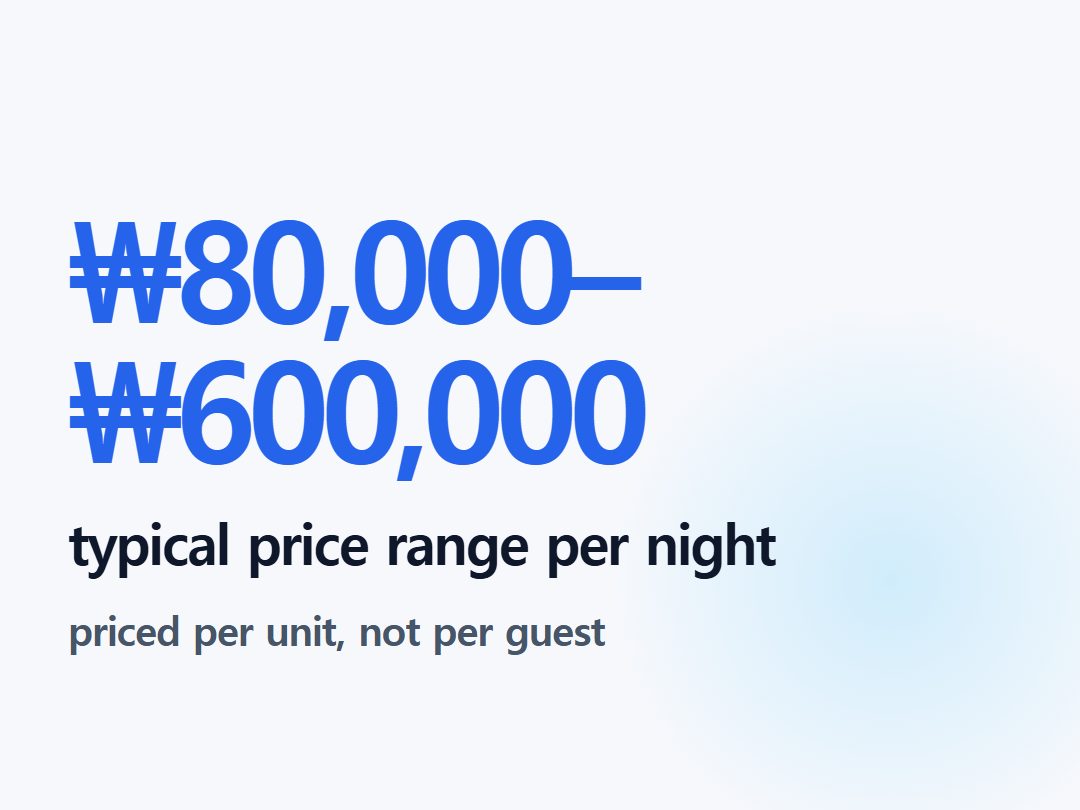
Pension pricing swings enormously by type and region. A standard ondol room commonly runs roughly ₩80,000 to ₩130,000 a night, while themed or pool-villa pensions can climb past ₩300,000 to ₩600,000.
The variety is part of the pitch. Owners market their properties by theme rather than by star rating:
- Pool villa pensions with private pools and mountain or ocean views
- Jjimjilbang pensions with a private sauna room built into the unit
- Kids pensions styled like a small theme park for families
Because the space is rented whole, most also rent barbecue equipment separately — samgyeopsal (grilled pork belly) cooked on an outdoor grill is close to a default activity for a pension weekend, and some owners will prepare a full meal for an extra fee.
Weekday and off-season rates typically undercut weekend prices by a wide margin, since demand for a pension weekend concentrates almost entirely around Friday and Saturday nights.
A label with no legal weight
Here is the part that surprises most first-time visitors: putting the word pension on a sign does not require any certification at all. The same is true of the word hotel in Korea, where uncertified buildings use the name freely with no legal consequence.
The Standard Korean Dictionary itself defines a pension loosely, as a small-scale, upscale lodging with the atmosphere of a home and the convenience of a hotel — a description of a feeling, not a regulated standard a building inspector could check.
Does the pension sign mean it's officially certified?
Usually, no. A building calling itself a pension is very likely operating as either an uncertified rental house or a registered rural homestay, not the smaller, separately certified tourist-pension category.
That gap is still unresolved in practice. Quality, safety standards, and amenities can vary sharply between two properties advertising the identical word, and nothing on the sign outside tells a guest which regulatory category — if any — actually applies.
Korea's three rural lodging types
| Type | Typical guest | Note |
|---|---|---|
| Minbak | Budget travelers | Spare room in someone's home; oldest, cheapest, common near beaches and mountains |
| Guesthouse | Foreign backpackers, solo travelers | Clustered near tourist districts |
| Pension | Domestic families and friend groups | Korea's single largest lodging category |
Frequently asked
What is a pension in Korea?
A pension is a whole-house countryside rental charged per building or unit rather than per guest, usually with a private kitchen and often ondol floor heating.
Is a pension the same as a hotel or guesthouse in Korea?
No — hotels charge per person per room, guesthouses skew toward foreign backpackers, and a pension is built for domestic families and friend groups renting a whole unit together.
How much does a pension cost per night in Korea?
A standard ondol room commonly runs about ₩80,000 to ₩130,000 a night, while themed or pool-villa pensions can climb past ₩300,000 to ₩600,000.
Sources
Every factual claim above is traceable. We do not translate articles — we gather facts from multiple outlets and write them ourselves.
- Pensions — Korea Tourism Organization
- How to Pension: A guide to pensions in South Korea — South of Seoul
- 펜션 (Pension) — NamuWiki
- The 12 Types of Korean Hotels Explained — Hidden Lanes
- 농어촌민박사업 시행지침 — Ministry of Agriculture, Food and Rural Affairs
- 농어촌민박사업과 관광펜션업의 기준 — 인권 행정사사무소


