If you've watched more than a handful of Korean dramas, you've probably seen one without knowing there's a word for it: a hidden twin nobody mentioned for twenty years, a chaebol heir who turns out to be the poor heroine's long-lost brother, a villain who survives a fall from a cliff only to return with a new haircut and zero recognition from anyone who loved them.
Korean viewers have a specific term for this style of storytelling — makjang (막장) — and it comes loaded with judgment. Calling a drama "makjang" is simultaneously an insult and a genre label. It is also, more often than not, a prediction that the show will be a ratings hit.
The short version
- Makjang means over-the-top Korean drama plots: birth secrets, revenge, faked deaths.
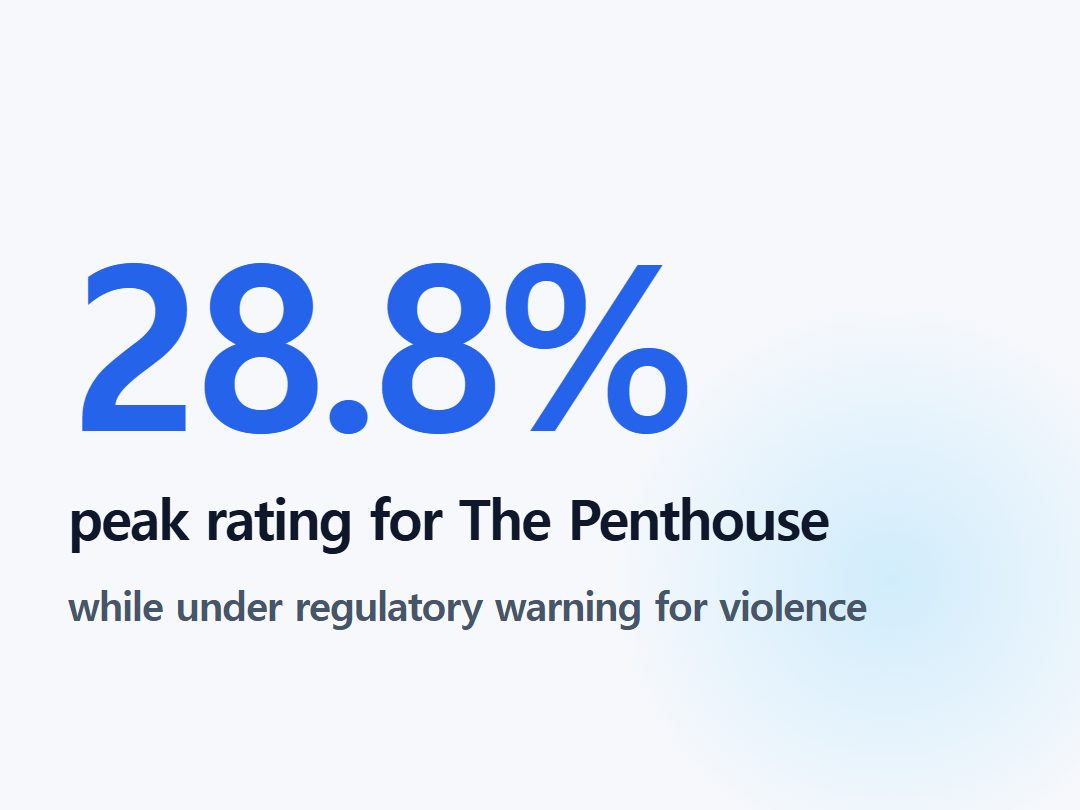
- The Penthouse hit 28.8% ratings despite an official regulator warning.
- Netflix's $2.5 billion K-drama push is spreading makjang into global hits.
Even the dictionary calls makjang implausible
Makjang is not a single show or a recent trend — it's a decades-old, still-thriving category of Korean television defined by extreme, implausible plotting deployed for maximum emotional impact.
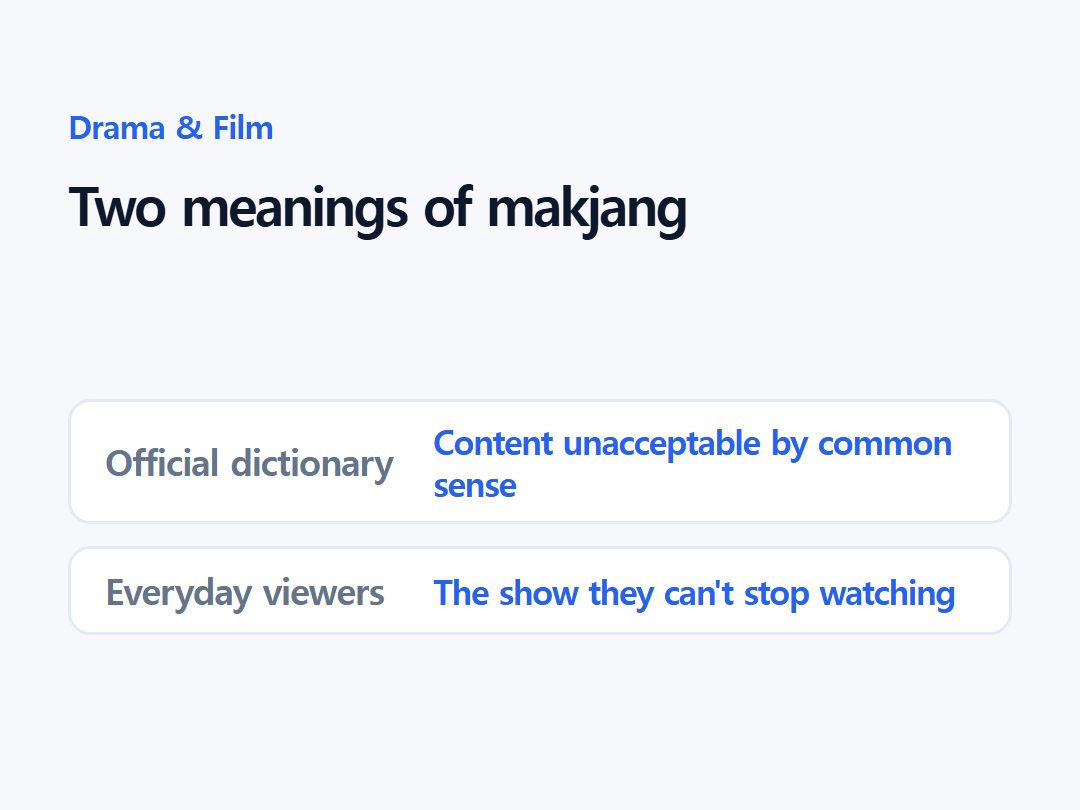
According to South Korea's National Institute of the Korean Language, the term officially describes drama content that is "difficult to understand or accept by the common sense and moral standards of ordinary people." That's a government-backed dictionary essentially defining a genre as things that shouldn't happen but do, repeatedly, on primetime television.
What makes makjang worth explaining to international readers isn't the plot twists themselves — birth secrets, faked deaths, affairs, revenge — those exist in melodrama everywhere.
It's the fact that in Korea, the word is used constantly, by critics and casual viewers alike, as a kind of shorthand insult that nobody actually treats as a reason to stop watching.
Some of the country's highest-rated television dramas of all time are makjang dramas, and everyone involved — networks, writers, audiences, regulators — knows it.
Why do Koreans watch what regulators condemn?
To understand why this matters, you first have to understand what the word is actually doing. "Makjang" isn't a formal genre category that networks pitch in advance; it's a label that gets applied, usually with a roll of the eyes, after a drama has already hooked its audience.
Linguistically, the term is widely understood to be a blend of two other Korean words: kkeutjang (끝장, "the absolute end") and majimak (마지막, "the last one") — evoking the idea of a story that has gone as far as it possibly can.
It also echoes an older, literal meaning of makjang as the farthest, deepest end of a coal mine shaft — a dead end with nowhere left to go. Either way, the imagery is the same: a story that has run out of restraint.
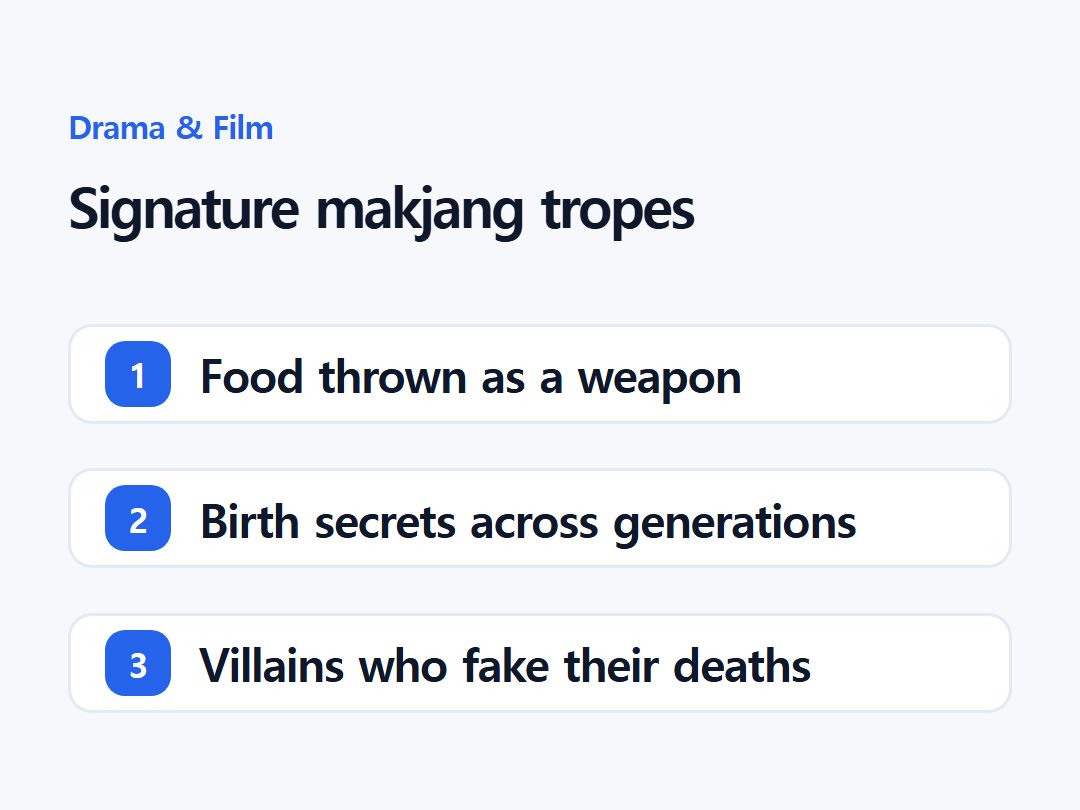
In practice, makjang dramas share a recognizable toolkit. Food gets thrown as a weapon — the so-called "kimchi slap," popularized by the 2014 daytime drama Everybody Say Kimchi, has since been followed by attacks involving kimbap, fermented soybean paste, and slices of grilled pork belly.
Characters fake their own deaths and return unrecognized after little more than a wig change. Wealthy families conceal birth secrets that unravel across a hundred episodes. Amnesia, secret siblings, and courtroom-adjacent revenge plots are standard. None of it is meant to be realistic — it is meant to be felt.
This is where the genre's double reputation comes from.
Korean critics and cultural commentators regularly complain that broadcasters lean on makjang because it's a cheap, reliable way to inflate ratings rather than invest in better writing — and that criticism has some institutional backing: South Korea's broadcasting regulator, the Korea Communications Standards Commission, has formally sanctioned makjang dramas over the years for content deemed excessive for their broadcast rating, including issuing an official warning over a school-bullying storyline in the 2020 hit The Penthouse: War in Life after the show drew more than 200 public complaints.
That warning wasn't symbolic — it cost the broadcaster SBS points on its next license renewal review.
And yet, at the exact same time The Penthouse was being sanctioned, it was breaking ratings records.
Its first-season finale hit a nationwide viewership rating of 28.8 percent — a figure so high it made the show the first miniseries in five years to cross 30 percent viewership at its peak episode on Korean terrestrial television. That is not a niche guilty-pleasure audience.
In a country with dozens of channels and endless streaming options, roughly one in three households with a television on was watching. This is the paradox international readers most often miss: makjang isn't a fringe genre that somehow survives despite disapproval.
It is frequently the single most-watched thing on Korean television, disapproved of by the very people who can't stop watching it.
From marital affairs to record-breaking cable dramas
The genre traces back to the early 2000s, with dramas like Autumn in My Heart (2000) often cited as an early template for the emotionally maximalist style that would later curdle into full makjang.
But the label and the format really solidified in the mid-2000s, when dramas such as Temptation of Wife (2008-2009) built entire storylines around infidelity, betrayal, and revenge, and became genuine ratings phenomena — popular enough in China and Mongolia that the lead actress went on to a career in Chinese television.
Academic research on the genre, published in the Journal of Japanese and Korean Cinema, describes makjang's rise as a deliberate competitive strategy: as more channels fought for the same audience, provocative, twist-heavy plotting became a way for broadcasters to differentiate their dramas and lock in viewers, particularly older, loyal daytime and weekend audiences.
The 2010s brought a shift upmarket.
Cable and streaming-adjacent channels like JTBC began applying makjang's emotional intensity to more "prestige" settings — private education, elite wealth, corporate succession — rather than just marital affairs. SKY Castle (2018-2019), about parents obsessing over getting their children into Korea's top universities, started with a modest 1.7 percent rating and climbed to a cable-record 23.78 percent by its finale, a number that stunned an industry used to cable dramas topping out in the single digits.
That record didn't last long: JTBC's own The World of the Married, a Korean adaptation of the BBC's Doctor Foster centered on a marriage collapsing into betrayal and revenge, ended its 2020 run with a 28.37 percent rating — still the highest rating any drama has recorded on Korean cable television.
Then came The Penthouse trilogy (2020-2021), written by Kim Soon-ok, a screenwriter already known in the industry for her makjang credentials.
It combined the wealth-and-status obsession of SKY Castle with the domestic betrayal of The World of the Married and pushed both further — chaebol families, faked deaths, framed murders, competitive private schooling — while simultaneously drawing regulatory warnings for its violence.
The show became both the clearest recent example of makjang's ratings power and a case study in how far the genre could go before Korean broadcast regulators stepped in.
Is Netflix quietly exporting makjang to the world?
The most significant shift underway is that makjang is no longer just a domestic phenomenon.
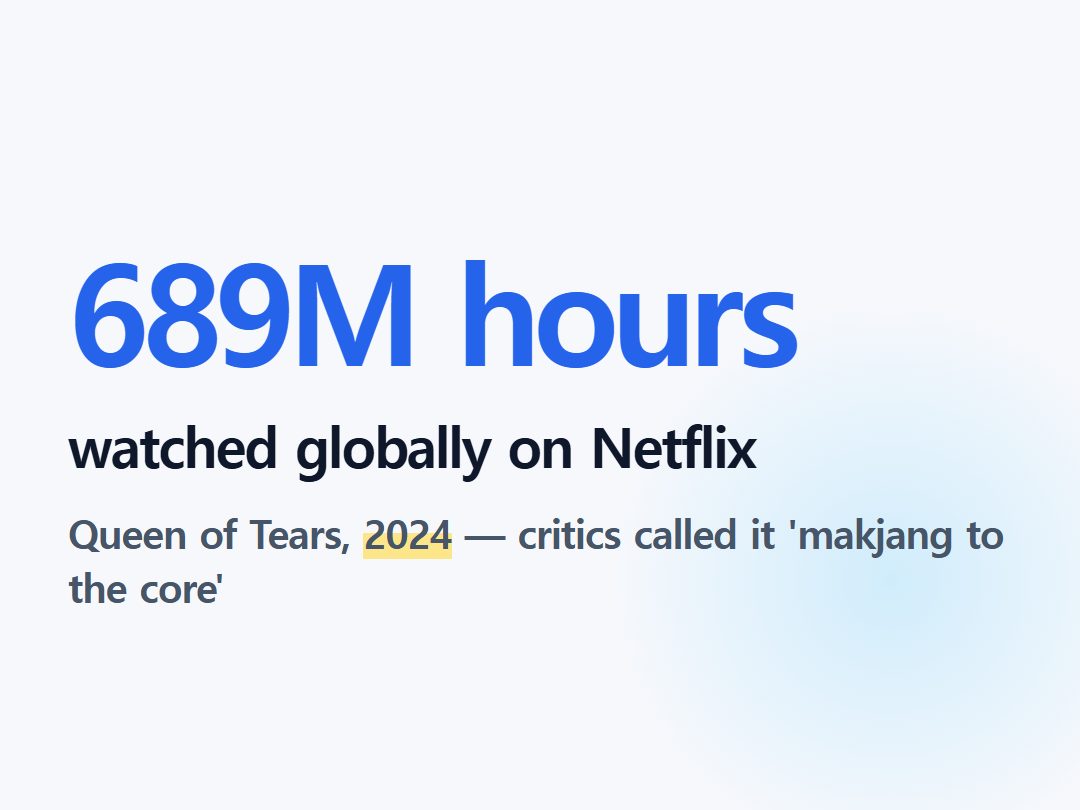
As Netflix has poured investment into Korean content — reportedly committing around $2.5 billion to Korean productions between 2024 and 2028 — makjang plotting has started showing up inside glossier, internationally exported dramas rather than staying confined to daytime soap operas. Queen of Tears (2024), starring Kim Soo-hyun and Kim Ji-won, became the most-watched Korean drama on Netflix in the first half of 2024, logging roughly 689 million viewing hours worldwide.
It's marketed internationally as a romance, but Korean recap outlets like Dramabeans tracked its back half turning increasingly "makjang" — corporate succession battles, a scheming in-law family, and revenge plotting layered underneath the central love story — with one recap warning readers they had "entered makjang territory" whether they'd signed up for it or not.
That hybridization looks likely to continue: industry coverage of the genre in 2025 pointed to makjang increasingly blending with thriller, fantasy, and other genres as producers look for ways to keep the format's emotional hooks while giving it broader export appeal.
For international readers, that means the tropes explained here — the birth secrets, the food-as-weapon fights, the impossible returns from the dead — are likely to keep surfacing in future Netflix hits, even when the marketing calls them romance or thriller rather than makjang.
What remains unresolved is whether Korean regulators and critics will keep treating the genre as a problem to be managed even as it becomes one of the country's most successful cultural exports — a tension that, fittingly, is itself very makjang.
Makjang's ratings escalation over two decades
| Drama | Years | Peak Metric | Note |
|---|---|---|---|
| Autumn in My Heart | 2000 | — | Early template for the emotionally maximalist style |
| Temptation of Wife | 2008-2009 | — | Infidelity/revenge plot became a ratings phenomenon |
| SKY Castle | 2018-2019 | 23.78% | Cable-record rating, up from a 1.7% start |
| The World of the Married | 2020 | 28.37% | Still the highest rating on Korean cable |
| The Penthouse: War in Life | 2020-2021 | 28.8% | First miniseries in 5 years to cross 30% at its peak episode |
| Queen of Tears | 2024 | 689 million viewing hours | Most-watched Korean drama on Netflix, H1 2024 |
Frequently asked
What does the word makjang mean?
It's widely understood as a blend of kkeutjang ("the absolute end") and majimak ("the last one"), evoking a story that's gone as far as it can — it also echoes an older meaning of makjang as the deepest, dead-end shaft of a coal mine.
What is the highest-rated makjang drama in Korea?
The Penthouse: War in Life hit a 28.8 percent nationwide rating, the first miniseries in five years to cross 30 percent at its peak episode, while The World of the Married still holds the record for Korean cable at 28.37 percent.
Is Queen of Tears considered a makjang drama?
It's marketed internationally as a romance, but Korean recap outlets like Dramabeans tracked its back half sliding into "makjang territory," with corporate succession battles, a scheming in-law family, and revenge plotting layered under the love story.
Sources
Every factual claim above is traceable. We do not translate articles — we gather facts from multiple outlets and write them ourselves.
- 'Penthouse: War in Life' rating climbs amid criticism of 'disturbing' storyline — The Korea Times
- 'The Penthouse: War in Life' gets 28.8% viewership rating, content warning from regulator — The Korea Herald
- Why is K-drama The Penthouse so addictive? From kimchi slap to strangling, all there is to know about 'makjang' dramas — South China Morning Post
- "SKY Castle" Sets New Record For Highest Ratings In Cable Network History With Final Episode — Soompi
- 'The World of the Married' sets ratings record for cable drama — The Korea Herald
- Changes and continuities of Makjang drama in the Korean broadcasting industry — Journal of Japanese and Korean Cinema
- [Beanie Review] Queen of Tears — Dramabeans
- 'Queen of Tears' ranks as most watched Korean series on Netflix in first half of 2024 — Korea JoongAng Daily