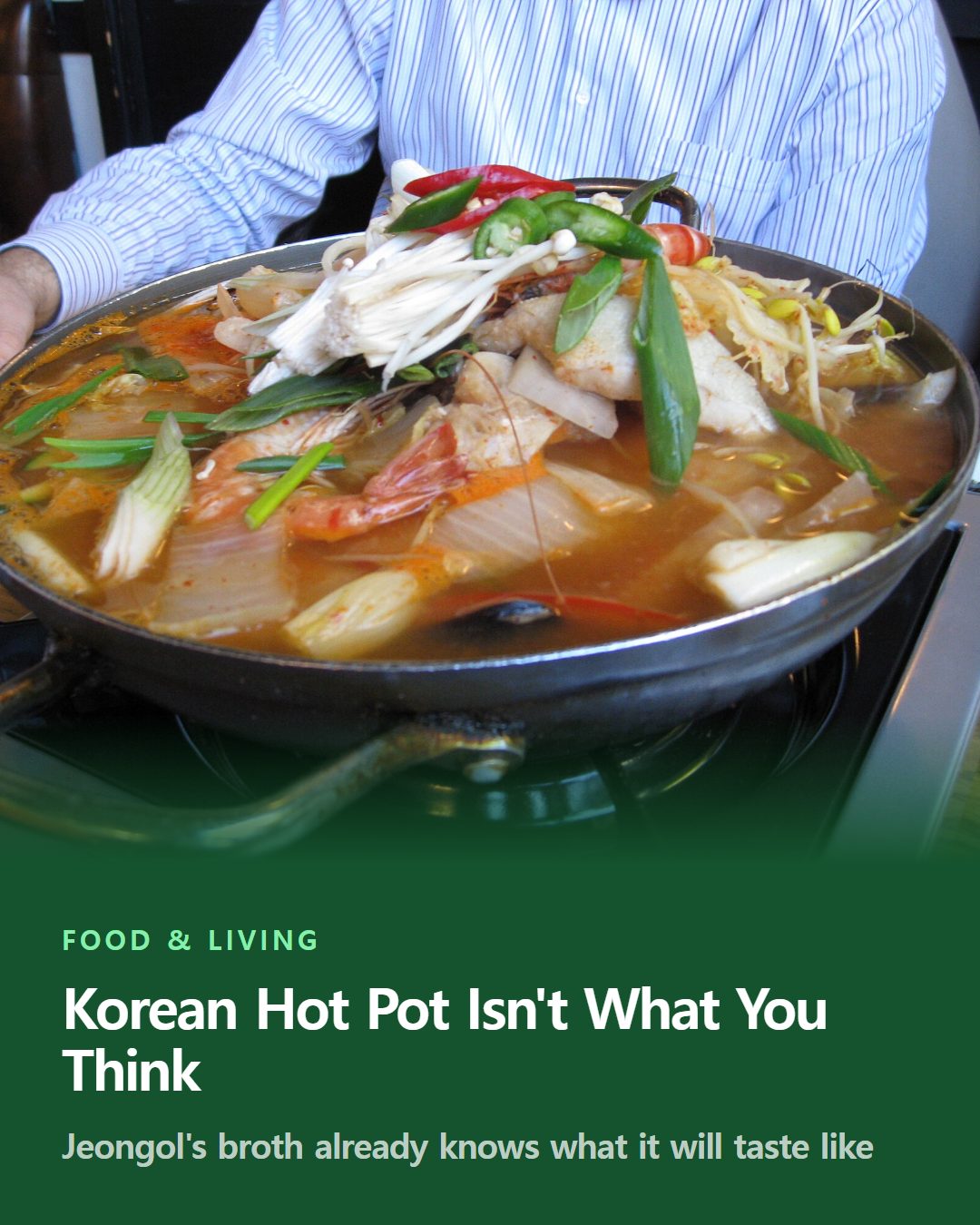
Jeongol (전골) is the Korean word closest to "hot pot" — a dish where meat, seafood, mushrooms, and vegetables are arranged in a wide, shallow pot, covered in broth, and simmered right at the table. It belongs to the same global family as Japanese nabe and Chinese huoguo: all three are communal, one-pot meals cooked and shared together, usually in the colder months.
The short version
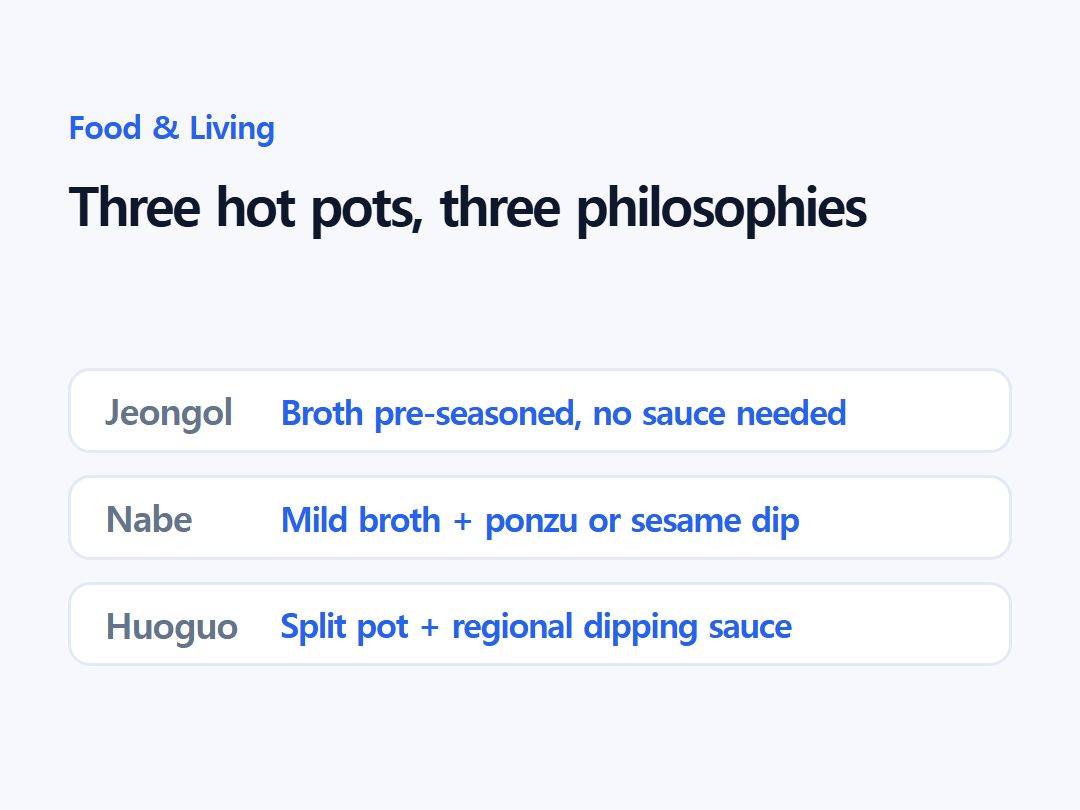
- Jeongol's broth is pre-seasoned, so no dipping sauce is needed at the table.
- Nabe uses mild broth with dipping sauces; huoguo often splits the pot in two.
- Budae-jjigae added Spam to jeongol after the Korean War, decades before it was legal.
But the three traditions solve the same basic problem — how to season a pot that many people are eating from at once — in different ways. The differences show up in how the broth is seasoned, how the pot is arranged, and where the dish came from, and none of that is visible from an English menu that simply says "hot pot."

The broth already knows what it will taste like
In most jeongol, the broth is seasoned before it ever reaches the table. Cooks add soy sauce, gochugaru (Korean red chili flakes), and garlic directly to the stock, or use pre-marinated meat such as bulgogi, so the liquid is already balanced by the time it starts to boil.
That means a diner can ladle broth and cooked ingredients straight into a bowl and eat immediately — no extra step required. The broth carries the full flavor on its own, and that single structural choice is the biggest difference between jeongol and the hot pot traditions next door.
Because the seasoning is baked into the liquid rather than added afterward, jeongol restaurants are usually built around a specific broth style rather than a neutral base — a soy-based version, a spicy gochujang version, or a milder doenjang (fermented soybean paste) version — and diners choose the pot, not the sauce.
Ingredients arranged, not dumped in
Traditional jeongol is served with its raw ingredients laid out in careful rings or wedges inside the pot — meat on one side, mushrooms on another, vegetables fanned around the edge — before the broth goes in and the burner is lit.
The arrangement is part of the dish, not an afterthought. It traces back to jeongol's use as formal or celebratory food, where a messily piled pot would not have passed for a royal-court or guest table, and the habit has carried over into how restaurants plate it today.
Where jeongol actually splits from jjigae
Korean menus list both jeongol and jjigae (찌개), and the line between them confuses even some Korean speakers. Jjigae is built around a single main ingredient — kimchi jjigae, doenjang jjigae — and is usually finished cooking in the kitchen before it reaches the table already mixed.
Jeongol, by contrast, is defined by having several main ingredients rather than one, and by finishing its cooking at the table. Dishes like beoseot-jeongol (mushroom hot pot) or nakji-jeongol (octopus hot pot) take their names from a lead ingredient, but still combine it with several others in the pot. The cooking, not just the eating, happens communally.
A soldier's helmet gave the dish its name
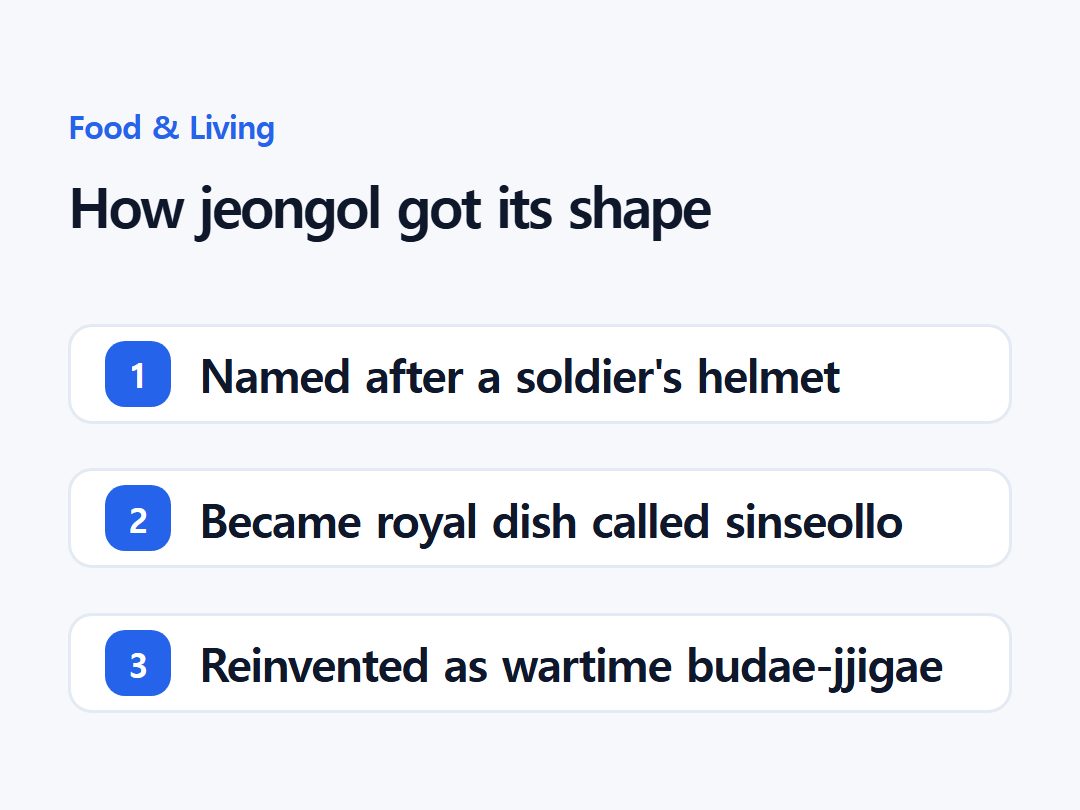
One long-standing account of jeongol's origin, recorded in the late Joseon-era text Manguksamulkiwon Yeoksa, traces it to soldiers on campaign who had no proper cooking vessels. According to the story, they used an upturned iron war helmet, called a jeonlip, to roast meat and boil wild greens over a campfire.
Scholar Jang Ji-yeon later linked the dish's name to this story, arguing that home cooks adopted pots shaped like the helmet — wide-brimmed with a shallow, sunken center — and the name stuck. It is a folk etymology rather than a documented fact, but it is the explanation most Korean food histories repeat, and it still describes the shape of a jeongol pot today.
How a wartime shortcut became royal tableware
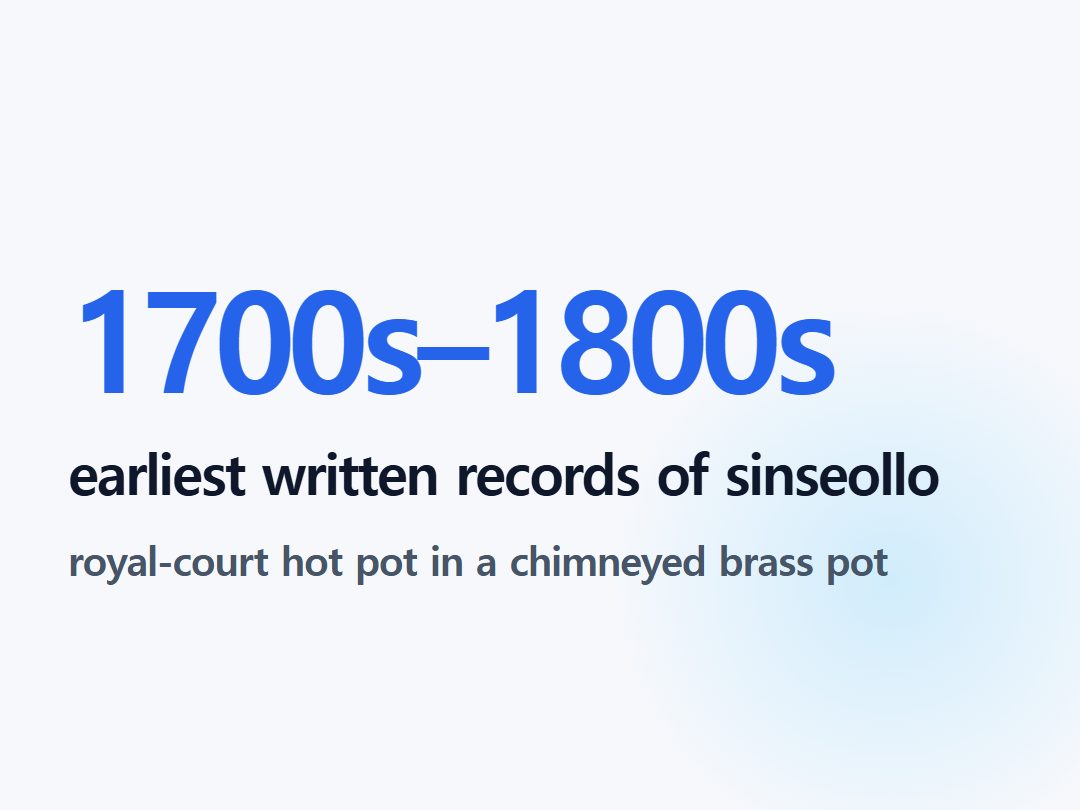
Jeongol's more prestigious branch developed in the opposite direction. Sinseollo (신선로), also recorded under the name yeolguja-tang — roughly, "soup that delights the mouth" — is a royal-court version cooked in a specialized brass vessel with a central charcoal chimney built into the middle, keeping the broth simmering without a separate stove.
Korean texts from the 1700s and 1800s describe the dish being filled with a wide range of ingredients arranged around that chimney:
- Beef and other meats
- Mullet, abalone, and sea cucumber
- Radish, mushrooms, and ginkgo nuts
It was once reserved for kings and nobility, and it remains a special-occasion dish today largely because the vessel itself is expensive and the arrangement is labor-intensive — not something most households make on a weeknight.
Spam and instant noodles wrote a newer chapter
Jeongol's modern history includes budae-jjigae, or army stew, which appeared after the 1950–53 Korean War near U.S. military bases such as Uijeongbu, where processed American rations were easier to find than fresh meat.
Cooks — including Heo Gi-suk, widely credited with popularizing the dish at her restaurant in Uijeongbu — added Spam, sausage, and eventually instant ramyeon noodles to a spicy, gochujang-based broth cooked communally at the table. Spam itself was not legally sold in Korea until 1987, so a black market supplied the dish's signature ingredient for decades before that.
Restaurants today market the dish under both names, budae-jjigae and budae-jeongol, which shows how loosely the two category terms actually get applied outside formal cooking texts. Large chains built entirely around the dish, such as Nolboo, now operate well over a thousand locations across the country.
Japan hands the seasoning to the diner, not the pot
Japanese nabemono, or nabe, is built on the opposite principle from jeongol. Broths for dishes like shabu-shabu and mizutaki are deliberately mild, often just kombu-based dashi, leaving the flavor to be added at the table rather than in the pot itself.
The two standard tools for that are ponzu, a citrus-and-soy sauce usually made with yuzu, and goma-dare, a creamy sesame sauce. Diners cook thin slices of meat or vegetables briefly in the broth, then dip each piece individually — a slower, more customizable process than ladling from an already-seasoned Korean pot.
Not every nabe dish follows this pattern. Sukiyaki, cooked in a sweetened soy broth, is strongly flavored on its own and is typically eaten with raw egg rather than a dipping sauce — a reminder that nabe itself covers a range of broth styles, even if the lightly seasoned, dip-based version is the most common point of comparison with jeongol.
China splits the pot before it splits the flavor
Chinese huoguo takes a third approach. Many restaurants serve a yuanyang guo, or "mandarin duck pot" — a single pot physically divided in half, typically one side filled with mild broth and the other with a numbing, chili-heavy Sichuan-style broth built from dried chilies and Sichuan peppercorns.
As with Japanese nabe, the broth is often secondary to the dipping sauce, and the sauce itself varies sharply by region:
- Northern China: sesame paste with fermented tofu
- Sichuan and Chongqing: garlic and sesame oil
- Cantonese-style: a sweeter, seafood-based sauce
One popular origin story places the spicy Chongqing style at the city's Chaotianmen Wharf in the early 1800s, where laborers boiled leftover cuts of meat in a chili-and-peppercorn broth to make cheap scraps edible — a working-class origin that contrasts with jeongol's court-food branch.
What "hot pot" leaves out in translation
English menus and articles — including this one — default to calling jeongol "Korean hot pot" because there is no better single term available. But the phrase erases the specific thing that sets it apart: a broth that is finished before it is served, not after.
- Jeongol: broth pre-seasoned, no dipping sauce needed
- Nabe: mild broth, flavor added through ponzu or sesame dip
- Huoguo: pot often split in two, paired with regional dipping sauces
The category is also unsettled within Korean itself. Restaurants use "jeongol" and "jjigae" inconsistently, and dishes like budae-jjigae move between both labels depending on who is naming the menu. For international readers, the more accurate description is not "hot pot" alone, but hot pot with the seasoning already built in.
How Korea, Japan, and China season their hot pot
| Dish | Broth | Seasoning method |
|---|---|---|
| Jeongol (Korean) | Pre-seasoned before serving | No dipping sauce needed |
| Nabe (Japanese) | Mild, often kombu dashi | Ponzu or sesame dip at the table |
| Huoguo (Chinese) | Often split into mild and spicy halves | Regional dipping sauces vary by area |
Frequently asked
What's the difference between jeongol and jjigae?
Jjigae centers on one main ingredient and is usually finished in the kitchen, while jeongol has several main ingredients and finishes cooking at the table.
Why is budae-jjigae called army stew?
It originated near U.S. military bases like Uijeongbu after the 1950–53 Korean War, when cooks added Spam and other American rations to a spicy gochujang broth.
Is jeongol the same as Japanese nabe or Chinese hot pot?
No — jeongol's broth is pre-seasoned before serving, while nabe relies on dipping sauces like ponzu and huoguo often splits the pot into mild and spicy halves.
Sources
Every factual claim above is traceable. We do not translate articles — we gather facts from multiple outlets and write them ourselves.
- Jeongol — Wikipedia
- Nabemono — Wikipedia
- Sinseollo — Wikipedia
- Budae-jjigae — Wikipedia
- 전골 (Jeongol) — Encyclopedia of Korean Culture
- This Popular Korean Dish Came from the Aftermath of the Korean War — Military.com
- All About Huoguo: Chinese Hot Pot — Bokksu Market
- How to Nabe: A Complete Guide to Japanese Hot Pot — San-J


