
"KPop Demon Hunters" premiered on Netflix on June 20, 2025, as an animated musical about a K-pop girl group who moonlight as monster slayers. Within months it became the most-watched title in the platform's history, across movies and series combined.
The short version
- KPop Demon Hunters became Netflix's most-watched title ever, then won two Oscars.
- Rumi is half-demon and embraces it instead of hiding it in the finale.
- The song 'Golden' spent eight weeks at No. 1 and won a Grammy.
Directed by Maggie Kang and Chris Appelhans for Sony Pictures Animation, it went on to win two Academy Awards in March 2026. This piece explains the plot, the ending, and the Korean context that international viewers tend to miss.

Three pop idols with a second job: hunting demons
The story follows Huntr/x, a fictional three-member girl group made up of Rumi, Mira, and Zoey. By day they are Korea's biggest idol group — the industry term for a professionally trained, agency-managed pop act; in secret, they are the latest in a line of demon hunters who protect the human world.
Their power source is music. Every performance strengthens the Honmoon, a barrier between Earth and the demon realm that the group is trying to seal for good by becoming popular enough to reach a golden, permanent version of it.

A rival boy band that turns out to be demons in disguise
Huntr/x's competition arrives as the Saja Boys, a five-member group that debuts out of nowhere and instantly pulls fans away. The twist: they are demons sent by the demon king Gwi-Ma, disguised as idols to weaken the Honmoon from the inside.
Their name comes from jeoseung saja, grim-reaper-like death spirits in Korean folklore, and the group's leader Jinu appears in traditional gat hats and hanbok at points in the film — a visual joke that only lands if the reference is familiar.
The half-demon secret Rumi hides from her own group
Rumi, Huntr/x's lead singer, hides something even her bandmates don't know: her father was a demon, and demon marks are spreading across her skin. She has concealed this her whole life with help from her adoptive mother, Celine, a former demon hunter.
As Jinu and Rumi grow close, he learns her secret — and later exposes it during a live performance, letting other demons impersonate Mira and Zoey on stage to humiliate her in front of the crowd.

A sacrifice, a new song, and a barrier restored
Betrayed and exposed, Rumi is hypnotized along with the rest of the audience by Gwi-Ma, who forces the crowd to watch the Saja Boys instead. She breaks the trance by debuting a new song rather than hiding her demon marks, which lets Mira and Zoey fight beside her again.
Jinu, who has fallen for Rumi, sacrifices himself to save her. Huntr/x defeats Gwi-Ma and reseals the Honmoon. The film closes with Rumi accepting her demon half instead of erasing it, and the trio giving up a planned break to stay with their fans.

Why the film's freedom is the least realistic part
Korean viewers picked up on something international audiences often miss: Huntr/x's independence is close to fantasy. In the film, the trio choose their own diets, release music on a whim, and openly defy their manager. Real idols rarely get any of that.
Under Korea's agency system, entertainment companies control most of a group's career — song selection, comeback timing (the coordinated relaunch of a group with a new single and concept), diet, and public image. A 2010 Korea Fair Trade Commission reform, prompted by a lawsuit from the group TVXQ over a 13-year deal, now caps standard exclusive contracts at seven years.
Trainees — unpaid hopefuls who train for years before a possible debut — are also nothing like the film's already-successful leads. Groups like TWICE, BLACKPINK, and ITZY, the real acts Huntr/x visually echoes, do not get three-month breaks between promotions; the film's ending reads more as wish fulfillment than industry norm.
EJAE, the songwriter who lived the plot before she wrote it
Rumi's singing voice belongs to EJAE (Kim Eun-jae), who also co-wrote three of the film's songs, including "Golden." Before that career, she spent a decade as a trainee at SM Entertainment, one of Korea's largest agencies, starting at age 11.
She has described the training system as constant, quiet competition — internal evaluations that could end a trainee's chance at debut without warning. Writing songs for TWICE, aespa, Le Sserafim, and Red Velvet after leaving the trainee track is itself a common alternate route for idols who never debut.
The real K-pop industry inside a fictional band
Several details in the film are not invented. The production drew on working K-pop professionals so Huntr/x's music and choreography would move like an actual group's, not an outsider's guess at one.
- Teddy Park, longtime producer for BLACKPINK, BigBang, and 2NE1, worked on the soundtrack
- Jam Republic, a professional K-pop choreography crew, designed the group's dance sequences
- TWICE members Jihyo, Jeongyeon, and Chaeyoung recorded their own version of the in-film song "Takedown"
Director Maggie Kang, born in Seoul and raised in Toronto, researched in Korea before writing the film, visiting Gwangjang Market, Namsan Tower, and other sites the film later recreates in animated form.
Korean myths the film borrows without explaining
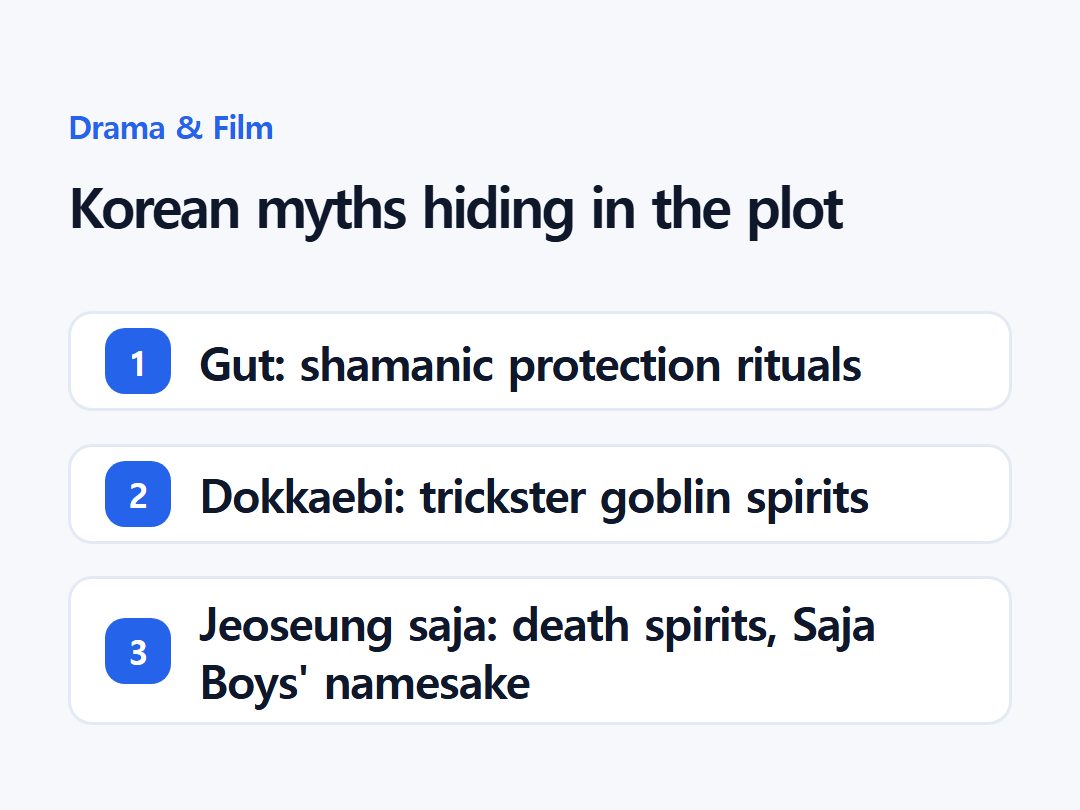
Beyond the K-pop setting, the film leans on folklore that Korean audiences recognize instantly and international viewers usually do not.
- Gut — shamanic rituals once performed to protect villages from evil spirits, echoed in Huntr/x's stage rituals
- Dokkaebi — trickster goblin spirits from Korean folk tales, worked into the demon designs
- Jeoseung saja — death spirits who guide souls to the afterlife, the namesake of the Saja Boys
Kang has said this specificity was intentional. After more than a decade in Hollywood animation without a single Korean-led project, she built the film around details "you have to know Korea" to get right.
From Netflix's most-watched title to a historic Oscar sweep
The film's rise ran entirely through streaming data rather than a box office. It passed "Red Notice" as Netflix's most-watched movie in August 2025, then passed "Squid Game" season one in September to become the most-watched title of any kind, film or series, in the platform's history.
By the end of 2025 it had logged more than 500 million views and stayed in Netflix's weekly top ten for 23 consecutive weeks. A sing-along theatrical release even topped the North American box office for a weekend months after its Netflix debut, an unusual afterlife for a streaming-only film.
Before the Oscars, the film had already swept Best Animated Feature at the Golden Globes, the Critics' Choice Awards, and the Producers Guild Awards, plus ten Annie Awards. At the 98th Academy Awards on March 15, 2026, it won Best Animated Feature and Best Original Song, making Kang the first filmmaker of South Korean descent to win in that category.
Eight weeks at No. 1 — what Golden's chart run means
"Golden," the film's central anthem, spent eight weeks atop the Billboard Hot 100 and eighteen weeks atop the Billboard Global 200. It is the first Hot 100 number one led by female K-pop vocalists, following Jung Kook's "Seven" and Jimin's "Like Crazy" in 2023, and BTS's earlier run of chart-toppers.
In February 2026 it became the first K-pop song to win a Grammy, after already winning Best Original Song at the Golden Globes and Critics' Choice Awards. For a song written for animated characters, that run put it in direct competition with, and ahead of, real K-pop acts on the actual charts.
What's still unresolved
A sequel is officially confirmed. Netflix announced it on March 12, 2026, with Kang and Appelhans returning to write and direct. Early reports floated a 2029 release, but Sony Pictures Animation executives have since called that date "far-fetched" given how long animation on this scale takes to produce.
The film also leaves its central tension unresolved by design: it presents an idol group with far more freedom than any real one has, without directly addressing the contract and image-control practices its own satire is built on. Whether the sequel engages that more directly, or stays in wish-fulfillment territory, is not yet known.
Korean folklore terms the film uses without explaining
| Term | Meaning | Role in the film |
|---|---|---|
| Gut | Shamanic rituals once performed to protect villages from evil spirits | Echoed in Huntr/x's stage rituals |
| Dokkaebi | Trickster goblin spirits from Korean folk tales | Worked into the demon designs |
| Jeoseung saja | Death spirits who guide souls to the afterlife | Namesake of the Saja Boys |
Frequently asked
How does KPop Demon Hunters end?
Rumi accepts her demon half instead of erasing it, Jinu sacrifices himself to save her, and Huntr/x defeats Gwi-Ma to reseal the Honmoon.
Is KPop Demon Hunters getting a sequel?
Yes, Netflix confirmed a sequel on March 12, 2026, with Maggie Kang and Chris Appelhans returning to write and direct.
Who sings for Rumi in KPop Demon Hunters?
EJAE (Kim Eun-jae) provides Rumi's singing voice and co-wrote three of the film's songs, including 'Golden.'
Sources
Every factual claim above is traceable. We do not translate articles — we gather facts from multiple outlets and write them ourselves.
- 'KPop Demon Hunters': Release Date, Awards, Plot, Sequel, and Merch — Netflix Tudum
- KPop Demon Hunters Ending Explained: How Rumi's Big Secret Sets Up A Wider Franchise — Screen Rant
- 'KPop Demon Hunters' Is Netflix's Most-Watched Movie in History — Variety
- KPop Demon Hunters Surpasses 500 Million Total Views on Netflix — Animation Magazine
- 'Kpop Demon Hunters' Creator Maggie Kang Names Her Favorite Character and Reveals How She Injected Korean Culture Into Netflix Hit at Busan — Variety
- 'KPop Demon Hunters' Singer-Songwriter EJAE on 'Golden' Hitting No. 1 on Hot 100: 'I Cried All Day' — The Hollywood Reporter
- HUNTR/X's 'Golden' Is No. 1 on Billboard Hot 100 for Eighth Week — Billboard
- 'KPop Demon Hunters' makes Oscars history with animated feature, song wins — Good Morning America
- [REPORTER'S NOTEBOOK] What 'KPop Demon Hunters' gets right, wrong about K-pop industry — The Korea Times
- Her agency crushed her K-pop idol dreams. Her reinvention brought them back to life – and won her a Grammy — CNN Business
- Is the '7-year itch' a thing of the past? — The Korea Herald
- 'KPop Demon Hunters 2' May Not Release Until After 2029 — What's on Netflix