Read enough Korean web novels and one word starts repeating: cheonma (천마, "Heavenly Demon"). It shows up as a villain's backstory, a protagonist's new identity after reincarnation, or just a passing comparison — "strong as the Heavenly Demon."
The short version
- "Heavenly Demon" is Korean web fiction's shorthand for the strongest, unbeatable villain type.
- The character originated in a 1966 Chinese wuxia novel, not Korea.
- Return of the Blossoming Blade's novel has passed 700 million downloads on Naver Series.
It is one of the most recycled characters in the industry. Almost nobody outside Korea's fandom knows why that specific title, rather than any other, became the default answer to "who is the strongest person in this world."
A title that only means one thing: unbeatable
In muhyeop (무협), Korea's genre of Chinese-inflected martial-arts fiction, stories are usually built around three factions. English fan communities often call the genre's fictional setting "murim" (무림), literally "the martial world."
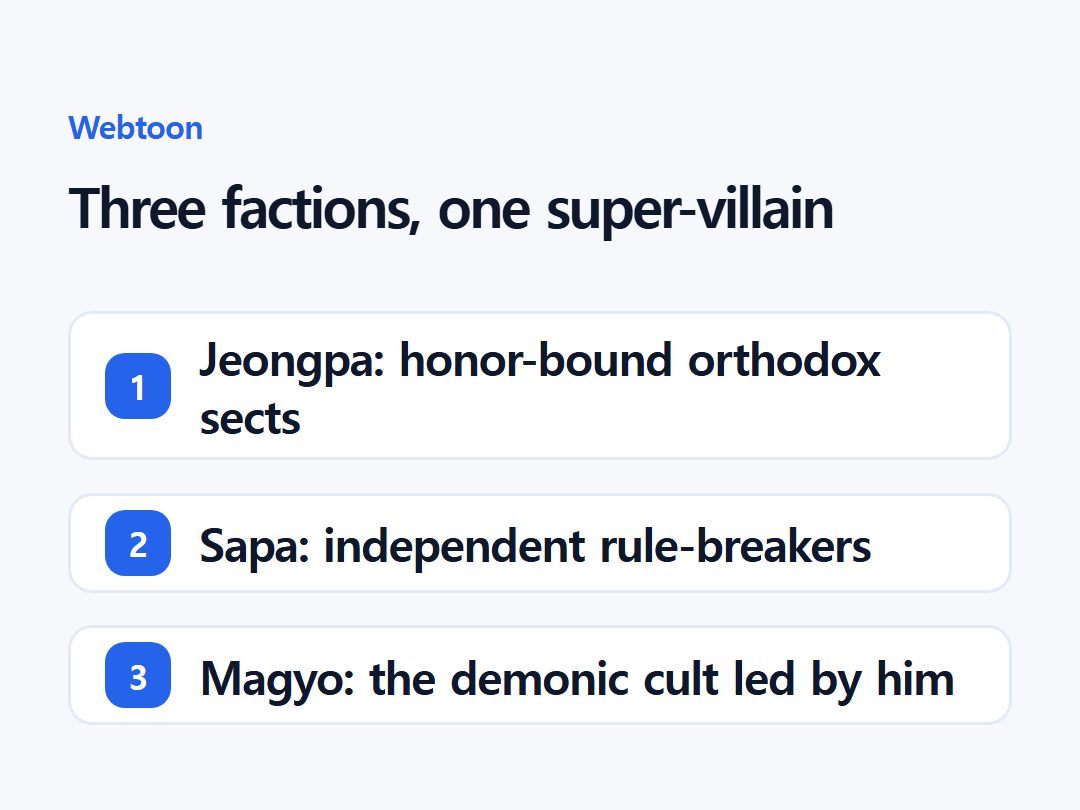
- Jeongpa (정파): orthodox sects bound by codes of honor and hierarchy.
- Sapa (사파): independent, rule-breaking outsiders who are not necessarily evil.
- Magyo (마교), the "demonic cult": a faction built purely on power, feared by both of the others.
The Heavenly Demon sits at the top of the demonic cult. Stories routinely describe the cult as so overwhelming that the orthodox and outsider factions have to set aside their own rivalry just to survive against it — which is the entire point of the title. Calling a character the Heavenly Demon is shorthand for "stronger than everyone else combined."
A minor villain from a 1966 wuxia novel
The character is not originally Korean. According to genre history compiled on NamuWiki, a figure resembling the Heavenly Demon first appeared in Chinese author Huanzhulouzhu's 1941 novel Legend of the Swordsmen from Mount Shu, described there as a calamity-bringing leader of evil immortals.
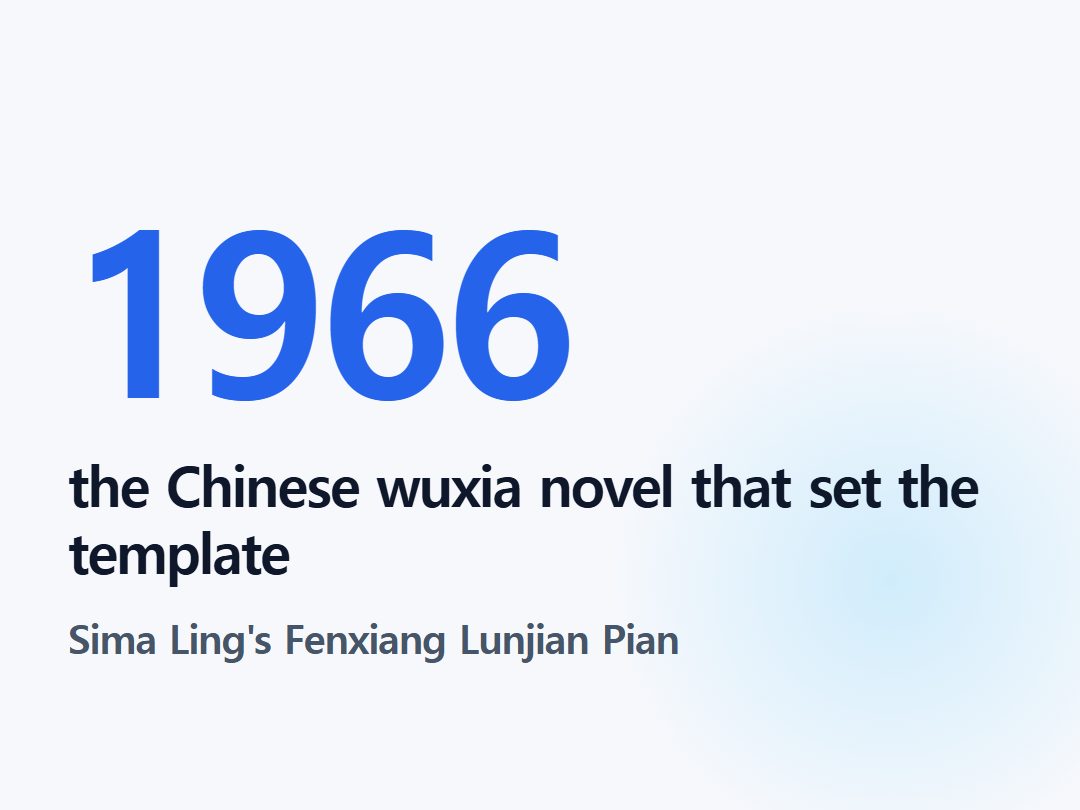
The image readers now recognize was set a generation later. Sima Ling's 1966 novel Fenxiang Lunjian Pian reworked the character into the grand master of the outsider faction — a figure the entire martial world feared and respected.
That novel also introduced the signature technique later writers kept reusing, a martial art called Cheonma-singong. It is the reason "Heavenly Demon" reads today as a specific archetype rather than a generic villain name.
Korea got its own version through a comic, not a novel
Korean writers imported and adapted this Chinese wuxia tradition through decades of serialized print fiction. The work most often credited with fixing the trope domestically is the 1980s martial-arts comic Yeolhyeolgangho, whose Cheonma-singong setting became the template Korean muhyeop writers kept borrowing afterward.
Notably, that original version was not simply evil. In Yeolhyeolgangho, the Heavenly Demon led the outsider faction rather than the demonic cult, taking the role to protect the weak per his dying master's wish.
The character's later, more familiar image — absolute ruler of the demonic cult — was cemented by a different 1990s work, The Emperor's Sword. That novel gave the Heavenly Demon its now-standard role as a spirit-form mentor figure and locked in the "reigning demon lord" setting most web novels still use today.

For twenty years, it was a dead power gauge
What is easy to miss is that the Heavenly Demon was not always a protagonist. Through the 1990s and 2000s, muhyeop fiction mostly treated it as a legendary founder mentioned in passing — cited alongside real Shaolin and Wudang founding figures as a benchmark for how strong someone else is, never appearing on the page alive.
Genre critics writing about clichés from that era had a specific, slightly mocking name for this use: a "dead power gauge" — a legend invoked only to measure a living character's strength against, because a figure who is already dead or retired can never actually be surpassed in the story. For roughly two decades, that was the character's entire job.
Why serialized fiction turned the ruler into the hero
That changed once Korean genre fiction moved from print rental shops to daily web serialization. Munpia, one of the platforms that now anchors this shift, was founded in 2002 by muhyeop writers under the name "Gomurim" — literally "ancient martial world."
A dead legend mentioned once in chapter one is a fine detail in a novel readers finish in a weekend. It is a wasted opportunity in a story readers pay for one chapter at a time, where every episode needs its own payoff.
Making the strongest being in the setting into the actual protagonist solves that problem immediately. There is no slow climb through weaker opponents before the character matters.
Writers frequently pair this shortcut with hoegwihwan (회빙환) — Korean web fiction's regression, possession, and reincarnation formula, covered in more depth elsewhere on K Deep Cut. A hero who wakes up already carrying the Heavenly Demon's memories or body skips the setup entirely and starts the story at maximum power.
Two different ways writers reuse the same character
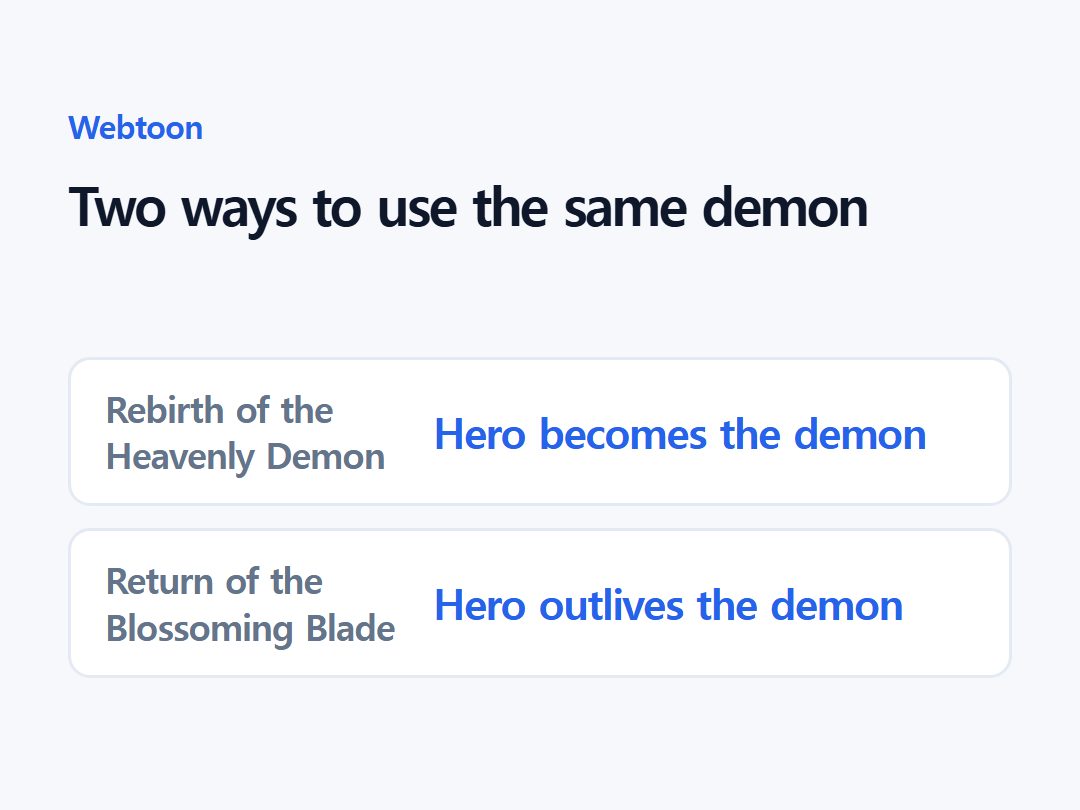
Not every story uses the Heavenly Demon the same way. Some rewrite the demon as the hero; others keep it as the villain the hero eventually surpasses.
| Approach | Example |
|---|---|
| Protagonist becomes the Heavenly Demon | Rebirth of the Heavenly Demon, where an aging cult leader dies and wakes up in a young swordsman's body, memories intact |
| Protagonist defeats, then outlives, the Heavenly Demon | Return of the Blossoming Blade, where the hero dies fighting the demon, wakes a century later, and must rebuild his ruined sect |
Both approaches keep the same underlying function: the title still means "the ceiling of power in this world," whether the hero is racing to reach it or was born standing on it. Readers get either the fantasy of already being unbeatable, or the satisfaction of watching someone earn it.
Korea's most-read webtoon leans on this exact villain
The second approach currently has the bigger audience. Return of the Blossoming Blade — the English title for the Return of the Mount Hua Sect webtoon — topped the Korea Creative Content Agency's 2024 reader survey of 3,448 webtoon fans, ending Lookism's three-year run at number one.
The source novel's numbers explain why a platform would keep greenlighting Heavenly Demon stories: it has passed 700 million cumulative downloads on Naver Series, one of Korea's two largest web-fiction platforms, making it one of the best-selling titles the service has hosted.
The word escaped the genre entirely
By the 2020s, "Heavenly Demon" had stopped being a fiction-only term. Because it had spent decades meaning "the one nobody can beat," Korean internet slang picked it up as a general-purpose superlative, detached from martial arts stories altogether.
- Fan communities have jokingly called Michael Jackson's stage performances "Heavenly Demon" moves.
- Gaming communities use "Heavenly Demon death beam" (천마데스빔) as slang for a suspiciously aim-assisted shot.
- Genre-adjacent fiction now name-drops it as a comparison even in stories with no martial arts at all, from tower-climbing fantasy to modern hunter-and-dungeon action.
That crossover is itself evidence of saturation — a title only becomes shorthand once its meaning is common knowledge to people who never read the source material.
What writers are still trying to fix about it
The trope's overuse has a visible cost. Reader reviews on the fan site Novel Updates regularly dismiss new Heavenly Demon novels as, in one commenter's words, "too damn cliche" — predictable underdog-sect plots stacked on a predictable god-tier protagonist.
One active response is a role reversal: NamuWiki's genre timeline notes a growing wave of female Heavenly Demon protagonists, sometimes styled as a "young Heavenly Demon" (소천마), as in the novel My Fiancée Was the Young Heavenly Demon. Whether that variation genuinely revives a sixty-year-old character or just becomes its own predictable formula is still playing out chapter by chapter.
Two ways writers reuse the Heavenly Demon
| Approach | Example |
|---|---|
| Protagonist becomes the Heavenly Demon | Rebirth of the Heavenly Demon — an aging cult leader dies and wakes up in a young swordsman's body, memories intact |
| Protagonist defeats, then outlives, the Heavenly Demon | Return of the Blossoming Blade — the hero dies fighting the demon, wakes a century later, and rebuilds his ruined sect |
Frequently asked
What does Heavenly Demon (cheonma) mean in Korean web novels?
It's the ruler of the demonic cult in muhyeop fiction, shorthand for being stronger than every other faction combined.
Where did the Heavenly Demon character come from?
It traces back to Chinese wuxia, first appearing in Huanzhulouzhu's 1941 novel and getting its now-familiar form and signature technique in Sima Ling's 1966 novel Fenxiang Lunjian Pian.
Is Return of the Mount Hua Sect connected to the Heavenly Demon trope?
Yes — its hero dies fighting the Heavenly Demon and returns a century later; the webtoon topped Korea's 2024 reader survey of 3,448 fans, and its source novel has passed 700 million downloads on Naver Series.
Sources
Every factual claim above is traceable. We do not translate articles — we gather facts from multiple outlets and write them ourselves.
- 천마(무협) — NamuWiki
- 천마/웹소설 — NamuWiki
- 무협 웹소설 — NamuWiki
- 마교 — NamuWiki
- 환생천마 — NamuWiki
- 약혼녀가 소천마였다 — NamuWiki
- Martial Arts Webtoon Return of the Blossoming Blade Takes Top Spot in KOCCA Survey — Anime News Network
- Return of the Blossoming Blade — Wikipedia
- Rebirth of the Heavenly Demon — Fandom (Hwansaengcheonma Wiki)
- Korean Murim — Novel Updates