Ask a Korean to explain 정 (jeong), and many will pause, then land on some version of the same sentence: it can't really be translated. Not because English lacks vocabulary — dictionaries offer "affection," "attachment," "bond" — but because none of those words, alone or combined, carry what jeong actually does.
Understanding why matters more than it might seem. It explains why K-drama conflicts so often resolve in silence rather than apology, why a market vendor might toss an extra vegetable into your bag without being asked, and why a word Koreans use constantly keeps defeating every attempt to render it cleanly in English.
The short version
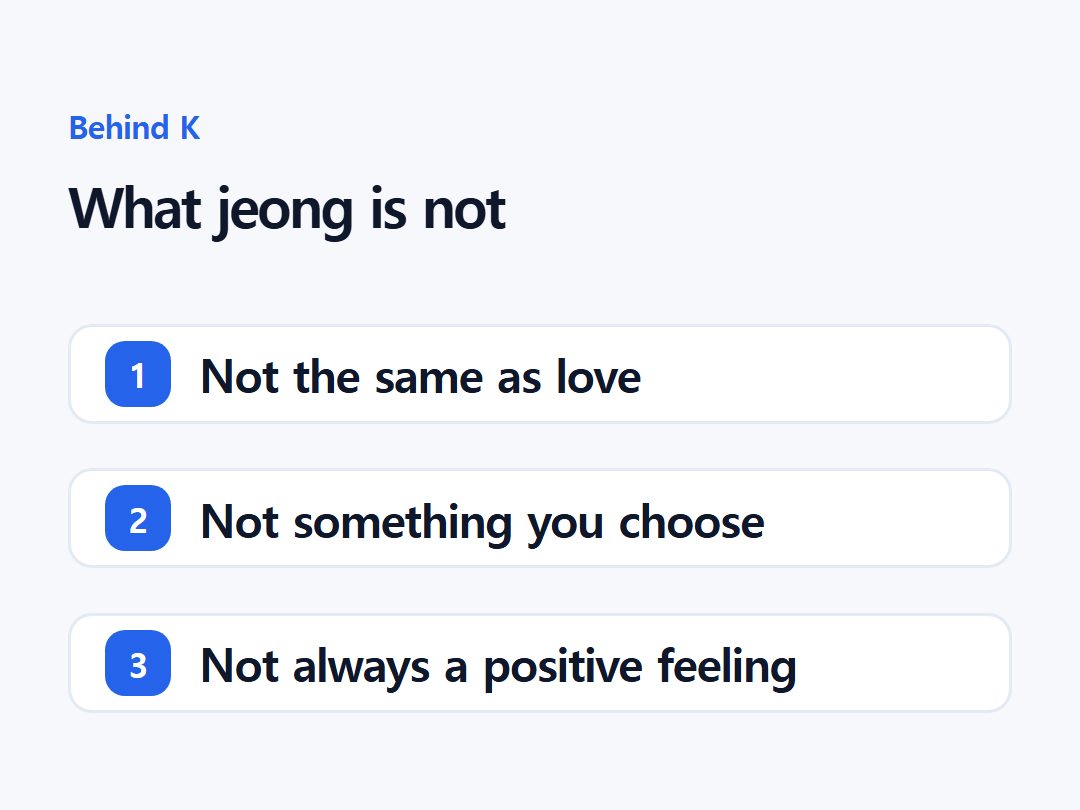
- Jeong is a bond that forms involuntarily, not a feeling you choose to have.
- Unlike guanxi or amae, jeong is reciprocal and expects no return.
- Han, Korean grief, only exists because jeong was broken first.
Why do Koreans say jeong 'enters' you?
Jeong describes the emotional bond that forms between people — or between a person and a place, an object, even a pet — through sustained closeness rather than deliberate choice. It blends warmth, obligation, familiarity, and loyalty into a single feeling that Korean speakers treat as self-evident and that English speakers have to reconstruct from several separate words at once.
The clearest evidence of how differently jeong operates is grammatical. Koreans don't say they "developed" jeong for someone; they say jeong-i deulda (정이 들다) — literally, "jeong enters" or "jeong takes hold." The grammatical subject of the sentence is the jeong itself, not the person feeling it. You do not choose to feel jeong. You simply notice, at some point, that it has already arrived.
Jeong is unconditional, unlike guanxi or amae
The first thing that separates jeong from love or friendship is that it does not require liking someone. Koreans routinely describe having jeong for a coworker who irritates them, a landlord they've never had a real conversation with, or a teacher who was strict to the point of unpleasant.
Jeong isn't about whether a relationship makes you happy; it's about the accumulation of shared time and proximity, which creates a bond that persists whether or not the feelings involved are comfortable ones.
Academic attempts to define jeong consistently note that it isn't an individual emotion at all.
A paper published in the peer-reviewed journal Psychiatry Investigation argues that unlike feelings such as happiness or sadness, which describe a state inside one person, jeong exists between people — it cannot be experienced alone, only in relation to someone or something else.
The same paper describes jeong as "unconditional, non-contractual, non-calculable, non-pragmatic," a description that draws a sharp line against how Western relationships are often framed: as agreements entered into, maintained, and renegotiated by two independent individuals.
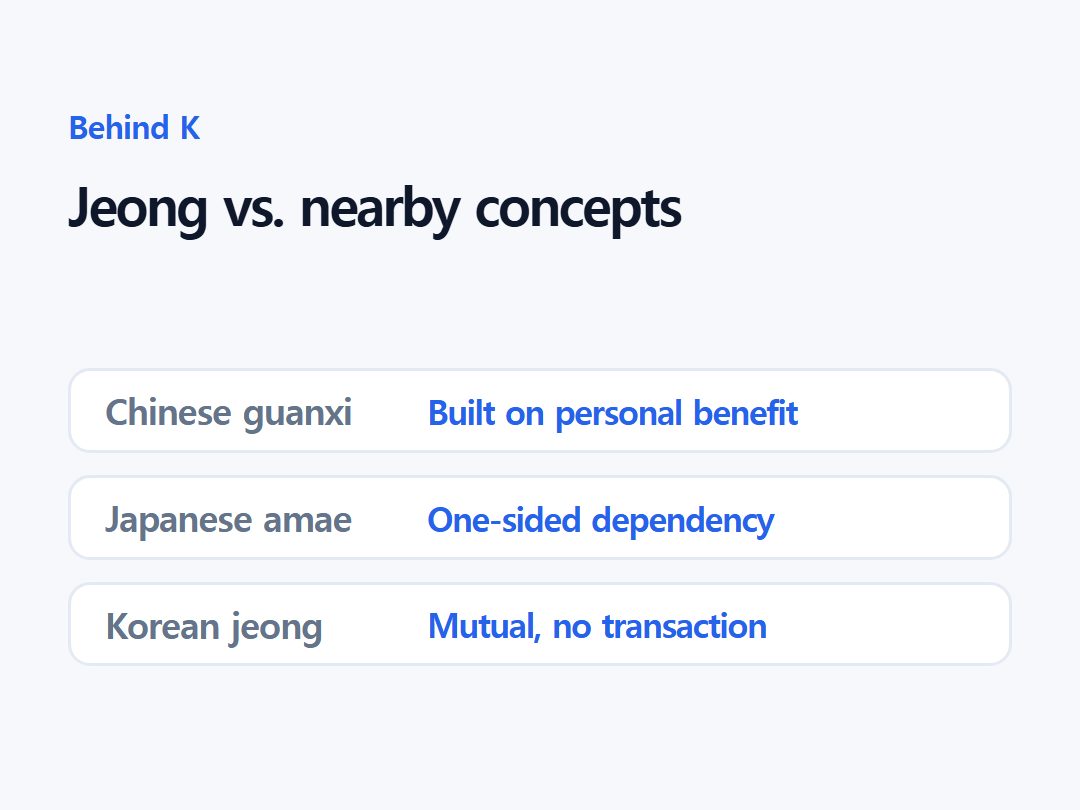
That contrast becomes sharper next to comparable East Asian concepts. Researchers at the ROK Center for Korean Studies note that Chinese guanxi (关系), often translated as "connections" or "social networking," is built around mutual personal benefit — cultivating relationships that will be useful later.
Japanese amae (甘え), the psychological concept of comfortable dependency, typically involves an imbalance, one party allowed to lean on the goodwill of another. Jeong, by contrast, is framed as reciprocal and non-transactional: nobody is keeping score, and nobody entered the relationship expecting a return.
This is tied to a broader cultural framework researchers call woori-seong (우리성), or "we-ness" — a foundational sense, dating back to Korea's historically village-based, interdependent agricultural society, that the group takes priority over the individual.
Where English speakers might say "we" to simply mean multiple separate people, Korean's use of "we" (우리) — as in uri jip ("our house," said even by someone describing their own single-family home) — carries an assumption of shared belonging that jeong sits inside.
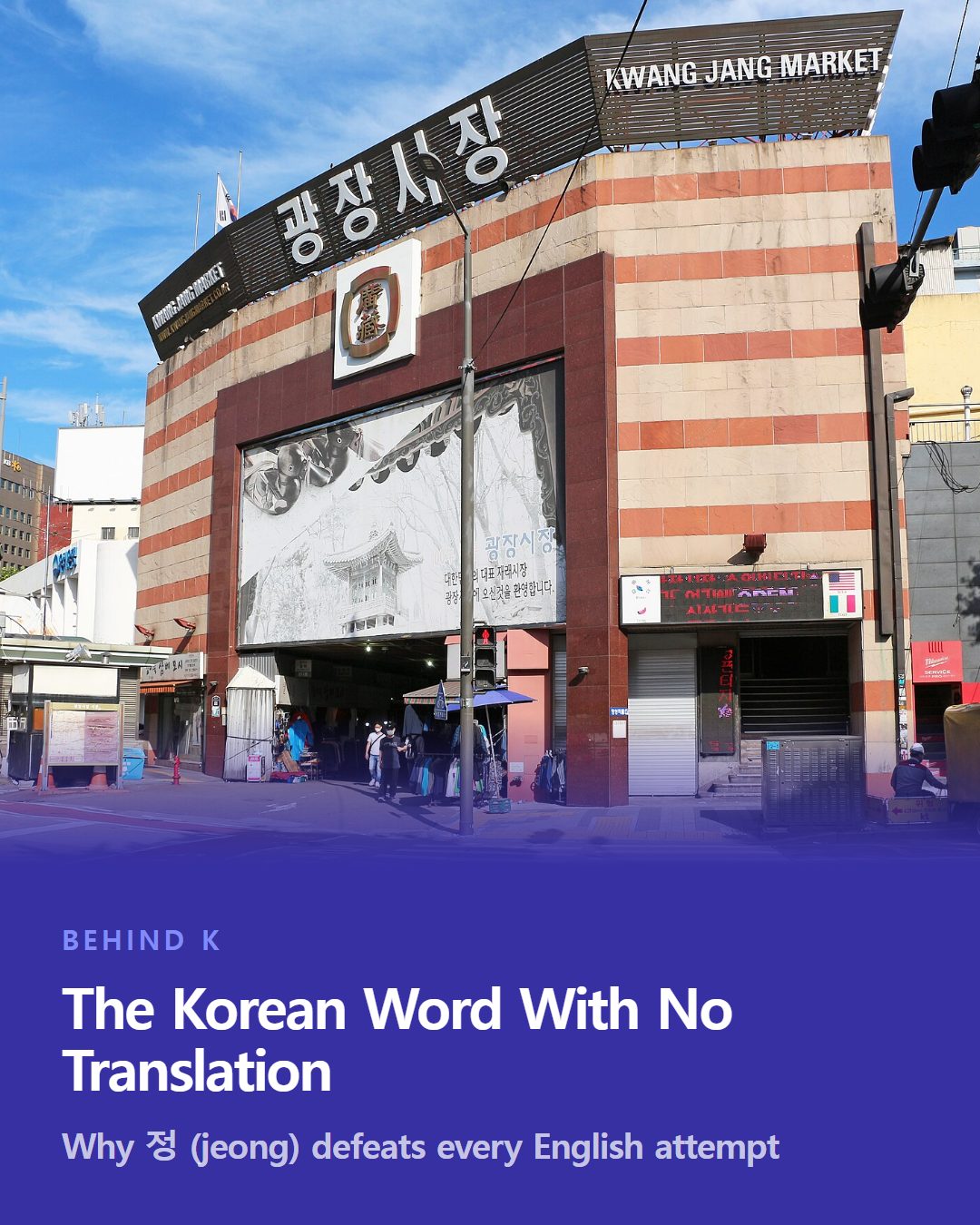
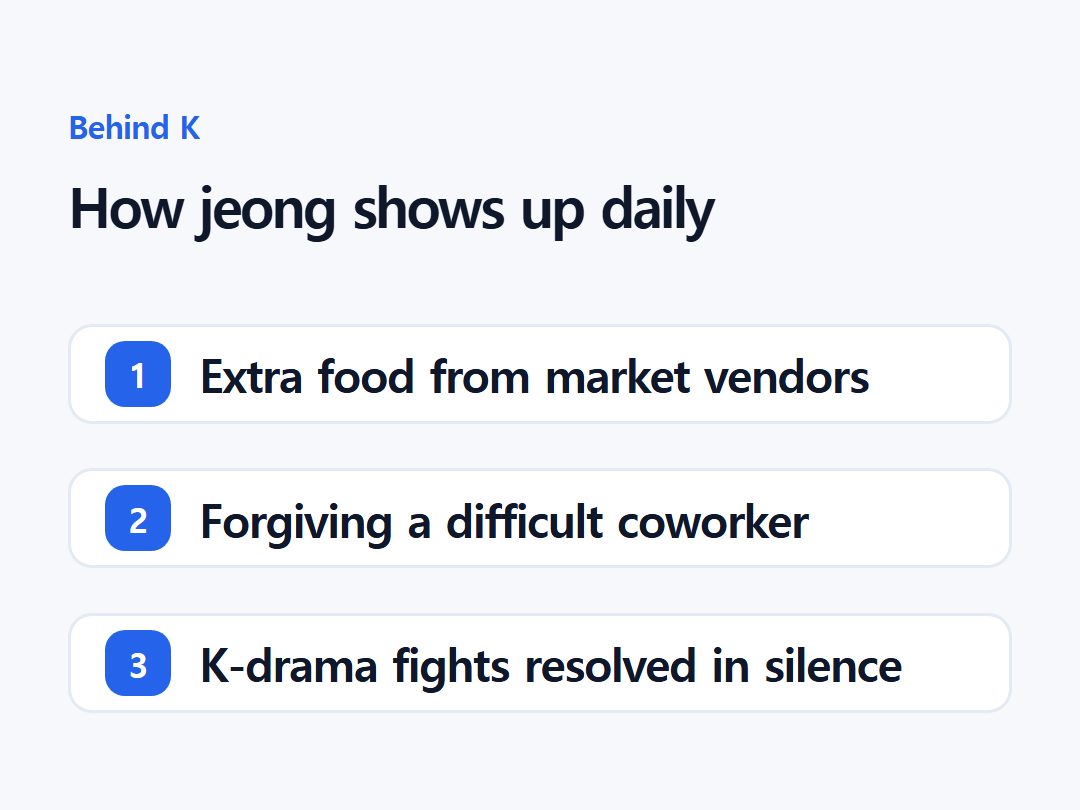
Jeong shows up constantly in ordinary interactions that foreigners in Korea often flag as surprising: a street vendor throwing in an extra piece of fruit without charge, a stranger commenting that you're not dressed warmly enough for the weather, an older woman treating a young stranger's hunger as her own problem to solve.
None of these people are performing customer service or politeness scripts. The behavior is read, within Korean culture, as jeong extending itself outward — a diffuse, low-grade sense of responsibility for people nearby, even people you don't know well.
Korean also has a specific compliment for people who carry an unusual amount of this quality: jeong-i manta (정이 많다), "having a lot of jeong." It describes someone warm, generous, and quick to form lasting attachments, and being called this is considered one of the higher compliments available in the language — a marker of someone genuinely good to know, not just pleasant to be around.
Jeong also explains a great deal about how Korean dramas — a genre built almost entirely around interpersonal conflict and its resolution — actually work.
Characters fight, betray each other, and cause real harm, but reconciliation tends to follow not from a formal apology-and-forgiveness exchange but from the bond itself reasserting that it was never actually broken.
A sibling who caused a decade of estrangement is let back into the family with a shared meal, no explicit words exchanged, because the underlying jeong was assumed to have survived the conflict.
International viewers sometimes read these scenes as underwritten or emotionally rushed; within the culture, the silence itself is doing the narrative work, because jeong was never something that needed to be re-earned through dialogue.
There is also a darker counterpart. Korean has a second, related emotional concept called han (한), often described as a suppressed, long-held grief or resentment.
According to the same Psychiatry Investigation research, han cannot exist without jeong preceding it — han is specifically what forms when a jeong-based bond is betrayed or broken. The paper notes that the warmer and deeper the original jeong, the more bitter the resulting han when that trust is violated.
This is why Korean fiction so often pairs the two: a devastating betrayal only registers as devastating because of how much unconditional bond existed beforehand.
Because jeong is understood to form involuntarily and persist stubbornly, ending it is treated as effortful rather than automatic. Korean has a phrase for this too: jeong-eul tteda (정을 떼다), "to detach jeong" — the deliberate, often painful work of severing a bond that will not simply fade with distance or time.
The phrase implies that walking away from a relationship and being emotionally free of it are two separate, sequential tasks.
How Korea's village life turned emotion into obligation
Jeong's written form, 情, is a Chinese character (pronounced qing in Mandarin) that broadly means "emotion" or "feeling" across the Sinosphere.
Korean usage narrowed that broader meaning specifically toward interpersonal attachment — while Chinese and Japanese developed their own distinct concepts (guanxi and amae, respectively) from related linguistic and philosophical roots, Korean jeong evolved into something with its own defining features: mutuality, involuntariness, and a resistance to being classified as either purely positive or purely negative.
Much of this is traced back to Korea's agrarian past, when small, tightly bound village communities depended on cooperative farming, shared resources, and extended kinship networks for basic survival.
Confucian social structures, which shaped Korean society for centuries, reinforced group harmony and mutual duty over individual autonomy, giving jeong a structural role beyond simple sentiment — it functioned as social glue in communities where isolation could be dangerous.
Over time, jeong also became something Koreans point to when explaining what makes their culture distinct.
Ask Koreans to name something uniquely their own, and jeong is one of the most common answers offered — not because other cultures lack warmth or attachment, but because Korean is one of relatively few languages to have compressed this particular bundle of feelings into one word that gets used in daily conversation, rather than treating it as a specialized or literary concept.
Is jeong fading among younger Koreans?
Jeong remains, by the admission of the people who study it most closely, genuinely unresolved as a concept. Researchers across linguistics, psychiatry, and theology have each proposed their own working definitions, and none claim to have settled it — one academic paper describes jeong outright as "ambiguous and amorphous," a concept better experienced than defined.
What is worth watching is how the word keeps being pressed into new contexts.
As Korean dramas, film, and variety shows reach larger English-speaking audiences, jeong is increasingly cited by name in reviews and cultural explainers trying to account for why certain scenes land emotionally despite no direct translation of what's happening.
Whether English ever settles on a workable shorthand — "found-family warmth," "unconditional bond," or simply borrowing the Korean word outright, as happened with han — is still an open question.
There's also a quieter domestic debate: whether jeong is weakening among younger, more urban, more individualistic generations of Koreans, or whether it persists in modified form — in group chats, in delivery-app tipping culture, in workplace loyalty — rather than in the market-stall and village settings usually used to illustrate it.
Either way, the next time a K-drama resolves a fight with a shared meal and no spoken apology, that gap is jeong doing the work English dialogue would otherwise have to spell out.
Jeong compared to related East Asian relationship concepts
| Concept | Language | Core meaning |
|---|---|---|
| Jeong (정) | Korean | Reciprocal, involuntary bond formed through shared time; non-transactional |
| Guanxi (关系) | Chinese | Cultivated connections built around mutual personal benefit |
| Amae (甘え) | Japanese | Comfortable dependency where one party leans on another's goodwill |
Frequently asked
What does jeong mean in Korean?
Jeong is the emotional bond that forms between people, or between a person and a place, object, or pet, through sustained closeness rather than deliberate choice, blending warmth, obligation, familiarity, and loyalty.
How is jeong different from love or liking someone?
Jeong doesn't require liking someone — Koreans routinely describe having jeong for an irritating coworker or a strict teacher — because it comes from accumulated shared time and proximity, not positive feelings.
What is the difference between jeong and han?
Han is a suppressed grief or resentment that can only form when a jeong-based bond is betrayed or broken, so the deeper the original jeong, the more bitter the resulting han.
Sources
Every factual claim above is traceable. We do not translate articles — we gather facts from multiple outlets and write them ourselves.
- Jung (정) Korean Meaning: The Untranslatable Bond That Defines Korean Culture — Markyana
- The uniquely Korean concept of Jeong (정/情) — Knowing Korea
- The Heartwarming Effect – Korean Cultural Code of Jeong (정) — ROK Center for Korean Studies
- Conceptualization of Jeong and Dynamics of Hwabyung — Psychiatry Investigation
- Understanding 정 (Jeong): The Untranslatable Korean Emotion — Hallyuism
- Key Family Culture and Relationship Patterns Frequently Seen in K-Dramas — KcontentHub