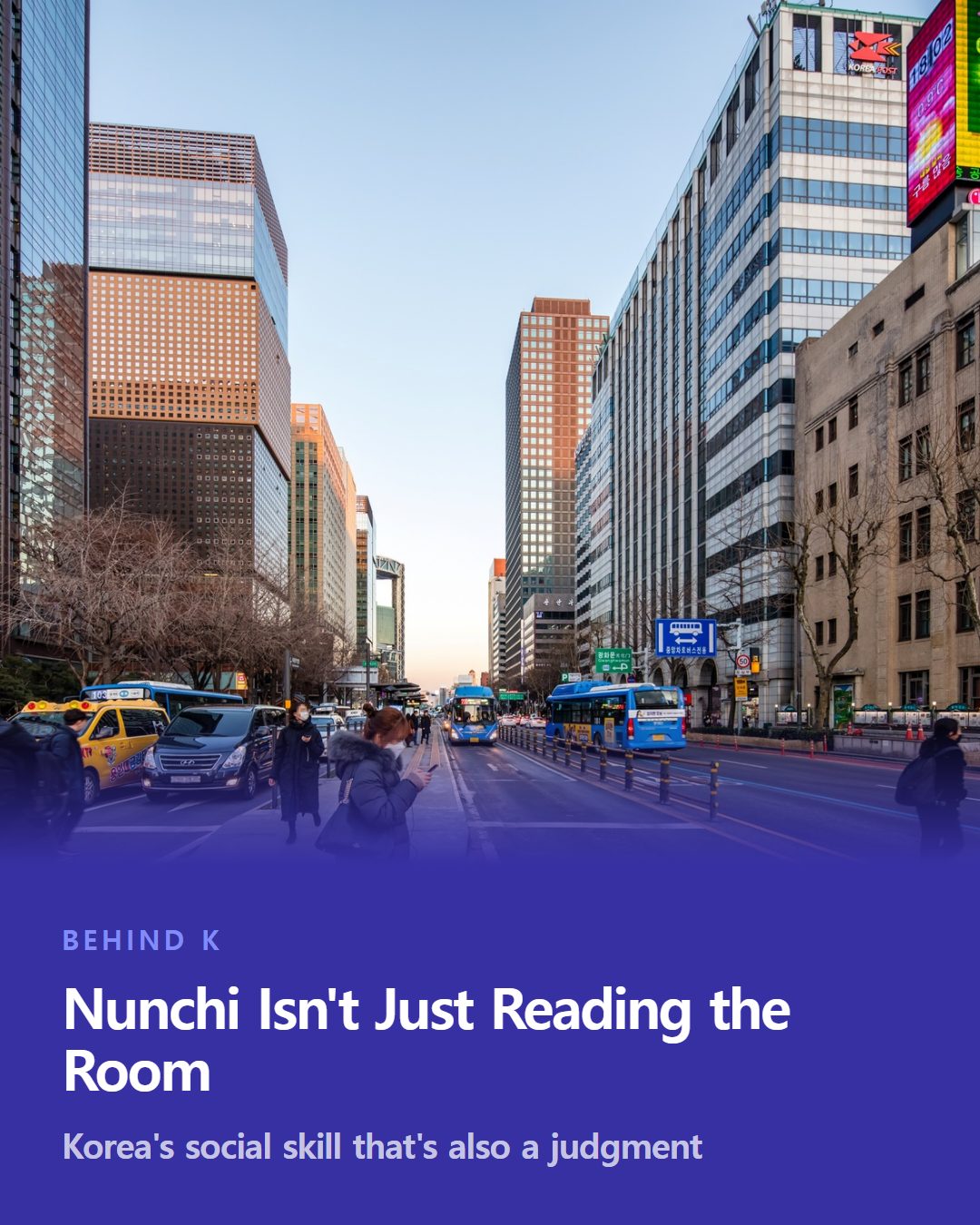
Nunchi (눈치) has become one of the most-cited "untranslatable" Korean words in English-language media: language apps teach it, a 2019 self-help book built an entire argument around it, and it shows up routinely in recaps of Korean dramas to explain why a character's silence, or a missed cue, mattered.
The usual shorthand is "reading the room." That translation is not wrong, but it is incomplete, and the part it leaves out is the part that actually explains why nunchi carries so much weight in Korean social life.
The short version
- Nunchi means acting on social cues, not just noticing them.
- Euny Hong's 2019 book popularized nunchi in English-language self-help.
- Collins Dictionary still lists nunchi as 'monitored,' not yet official.
A skill that also functions as a verdict
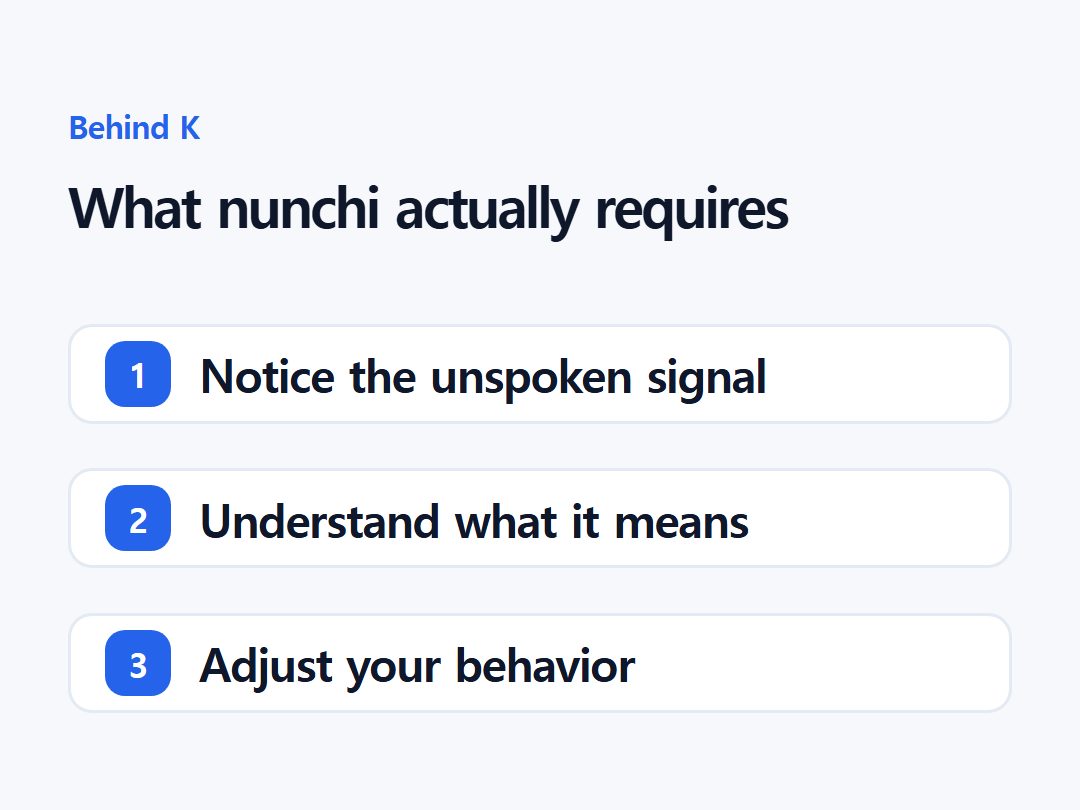
Literally, nunchi breaks down into nun (눈, eye) and chi (치, a measure or gauge) — "eye-measure." In practice it names two separate things bundled into one word: the perceptual skill of picking up on unspoken mood, tone, and social context, and the follow-through of adjusting your own behavior accordingly.
Noticing without acting does not count.
A person can clock exactly what is happening in a room and still be judged as having "no nunchi" (눈치 없다, nunchi eopda) if they fail to change course — speaking when they should stay quiet, staying at a gathering after the host has signaled it is time to leave, missing that a senior colleague's silence in a meeting is disapproval rather than agreement.
This is why "reading the room" undersells it.
Reading the room, in English, describes a moment of perception. Nunchi describes a standard of conduct. Calling someone 눈치 없다 is not a neutral observation about their attention span; it is a real social criticism, closer to calling someone tactless or self-absorbed than to saying they seem distracted.
On the positive side, 눈치가 빠르다 (nunchi-ga ppareuda, "quick nunchi") is a compliment about competence and consideration at once. The word functions as both a skill and an evaluative yardstick for character — which is the distinction international readers most often miss.
What makes nunchi different from emotional intelligence?
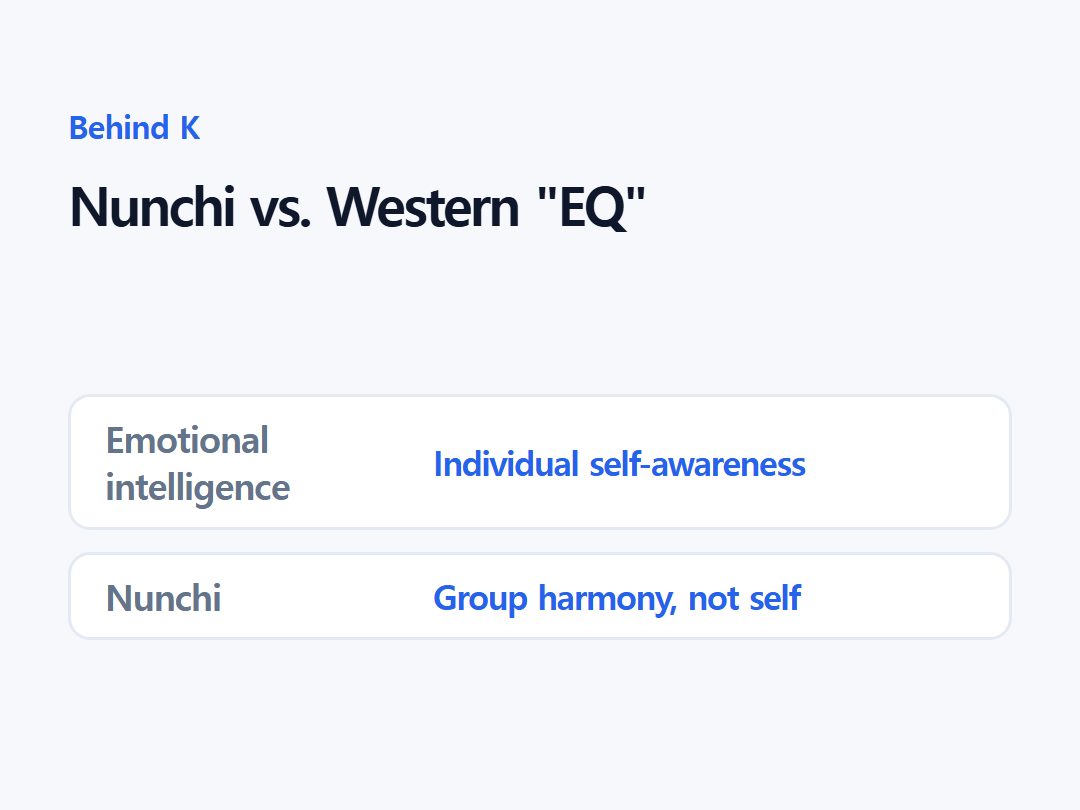
The closest Western comparison people reach for is emotional intelligence, but the two concepts point in different directions. Emotional intelligence, as commonly used in English, is largely about self-awareness and managing one's own responses.
Nunchi is oriented outward and collectively: its purpose is to protect group harmony, not to optimize an individual's inner state. You develop nunchi to serve the room, not to understand yourself.
That orientation traces back to Confucian social structure, which historically organized relationships around fixed hierarchies of age, rank, and role rather than individual negotiation.
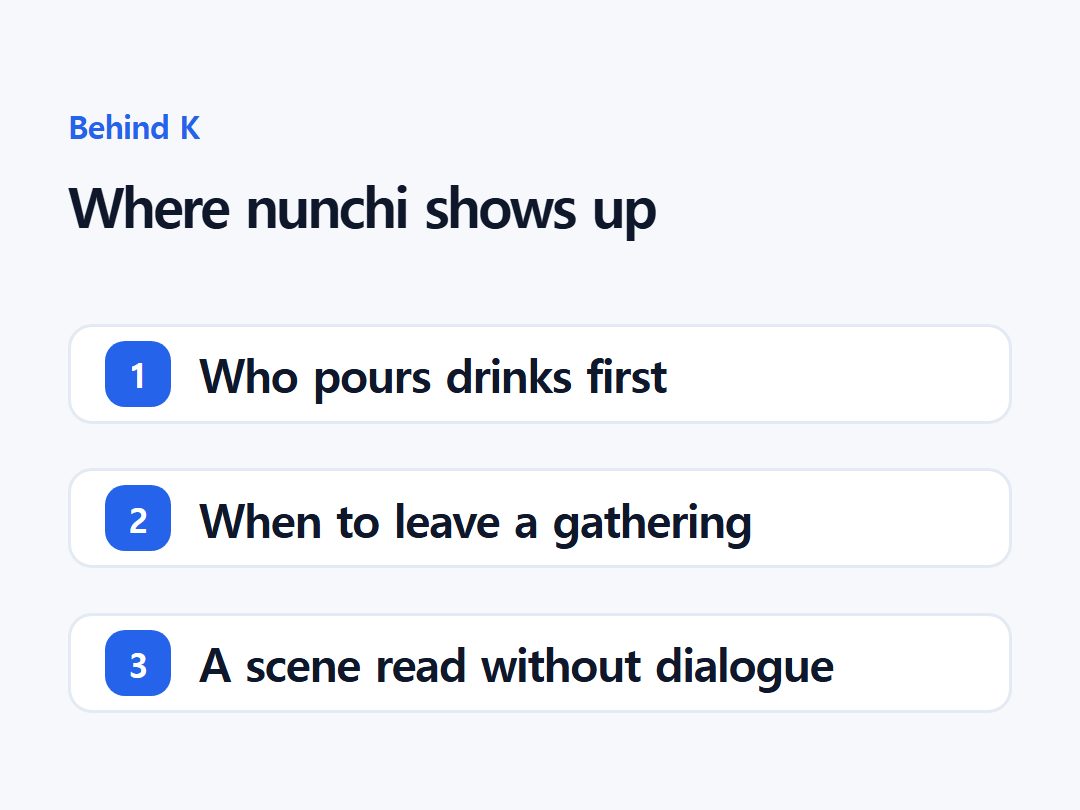
In a system where a junior person directly contradicting or questioning a senior person is discouraged, information has to travel by other means — tone, posture, pauses, who pours the drinks first, who speaks last.
Reading those signals accurately, and responding to them without being told, became the practical way subordinates managed relationships they were not permitted to manage through direct speech.
Nunchi is the name for that entire skill set, and it is still visibly at work in Korean offices today, where junior employees are expected to sense a supervisor's mood before contributing in a meeting, and where indirect signals — not explicit instructions — are frequently how feedback and requests move both up and down the chain.
Korea is often described by linguists and cultural researchers as a "high-context" communication culture, meaning a large share of meaning is carried by shared background and nonverbal cues rather than by explicit statement. Nunchi is essentially the trained ability to operate inside that system.
It sits alongside two related concepts that are equally hard to translate: kibun (기분), roughly one's pride, face, or emotional state, which good nunchi is partly designed to protect; and jeong (정), the accumulated emotional bond between people that builds up over shared time.
A person with strong nunchi is, in effect, someone skilled at reading kibun and maintaining jeong without needing anyone to spell out what is at stake.
This is also why the concept keeps surfacing in explanations of Korean drama and film to non-Korean audiences. A large share of the tension in Korean storytelling is built on the gap between what a character says and what the scene, through pauses, glances, and social positioning, is actually communicating.
A character who lacks nunchi — blurting out a private matter at a family dinner, missing that a boss's compliment is actually a rebuke, failing to notice a rival's shift in tone — is a familiar source of both comedy and conflict, because the failure is legible to a Korean audience as a real social transgression, not just an awkward moment.
Viewers who rely only on subtitles can miss this layer entirely, since the words on screen carry the dialogue while the performance carries the nunchi.
Nunchi's path from old hanja to Collins' monitored list
The word itself is old.
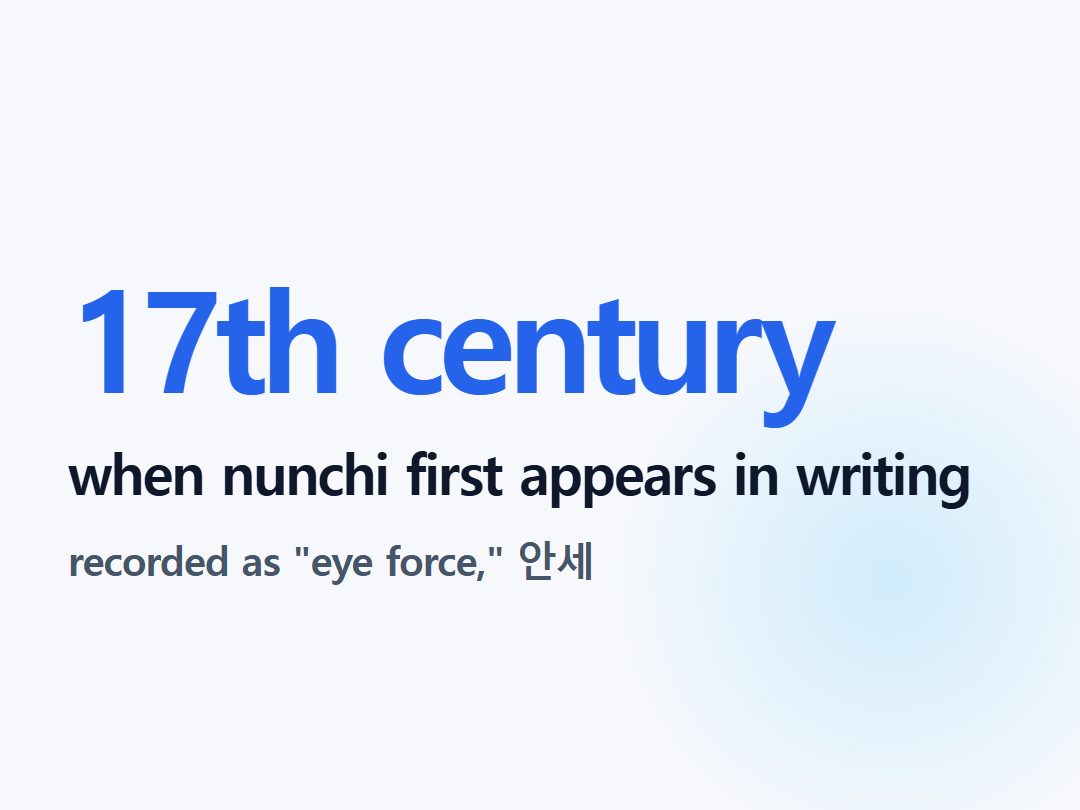
Reference works trace its earliest documented use to the 17th century, appearing as nunch'ui and written with the hanja (Chinese characters historically used in written Korean) 안세, meaning roughly "eye force" or "eye power." Its social function, however, predates the written record: the underlying expectation — that a junior person anticipates a senior person's needs without being told — is a direct extension of Confucian norms that shaped Korean family and court life for centuries before the word for it was ever set down.
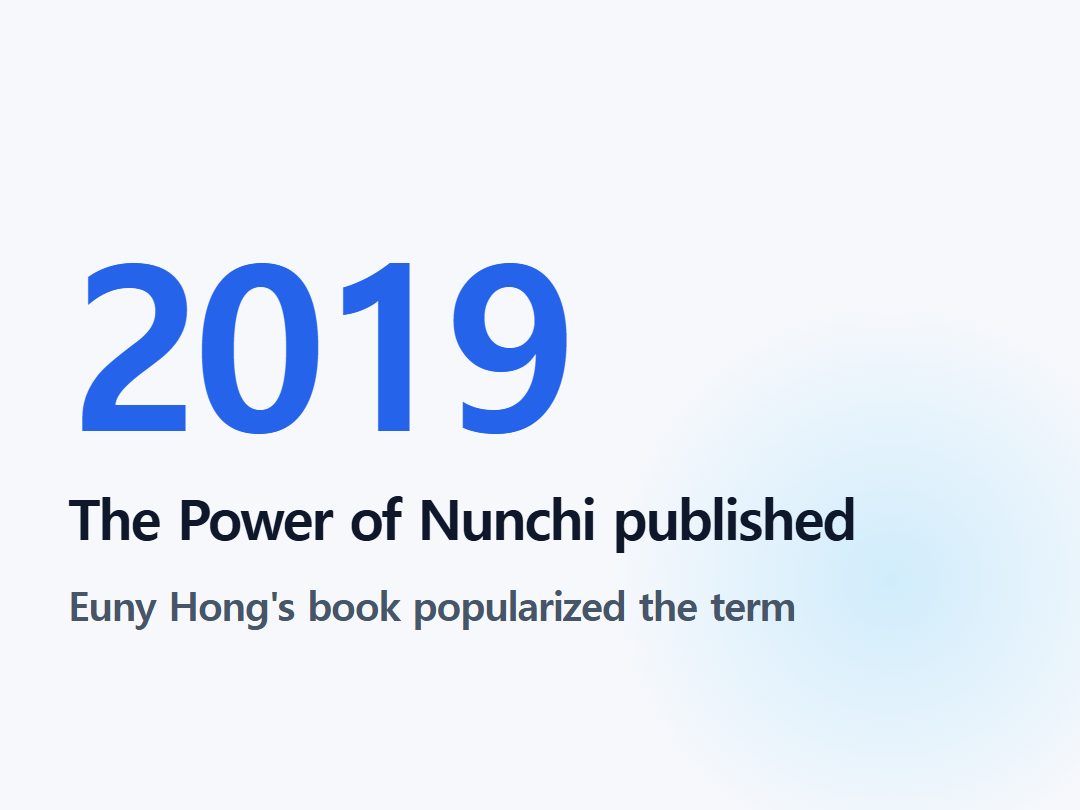
Nunchi's recent visibility in English owes a lot to one book. Journalist Euny Hong, who had earlier written The Birth of Korean Cool, published The Power of Nunchi: The Korean Secret to Happiness and Success in 2019 through Penguin.
The book frames nunchi as a transferable life skill and situates it, per its publisher's own description, as "the currency of life" in Korean society — arguing that most social and professional success in Korea runs through it.
The book arrived as part of a broader English-language publishing trend toward marketing untranslatable foreign concepts as self-help — the same wave that produced bestsellers built around the Danish hygge and the Swedish lagom — and it did the most, of any single English-language work, to move nunchi from a niche linguistics curiosity into general awareness.
That popularization is still working its way through English lexicography. Nunchi has been formally submitted to Collins English Dictionary as a new-word candidate, defined there as a Korean concept combining emotional intelligence with the ability to judge and respond to others' feelings.
As of now, it remains in Collins's "monitored" category — tracked for evidence of wider usage but not yet added as a standard entry, the same holding pattern many loanwords sit in for years before either entering common dictionaries or fading back out.
Will nunchi ever make it into English dictionaries?
Inside Korea, nunchi culture is under some generational pressure.
Younger workers, often referred to in Korean media shorthand as the "MZ generation" (a domestic blend of "Millennial" and "Gen Z" used to describe people roughly in their 20s and 30s), are more willing than previous cohorts to push back against the constant social monitoring nunchi traditionally demands, favoring more direct communication over reading silent cues.
Whether that shift meaningfully loosens nunchi's grip on Korean workplace and family life, or simply changes which situations it gets applied to, is not yet settled.
Outside Korea, the open question is smaller but concrete: does nunchi follow the path of jeong and han — Korean concepts widely referenced in English-language writing about Korea but never formally absorbed into English dictionaries — or does it complete the move that words like hygge already made, from "foreign concept explained in an article" to an entry with its own dictionary definition.
Collins's monitoring period will be one concrete marker to watch. In the meantime, the more useful habit for readers encountering nunchi in a recap or explainer is the one this article has tried to model: when you see "reading the room," ask what the writer left out about having to act on it.
Nunchi's timeline into English
| Period | What happened |
|---|---|
| 17th century | Earliest documented use as 'nunch'ui,' written with hanja meaning roughly 'eye force' or 'eye power' |
| 2019 | Euny Hong's The Power of Nunchi, published by Penguin, moves the term into mainstream English self-help |
| Present | Submitted to Collins English Dictionary as a new-word candidate; still sits in the 'monitored' category |
Frequently asked
What does nunchi mean in Korean?
Nunchi (눈치) combines 'eye' and 'measure' to describe both noticing unspoken social cues and adjusting your behavior to match them — noticing alone doesn't count.
Is nunchi the same as emotional intelligence?
Not exactly — emotional intelligence in English usually centers on self-awareness, while nunchi is oriented outward, aimed at protecting group harmony rather than an individual's inner state.
Is nunchi in the English dictionary?
Not yet — it has been submitted to Collins English Dictionary as a new-word candidate but remains in the 'monitored' category rather than a standard entry.
Sources
Every factual claim above is traceable. We do not translate articles — we gather facts from multiple outlets and write them ourselves.
- Nunchi — Wikipedia
- The Hidden Power of Nunchi (눈치) — CIEE
- Korean 눈치 Meaning: What Nunchi Really Translates To — TEUIDA
- Definition of NUNCHI | New Word Suggestion — Collins English Dictionary
- The Power of Nunchi by Euny Hong — Penguin Random House
- The Power of Nunchi: The Korean Secret to Happiness and Success — Barnes & Noble
- Nunchi in the Workplace: A Survival Guide for Working in Korea — AllAboutKorea