SM Entertainment, JYP Entertainment, YG Entertainment and HYBE all do the same basic thing: they scout teenagers, train them for years, and debut them as idol groups. From outside Korea, the four names often get lumped together as one category — ‘the K-pop agency.’
The short version
- SM, JYP, YG and HYBE differ in creative control, trainee criteria and company structure.
- HYBE alone runs as a multi-label holding company; the other three stay centralized.
- SM overtook HYBE in 2025 revenue, but HYBE still leads in market cap.
The overlap stops at the surface. Three things actually separate them:
- Who makes the creative decisions
- What each company looks for in a trainee before debut
- Whether the business is legally one company or several
Korean fans track these differences closely; they rarely make it into English-language coverage, which tends to treat every K-pop company as interchangeable.
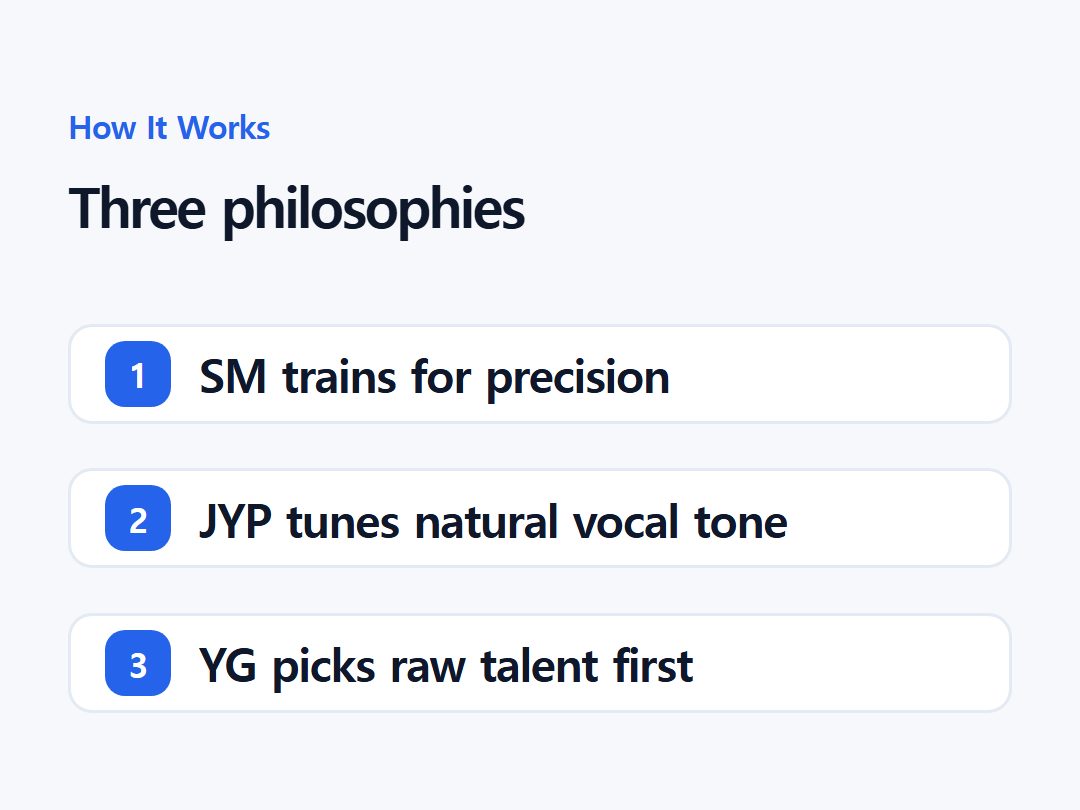
Same trainee pipeline, four different philosophies
All four run what's called the agency system: one company scouts, trains, produces and manages an artist, rather than a record label simply distributing music made elsewhere. A trainee can spend anywhere from months to several years — often unpaid or on a small stipend — learning to sing, dance and handle media before the company decides they're ready to debut.
That pipeline is identical across SM, JYP, YG and HYBE. What differs is what each company is training its trainees for.
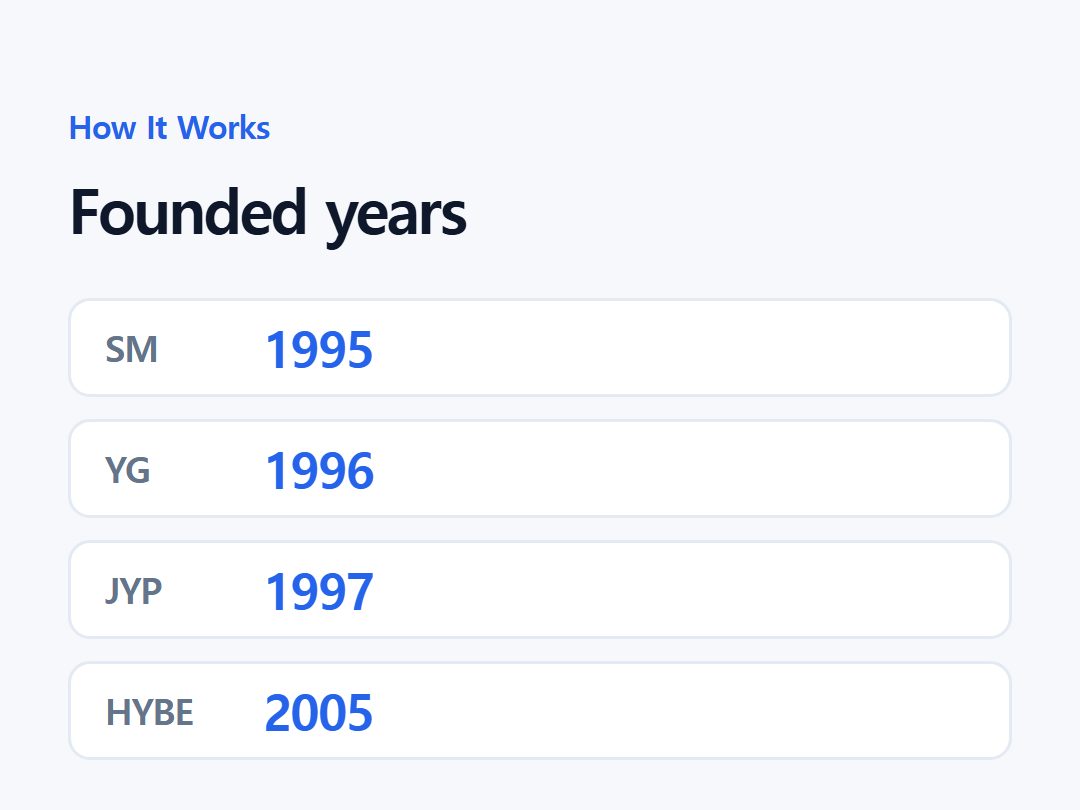
SM trains for precision, not personality
Lee Soo-man founded SM in 1995 after studying in the United States and observing both the American pop-production model and Japan's idol system. He combined the two into a single pipeline: audition, train in vocals and dance and language, then debut the strongest trainees under a tightly built group concept.
H.O.T's 1996 debut and S.E.S in 1997 proved the model worked, and rival companies copied it. SM's own output still leans on that origin: synchronized, almost architectural choreography and layered vocal arrangements, visible across EXO, NCT and aespa despite their very different concepts.
That emphasis on precision hasn't stayed frozen in the 1990s. Ahead of its 30th anniversary, SM unveiled ‘SM Next 3.0’ in January 2026, describing a shift from fixed internal production teams toward assigning creators project by project around each artist's concept — the company's own description of the change was that it is “an evolution, not a departure,” from its original training-heavy identity.
JYP builds around one man's ear for a voice
Park Jin-young founded JYP in 1997. His signature vocal philosophy, often summarized as ‘half air, half sound,’ prioritizes a natural, relatable tone over technically perfect delivery — a deliberate contrast to SM's more polished approach.
Park is also the company's final gatekeeper: reported accounts describe him personally reviewing every trainee's final audition, usually by video.
His mentoring style has shifted over time. He told TWICE trainees in 2014 to ‘be a good person before a good singer’; more recently, he's told incoming trainees that debuting won't automatically make them happy, and that they should choose their friends carefully.
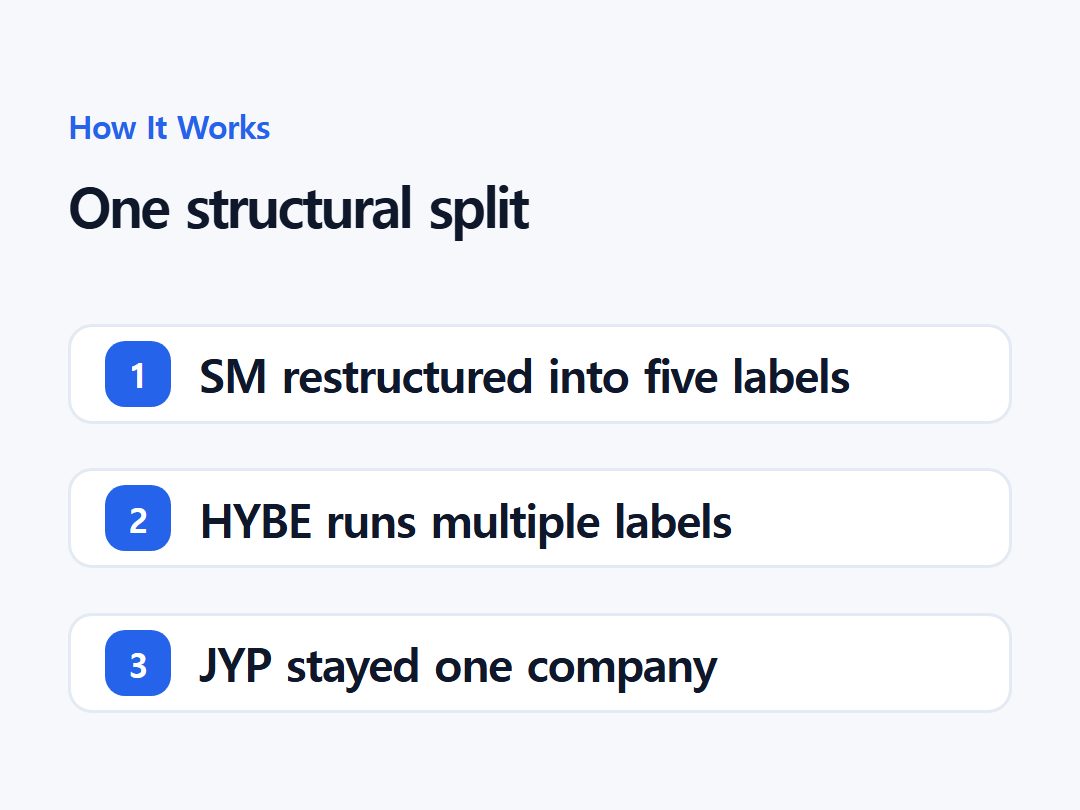
Structurally, JYP stayed closer to a single company than its rivals. It introduced internal divisions in 2017, and in 2024 renamed them ONE Label, BLU:M, STRIDE and SQUAD — but all four remain part of one legal entity, not separately branded companies.
YG picks the talent first and worries about the rest later
Yang Hyun-suk, a former member of the influential group Seo Taiji and Boys, founded what became YG in 1996 through several name changes before settling on YG in 2001. The company's hip-hop identity traces directly to Yang and longtime in-house producer Teddy.
YG's stated selection criteria differ from its rivals: trainees are expected to already be strong in at least one of singing, dancing or rapping, with visuals and background treated as secondary. Reported average training periods run around six years — longer than industry norms. The hip-hop through-line runs from BIGBANG and 2NE1 through BLACKPINK to TREASURE and BABYMONSTER today.
HYBE isn't one company — it's a holding company for several
Bang Si-hyuk co-founded HYBE's predecessor, Big Hit Entertainment, in 2005, after several years as a songwriter and producer at JYP, where he co-wrote hits for the group g.o.d. Big Hit nearly went bankrupt in 2007 before BTS's 2013 debut turned it into the industry's biggest player; the company was renamed HYBE in 2021.
Where SM, JYP and YG each run largely under one central creative structure, HYBE operates a deliberate multi-label system, in which each domestic label keeps its own production leadership rather than answering to a single in-house producer:
- BigHit Music — BTS, TXT
- Belift Lab — Enhypen, ILLIT
- Pledis — Seventeen, TWS
- Source Music and KOZ — additional rosters
HYBE has extended the same model overseas too, including KATSEYE, a joint venture with Geffen Records in the US, and label ventures in Japan and Latin America.
| Company | Founded | Founder | Structure today |
|---|---|---|---|
| SM | 1995 | Lee Soo-man | Multiple production centers (since 2023) |
| YG | 1996 | Yang Hyun-suk | Single company |
| JYP | 1997 | Park Jin-young | Single company, internal divisions |
| HYBE | 2005 | Bang Si-hyuk | Multiple independently branded labels |
One producer's 1990s bet became the whole industry's blueprint
SM's audition-train-debut model, built in the mid-1990s, became the template the entire industry still uses. JYP and YG built their own versions of it within a year of SM, each shaped around their founder's own musical background rather than SM's.
HYBE arrived a decade later as an outsider competing against an established ‘Big Three,’ and only became dominant after BTS's global breakout. Its multi-label approach — scaling the trainee system across several semi-independent companies instead of one central creative office — is the newest structural experiment among the four, not the original model.
A boardroom fight turned SM's founder-led model into five labels
SM's own structure changed more recently than people assume. In late 2022, SM ended its production contract with Lee Soo-man's company, and Kakao Entertainment acquired a large stake amid an ownership dispute between Lee and the board.
By February 2023, SM announced ‘SM 3.0,’ restructuring the company around five separate production centers and independent labels instead of one founder directing everything. Structurally, this moved SM closer to HYBE's multi-label model and further from the single-producer system Lee Soo-man had built.
Lee's exit came with a three-year non-compete clause tied to selling his stake to HYBE, which is set to expire in March 2026. He has stayed active abroad through his Singapore-based company A2O Entertainment, which has already registered a trademark in Korea and opened a Seoul office — a signal that the industry's original architect may soon compete directly with the system he built.
Revenue and stock price don't agree on which company is biggest
By revenue, the ranking flipped in 2025: SM, under Kakao, reported roughly $595 million, overtaking HYBE for the first time, driven by aespa and NCT tours and merchandise. JYP followed at roughly $500 million on the strength of TWICE and Stray Kids, with YG fourth at roughly $248 million, boosted by BLACKPINK's world tour.
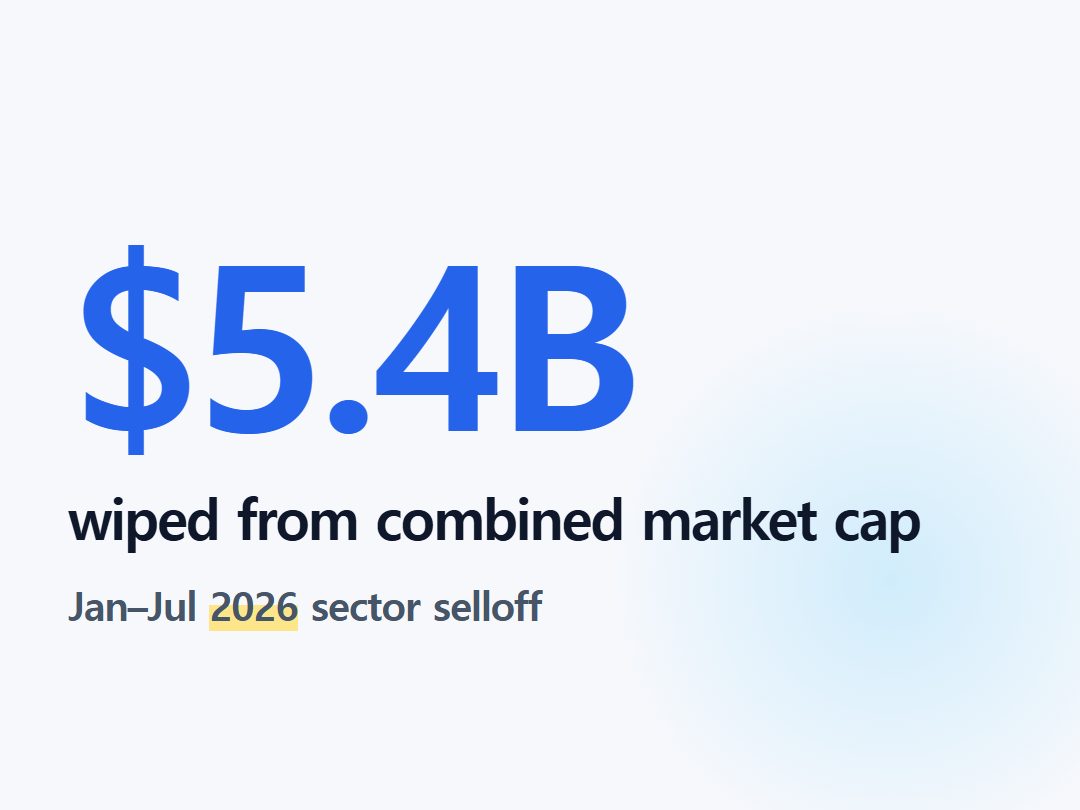
Market capitalization tells a different story. HYBE remained the largest of the four on the stock exchange into 2026, even after a brutal year for the sector: by mid-July 2026, the combined market cap of all four companies had dropped by roughly $5.4 billion since January, with SM's share price falling hardest.
A label dispute is testing whether the multi-label model holds
Since April 2024, HYBE has been in an escalating legal dispute with Min Hee-jin, then-CEO of its sub-label ADOR, over creative control and a shareholder buyout — a conflict that also drew in ADOR's group NewJeans. HYBE removed Min as CEO in August 2024, and repeated court rulings and appeals followed on both sides.
In February 2026, a Seoul court ordered HYBE to pay Min roughly $17.5 million in a shareholder dispute. HYBE has appealed, and several related lawsuits remain open.
The case doesn't threaten HYBE's overall scale, but it is the clearest real-world test of whether a semi-independent label inside a multi-label system can push back against its parent company — a tension SM may now face too, having adopted a similar structure in 2023.
2025 revenue ranking of the Big Four
| Rank | Company | 2025 Revenue | Key Driver |
|---|---|---|---|
| 1 | SM | ~$595 million | aespa and NCT tours and merchandise |
| 2 | JYP | ~$500 million | TWICE and Stray Kids |
| 3 | HYBE | Not disclosed | Overtaken by SM for the first time |
| 4 | YG | ~$248 million | BLACKPINK's world tour |
Frequently asked
What's the difference between SM, JYP, YG and HYBE?
All four use the same scout-train-debut pipeline, but they differ in who makes creative decisions, what they look for in a trainee before debut, and whether the business is legally one company or several.
Is HYBE bigger than SM?
It depends on the metric: SM overtook HYBE in 2025 revenue at roughly $595 million, but HYBE remained the largest of the four by market capitalization into 2026.
What is HYBE's multi-label system?
Instead of one central creative office, HYBE runs separate labels like BigHit Music, Belift Lab, Pledis, Source Music and KOZ, each keeping its own production leadership rather than answering to a single in-house producer.
Sources
Every factual claim above is traceable. We do not translate articles — we gather facts from multiple outlets and write them ourselves.
- Your idols' style by agency — The Korea Herald
- SM 3.0 — Wikipedia
- SM in internal feud over founder's exit from producing — The Korea Times
- JYP Entertainment — Wikipedia
- YG Entertainment — Wikipedia
- Bang Si-hyuk — Wikipedia
- HYBE Unveils New Label ABD — Billboard
- HYBE — Business — HYBE Corporation
- Biggest K-pop company by market capitalization 2026 — Statista
- Which K-Pop Groups Generated the Most Revenue for HYBE, SM, JYP, and YG in 2025? — KbizoOm
- South Korea's Big Four Entertainment Stocks Shed $5.4 Billion in Market Cap — BigGo Finance
- Min Hee-jin and Hybe's legal battle grinds on — even as NewJeans exit fight — The Korea Herald
- SM unveils new strategy, boy group debut amid key departures — The Korea Herald
- SM Entertainment founder eyes return as non-compete nears end — The Korea Herald