International readers often use "webtoon" and "web novel" interchangeably, or assume a webtoon is just a Korean word for "web comic." In Korea's publishing industry, they are two distinct products, made by different people, sold on different platforms, and — crucially — released in a specific order.
Many of the webtoons that reach global platforms first existed as plain text, sometimes for years, before a single panel was drawn.
The short version
- Most global webtoons started as text novels years before any art was drawn.
- Platforms only greenlight webtoons after novels prove themselves in daily chapter sales.
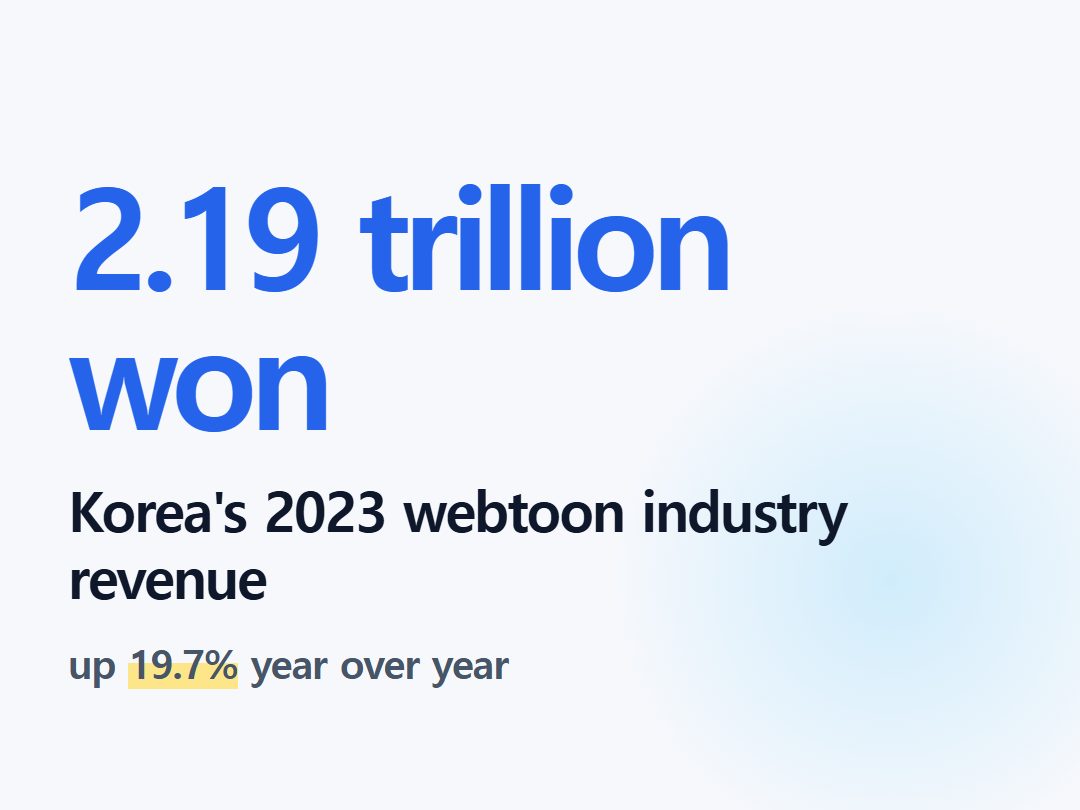
- Korea's webtoon revenue topped 2 trillion won for the first time in 2023.
Novels and webtoons are two separate stages
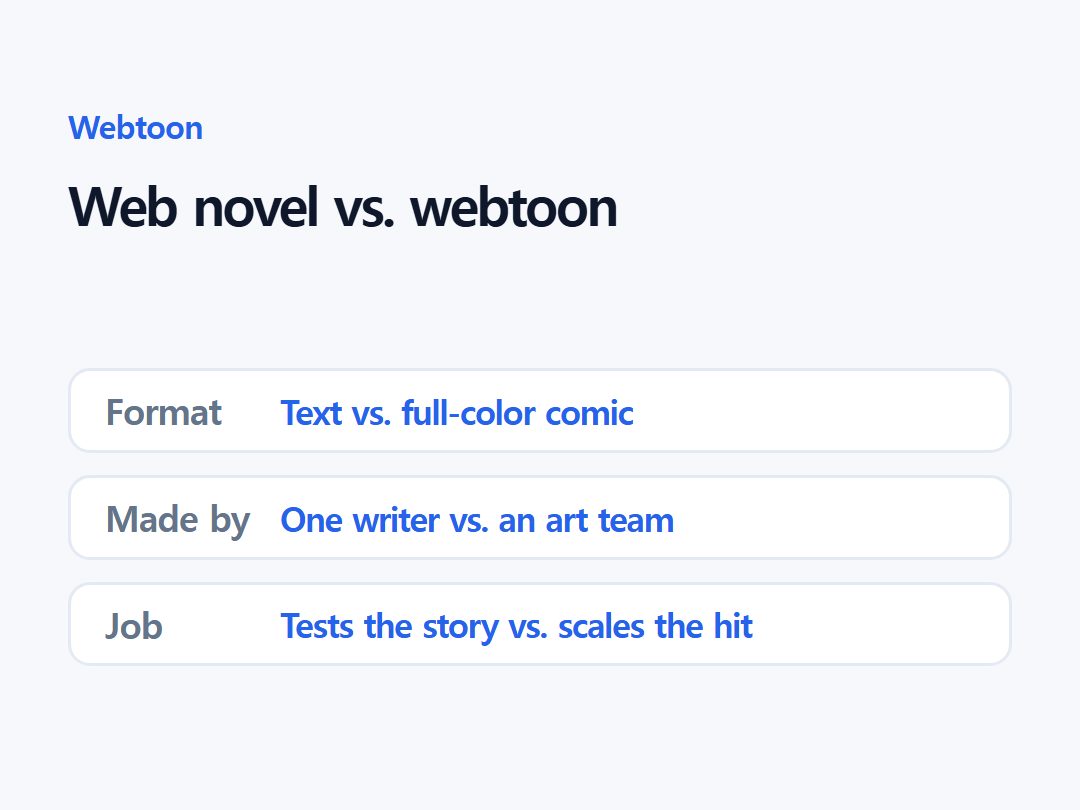
A web novel (웹소설) is serialized prose fiction, usually written by a single author and published in daily or near-daily chapters on text-focused platforms such as Munpia, Naver Series, or Kakao Page.
A webtoon (웹툰) is a full-color comic built for vertical scrolling on a phone screen, produced by an artist or small studio and released on platforms like Naver Webtoon or Kakao Webtoon.
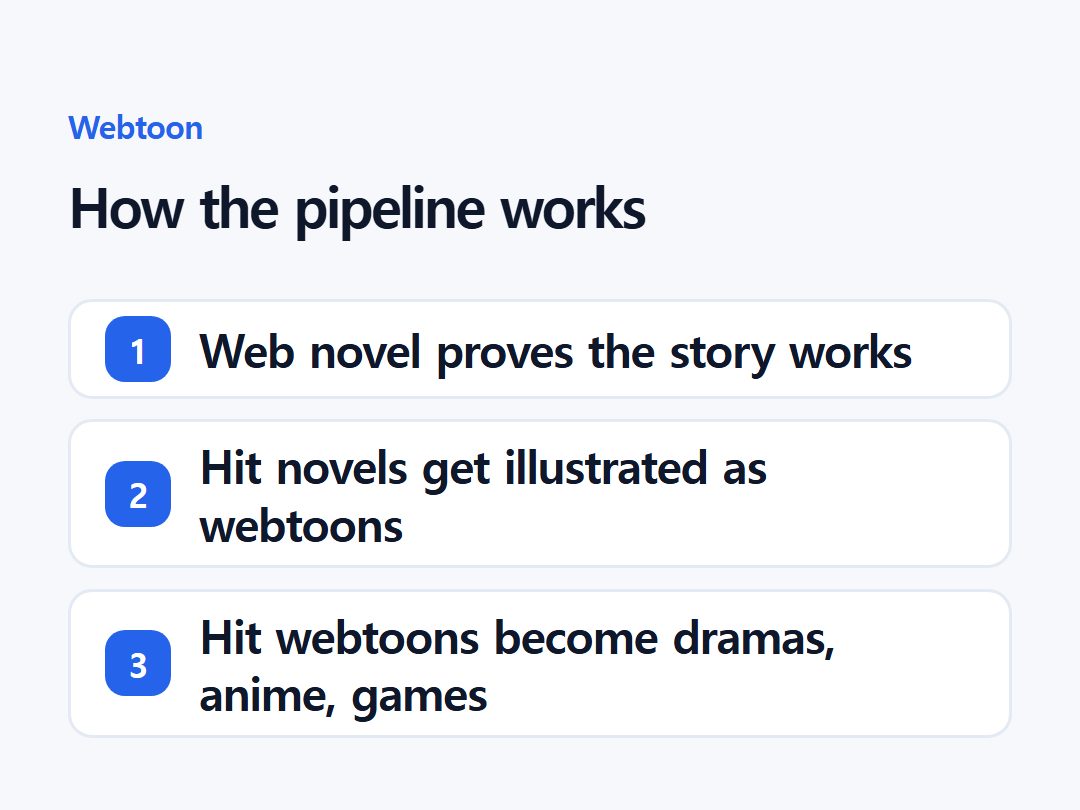
They are not two names for the same thing — they are two separate stages of a single content pipeline, and understanding that pipeline explains a lot about why some of the biggest "webtoons" international fans know already had a built-in fanbase, a finished plot, and years of reader feedback before they were ever illustrated.
Why do webtoons need a novel first?
The reason this two-stage structure exists comes down to cost and risk. Writing a web novel requires one person and a laptop; a chapter can be written, edited, and published in a day.
Producing a webtoon requires a writer, an illustrator, colorists, and often a background artist working as a team, with a single episode taking a studio days to complete. That gap in production cost means publishers and platforms have a strong incentive not to gamble webtoon-level budgets on an unproven story.
Web novels solve that problem by acting as a cheap, fast market test. Korean platforms track exactly how a novel performs chapter by chapter — how many readers pay to unlock episodes early, how many wait for the free release, how a title ranks on daily bestseller charts, how many downloads it accumulates over time.
Only novels that clear that bar, sometimes after tens of millions of cumulative downloads, get greenlit for the far more expensive step of becoming a webtoon.
The Korea Creative Content Agency has described this explicitly as a value chain running from web novel to webtoon to screen adaptation to merchandising, with each stage using the previous one's performance data to decide what gets funded next.
This is different from how comics-first markets usually work, where a story is conceived as a visual medium from the start.
In Korea's system, by the time a story is announced as a webtoon, it has frequently already been written, revised, and read to completion by hundreds of thousands or millions of people as a novel — meaning the plot, pacing, and twists are largely locked in before the art begins.
That is also why some Korean web novel fandoms include readers who followed a story for years in text before it was ever illustrated, and why spoiler culture around a hit webtoon sometimes traces back to a novel that finished serialization long before the comic did.
It also explains a pattern international readers notice without always knowing why: certain genres — fantasy, action, romance-fantasy, "regression" or "hunter" stories — are disproportionately webtoon adaptations of novels, because those tropes are cheap to test in text first.
Slice-of-life or single-arc dramedies, by contrast, are more often developed directly as webtoons, since their appeal is harder to gauge from prose alone.
Once a webtoon adaptation itself becomes a hit, the same validation logic repeats one level up: only the webtoons with proven fan engagement tend to get selected for the next, even costlier stage — a Netflix or Disney+ drama, an anime series, or a mobile game — because streamers and studios use the webtoon's view counts and subscriber numbers the same way publishers used novel chart rankings.
How Naver and Kakao built this pipeline
Naver launched a free web comics service in 2004, popularizing the vertical-scroll "webtoon" format domestically, and later took the format overseas by launching LINE Webtoon (now WEBTOON) for English-language readers in 2014.
Text serialization grew up alongside it on separate platforms: Munpia became Korea's largest text-only web novel hub, focused heavily on male-oriented genre fiction, while Naver's own novel arm was reorganized into the paid storefront Naver Series in 2018.
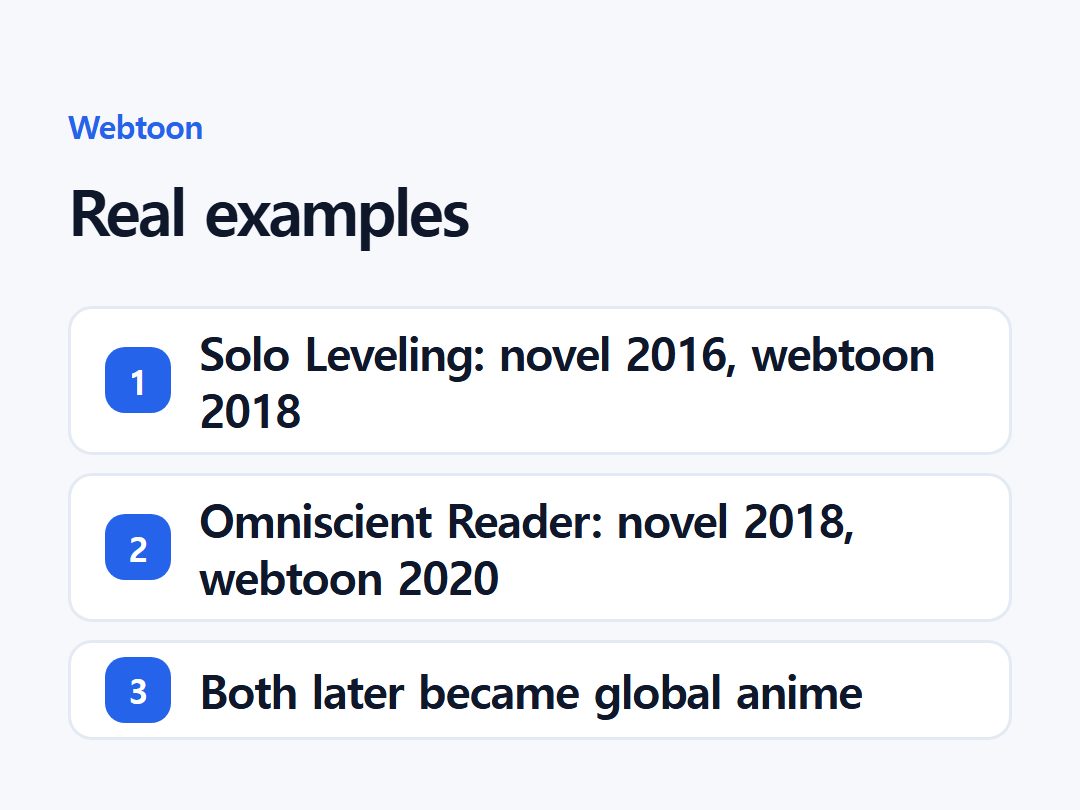
Kakao Page took a different route, hosting both novels and webtoons on one platform and actively converting hit novels into webtoons — a strategy the company refers to internally as "webtoonization." The clearest example is Solo Leveling, written by the author Chugong and serialized as a web novel on Kakao Page from 2016, then published in full by D&C Media.
Only after the novel had finished its run and built a large readership did REDICE Studio and illustrator Jang Sung-rak (known as Dubu) begin a webtoon adaptation, which launched in March 2018.
That webtoon ran until December 2023 and went on to become a Crunchyroll-era global anime hit in 2024–2025, with a live-action Netflix drama now in development. Omniscient Reader's Viewpoint followed the same sequence: a web novel on Munpia from January 2018 to February 2020, followed by a webtoon adaptation that launched on Naver Webtoon in May 2020 and later became the basis for an anime produced by Crunchyroll and Aniplex.
The scale of what this pipeline now generates is significant.
According to a 2024 industry survey by South Korea's Ministry of Culture, Sports and Tourism and the Korea Creative Content Agency, domestic webtoon industry revenue passed 2 trillion won for the first time, reaching roughly 2.19 trillion won (about $1.5–1.6 billion) in 2023 — a 19.7% increase from the previous year, continuing six straight years of growth since the agency began tracking the sector in 2018.
None of that revenue exists without the earlier, far cheaper text-novel stage that determines which stories are worth that investment in the first place.
Will streaming platforms skip the novel stage?
Not every webtoon is a novel adaptation, and the two markets are not identical in size or shape — Korea's publishing and electronic-publishing platforms track novel revenue separately from webtoon revenue, and plenty of original webtoons are commissioned without ever existing as text.
But industry reporting in 2026 has noted platforms leaning harder into "verified IP" — extending already-proven franchises across formats rather than greenlighting new, unproven webtoons — which raises an open question about how much room is left for original stories that skip the novel stage entirely.
Also worth watching is how far up the chain this staged model keeps extending.
Naver has already named further web novels and webtoons slated for screen adaptation, and Kakao's overseas platform Piccoma has used the same validated-IP approach to become the top digital comics service in Japan, where Korean titles reportedly generate roughly half its revenue despite making up only a small fraction of its catalog.
That success is not automatic at every stage, though — a novel's popularity does not guarantee its webtoon will hit the same numbers, and a webtoon's fanbase does not always translate into traffic once a drama or anime adaptation airs, since fans can watch the screen version without ever returning to the platform where the original was published.
Industry analysts have flagged that gap as a real limit on how cleanly the pipeline converts attention into revenue at every step.
Whether that staged, data-driven pipeline — novel proves the story, webtoon proves the audience, screen adaptation proves the franchise — keeps scaling globally, or whether streaming platforms start greenlighting Korean stories earlier in the process and skipping a stage, is one of the more consequential shifts to track in how Korean IP reaches the rest of the world.
Four stages from novel to merchandising
| Stage | What Happens | Solo Leveling Example |
|---|---|---|
| 1. Web novel | Author publishes serialized text; platform tracks paid unlocks and chart rank | Serialized on Kakao Page starting 2016 |
| 2. Webtoon | Only novels that clear a performance bar get a full art team | Adaptation launched March 2018, ran until December 2023 |
| 3. Screen adaptation | Only webtoons with proven view counts get selected for anime or drama | Anime hit in 2024–2025; Netflix live-action drama in development |
| 4. Merchandising | Franchise extends into games and licensing once screen success is proven |
Frequently asked
Is a webtoon the same as a web novel?
No — a web novel is serialized prose text, while a webtoon is a full-color comic made for vertical scrolling, and in Korea's industry the novel is almost always written first.
Was Solo Leveling a novel before it became a webtoon?
Yes, it was serialized as a web novel on Kakao Page starting in 2016, and the webtoon adaptation by REDICE Studio and illustrator Dubu didn't launch until March 2018.
How big is the Korean webtoon industry?
Domestic webtoon revenue passed 2 trillion won for the first time in 2023, reaching about 2.19 trillion won (roughly $1.5–1.6 billion), a 19.7% increase from the prior year.
Sources
Every factual claim above is traceable. We do not translate articles — we gather facts from multiple outlets and write them ourselves.
- Solo Leveling — Wikipedia
- The History of Solo Leveling — The Beat
- Omniscient Reader's Viewpoint — Wikipedia
- '김부장'·'나 혼자만 레벨업'…웹툰 시장, 신작 대신 검증 IP 올인 — Aju Business Daily
- 웹툰·웹소설 IP 전성시대...흥행·효율 '선순환 생태계' 구축 — Digital Today
- "K웹툰 산업 규모 2조원 돌파…불법 시장은 20% 차지" — Electronic Times (etnews)
- How Webtoons Are Becoming The Latest Korean Export With Global Impact — Deadline
- New webtoon-to-dramas boost Kakao Entertainment's IP success — Kakao Entertainment Newsroom
- Korean Webtoons: Naver, Kakao, and Global K-Comics — Daebak