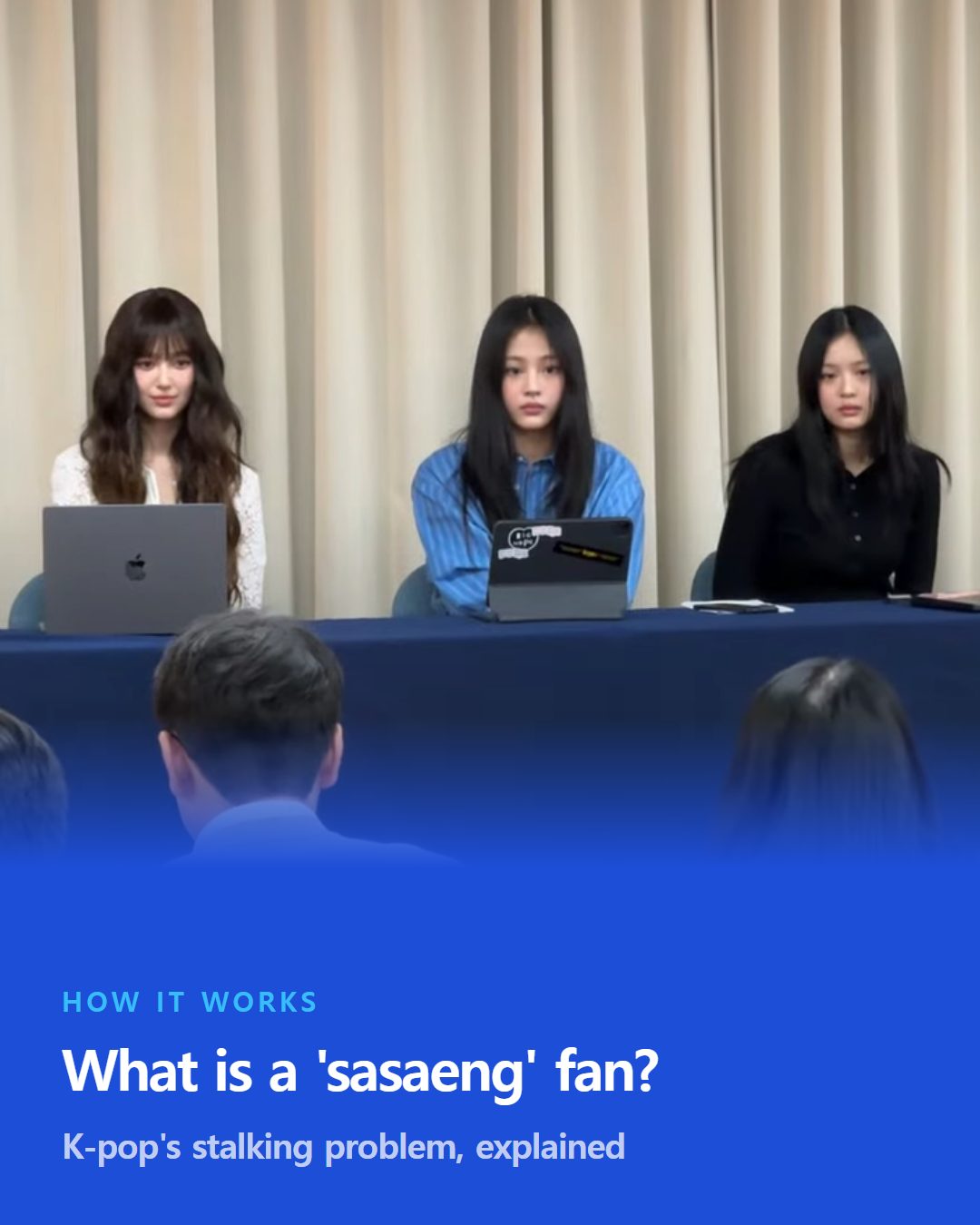
In June 2026, HYBE label BigHit Music told fans it had found GPS trackers hidden on vehicles carrying its new group CORTIS during tour stops in Paris.
The agency said the people responsible had hired local drivers to trail the group to undisclosed locations, and it announced criminal complaints with "no settlement or leniency," citing the fact that most CORTIS members are minors.
A few months earlier, in November 2024, a fan hiding in an emergency stairwell ambushed The Boyz member Sunwoo outside his apartment door; the group's agency, IST Entertainment, said staff were assaulted while restraining the intruder, and separately reported a GPS tracker on the group's van and deliberately slashed tires.
The short version
- Sasaeng fans stalk, track, and invade K-pop idols' private lives, not just admire them.
- South Korea only criminalized stalking in 2021, after decades with no such law.
- Agencies like HYBE now default to criminal complaints instead of quiet warnings.
Both cases were described by the agencies, and by Korean media covering them, using a single word: sasaeng. For readers outside Korea, the term rarely appears in English-language coverage of K-pop — but inside the industry, it names a problem the business has been fighting, with limited success, for three decades.
Fans have broken in, filmed idols, and followed them
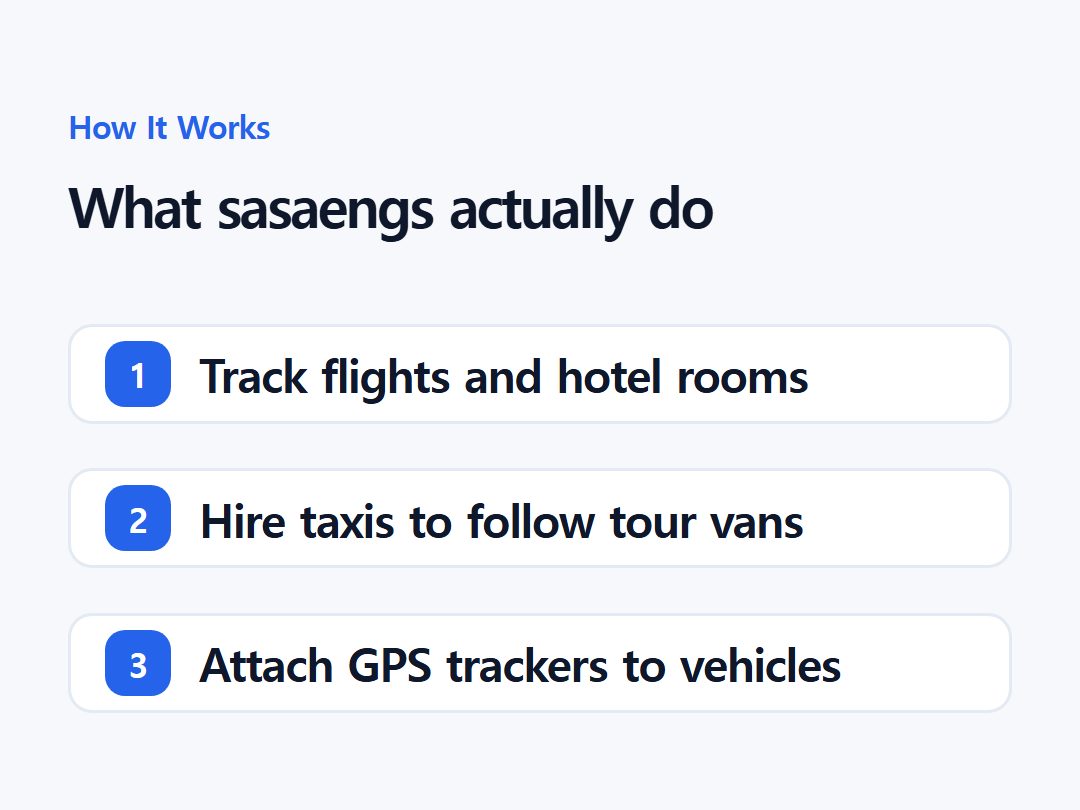
Sasaeng (사생팬) combines the Korean words for "private" (사, sa) and "life" (생, saeng) — literally, a fan who invades a celebrity's private life. It describes fans whose devotion crosses from admiration into surveillance, trespassing, or stalking: camping outside dorms, chasing tour vehicles, obtaining home addresses and flight information, or contacting idols through personal phone numbers obtained illegally.
The behavior is not new, but 2023–2026 produced an unusually dense run of high-profile cases. SM Entertainment went public in 2023 after a fan broke into NCT member Haechan's home, and again after another fan filmed the interior of bandmate Jaehyun's hotel room during a U.S. tour.
JYP Entertainment issued repeated warnings over fans loitering outside Stray Kids' dormitory.
TVXQ's Kim Jae-joong posted photographs of taxis hired by sasaengs to track his movements, saying the harassment made him feel he "wanted to die." Each case ended the same way: an agency statement naming the behavior as a crime, not a fan quirk, and a promise of legal action.
Why does K-pop's fan intimacy invite stalkers?
To understand why sasaeng fans exist at a scale rarely seen around Western celebrities, it helps to understand how K-pop sells access.
Idols under the agency system — the model in which a management company scouts, trains, and contractually manages performers for years before and during their careers — are marketed on manufactured intimacy.
Fan meetings, live-streamed vlogs, and direct-message platforms like Weverse (a fan community app where idols post personal updates and interact with subscribers) are core parts of the business, not side content. The product is not just music; it is the feeling of proximity to the artist.
Sasaeng fans are what happens when a small number of people treat that manufactured proximity as literal access.
Academic researchers who have studied the phenomenon describe sasaengs as, in effect, the fandom's most literal customers — people acting on the intimacy the industry itself sells, taken to a criminal extreme.
That framing is uncomfortable for an industry built on parasocial closeness, which is one reason agencies were slow, for years, to treat the behavior as a security and legal problem rather than an embarrassing public-relations issue.
The consequences are concrete. BTS member V has said the group started flying private instead of commercial partly because of safety concerns tied to sasaeng behavior. NCT's Renjun has described being photographed while asleep and having fans book adjacent airplane seats.
In 2011, Girls' Generation's Taeyeon was physically pulled off stage mid-performance by a fan.
These are not isolated eccentrics; agencies now describe organized networks — fans splitting the cost of hired taxis and trackers, sharing real-time location tips in group chats, and impersonating event staff to get near artists.
There is also a scale problem specific to K-pop's global reach.
As idols tour internationally, sasaeng behavior has followed them across borders — the CORTIS tracking happened in France, and HYBE has separately pursued a defendant located in Argentina over thousands of defamatory posts — which puts alleged offenses outside the reach of Korean police and into a slower, costlier process of international legal cooperation.
International fans are often the last to hear about any of this, for a simple reason: agency statements about sasaeng incidents are written for the domestic fan base and rarely get translated or picked up by English-language entertainment press, which tends to cover comebacks and chart placements instead.
That gap matters, because it lets a distorted picture take hold overseas — where "obsessive fan" behavior circulating on social media can look like a fandom-wide quirk rather than a small, criminal minority that the fandom itself generally condemns.
Fan communities have their own term, "anti," for hostile fans, but sasaengs are a separate category: they act out of possessive devotion, not hostility, which is part of why agencies have historically hesitated to publicly shame them the way they would an anti.
How South Korea finally made stalking illegal
The term predates the internet. Industry veterans trace organized obsessive-fan behavior back to Korea's first idol groups in the 1990s, such as H.O.T. and g.o.d, though "sasaeng" as a label came into common use later.
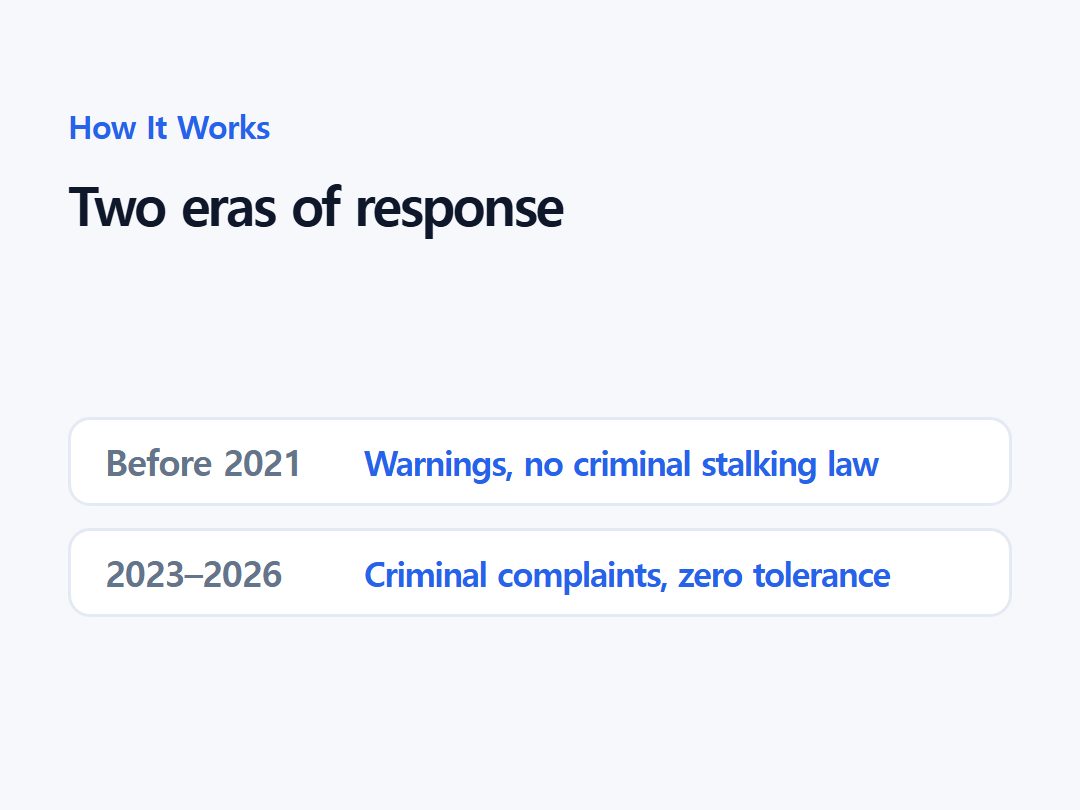
What changed the stakes was not the behavior but the law: for decades, South Korea had no statute that criminalized stalking itself. Police could act only if a stalker committed a separate offense, such as trespassing, or issue a minor "causing anxiety" citation that carried little deterrent effect. Victims and their agencies had few tools beyond public statements and civil suits.
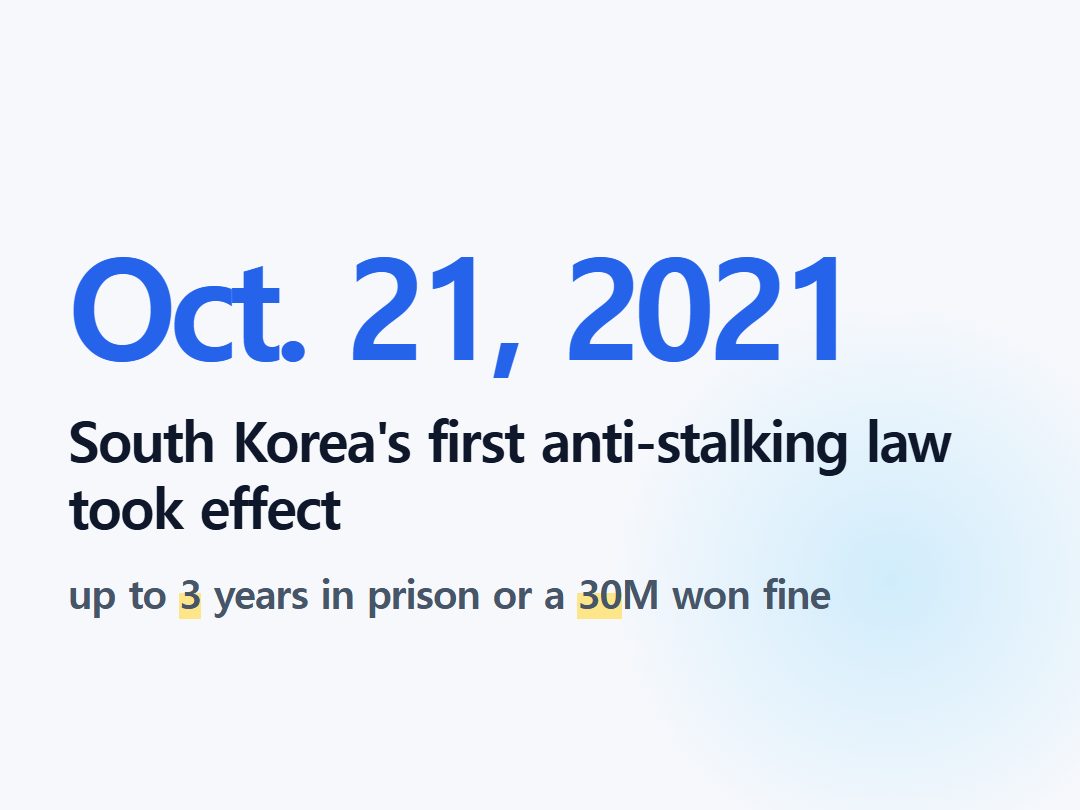
That changed on October 21, 2021, when the Act on Punishment of the Crime of Stalking took effect, criminalizing repeated, unwanted approaches, following, or contact that causes fear — punishable by up to three years in prison or a 30 million won ($21,000) fine, rising to five years or 50 million won if a weapon is involved.
Police also gained power to issue on-the-spot restraining orders, including a 100-meter no-approach rule. The law was strengthened again in 2023 with the Act on Prevention of Stalking and Protection of Victims, closing gaps such as inadequate victim-protection measures during investigations.
Agencies built their own infrastructure on top of the new law. SM Entertainment launched a fan-reporting channel, KWANGYA 119, in 2023 so fans could flag defamation and privacy violations for legal review.
HYBE, JYP, and other major labels have since issued formal warning notices citing the stalking law by name, and several have begun pursuing criminal complaints as a default response rather than a last resort — a shift from the earlier pattern of quiet warnings and occasional leniency.
Idols themselves have increasingly used their own platforms as an early-warning system: BTS' Jungkook used a Weverse livestream in December 2023, shortly before beginning his mandatory military service — the roughly 18-month enlistment required of nearly all South Korean men, including idols — to describe sasaengs waiting outside his house, and TXT's Taehyun used the same platform to report that someone had pre-booked and altered the members' in-flight meal orders, a sign that a sasaeng had obtained their confidential flight details.
Will the CORTIS case lead to real convictions?
Enforcement remains the unresolved part of the story. Legal experts note that proving "repeated" conduct under the 2021 law is harder than it sounds: a single instance of waiting at an airport or following a car does not meet the legal bar, so agencies must document patterns over time before police can act.
Digital harassment — fake accounts, doxxing, or the illegal trade of flight itineraries, which BigHit Music says it is now prosecuting in the CORTIS case — sits in an even greyer legal zone than physical stalking.
The CORTIS investigation, opened in mid-2026, is ongoing, as is scrutiny of how effectively cross-border cases like it can actually be prosecuted. Whether agencies' newer zero-tolerance language translates into convictions, rather than settlements, is the detail worth tracking — it is the difference between a stronger statement and a functioning deterrent.
A timeline of sasaeng cases and the law
| Year | Event |
|---|---|
| 2021 | Act on Punishment of the Crime of Stalking takes effect Oct. 21, criminalizing repeated unwanted contact |
| 2023 | Law strengthened via Act on Prevention of Stalking and Protection of Victims; SM launches KWANGYA 119 reporting channel |
| 2024 | Fan ambushes The Boyz's Sunwoo outside his home; GPS tracker and slashed tires found on group's van |
| 2026 | GPS trackers found on CORTIS tour vehicles in Paris; BigHit Music files criminal complaints |
Frequently asked
What does 'sasaeng' mean in K-pop?
Sasaeng (사생팬) combines the Korean words for 'private' and 'life' — it describes fans whose devotion crosses into surveillance, trespassing, or stalking of idols.
Is stalking a crime in South Korea?
Yes, but only since October 21, 2021, when the Act on Punishment of the Crime of Stalking took effect, punishable by up to three years in prison or a 30 million won fine.
What happened with the GPS trackers found on CORTIS's vehicles?
In June 2026, BigHit Music said GPS trackers were found hidden on vehicles carrying CORTIS during Paris tour stops, hired by people who trailed the group, and announced criminal complaints with no settlement or leniency.
Sources
Every factual claim above is traceable. We do not translate articles — we gather facts from multiple outlets and write them ourselves.
- Stalker fans, or 'sasaeng' continue to plague entertainment landscape — The Korea Herald
- K-pop group Cortis' agency warns fans after finding GPS tracking device on transport vehicle — Malay Mail
- BigHit Music files legal action over Cortis stalking, flight info leaks and GPS tracking — Korea JoongAng Daily
- Crazed Sasaeng fan attacks The Boyz member Sunwoo and staff member, agency says there will be no leniency — allkpop
- SM vows legal action against obsessive fan for trespassing into NCT member's hotel room — The Korea Times
- K-pop artists, agencies step up fight against 'sasaeng' fans — Inquirer.net
- Sasaeng fan — Wikipedia
- Act on Punishment of Crime of Stalking — Korea Legislation Research Institute