
A Korean drama becomes a global hit and, within days, it is sitting in the same spot on Netflix in Seoul, Sao Paulo, and Stockholm.
A Korean movie becomes a global hit — an Oscar winner, a 10-million-admission blockbuster — and international fans spend months asking the same question on forums: where can I actually watch this, legally, where I live? The answer is not censorship or neglect.
It is a licensing structure. Korean film rights are sold territory by territory, title by title, to different companies with different release calendars, while Korean drama rights are increasingly sold in bulk to a single global platform. Same country of origin, two entirely different distribution systems.
The short version
- Korean movie rights are sold territory by territory, not as one global deal.
- Parasite's rights went to four separate companies across theatrical and streaming.
- Korean dramas skip this fragmentation via Netflix's direct multi-year studio deals.
Why isn't this Korean movie streaming everywhere?
The core thing international readers usually don't know is that a Korean movie is not one product with one worldwide release date. It is dozens of separate contracts.
When a Korean production company or its sales agent takes a finished film to a festival market — Cannes, Berlin, the American Film Market — they sell the rights region by region to whichever distributor bids for that territory.
North America might go to one company, the UK to another, Latin America and continental Europe to a third, and so on. Each of those buyers then decides, independently, when and how to release the film: theatrically first, straight to a streaming platform, or a mix of both, on its own schedule.
This is exactly what happened with Bong Joon-ho's Parasite. Neon bought North American rights in 2018 and built a slow-expanding theatrical campaign that peaked after its Oscar wins.
Curzon separately bought UK and Ireland rights ahead of the Cannes premiere and, unusually for the company, gave the film a full nationwide theatrical window rather than its usual day-and-date release.
Streaming came even later and in pieces: Hulu got exclusive US streaming rights in April 2020, while Amazon Prime Video picked up rights everywhere else outside the US that same spring. One film, one release, four separate companies deciding four separate timelines.
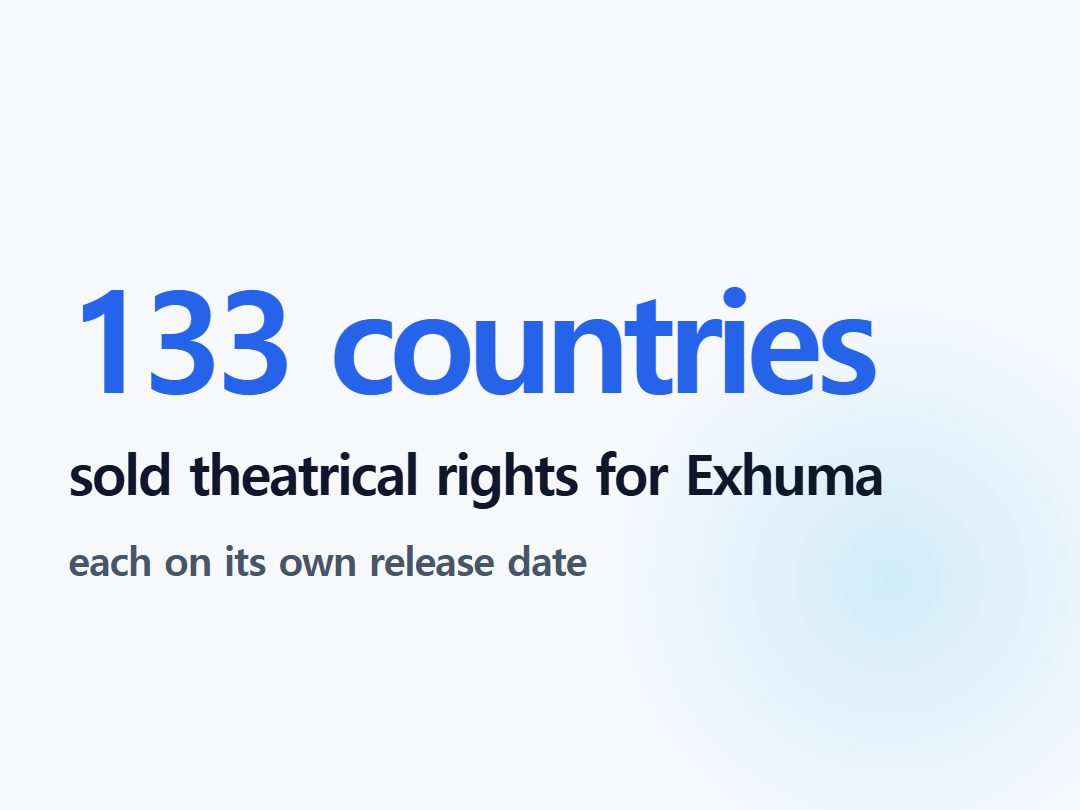
The pattern holds for recent blockbusters too. The 2024 horror hit Exhuma sold theatrically to distributors in 133 countries, with staggered opening dates — Australia and Southeast Asia in mid-March, North America and the UK a day later, the Philippines and Thailand weeks after that.
But its streaming rollout was even more fragmented: the film reached Viki subscribers in the US and Canada first, while its eventual Netflix release was limited to Korea only for a stretch, leaving international fans to piece it together across AMC+, Shudder, OnDemandKorea, Apple TV, and other services depending on their country. The Roundup: Punishment, which crossed 10 million admissions in Korea the same year, followed the same genre-film path: sold market by market, mostly through Asia-focused distributors, with no single global streaming home.
Compare that to how Korean dramas now typically reach the world.
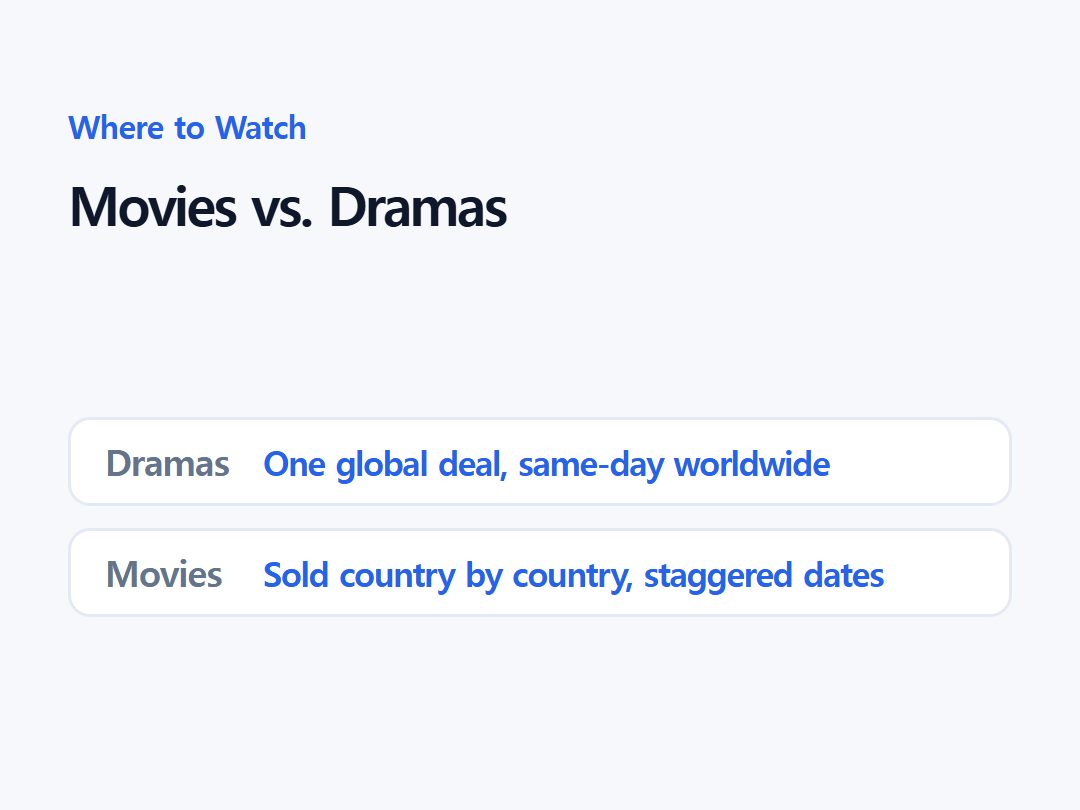
Netflix built multi-year output deals directly with Korean studios such as Studio Dragon and JTBC, meaning many current dramas are licensed — or produced — for Netflix's entire global library at once, dropping in every territory the platform operates in on the same day.
That is a fundamentally different deal structure from a film sold piecemeal to festival buyers. It is also why a drama fan can reasonably expect a new Korean series to appear on their home Netflix, while a film fan has to actively hunt for who bought their country's rights.
Independent sales agents split Korean films by country
Korean cinema and Korean television grew global audiences through different pipelines, and the film side is still catching up to the streaming era on its own terms.
Korea's domestic film industry has long been dominated by a handful of vertically integrated companies — CJ ENM chief among them, along with Showbox — that control production, domestic theatrical distribution, and Korea-based streaming rights for the same titles, but do not necessarily control what happens once a film leaves the country.
For international distribution, Korean producers have historically relied on independent sales agents who shop the film territory by territory at festival markets, the same system used across most of world cinema outside major English-language studios.
Genre and arthouse distributors filled the gap this created.
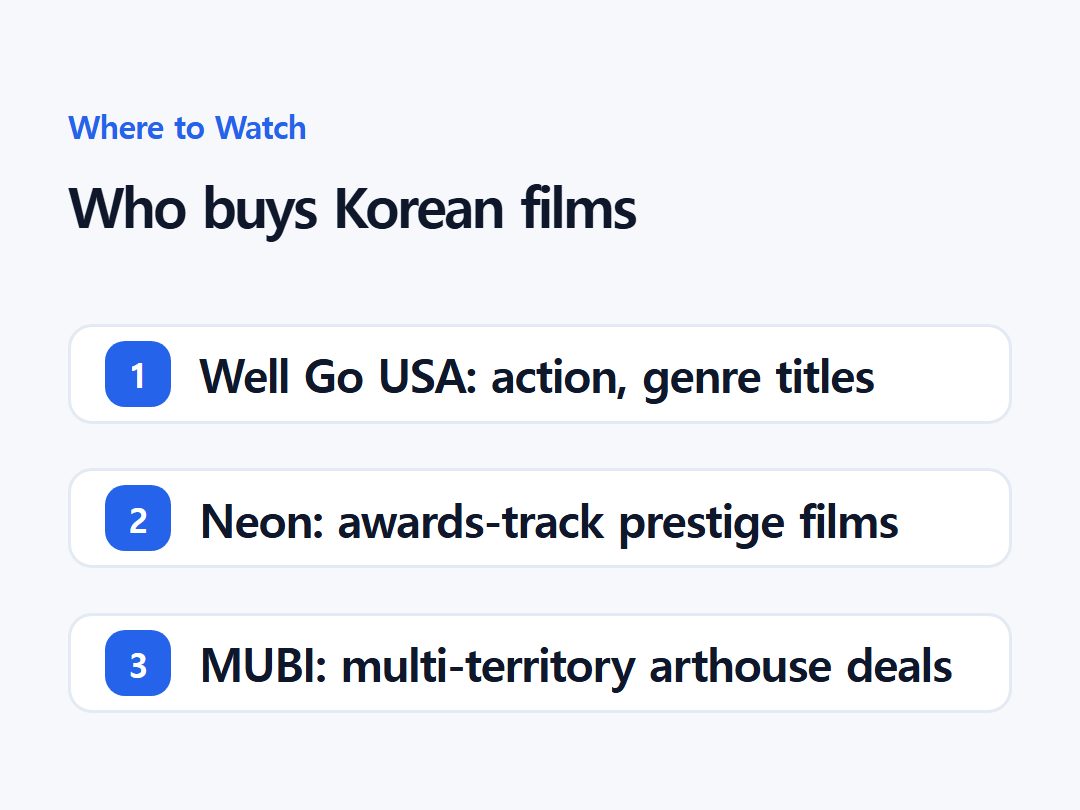
Well Go USA, a Texas-based distributor, became one of the most consistent North American buyers of Korean action and thriller titles, acquiring films like Escape From Mogadishu, Alienoid, and Hansan: Rising Dragon for US and Canadian theatrical and home-entertainment release.
Neon took the opposite end of the market, positioning itself for awards-track prestige titles after Parasite's success — it later acquired 20th-anniversary rights to Park Chan-wook's Oldboy and, in 2026, North American, UK, and Australian rights to Na Hong-jin's Hope.
MUBI, meanwhile, has been expanding into Korean arthouse cinema by picking up the same film for a cluster of European and Latin American markets at once. None of these companies coordinate release dates with each other, because none of them are obligated to.
Korean dramas avoided this fragmentation largely because Netflix moved early and aggressively. The platform began licensing Korean content around 2016 and deepened the relationship through direct studio partnerships that guaranteed simultaneous global streaming rights as part of the original deal — a structure films, sold late and separately after already being finished, rarely have access to.
Will Korean films ever get one global home?
The legal streaming map for Korean film is still being redrawn.
On the drama and variety-show side, KOCOWA+ — a US-based platform focused on near-simulcast Korean broadcast content — expanded onto Prime Video in the UK in September 2025, and in December 2025 it absorbed exclusive rights to its own catalog from Viki, meaning fans who used to find that content bundled into Viki Pass Plus now need a separate KOCOWA+ subscription. That kind of consolidation could eventually extend to film libraries, but has not yet.
On the film side, the more relevant trend is arthouse distributors like MUBI buying multiple territories in a single deal, which narrows — without eliminating — the patchwork problem for non-English-speaking fans in Europe and Latin America.
Genre and blockbuster Korean films, however, are likely to keep following the older model: sold country by country, released on staggered dates, and available through a different combination of platforms depending on where a reader happens to live.
For now, the most reliable approach for an international viewer is not to assume a hit Korean film will appear on their default streaming platform, but to check region-specific listings — because the company that bought the rights next door may not be the one that bought them at home.

Parasite's Rights, Sold Four Times Over
| Distributor | Territory | Rights Type | Timing |
|---|---|---|---|
| Neon | North America | Theatrical | Bought 2018; rollout peaked after Oscar wins |
| Curzon | UK & Ireland | Theatrical | Bought ahead of Cannes premiere; full nationwide window |
| Hulu | United States | Streaming | Exclusive, from April 2020 |
| Amazon Prime Video | Rest of world outside US | Streaming | Same spring as Hulu deal |
Frequently asked
Why isn't a Korean movie available on Netflix in my country?
Korean films are sold to different distributors territory by territory, so release platforms and dates vary by country, unlike Korean dramas, which Netflix often licenses globally at once.
Where can I watch Parasite outside the US?
Rights were split by region: Curzon handled UK and Ireland theatrically, Amazon Prime Video streamed it everywhere outside the US, and Hulu had exclusive US streaming rights starting April 2020.
Why do Korean dramas stream everywhere at once but Korean movies don't?
Netflix built direct multi-year output deals with studios like Studio Dragon and JTBC for dramas, guaranteeing simultaneous global rights, while films are still sold late and separately to festival buyers after they're finished.
Sources
Every factual claim above is traceable. We do not translate articles — we gather facts from multiple outlets and write them ourselves.
- 15 Best Streaming Services for Korean Movies in 2026 — A Good Movie to Watch
- How to Watch Korean Dramas and Live Korean TV Internationally in 2026 — HanCinema
- KOCOWA Leaves Viki, Fans Directed to KOCOWA for Complete Korean Drama and Variety Show Access — Business Wire
- KOCOWA Expands UK Presence with Launch on Prime Video — Business Wire
- South Korea's Top Film Distribution Companies [2025] — Vitrina
- Film Distribution in Japan vs Korea: Rights, Royalties, and Windows — Molten Cloud
- Well Go USA Entertainment Acquires North American Rights To Korean Film 'Escape From Mogadishu' — Deadline
- Mubi Acquires Korean Thriller Hope Ahead of Cannes Premiere — Variety
- Bong Joon-Ho's Drama 'Parasite' Bought by Neon — Variety
- Bong Joon-ho's Cannes title 'Parasite' lands UK deal — Screen Daily
- Occult blockbuster 'Exhuma' set for release in 133 countries — Korea.net
- Exhuma Korean Movie (2024): Is It Available on Netflix? — ComingSoon.net
- Korea Box Office: 'The Roundup: Punishment' Hits $75 Million — Variety