International viewers usually assume a Korean drama is available "on Netflix" and stop there. In practice, the same title can sit on four or five different legal platforms depending on the country, arrive with fan-made subtitles instead of professional ones, or not be licensed outside Korea at all.
None of this is a glitch. It is the result of how Korean broadcasters, streamers, and studios sell the rights to their shows, and understanding it is the difference between finding a drama and giving up on it.
The short version
- Content is licensed by territory, so no single platform has everything.
- Netflix and Viki offer the broadest international access to Korean dramas.
- KOCOWA+ posts broadcaster dramas with subtitles within six hours in the Americas.
Five different platforms split legal access abroad
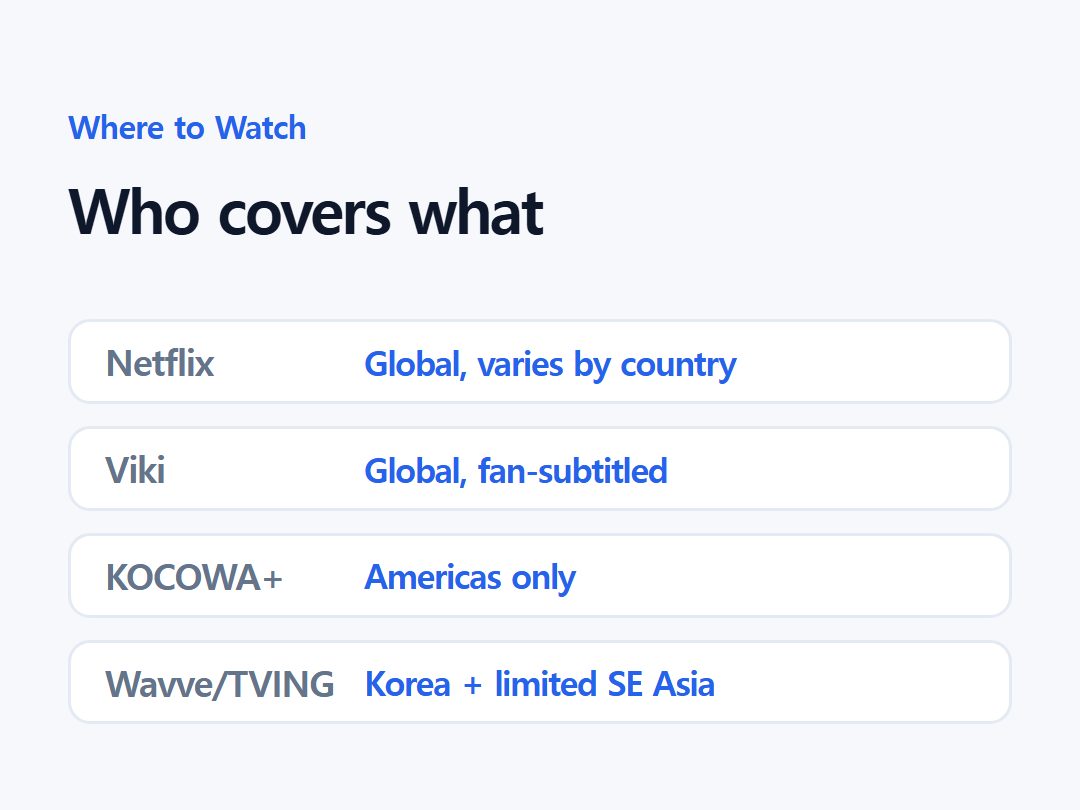
There is no single global home for Korean dramas. Five platforms currently account for most legal access outside Korea: Netflix, Rakuten Viki, KOCOWA+, TVING (through partner platforms), and Disney+. Each operates under a different licensing model, covers different regions, and handles subtitles differently.
Korea's two biggest domestic streamers, Wavve and TVING, are largely walled off from foreign viewers by design, while the broadcaster-owned platform KOCOWA+ exists specifically to serve the Americas.
In June 2025, South Korea's Fair Trade Commission conditionally approved a merger between Wavve and TVING, consolidating the domestic streaming market from four major players to three — a change with no direct effect on what international viewers can watch, but one that reshapes the industry behind the scenes.
Which streaming platforms actually have Korean dramas?
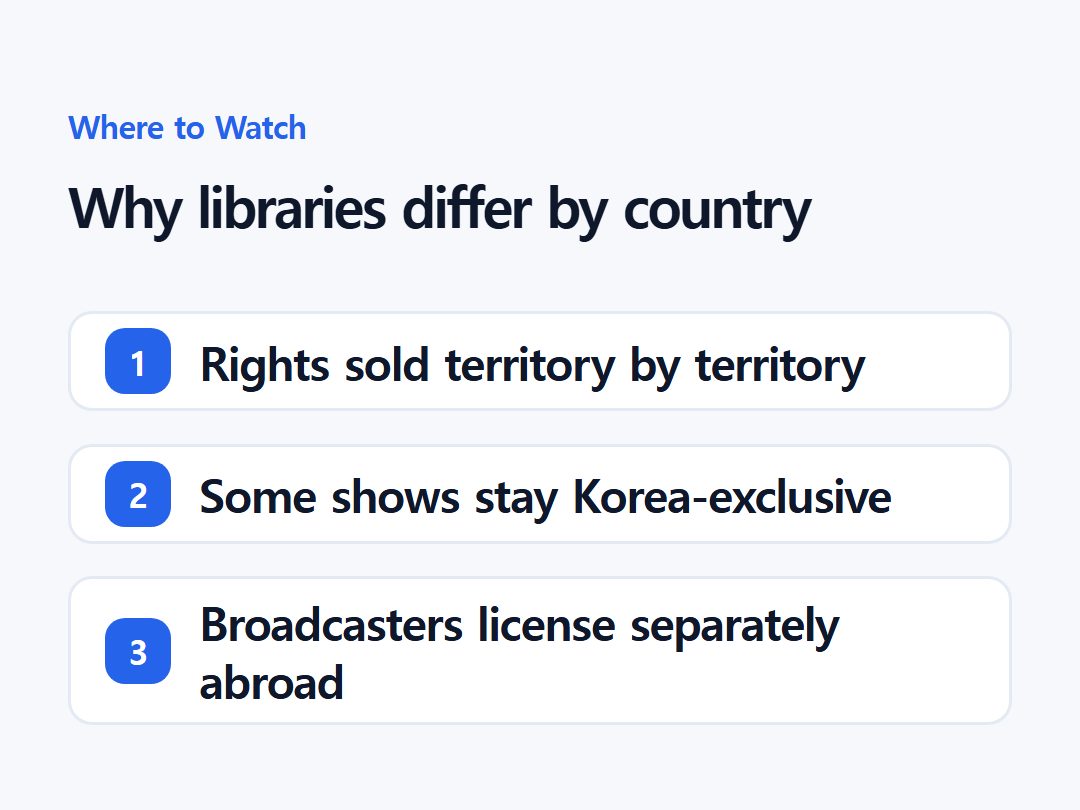
The reason a K-drama fan in Berlin, Manila, and São Paulo can see three completely different catalogs comes down to one concept: content is licensed by territory, not globally.
When a Korean production company or broadcaster sells streaming rights, it typically sells them country by country or region by region, not as a single worldwide package.
Netflix's Korean-language catalog in South Korea itself is smaller than its catalog in the United States, because some Korean-made shows are licensed exclusively to domestic services like Wavve or TVING and never reach Netflix's Korean library at all.
The reverse also happens: a drama can be a Netflix original outside Korea while airing on a completely different network at home.
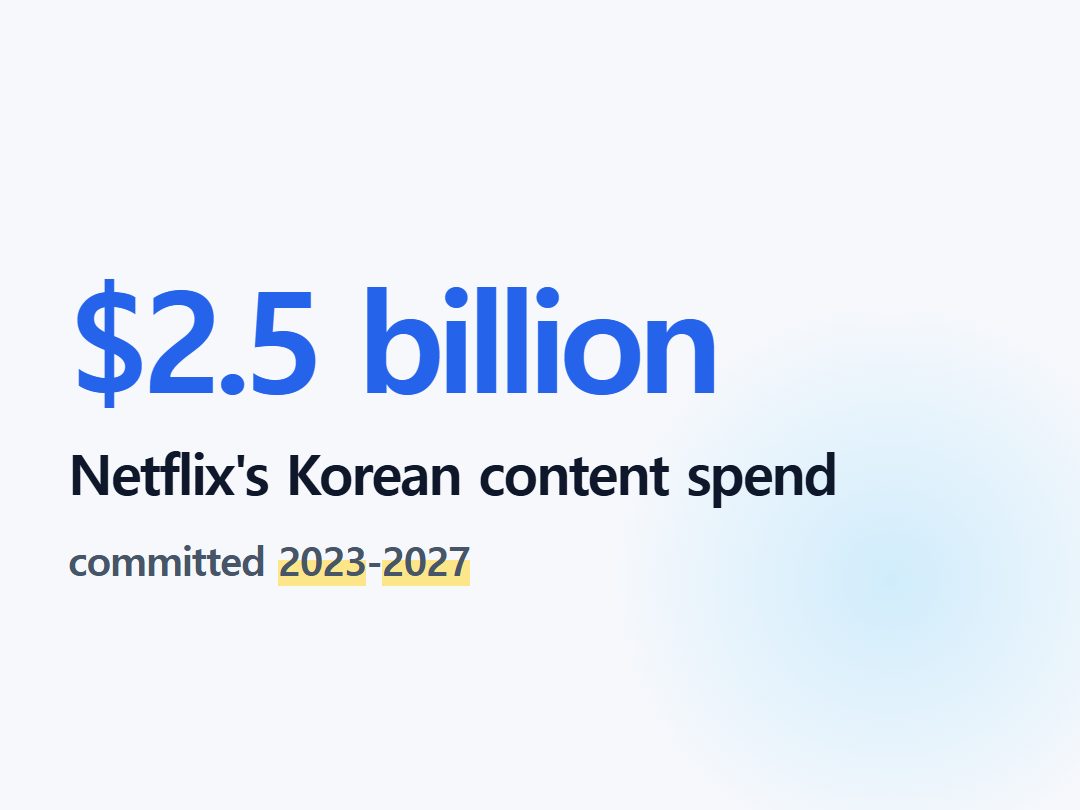
Netflix has the broadest and most consistent international footprint. Since 2023, the company has committed $2.5 billion to Korean film, series, and unscripted production over four years — roughly double what it had spent in the market since entering in 2016.
Netflix has said that more than 60% of its subscribers watched at least one Korean title in 2022, and it has continued to expand its slate every year since, including a lineup of more than 30 Korean series and films for 2026.
Netflix also offers some of the widest dubbing support of any platform, with subtitles and dubs available in dozens of languages on many titles, though not every show gets full dubbing.
The catch is that Netflix licenses Korean content on a title-by-title, country-by-country basis, so a drama available in the UK may not be available in Australia, and vice versa.
Rakuten Viki works differently and is arguably the most useful platform for viewers whose language isn't well served elsewhere.
Viki is officially licensed — it is not a piracy site — but it relies on a global volunteer community to translate subtitles into upward of 200 languages, a system it calls its contributor community.
Volunteers segment, translate, and edit subtitles collaboratively, often within hours of a Korean broadcast, because many Viki titles are simulcast (streamed close to the same time they air in Korea).
Viki has a free, ad-supported tier available in most countries, plus paid tiers — Viki Pass and Viki Pass Plus — that remove ads and unlock a larger back catalog.
Because subtitles are volunteer-made, quality varies by language and by title; well-resourced language teams produce excellent translations quickly, while smaller ones can lag or vary in polish.
Wavve, jointly owned by Korea's three major terrestrial broadcasters — KBS, MBC, and SBS — along with telecom operator SK Telecom, is Korea's equivalent of a broadcaster-backed streaming service.
It checks viewers' IP addresses and blocks access from outside its licensed territories, which are currently South Korea plus a handful of Southeast Asian markets (including Singapore, Malaysia, Indonesia, the Philippines, Vietnam, Thailand, and Laos).
It is not built for a general international audience, and there is no legal way around its geo-block.
That's where KOCOWA+ comes in. Wavve bought KOCOWA in December 2022 specifically to give itself an international arm, and KOCOWA+ now operates as a separate, Americas-focused platform, licensing content directly from KBS, MBC, and SBS for viewers in the United States, Canada, and Latin America.
Because it sources straight from the broadcasters, KOCOWA+ can post professionally subtitled episodes in English, Spanish, and Portuguese within about six hours of the Korean broadcast — faster than most other legal options, though its library skews toward broadcaster dramas rather than cable or streaming-original series.
TVING, owned by media company CJ ENM, is the domestic home for many popular cable and streaming-original dramas (the kind that air on tvN or premiere directly on TVING).
It has historically been geo-blocked outside Korea, but that has started to change through partnerships rather than a standalone international app: a TVING content hub launched inside Disney+ in Japan in November 2025, and a similar TVING-branded hub arrived on HBO Max in January 2026, covering 17 markets across Southeast Asia, Taiwan, and Hong Kong.
Viewers in those specific regions can now reach TVING's catalog through a platform they may already subscribe to, but the option doesn't yet extend to North America or Europe.
Disney+ has taken a different approach: rather than distributing existing Korean broadcasts, it commissions its own Korean originals, including the superhero series "Moving" and the gambling drama "Big Bet," which are typically available wherever Disney+ operates, subject to the platform's normal regional library differences.
Two smaller pieces of the puzzle are worth knowing about. Coupang Play, the streaming arm of e-commerce company Coupang, produces its own Korean originals but is aimed almost entirely at the domestic market; a few of its shows reach international viewers only through separate licensing deals with platforms like Viki. Amazon Prime Video carries a modest but growing Korean drama library, generally smaller than Netflix's or Viki's and built through opportunistic licensing rather than heavy original investment.
How illegal streaming sites lost to licensed platforms
Ten years ago, international fans without access to official platforms often turned to unauthorized streaming sites that ripped broadcasts and posted them with unofficial subtitles.
Sites like DramaFever (later folded into Viki), KissAsian, and Dramacool filled a real gap in access, but they operated outside copyright law and paid nothing back to Korean creators.
Legal streaming closed most of that gap over the following decade: Viki built a licensed alternative around volunteer subtitling as early as the 2010s, Netflix began major Korean investment after the international breakout of shows like "Descendants of the Sun" and, later, "Squid Game," and Korean broadcasters eventually built their own international arm in KOCOWA.
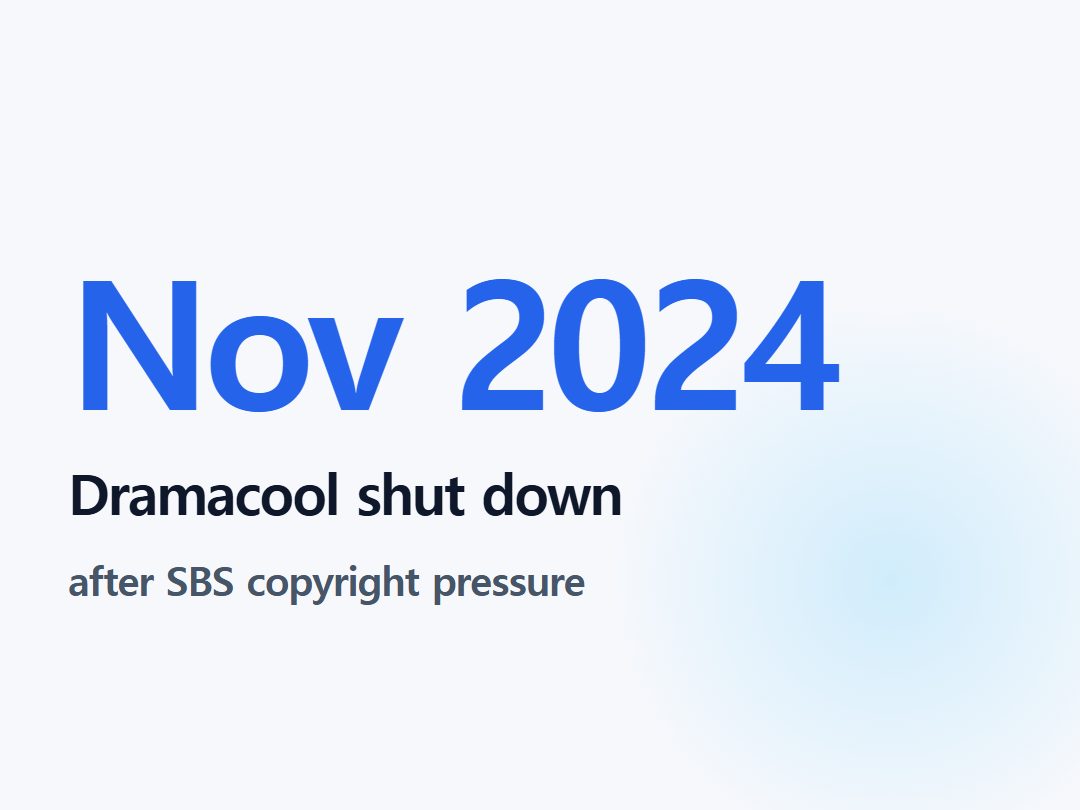
Enforcement caught up too — Dramacool, one of the last major piracy holdouts, shut down in November 2024 after sustained copyright pressure, including action from SBS.
The current landscape, fragmented as it is, reflects a real transfer of viewership from unlicensed sites to paying (or ad-supported) platforms, even if that transfer created its own maze of regional rules.
Will Wavve and TVING ever launch outside Korea?
The Wavve-TVING merger, approved with conditions in June 2025, is still being finalized domestically and comes with a price freeze through the end of 2026, but it says nothing yet about international access — whether a merged Wavve-TVING service will eventually build its own global app, expand the HBO Max and Disney+ hub model to more regions, or leave KOCOWA+ as its sole international outlet is unresolved.
TVING's hub deals with Disney+ and HBO Max suggest Korean platforms increasingly prefer piggybacking on existing global services over building their own international apps from scratch, which could become the template other Korean streamers follow.
For now, the practical advice for international viewers hasn't changed much: check Netflix and Viki first for the broadest reach, use KOCOWA+ if you're in the Americas and want next-day broadcaster dramas, and expect that no single subscription will ever cover everything.
Where to legally watch Korean dramas, by platform
| Platform | Where it works | Subtitles/Dubs | Key detail |
|---|---|---|---|
| Netflix | Title-by-title, country-by-country worldwide | Dozens of languages, dubbing on many titles | $2.5B committed to Korean content, 2023–2026 |
| Rakuten Viki | Free tier in most countries, plus paid tiers | Volunteer-translated, upward of 200 languages | Many titles simulcast within hours of Korean broadcast |
| KOCOWA+ | US, Canada, Latin America | English, Spanish, Portuguese | Posts episodes within about six hours of broadcast |
| Wavve | South Korea plus a handful of Southeast Asian markets | Not specified | Geo-blocked elsewhere with no legal workaround |
| TVING | Korea, plus Japan (via Disney+) and 17 SE Asia/Taiwan/HK markets (via HBO Max) | Not specified | Not yet available in North America or Europe |
| Disney+ | Wherever Disney+ operates | Standard Disney+ regional library rules | Commissions its own Korean originals like "Moving" and "Big Bet" |
Frequently asked
Why isn't every Korean drama on Netflix?
Rights are licensed by territory and title, not globally, so some shows go exclusively to domestic services like Wavve or TVING and never reach Netflix's library, even inside Korea.
How can I watch Korean dramas outside Korea?
Check Netflix and Rakuten Viki first for the broadest reach, and if you're in the US, Canada, or Latin America, KOCOWA+ streams broadcaster dramas with professional subtitles within about six hours of the Korean broadcast.
Can I use Wavve or TVING outside Korea?
Wavve is geo-blocked to South Korea and a few Southeast Asian markets with no legal workaround, while TVING is only reachable abroad through partner hubs on Disney+ in Japan and HBO Max in 17 Southeast Asian, Taiwan, and Hong Kong markets.
Sources
Every factual claim above is traceable. We do not translate articles — we gather facts from multiple outlets and write them ourselves.
- Netflix Confirms Plans To Spend $2.5BN On Korean Content Over Four Years — Deadline
- Netflix's $2.5 billion investment in Korean content appeals to audiences worldwide — CNBC
- Netflix Unveils Stacked Korean Content Slate of 33 Series and Films for 2026 — The Hollywood Reporter
- Rakuten Viki contributor community — Viki
- Wavve — Wikipedia
- Antitrust watchdog conditionally approves Tving-Wavve merger — The Korea Times
- South Korea's Wavve Buys K-Content Streamer KOCOWA — Deadline
- CJ ENM's TVING Expands K-Drama Slate in Japan, Asia-Pacific via Disney+ and HBO Max — Variety
- TVING launches in Japan — The Korea Herald
- Disney Plus Unveils 2026 Korean Drama Slate & APAC Strategy — Kpopmap
- Popular illegal drama streaming site Dramacool shuts down — Mothership.SG