Two friends in different countries open Netflix, search for the same Korean drama, and get two different results. One finds it in seconds. The other gets nothing — not even a listing. Neither is doing anything wrong, and neither Netflix app is broken.
The gap is built into how Netflix actually acquires Korean content, and it is one of the most consistently misunderstood parts of the platform for viewers outside Korea.
The short version
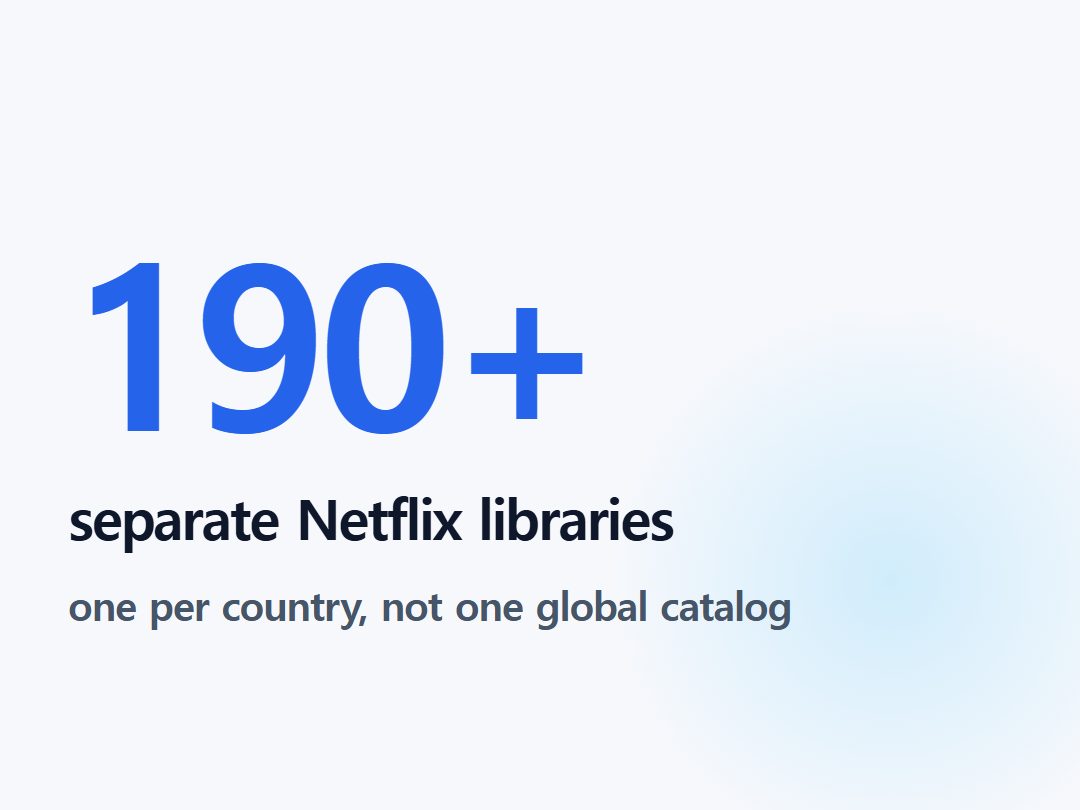
- Netflix runs 190+ separate country libraries, not one global catalog.
- Korean broadcasters license shows territory by territory, causing country-to-country gaps.
- Netflix Originals like Squid Game skip licensing and launch everywhere at once.
Two licensing paths decide where shows stream
Netflix's catalog is not one global library. It is closer to more than 190 separate libraries, one for roughly each country or region the service operates in, and a given title only appears in the libraries where Netflix has secured the rights to show it.
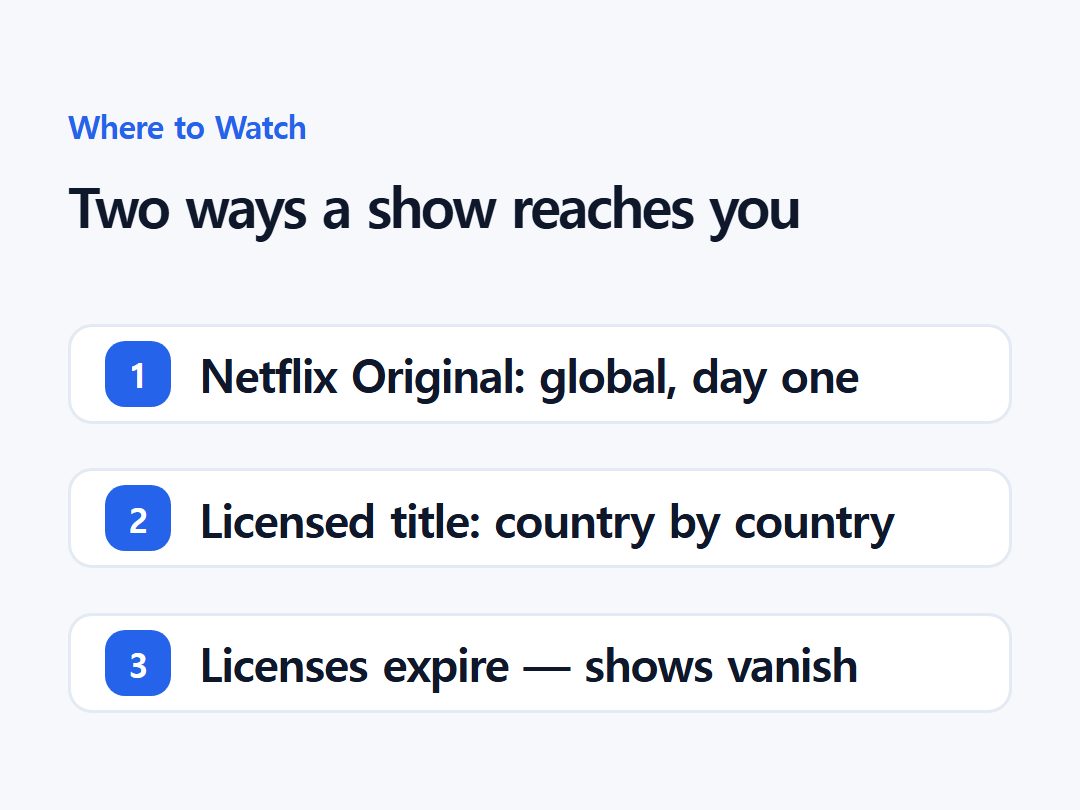
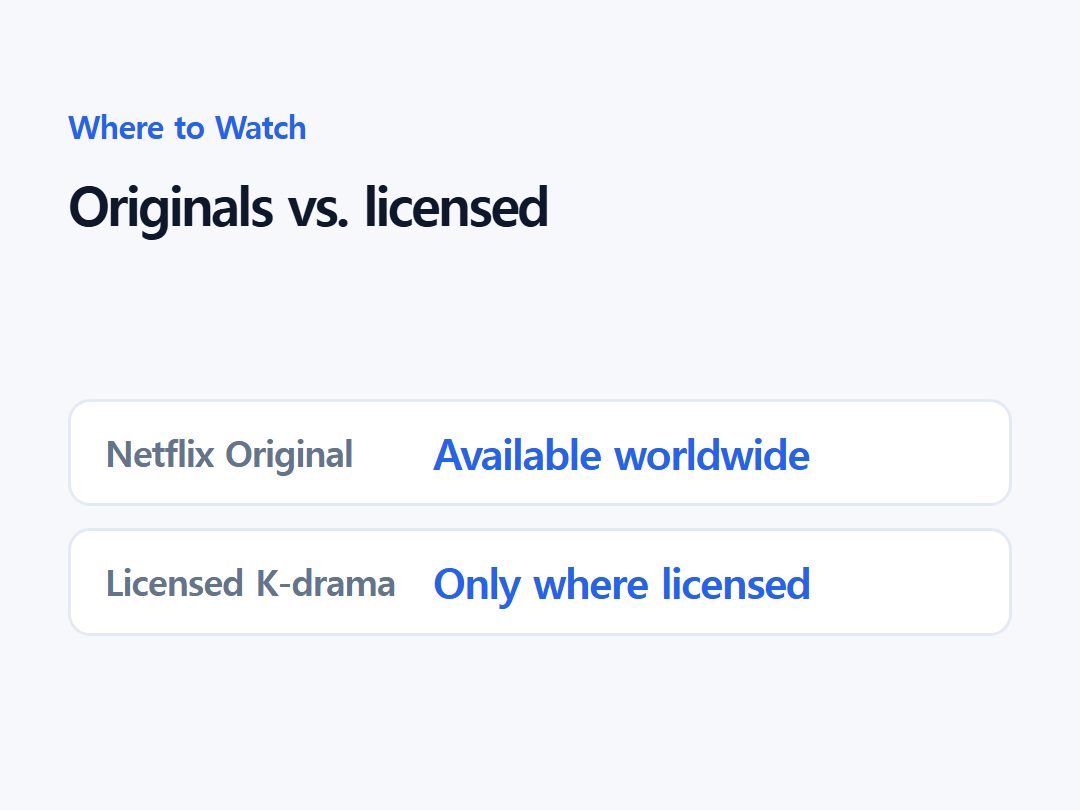
Two things decide whether a Korean drama or variety show lands in your country's library: whether Netflix produced or fully commissioned the title itself (a "Netflix Original"), or whether Netflix licensed it from a Korean broadcaster or studio for specific territories only.
The first category tends to appear everywhere at once. The second category is where the patchwork comes from.
The licensing deals behind Netflix's vanishing K-dramas
The core mechanism is territorial licensing.
When a Korean broadcaster such as JTBC, tvN, KBS, SBS, or MBC makes a drama, it typically owns the rights outright and sells streaming rights market by market — sometimes to Netflix, sometimes to a domestic Korean platform, sometimes to a regional rival such as Viki, Disney+, Wavve, or TVING, and sometimes to several of these at once for different territories.
Netflix cannot simply buy "the world" in one transaction unless the rights holder agrees to sell it that way, and rights holders frequently do not, because splitting territories lets them extract more value from each individual market.
The 2019 licensing agreement between Netflix and Studio Dragon, the production arm of media conglomerate CJ ENM, is a clear illustration.
Under that deal, a drama like "Record of Youth" kept its first broadcast window on tvN inside South Korea, while Netflix held the exclusive streaming rights everywhere else in the world.
That single show therefore lived in two different systems at once: domestic viewers watched it through tvN's own channels first, while every other country saw it only on Netflix.
Multiply that kind of split across hundreds of titles, each with its own negotiated territory list, exclusivity period, and expiration date, and the result is a catalog that looks different from country to country by design, not by accident.
An earlier deal shows the same logic from the opposite direction.
In 2017, Netflix signed its first major licensing agreement with JTBC, initially covering titles like the variety show "Abnormal Summit" and the cooking show "Chef & My Fridge." Those shows streamed on Netflix in more than 20 languages internationally — but reached Netflix's own Korean service only a day after they aired on JTBC domestically, because JTBC still controlled the first broadcast window at home.
In other words, being "on Netflix" and being "on Netflix in a specific country" are two different facts, and a title can satisfy one without the other for weeks, months, or indefinitely.
This is also why titles disappear and sometimes reappear. Licensing deals are time-bound.
When a contract's exclusivity window ends, a rights holder can decline to renew, sell the next window to a competing platform, or take the title back to license somewhere else entirely — and the show quietly drops off Netflix in that market, even though it may still be streaming normally in others.
None of this requires any announcement to viewers, which is part of why it feels arbitrary from the outside.
Netflix enforces these borders deliberately. When the company expanded from a handful of countries to more than 190 in January 2016, it inherited a huge backlog of pre-existing, territory-specific rights deals that studios and broadcasters had signed years before Netflix arrived in those markets.
Rather than wait to renegotiate everything as one global license, Netflix launched everywhere at once and left the patchwork in place.
It has since actively worked to block VPN and proxy access specifically to protect those licensing agreements, stating in 2016 that it would restrict members using proxies or "unblockers" to the country where they were actually located, because allowing cross-border access would put Netflix in breach of the deals it signed with content owners.
The financial stakes explain why Netflix keeps investing in this messy system rather than avoiding Korean content altogether.
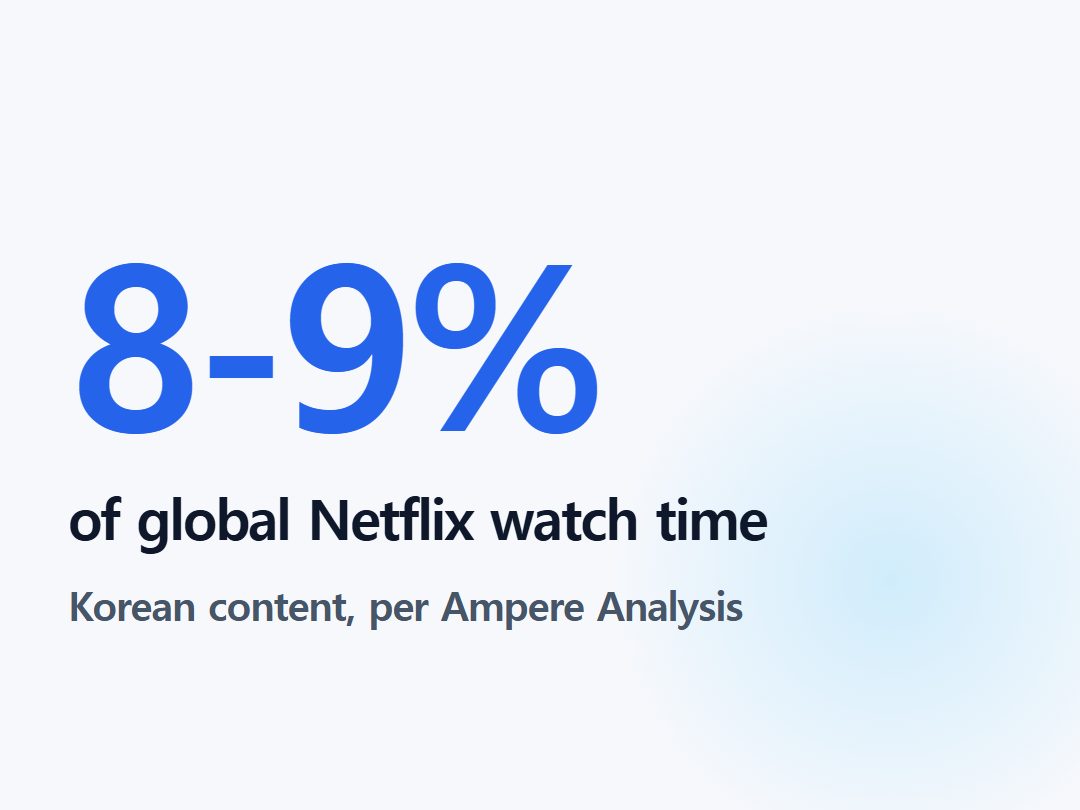
Industry analysis from Ampere Analysis found that Korean content has been the second most-watched non-U.S. content category on Netflix globally, ahead of the U.K. and Japan, accounting for roughly 8 to 9 percent of total Netflix viewing hours since 2023.
Netflix has reportedly committed around 2.5 billion dollars to Korean content between 2024 and 2028.
That scale of investment is exactly why Netflix has pushed harder into fully-owned Originals — shows it finances and controls outright, such as "Kingdom," "Sweet Home," and "Squid Game" — because Originals let Netflix skip the territory-by-territory negotiation entirely and release a title in every market on the same day.
How Netflix shifted from licensing to owning
Before its 2016 global expansion, Netflix operated in a limited number of countries and built its catalog through relatively contained, country-specific licensing. The sudden jump to near-worldwide availability meant Netflix was now trying to serve a global audience with rights that had been negotiated for a pre-global era, creating the country-by-country gaps that persist today.
Korean content entered this system gradually. The 2017 JTBC deal was Netflix's first serious push into Korean broadcaster licensing.
By November 2019, Netflix had expanded that relationship into a multi-year agreement giving it worldwide streaming rights to more than 20 JTBC drama titles, and separately signed a multi-year deal with Studio Dragon covering both new co-productions and distribution of existing tvN dramas — a deal that also gave Netflix an option to take a 4.99 percent equity stake in Studio Dragon itself.
At the same time, Netflix began commissioning true Originals rather than only licensing existing shows. "Kingdom" premiered in January 2019 as one of Netflix's first Korean Originals, arriving in every Netflix market simultaneously because Netflix, not a Korean broadcaster, held the rights from the start.
The global success of "Squid Game" in 2021 reinforced that this ownership model was commercially safer and simpler to distribute than licensing, and Netflix has leaned further into direct production of Korean content since.
More recently, some of Netflix's Korean partners have pulled in the opposite direction.
CJ ENM shifted strategic focus toward building up its own streaming platform, TVING, including a merger with KT's Seezn service, signaling that Korean media companies want to retain more leverage over their own content rather than distributing everything through a single exclusive Netflix deal.
That shift adds a new source of catalog fragmentation on top of the existing territorial licensing system.
Will Korean shows keep leaving for TVING?
The territorial licensing system is not going away.
Analysts covering Netflix's Korean strategy expect the company to keep running a dual approach — continuing to fund high-profile Originals for guaranteed global day-one releases, while still licensing additional titles from Korean broadcasters on a market-by-market basis to fill out the catalog more cheaply.
That means the experience of finding a K-drama on Netflix in one country but not another will likely remain permanent, not a temporary bug to be fixed.
What is worth watching is whether Korean studios keep drifting toward their own platforms like TVING and Wavve instead of signing broad Netflix licensing deals, which could mean fewer, not more, Korean titles reaching international Netflix libraries in the future even as Netflix's overall investment in Korean content grows.
For viewers, the practical takeaway does not change: if a show is a Netflix Original, it is almost certainly available wherever Netflix operates. If it is not, its presence in your country's library is the result of a specific, expiring business deal — and its absence usually is too.
How Netflix's Korean content strategy evolved
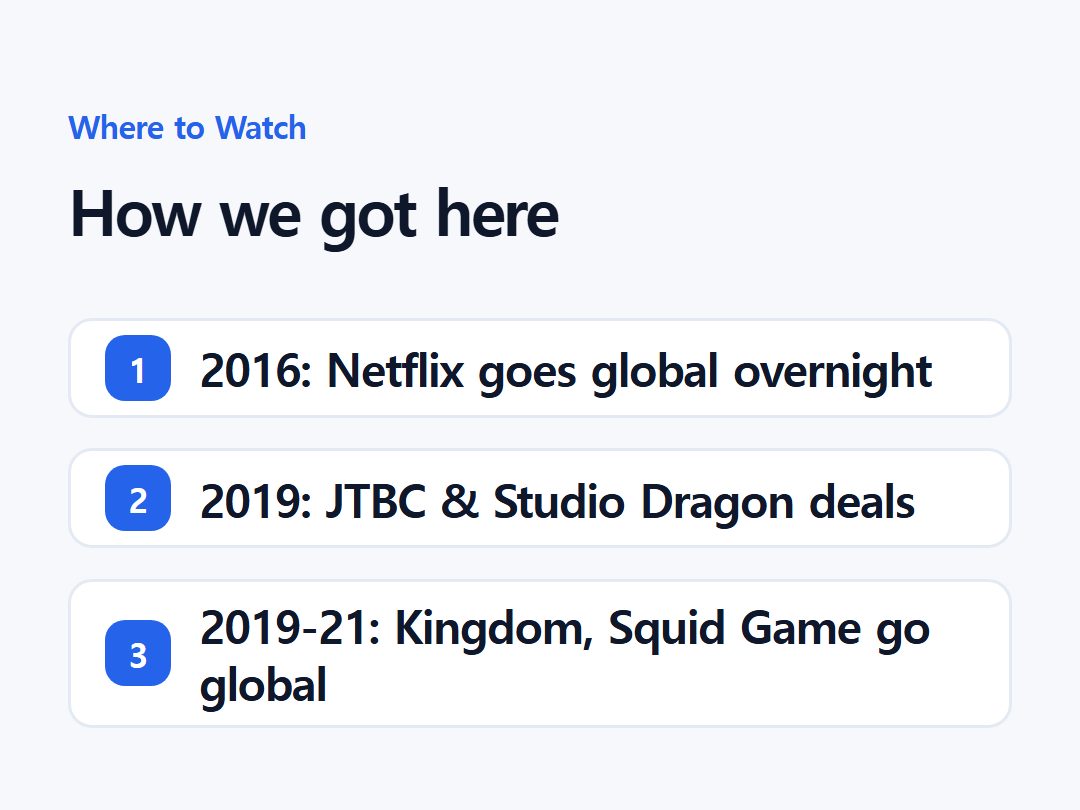
| When | What happened |
|---|---|
| Jan. 2016 | Netflix expands to 190+ countries, inheriting old territory-specific rights deals |
| 2017 | First major licensing deal with JTBC (Abnormal Summit, Chef & My Fridge) |
| Jan. 2019 | Kingdom premieres as one of the first Korean Originals, released worldwide day-one |
| Nov. 2019 | Multi-year JTBC deal (20+ titles) and Studio Dragon deal signed, with option for 4.99% equity stake |
| 2021 | Squid Game's global success reinforces the Originals-first strategy |
| Recently | CJ ENM shifts focus to its own platform TVING, merging with KT's Seezn |
Frequently asked
Why is a K-drama on Netflix in one country but not another?
Netflix operates separate libraries per country, and licensed (non-Original) Korean shows are sold to specific territories only, so a title can appear in one market and be missing in another.
Will a K-drama that disappeared from Netflix come back?
Possibly — licensing deals are time-bound, so a title can drop off Netflix when its contract ends and later reappear if the rights holder re-licenses it, but there's no guarantee or announcement.
How can I tell if a Korean show will be on Netflix everywhere?
Check if it's a Netflix Original, like Kingdom or Squid Game, since those are fully produced or commissioned by Netflix and launch in every market simultaneously, while licensed titles from broadcasters like JTBC or tvN are region-specific.
Sources
Every factual claim above is traceable. We do not translate articles — we gather facts from multiple outlets and write them ourselves.
- JTBC-Netflix Ink Multi-Year Deal for High-Quality Korean TV Series — Netflix (official)
- Netflix Simulcasts New Korean Original Series MAN x MAN by JTBC in Over 20 Languages Globally — Netflix (official)
- Netflix Inks Multi-Title Licensing Deal With South Korea's JTBC — The Hollywood Reporter
- Netflix to Spin 'Record of Youth' Korean Drama From Studio Dragon — Variety
- Enter the Dragon: Netflix steps closer to borderless content with Korea's CJ ENM — MIDiA Research
- Netflix Says It Will Crack Down On Customers Using VPNs To Access Its Global Catalog — TechCrunch
- Korean content ranks second globally on Netflix, surpassing UK and Japan — The Korea Times
- How Netflix Both Supercharges and Risks Derailing South Korea's Content Industry — The Diplomat