International fans searching for a specific older Korean drama — something from the 1990s, or a mid-2000s hit that never made it onto Netflix — often hit the same wall: it is not on Viki, not on Netflix, not on any of the apps that usually carry Korean content.
This is not usually a case of a show being deliberately withheld.
It is what happens when a licensing deal runs out and nobody renews it, a mechanism Korean fans understand intuitively because Korean broadcasters and platforms discuss it openly, but one that rarely gets explained to viewers outside Korea, who tend to assume that “it aired once” means “it exists online forever.”
The short version
- KOCOWA pulled its catalog from Viki in November 2025 over a licensing dispute.
- Platforms only license dramas temporarily — studios keep ownership, so licenses can lapse.
- Korean drama commissions fell 20% by 2025 even as global demand kept rising.
KOCOWA pulled its shows off Viki
There is no single triggering event here; this is a standing, structural gap that has existed for as long as Korean dramas have been licensed for streaming outside Korea, and it resurfaces every time a distribution deal lapses.
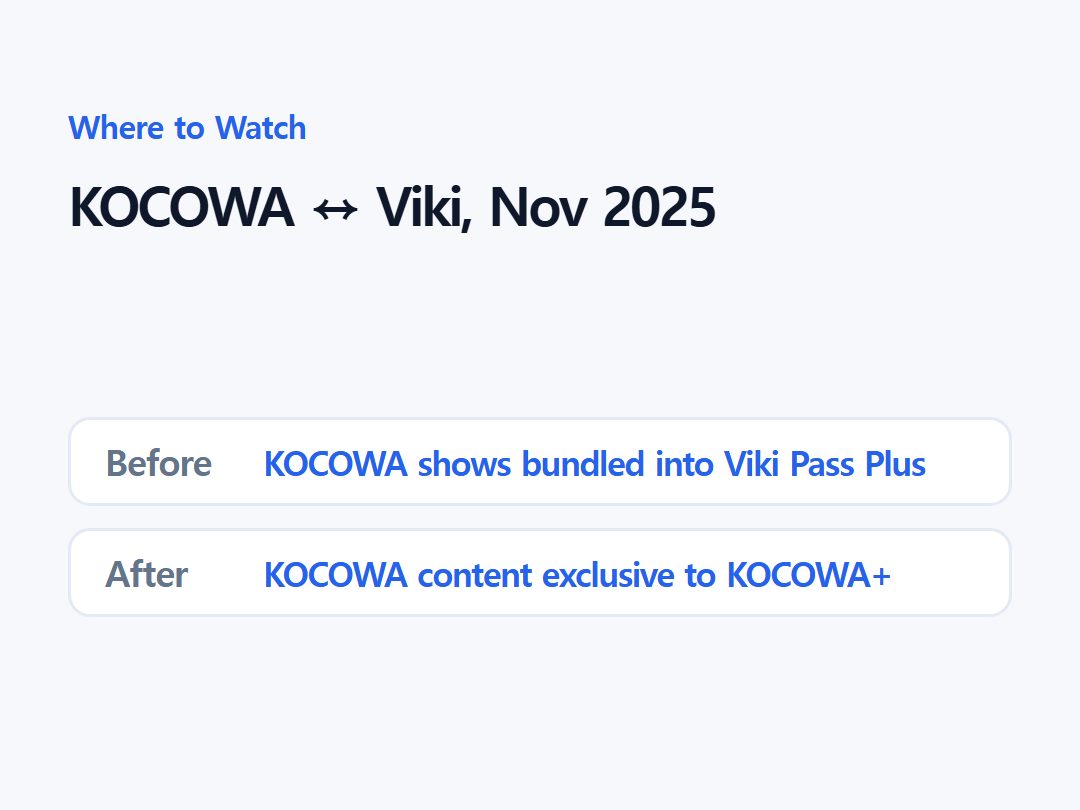
The clearest recent example: in November 2025, KOCOWA — the streaming service jointly owned by South Korea's three biggest broadcasters — ended its content-distribution partnership with Rakuten Viki.
Viki's paid tier, Viki Pass Plus, had for years bundled in KOCOWA's catalog of KBS, MBC and SBS dramas and variety shows; when the deal ended, that entire slice of programming, including long-running shows like Running Man, Home Alone and The Manager, plus dramas from more than 35 Korean broadcasters and studios, disappeared from Viki and became accessible only through KOCOWA's own service, KOCOWA+.
In the company's own announcement, KOCOWA's CEO, Seungmin Kang, acknowledged that “the conclusion of our partnership has left many of our valued viewers disappointed.” Nothing about the shows themselves changed.
What changed was a contract between two companies — and that is, in miniature, the exact mechanism behind almost every “why can't I find this drama anywhere” complaint.
Why do licensed dramas just disappear?
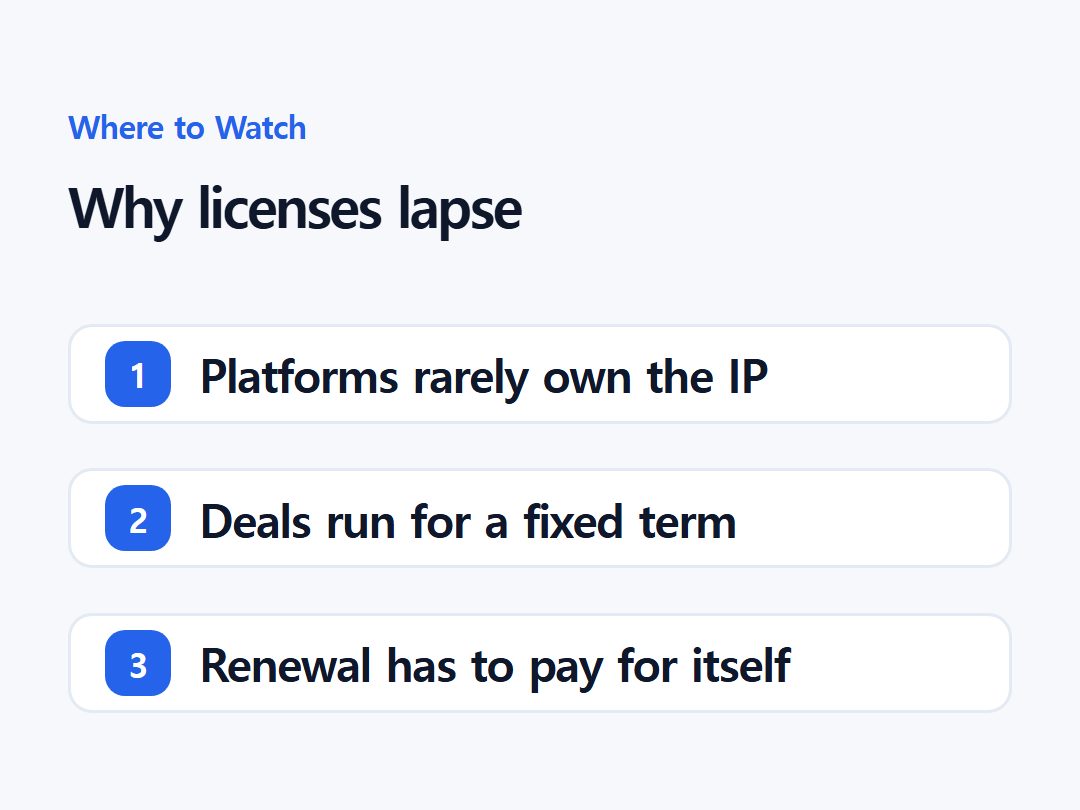
The background international readers are usually missing is basic to how the Korean drama business works, but it is rarely spelled out: streaming platforms almost never own the dramas they carry.
Ownership of a show — its underlying intellectual property, or IP — typically stays with the Korean broadcaster or production studio that made it, such as KBS, MBC, SBS, JTBC Studios or Studio Dragon.
What a platform like Viki, Netflix or Tubi usually buys is a license: the right to stream that show for a fixed period, in specific countries, in exchange for a fee.
When that period ends, the platform either pays to renew it, lets it lapse, or lets a competitor pick it up — at which point the show is not deleted from existence, but it does become effectively invisible to anyone searching official streaming catalogs.
Viki's own support documentation is explicit about this: content is licensed “for a certain period, not indefinitely,” and when a title disappears it usually means the licensing agreement with the content provider has ended.
The same explanation notes that music rights and syndication arrangements can complicate renewal further, since the rights to a drama's soundtrack are often negotiated separately from the rights to the footage itself, and a lapsed music license can pull a whole show even when the underlying video rights are otherwise fine.
This is also where Netflix's Korean catalog works differently depending on the title, a distinction that is not obvious from outside Korea.
A small number of high-profile Korean series — Squid Game and Kingdom, for instance — are true Netflix Originals: Netflix funded the entire production in exchange for full ownership of the IP, which is why these specific titles are not going anywhere and do not depend on a renewable license.
Most other Korean dramas on Netflix, including many hits from JTBC and Studio Dragon, are licensed or co-produced instead: Netflix holds exclusive streaming rights for a set period (often global rights excluding China, and sometimes only non-exclusive rights within Korea itself), while the studio keeps ownership.
Those titles carry exactly the same expiration risk as anything on Viki or Tubi — they simply have not hit that expiration point yet, or have been renewed because they still draw an audience.
That last point is the crux of why it is specifically older and niche dramas that vanish, rather than recent hits. Renewing a license costs money, and platforms renew what still pulls viewers.
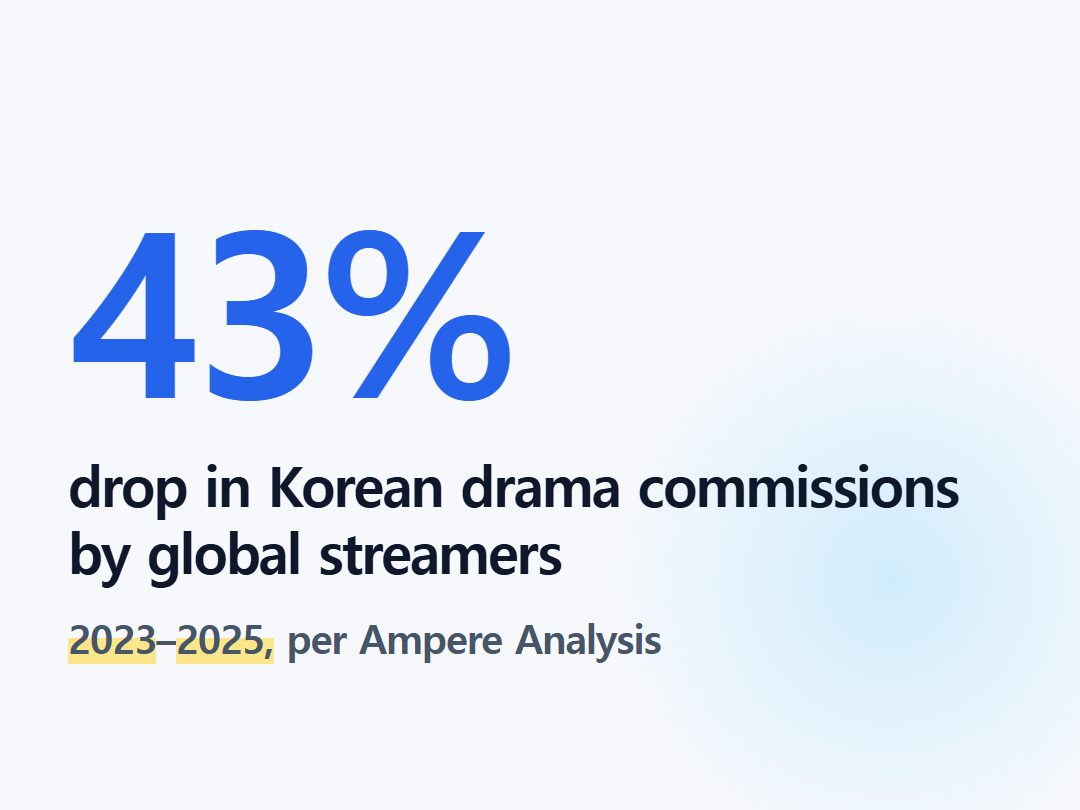
According to the industry analysis firm Ampere Analysis, commissioning of new Korean scripted series fell 20% between the first half of 2023 and the first half of 2025, with international streamers cutting their commissions by 43% over that same period — even as global appetite for Korean content kept rising, with the share of international viewers who say they watch Korean series or films “sometimes” or “very often” climbing from 22% in 2020 to 35% by 2025.
Platforms under budget pressure prioritize the titles most likely to justify their licensing fee: new releases and proven hits.
A twenty-year-old drama with a small, scattered fanbase is a much harder case to make, which is why so many of them quietly fall out of licensing rotation and simply stay there, even while overall demand for Korean content keeps climbing.
Licensing is also almost always negotiated by country, which is why a drama can be streaming legally in the United States while being unavailable everywhere else — a frequent source of confusion for readers who assume “streaming” is one global state rather than a patchwork of separate regional deals.
From bootleg subs to KOCOWA and Netflix
For most of the 2000s, there was effectively no official way to watch Korean dramas outside Korea; international fans relied on fan-made subtitles and unlicensed reuploads, because no legal platform had bothered to license the back catalog for a foreign audience.
Rakuten Viki, launched in 2010, was the first major platform built specifically around this gap, pairing licensed Korean (and other Asian) content with volunteer-run, community-produced subtitles — but from the start, Viki's deals with content owners came with the same fixed-term structure that causes today's disappearances.
Korean broadcasters eventually built their own answer.
In 2016, KBS, MBC and SBS — competitors on air, but jointly exposed to the same overseas piracy problem — formed a joint venture with SK Telecom called Korea Content Platform, which launched in the United States in 2017 under the brand KOCOWA, giving all three networks' shows a single legal home with official subtitles.
KOCOWA (later rebranded KOCOWA+) expanded into Europe and Oceania in 2024 and, for years, also licensed part of its catalog to Viki — the exact arrangement that ended in November 2025.
Netflix changed the picture again starting around 2019, when it began directly financing and co-producing Korean series in large numbers rather than only licensing finished shows, a shift that produced the wave of full Netflix Originals audiences now associate with Korean content.
But Ampere Analysis notes that Netflix's continued investment is increasingly concentrated in new, high-profile and unscripted projects rather than in re-licensing older catalog titles, so its growth has not closed the back-catalog gap for anything made before the streaming era took hold.
Individual broadcasters have also tried to plug part of that gap themselves, outside the subscription-platform system entirely.
KBS's YouTube channel “KBS Drama Classic” has been uploading full historical and classic dramas since 2012 and moved to continuous free streaming in 2020, later adding a paid membership tier for premium titles such as Immortal Yi Sun-sin and Tears of the Dragon.
SBS followed with its own free channel for older shows, “Bad — SBS Old Drama,” in August 2022. Neither replaces a full commercial streaming catalog, but both exist precisely because the broadcasters recognized that licensing deals alone were leaving decades of their own programming inaccessible.
Will the missing dramas ever return?
Two things remain unresolved.
First, whether any of the programming KOCOWA pulled from Viki in November 2025 comes back under new terms: some Viki users have reported a handful of titles, including Healer and Return of Superman, reappearing on the platform through 2026, though neither company has confirmed whether this reflects a renewed KOCOWA partnership or a separate licensing arrangement, so it should be treated as provisional rather than a settled fix.
Second, whether the demand-versus-supply gap Ampere Analysis identified — rising global interest paired with shrinking commissions — eventually pushes platforms to invest in re-licensing older catalog titles, or whether spending stays concentrated on new releases, leaving the back catalog exactly as fragmented as it is now.
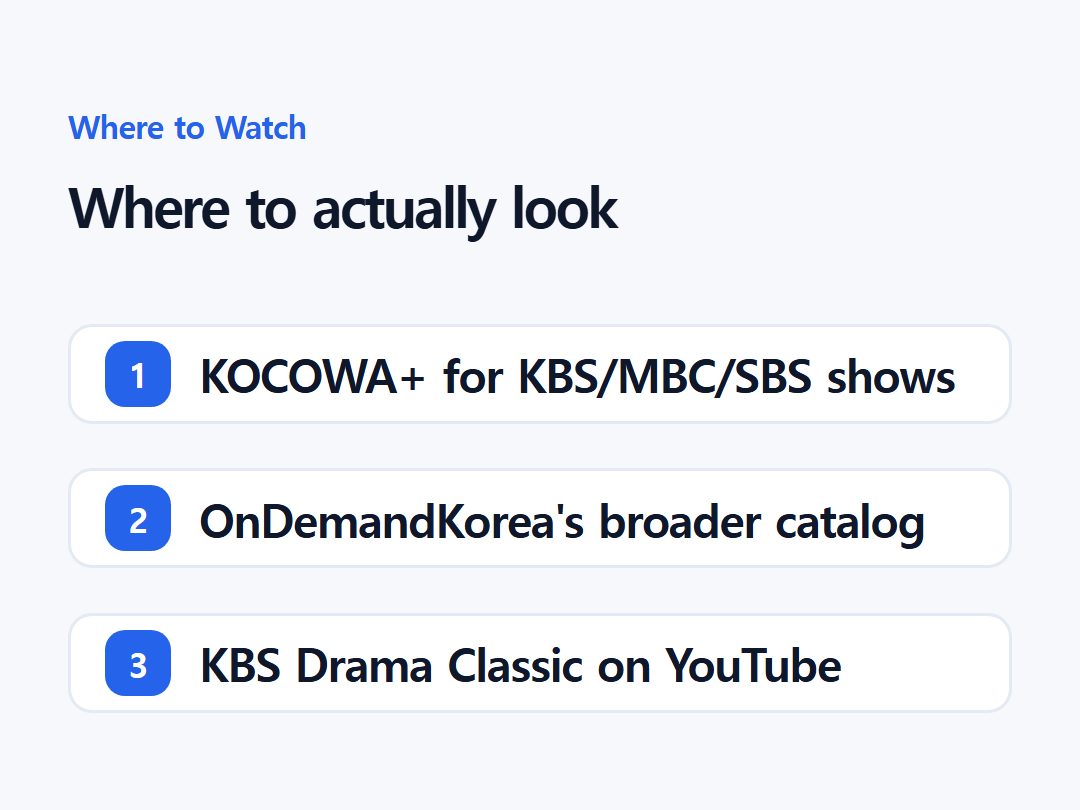
In practical terms, readers looking for a specific older title that is not on Netflix or Viki have a short, ordered list of places actually worth checking before assuming a drama is lost entirely:
| Where to check | What it's good for |
|---|---|
| KOCOWA+ | Full KBS/MBC/SBS archive, including titles recently pulled from Viki |
| OnDemandKorea | Broadest catalog across KBS, MBC, SBS, JTBC and more; North/South America only |
| KBS Drama Classic (YouTube) | Free historical dramas, with a paid tier for premium titles |
| Region-free import DVD | Last resort for titles never digitized or no longer licensed anywhere |
None of these guarantee every title, since catalogs are still licensed country by country and change on their own schedule. But understanding that a missing drama usually reflects an expired contract, not a lost or suppressed show, is the difference between giving up on a search and knowing where to look next.
Where to look for a missing older Korean drama
| Where to check | What it's good for |
|---|---|
| KOCOWA+ | Full KBS/MBC/SBS archive, including titles recently pulled from Viki |
| OnDemandKorea | Broadest catalog across KBS, MBC, SBS, JTBC and more; North/South America only |
| KBS Drama Classic (YouTube) | Free historical dramas, with a paid tier for premium titles |
| Region-free import DVD | Last resort for titles never digitized or no longer licensed anywhere |
Frequently asked
Why isn't this old Korean drama on Netflix or Viki?
Most Korean dramas are only licensed to platforms for a fixed period; when that license expires and isn't renewed, the show disappears from that platform even though it still exists.
Where can I watch old Korean dramas that aren't streaming anywhere?
Try KOCOWA+ for the full KBS/MBC/SBS archive, OnDemandKorea for a broader catalog, KBS Drama Classic on YouTube for free historical titles, or a region-free import DVD as a last resort.
Why did shows disappear from Viki in 2025?
In November 2025, KOCOWA ended its content-distribution partnership with Viki, pulling its catalog of KBS, MBC and SBS shows and making them accessible only through KOCOWA+.
Sources
Every factual claim above is traceable. We do not translate articles — we gather facts from multiple outlets and write them ourselves.
- Why do shows expire on Viki? — Viki Support
- KOCOWA Leaves Viki: Fans Directed to KOCOWA+ for Complete Korean Drama and Variety Show Access — Business Wire
- Is KOCOWA Available on Viki? — KOCOWA Help Center
- How Netflix licenses TV shows and movies — Netflix Help Center
- Ampere Analysis: Demand for K-content expands as commissions shrink — Broadband TV News
- Streaming media platform Kocowa launches in the United States, offering access to Korean TV Programs — PR Newswire
- K-content streaming service Kocowa to launch services in Europe, Oceania — The Korea Herald
- KBS Drama Classic — NamuWiki
- OnDemandKorea — Watch Korean Dramas, Movies Online — OnDemandKorea
- Is Viki still worth it now that the KOCOWA partnership ended? — Viki Discussions (community forum)