Korean webtoons — the vertically scrolling digital comics that originated on Naver's platform in the mid-2000s — have become one of Korea's most successful cultural exports, feeding a growing pipeline of K-drama and film adaptations.
But international readers hunting for English versions routinely run into two different internets: a handful of licensed apps with official translations, and a much larger, harder-to-avoid network of pirate sites offering the same titles for free, often faster.
Here is where the legal versions actually live, and why the platform a reader picks is not a minor detail.
The short version
- Five licensed apps split Korea's webtoon catalogue — none carries everything.
- Reported piracy cases rose roughly eightfold over four years through 2025.
- Pirated chapters send zero revenue back to the original creators.
Where can you legally read Korean webtoons?
There is no single news event driving this guide — it is a standing gap. Korea runs two parallel, competing webtoon ecosystems, built by Naver and Kakao, each licensing titles out to a scattering of English-language apps.
No single app carries everything, so readers who don't know the landscape default to whichever pirate aggregator shows up first in a search.
That gap has widened in visibility recently because Korean authorities and both companies have spent 2025 and 2026 in court and in raids against those piracy networks, exposing just how large the illegal side of the market had grown.
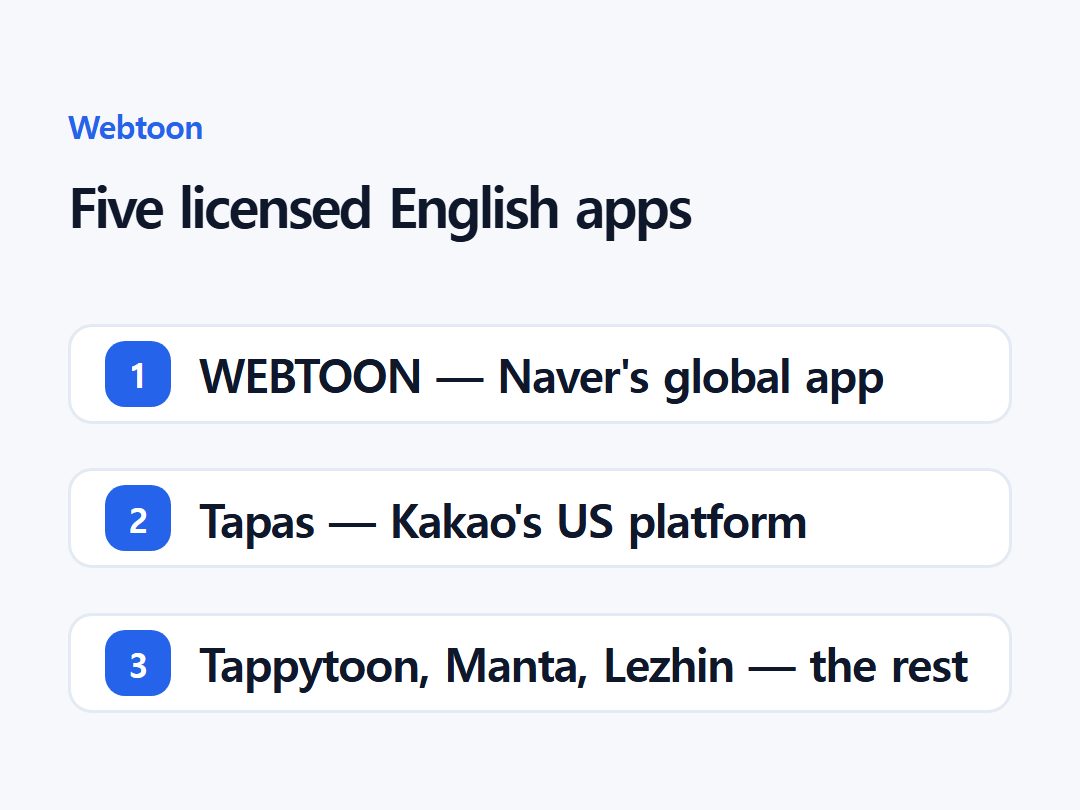
The legal, English-language options fall into a short list:
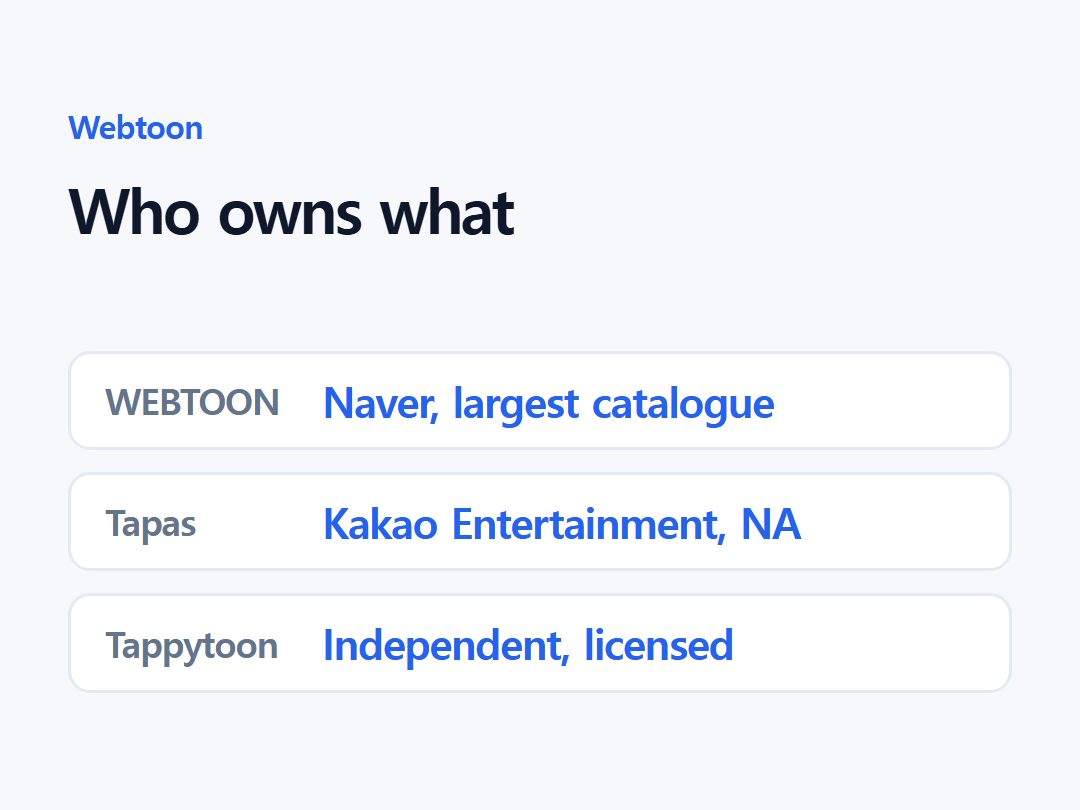
- WEBTOON — Naver's global app, free to download, hosting the largest catalogue of officially translated originals plus an open self-publishing arm called Canvas.
- Tapas — Kakao Entertainment's North American platform, covering both webtoons and web novels.
- Tappytoon — an independent, officially licensed platform (Contents First Inc.) that sources titles from Naver, Kakao, and other Korean publishers, with a catalogue skewed toward romance, drama, and BL.
- Manta — owned by Korean platform RIDI, a subscription-based English and Spanish service.
- Lezhin Comics — a Korean portal with its own English-language storefront, known for mature-audience genres.
All five operate on some version of a freemium model: most episodes are free to read, with newer chapters unlocked early through a coin or points purchase, or through a wait — commonly branded fast pass or time till free. Completed series are usually free in full.
Why the app you pick decides who gets paid
The reason this matters more than it looks is that Korean publishers license each title exclusively, usually to just one or two of these platforms.
A webtoon popular on Naver's Korean-language site is not automatically available, in full, on the English WEBTOON app — and a Kakao-owned title might sit on Tapas, or on Tappytoon, or on Manta, depending on which distribution deal the publisher signed. There is no single legal search engine that spans all of them.
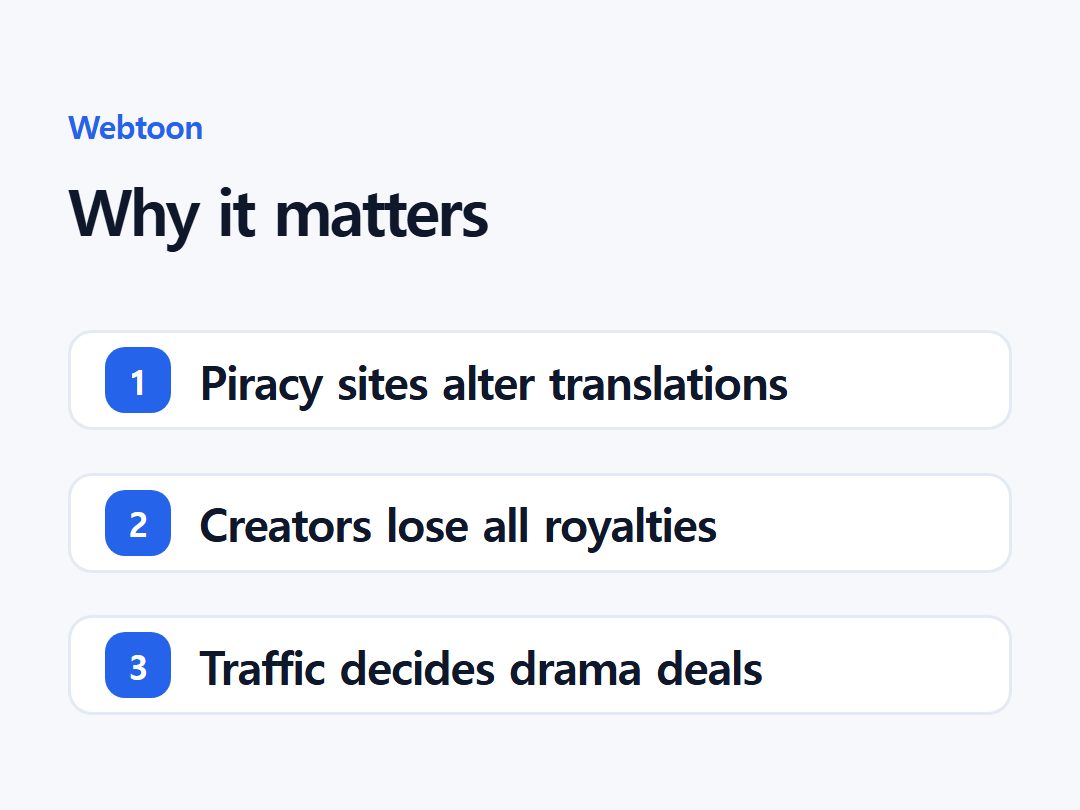
That fragmentation is precisely what pirate aggregator sites exploit: they scrape every platform into one feed, which is far more convenient than hunting across five apps — but that convenience is built entirely on uncompensated, unlicensed copying.
The financial mechanics matter here. Coin and subscription revenue on official platforms funds the split between the platform and the creator — in Korea's webtoon industry, that revenue share is often the difference between a series continuing and a creator being unable to sustain a weekly release schedule.
When a title is pirated, translated without authorization, and redistributed, none of that revenue reaches the studio or artist, even though the story is the same one being consumed.
Platform executives and Korean officials have also linked international readership numbers directly to which webtoons get greenlit for K-drama or film adaptations, since studios use official platform engagement data — not pirate site traffic — to judge a title's audience.
Translation quality is the other half of the why-it-matters case, and it cuts less cleanly than it might seem.
Officially licensed translations go through paid, edited localization, which generally produces more natural English phrasing and preserves context and jokes better than unofficial fan translations, which vary wildly in quality and often hew too literally to Korean sentence structure.
But official platforms are not automatically superior on every count: some licensed sites have leaned on lightly-edited machine translation to move faster, which readers and critics have flagged as a step backward from careful human localization.
Naver's WEBTOON has responded by piloting an opt-in AI translation program for its Canvas creators in 2026 — letting independent artists choose whether to have their work machine-translated into seven languages, with the ability to withdraw at any time — a deliberate attempt to keep translation quality decisions with the creator rather than with a scraping site.
Piracy sites carry risks beyond ethics, too. Illegal aggregators routinely alter or truncate translations, strip out creator credits, and monetize traffic through intrusive ads and, in some documented cases, malware — none of which the reader has any way to verify or control, since these sites operate outside any accountability structure.
Two platforms grew for decades, then sued pirates
Naver Webtoon launched in Korea in 2004 as a free platform for Korean-language digital comics.
Naver took the format overseas in July 2014 under the name LINE Webtoon, reasoning that the Naver brand had little recognition outside Korea, and rebranded again in 2019 to the simpler WEBTOON name it now carries in English, Spanish, and French.
The company went public on Nasdaq in June 2024 under the ticker WBTN, formalizing its position as the dominant global webtoon exporter.
Kakao built a parallel but more fragmented path. Its webtoon business began as Daum Webtoon in 2003, predating even Naver's platform, and was relaunched as Kakao Webtoon in 2021 after Daum's 2014 merger with Kakao — but Kakao Webtoon itself was never built out in English.
Instead, Kakao Entertainment expanded into North America by acquiring Tapas and the web-novel platform Radish in 2021, merging their operations in 2022.
That structure proved unstable: Kakao shut down Radish entirely by the end of 2025, consolidating its English-language strategy around Tapas as the two companies' remaining North American storefronts, alongside separately-owned Tappytoon and Manta as the other licensed outlets for Kakao- and RIDI-linked titles.
Piracy grew alongside all of this. Sites such as Newtoki, Agitoon, and OKTOON built massive readerships by scraping paid chapters from every Korean platform and distributing them for free, in some cases translated into English by secondary networks downstream.
Korean officials have said reported webtoon piracy cases rose roughly eightfold over four years through 2025, even as the government's Copyright Protection Division remained understaffed relative to the caseload.
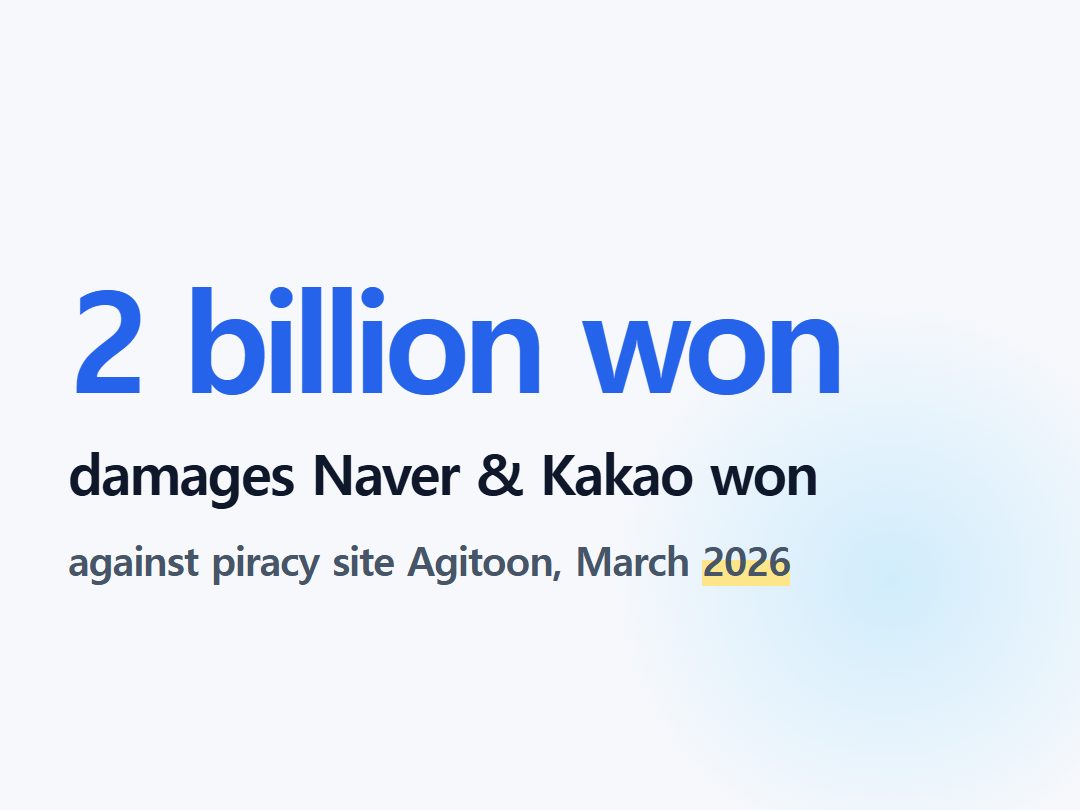
Enforcement escalated sharply in 2025 and 2026: Korean courts sentenced the OKTOON operator to four and a half years in prison on appeal in late 2025; Kakao Entertainment and Naver WEBTOON won a joint 2-billion-won ($1.33 million) civil judgment against the operator of Agitoon, one of the country's largest piracy sites, in March 2026; and international cooperation with Interpol led to arrests tied to piracy networks operating out of North Africa and Spain.
What's still unresolved for legal webtoon readers?
Several threads remain open. WEBTOON's opt-in AI translation program is still in beta for English-language Canvas creators as of 2026, with an eventual expansion to more languages and to licensed Originals series still unconfirmed.
Enforcement against piracy sites is continuing but unevenly resourced — Korean officials have acknowledged that the vast majority of takedown requests still fail, and that the government's international cooperation budget has stayed flat even as case volume climbs.
And Kakao's English-language catalogue remains split across Tapas, Tappytoon, and Manta with no announced plan to unify it, meaning readers will likely keep needing more than one app for the foreseeable future.
Until that consolidation happens, the practical advice for readers stays simple: check WEBTOON and Tapas first, then Tappytoon, Manta, or Lezhin Comics for anything missing — all of which return money and translation credit to the people who actually made the work.
Legal English-language webtoon platforms
| Platform | Owner / Operator | Catalogue focus |
|---|---|---|
| WEBTOON | Naver | Largest catalogue of official translations, plus Canvas self-publishing |
| Tapas | Kakao Entertainment | Webtoons and web novels |
| Tappytoon | Contents First Inc. (independent) | Sources from Naver, Kakao, others; skews romance, drama, BL |
| Manta | RIDI | Subscription, English and Spanish |
| Lezhin Comics | Lezhin (Korea) | Mature-audience genres |
Frequently asked
Where can I legally read Korean webtoons in English?
Five licensed apps split the catalogue — WEBTOON, Tapas, Tappytoon, Manta, and Lezhin Comics — but no single one carries every title, since publishers license each series exclusively to just one or two platforms.
Is WEBTOON free?
Yes, WEBTOON is free to download and most episodes are free to read, with newer chapters unlocked early through a coin purchase or by waiting (fast pass / time till free).
Is it illegal to use pirate webtoon sites like Agitoon or Newtoki?
These sites scrape and redistribute paid chapters without authorization; Korean courts sentenced the OKTOON operator to four and a half years in prison, and Kakao and Naver won a 2-billion-won ($1.33 million) judgment against Agitoon's operator.
Sources
Every factual claim above is traceable. We do not translate articles — we gather facts from multiple outlets and write them ourselves.
- WEBTOON Entertainment Announces Unified International CANVAS Platform Helping Creators Grow Their Audience and Earnings — Business Wire
- Kakao Entertainment to Shut Down Web Novel Platform Radish by End of 2025 — Anime News Network
- Kakao Entertainment, Naver Webtoon Win Civil Lawsuit Against Major Piracy Site Agitoon — Anime News Network
- Korean Court Upholds Prison Sentence for Operator Behind Major Webtoon Piracy Site OKTOON — Anime News Network
- Korean Gov't Official: Webtoon Piracy Cases Surge Eightfold in 4 Years, but 91% of Takedown Requests Fail — Anime News Network
- Kakao Entertainment, Naver Webtoon Win $1.4M Lawsuit Against Piracy Site — Seoul Economic Daily
- North Africa-based operator of Korean content piracy sites arrested — The Korea Herald
- Major comics piracy hubs in South Korea are shutting down. Here's how it happened — The Korea Herald
- Kakao Entertainment Merges US-Based Digital Storytelling Platforms Tapas and Radish — PR Newswire
- Tappytoon — Wikipedia
- Manta (platform) — Wikipedia
- Lezhin Comics — Wikipedia