In June 2025, producer Teddy's label The Black Label debuted a five-member act called ALLDAY PROJECT — Annie, Bailey, Tarzzan, Woochan and Youngseo. What made the debut notable wasn't the lineup's talent alone; it was that the group mixes men and women in one act, something Korean pop has almost entirely avoided for a decade.
The short version
- ALLDAY PROJECT is the first major co-ed K-pop group in eight years.
- Fandom's photocard economy rewards single-gender acts, not five-person co-ed lineups.
- KARD's success didn't stop its 2026 disbandment when its contract ended.
A five-member act that broke an eight-year pattern
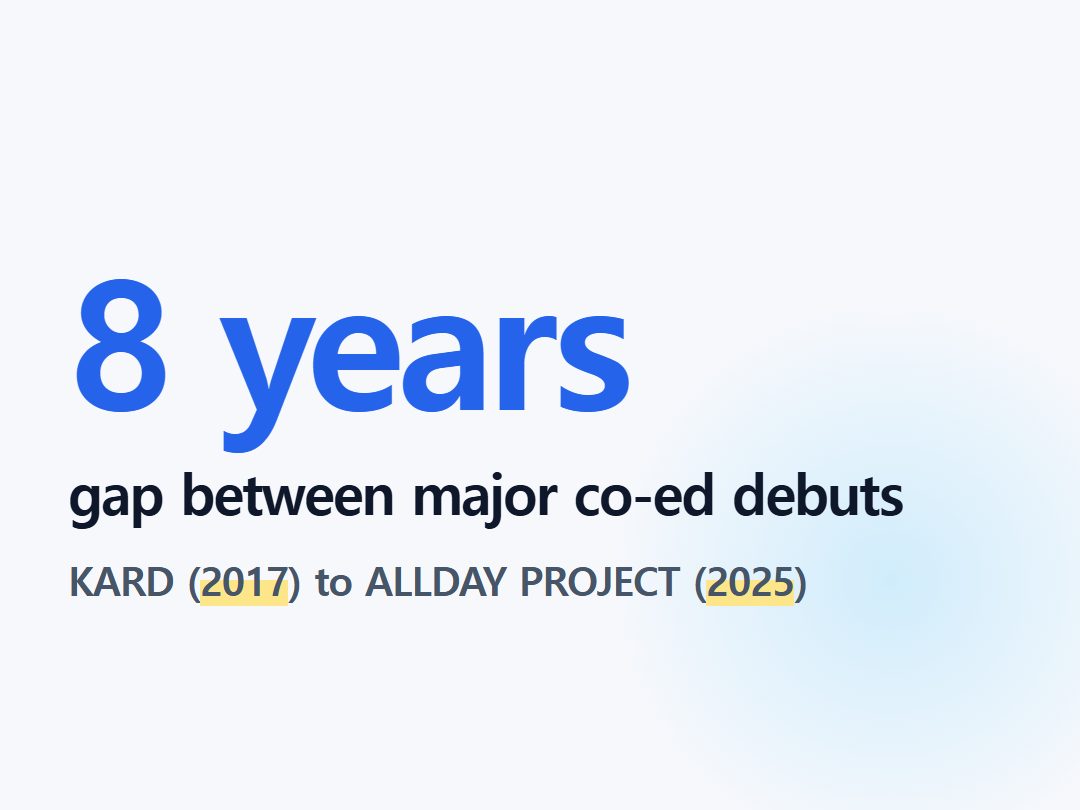
A co-ed group — industry shorthand for a mixed-gender act, as opposed to the all-male or all-female lineups that dominate K-pop — was, until 2025, close to extinct. ALLDAY PROJECT was reported to be the first major mixed-gender idol act since KARD's 2017 debut, an eight-year gap in a genre that releases dozens of new groups a year.
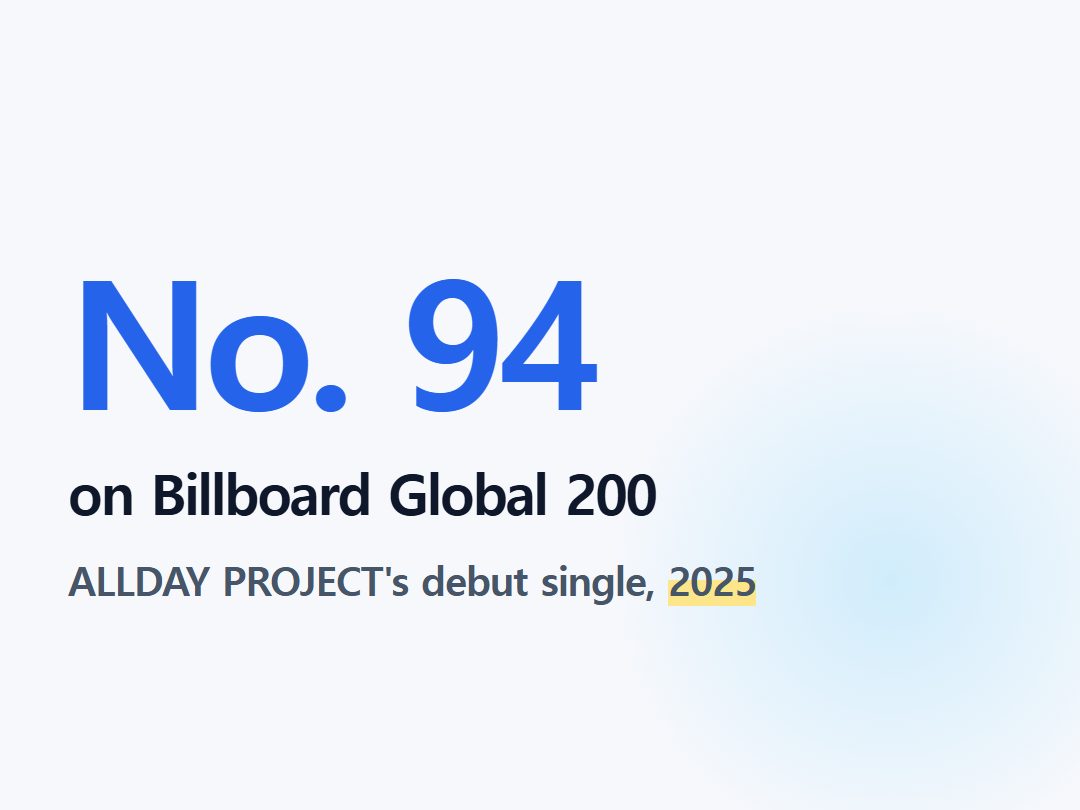
The debut performed well by any measure. Their single "Famous" topped Melon's Top 100 within four days, the group hit No. 1 on Mnet's M Countdown ten days after release, and "Famous" entered Billboard's Global 200 at No. 94.
Korean pop was not always split by gender
Mixed-gender lineups weren't always unusual. In the 1990s and early 2000s, co-ed acts were a normal part of Korean pop, built around television variety and music-show exposure rather than the online fandom systems that came later.
- Roo'ra
- Cool
- Sharp
- Turtles
- Koyote
Koyote, formed in 1998, is one of only two co-ed groups that stayed continuously active into the 2020s — the other being KARD. Everything else from that era either disbanded or, like Sunny Hill, quietly dropped its male member and continued as a girl group.
A fandom economy built to reward one favorite, not five
This is the part international fans usually miss: the shift away from co-ed groups tracks the rise of a specific business model, not a change in listener taste. Korean music critic Lim Hee-yun told The Korea Herald that co-ed groups peaked when "public exposure relied heavily on domestic broadcast TV."
Today's market, she added, is a "multi-platform world where success hinges on passionate engagement through social media and short-form content — that works best when fans can hyper-focus on a single idol." That shift rewards agencies that can build a fandom around one clearly defined image, not five.
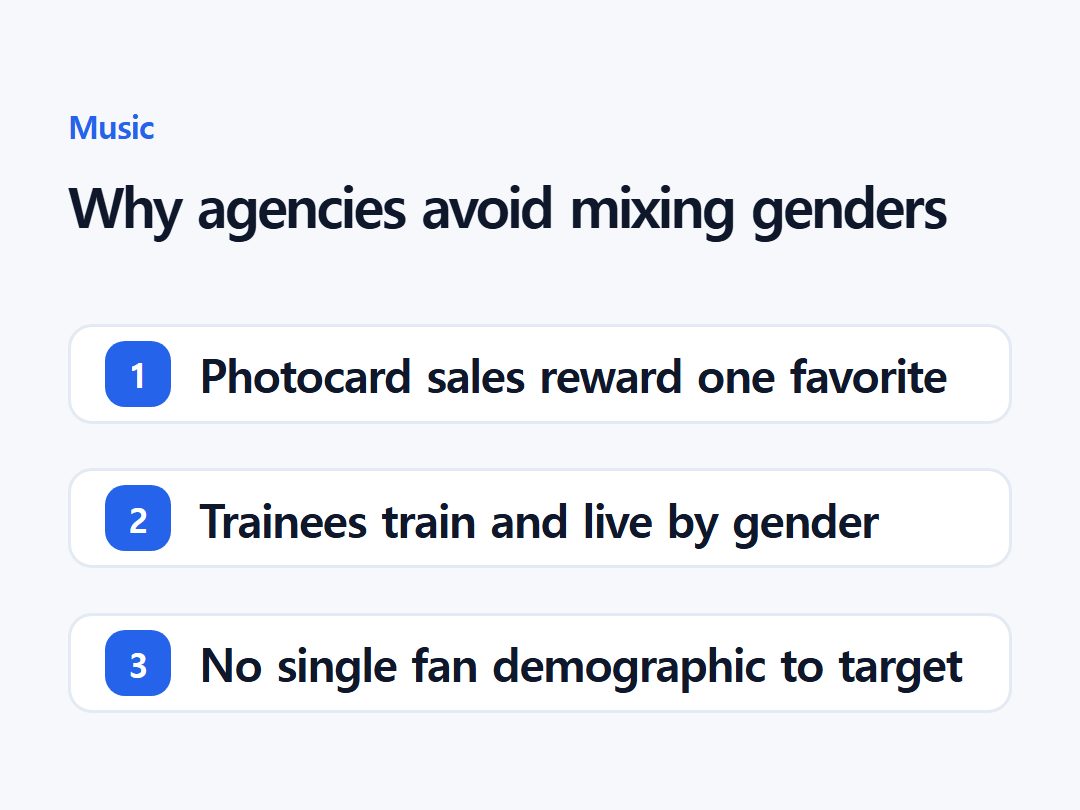
That hyper-focus has a physical product attached to it: the photocard, a randomly inserted card packaged inside every album. Fans buy multiple copies of the same album chasing a card of their bias — their favorite member — and a resale market prices cards by that member's individual popularity.
A five-member co-ed lineup doesn't multiply that system, it fragments it. Fans drawn in for the male members don't reliably buy for the female members' cards, and vice versa, so an agency is effectively running two smaller, harder-to-predict fandoms instead of one large, self-reinforcing one.
Trainees are grouped and housed by gender before a single song is written
The disadvantage starts well before debut. Music critic Seo Jeong Min-gap explained to The Korea Times that Korean idol groups typically train and later live together in a company-provided dorm to build on-stage chemistry — and mixed-gender cohabitation, from trainee years through active promotion, is something Korean agencies and the public both treat as inappropriate.
Because trainee academies sort teenagers by gender from the start, building a mixed group means deliberately working against a training pipeline the rest of the industry is optimized for. A typical trainee track separates candidates by gender across several stages:
- Vocal and dance coaching cohorts
- Dormitory housing and daily schedules
- Visual concept and styling direction
None of that infrastructure disappears for a co-ed act — it has to be rebuilt in parallel, which is one reason so few agencies attempt it.
Marketing has to pick a target audience — and co-ed groups can't
Seo also pointed to a narrower commercial problem: girl groups tend to draw a heavily male fanbase, and boy groups a heavily female one. A mixed-gender act struggles to out-compete a boy group for female fans or a girl group for male fans, leaving agencies without a clean demographic to build a promotion budget, endorsement pitch, or comeback concept around.
Critic Jung Min-jae added a second, self-reinforcing factor: because so few recent co-ed groups had broken through commercially, agencies had little recent precedent to justify the financial risk of trying again.
One shared dance move can trigger a boycott
The sensitivity around gender-mixing isn't hypothetical. In February 2026, rookie boy group LNGSHOT — under Jay Park's label More Vision — faced sustained backlash after performing a music-show routine that paired its four members with the label's female trainees.
According to Koreaboo and Bandwagon Asia, negative reactions from the live audience were strong enough that producers reportedly re-shot the segment, and a coalition of fans later sent protest trucks to the agency's headquarters. Signs at the protest read, "fans are not obligated to support two teams" — a complaint about being asked to fund a second, unofficial act, not about romance.
The episode shows the risk agencies weigh isn't only about dating scandals. Even platonic, choreographed gender-mixing can be read by a fandom as diluting the exclusive attention a single-gender act is expected to offer.
Even a chart-topping co-ed group still ran on the industry's usual clock
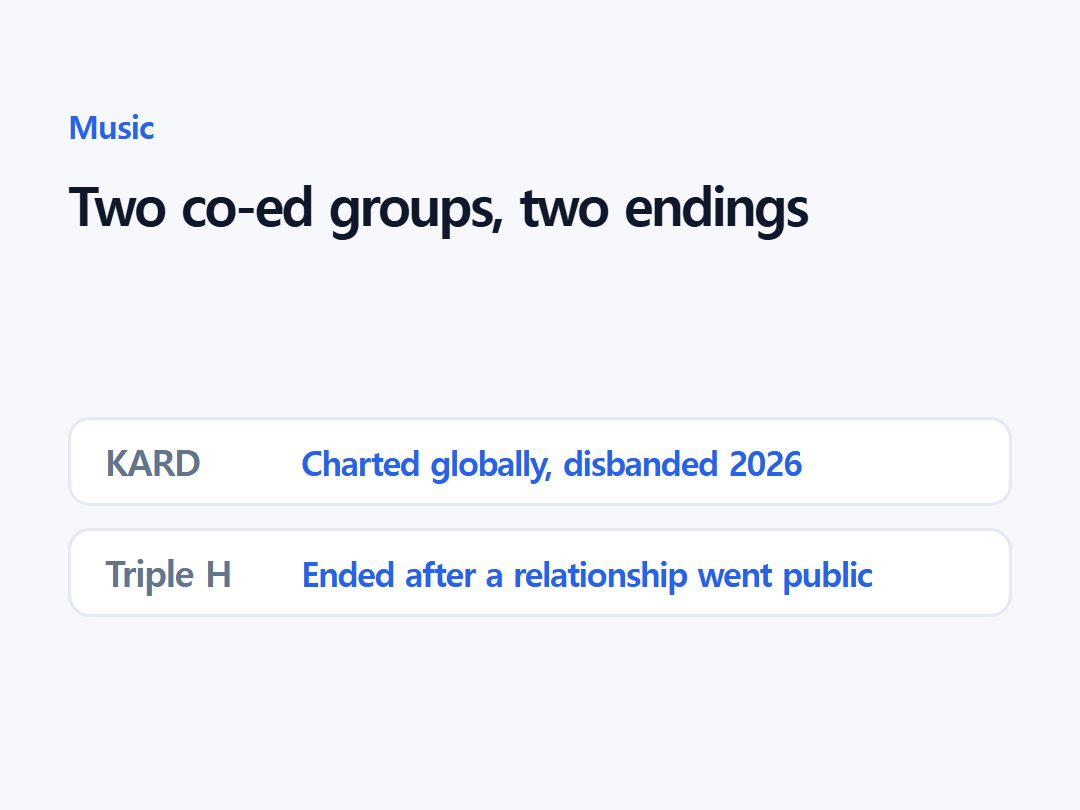
KARD is the clearest evidence that a co-ed group can succeed commercially and still not change the underlying economics. The DSP Media group — BM, J.Seph, Somin and Jiwoo — built genuine international success, including chart runs across Latin America, after debuting in 2017.
Yet in July 2026, DSP Media announced KARD would disband once its contract expired at year's end, closing with one final album and a world tour. Nine years of proven success didn't extend the group past its original contract cycle.
That is a reminder that co-ed groups sign the same fixed-term agency contracts as any other act, but without the reformation pipeline — solo debuts, sub-units, repackaged lineups — agencies routinely build around a successful single-gender group once its contract nears its end.
The industry's caution around mixed-gender pairing has a second precedent: Cube Entertainment's Triple H, featuring HyunA and E'Dawn, ended in 2018 after the two members' relationship became public without company approval and both were dropped from the label. It remains a reference point for why agencies frame co-ed lineups as reputational risk, independent of chart performance.
What ALLDAY PROJECT is doing differently, so far
Teddy's approach departs from the standard idol pipeline in a way that may matter here. Reporting from The Korea Herald describes him avoiding rigid, standardized training and choreography in favor of letting each member's individuality lead — the opposite of the uniform, gender-tracked system that makes mixed casting logistically awkward elsewhere.
The lineup itself reflects that approach. Rather than five trainees raised through one identical academy track, members arrived with separate backgrounds, including a rapper from the survival show "Show Me the Money" and a performer who had trained toward debut at a different agency, according to Grazia.
Casting outside the standard academy track sidesteps some of the gender-tracked training pipeline described above, though it isn't a fix every agency can copy easily.
The group has also kept momentum past its debut single: a pre-release track, "One More Time," arrived November 17, 2025, ahead of their self-titled first EP on December 8, led by "Look at Me." That's two comeback cycles in six months — an early sign the group isn't a one-single novelty.
What is still unresolved
One strong debut doesn't settle the structural problem. ALLDAY PROJECT has yet to be tested by the scenario that actually challenges co-ed groups: a slower comeback cycle, a member dating rumor, or a contract renewal years from now, the exact point where KARD's story ended despite its success.
Whether other agencies follow The Black Label's lead likely depends less on ALLDAY PROJECT's first-week chart numbers than on whether its fandom keeps buying, engaging, and re-signing across several years — the part of the co-ed business case no group since Koyote has fully proven.
Co-ed K-pop groups: debut year and outcome
| Group | Debut | Outcome |
|---|---|---|
| Roo'ra, Cool, Sharp, Turtles | 1990s–2000s | Disbanded or converted to single-gender act |
| Koyote | 1998 | Still active, one of only two co-ed groups to last into the 2020s |
| KARD | 2017 | Disbanding at end of 2026 when contract expires |
| ALLDAY PROJECT | June 2025 | Debuted; two comeback cycles within six months |
Frequently asked
Why are there so few co-ed K-pop groups?
Agencies built their fandom model around solo photocards and gender-tracked trainee dorms and coaching, both of which mixed-gender lineups fragment or complicate.
Is ALLDAY PROJECT the first co-ed K-pop group since KARD?
ALLDAY PROJECT was reported to be the first major mixed-gender idol act since KARD's 2017 debut, an eight-year gap.
Is KARD disbanding?
Yes, DSP Media announced in July 2026 that KARD will disband once its contract expires at year's end, closing with a final album and world tour.
Sources
Every factual claim above is traceable. We do not translate articles — we gather facts from multiple outlets and write them ourselves.
- ALLDAY PROJECT breaks through K-pop's 'co-ed group wasteland' — The Korea Times
- Watch: THEBLACKLABEL's Co-Ed Group ALLDAY PROJECT Unveils Powerful "WICKED" Performance Videos For Debut — Soompi
- Can coed K-pop make a comeback? Teddy's 'Allday Project' stirs new hope — The Korea Herald
- Why are mixed-gender groups rarely seen in K-pop? — The Korea Times
- KARD disbands after 10 years, but members insist story is not over — The Korea Times
- Co-Ed KPop Group KARD To Disband After First Album And World Tour — Forbes
- Triple H (band) — Wikipedia
- Viral Boy Group "Booed" By Fans After Intimately Performing With Female Trainees During Music Show — Koreaboo
- Jay Park's boy group LNGSHOT is facing fan backlash for dancing with women (no, really) — Bandwagon Asia
- AllDay Project (EP) — Wikipedia
- Allday Project: The First Co-Ed Group From The Black Label — Grazia