South Korea's most acclaimed thrillers rarely stay in the realm of pure fiction. Memories of Murder, The Chaser, Silenced, and Montage all open with some version of the same disclaimer: based on real events. Korean audiences usually know which case is meant before the opening credits finish.
The short version
- Five acclaimed Korean thrillers are each based on one documented real crime.
- Silenced led Korea to reopen a case and pass a new law.
- Courts almost always protect filmmakers over objecting victims' families.
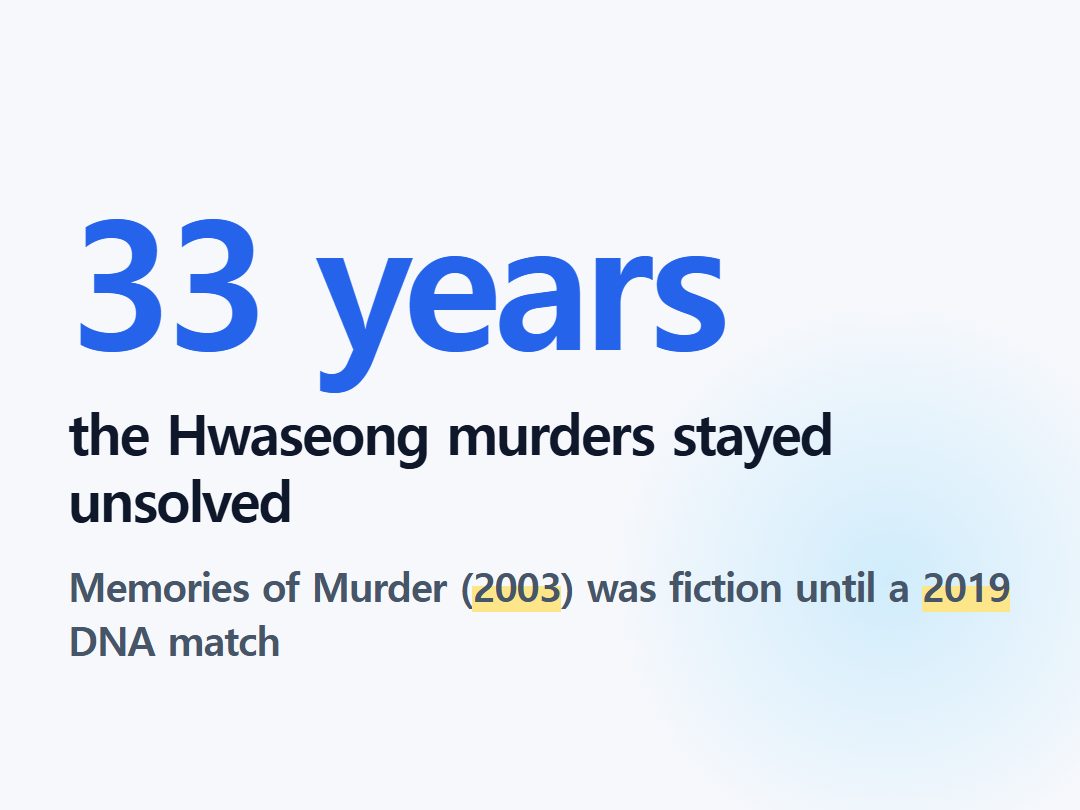
That naming is not a marketing trick. Each film is tied to a documented, specific crime — a serial-murder investigation that stayed open for 33 years, a child-abuse scandal at a school for deaf students, a legal deadline that determines whether a killer can ever be charged.
What international viewers usually miss is that the real case does not end when the film does. The people who lived it keep going to court, giving interviews, and in some cases objecting to the film itself.
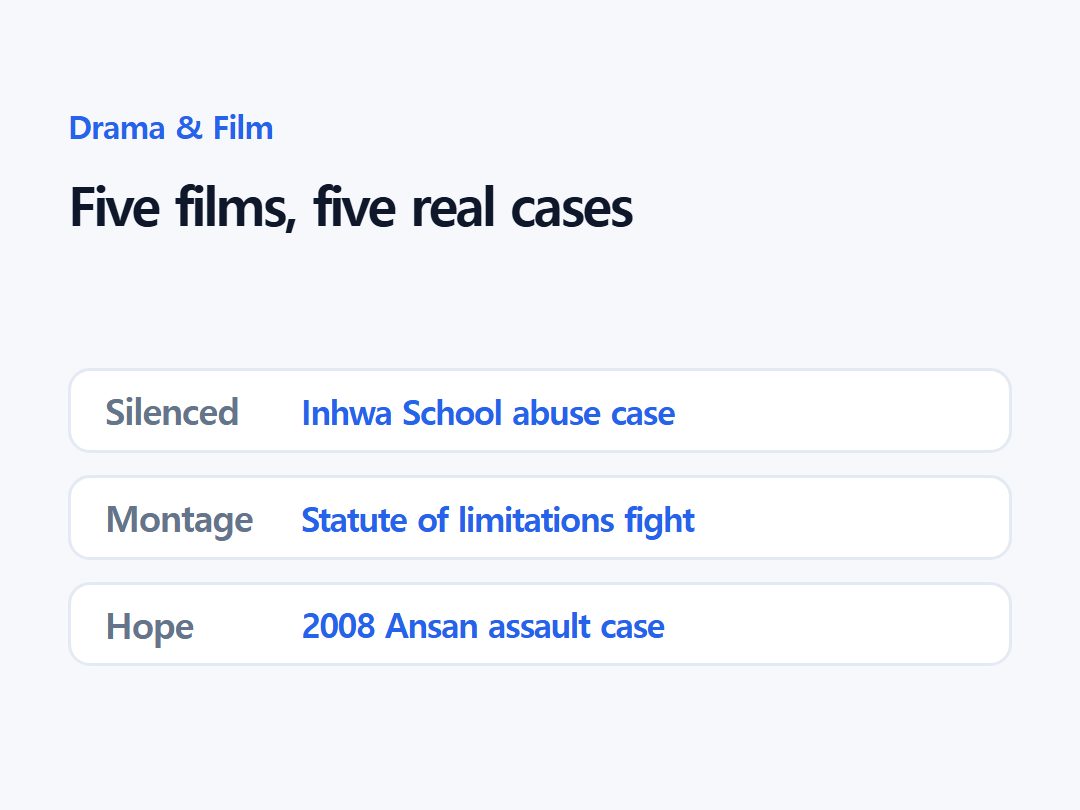
Five films, five real cases
The pattern spans two decades of Korean cinema, and each title maps onto a specific event rather than a general theme.
| Film (year) | Real case | What happened to the case |
|---|---|---|
| Memories of Murder (2003) | Hwaseong serial murders, 1986–1991 | Unsolved for 33 years; DNA matched a suspect in 2019 |
| The Chaser (2008) | Yoo Young-chul killings, 2003–2004 | Killer already caught; film echoes his profile, not his name |
| Silenced (2011) | Gwangju Inhwa School abuse, early 2000s | Reopened after release; new law passed within weeks |
| Hope / Wish (2013) | 2008 assault of an 8-year-old in Ansan | Perpetrator already sentenced; case was legally closed |
| Montage (2013) | Composite of child-murder cases nearing expiry | Fictional, but tracked a real law passed two years later |
A film did in weeks what an investigation could not do in years
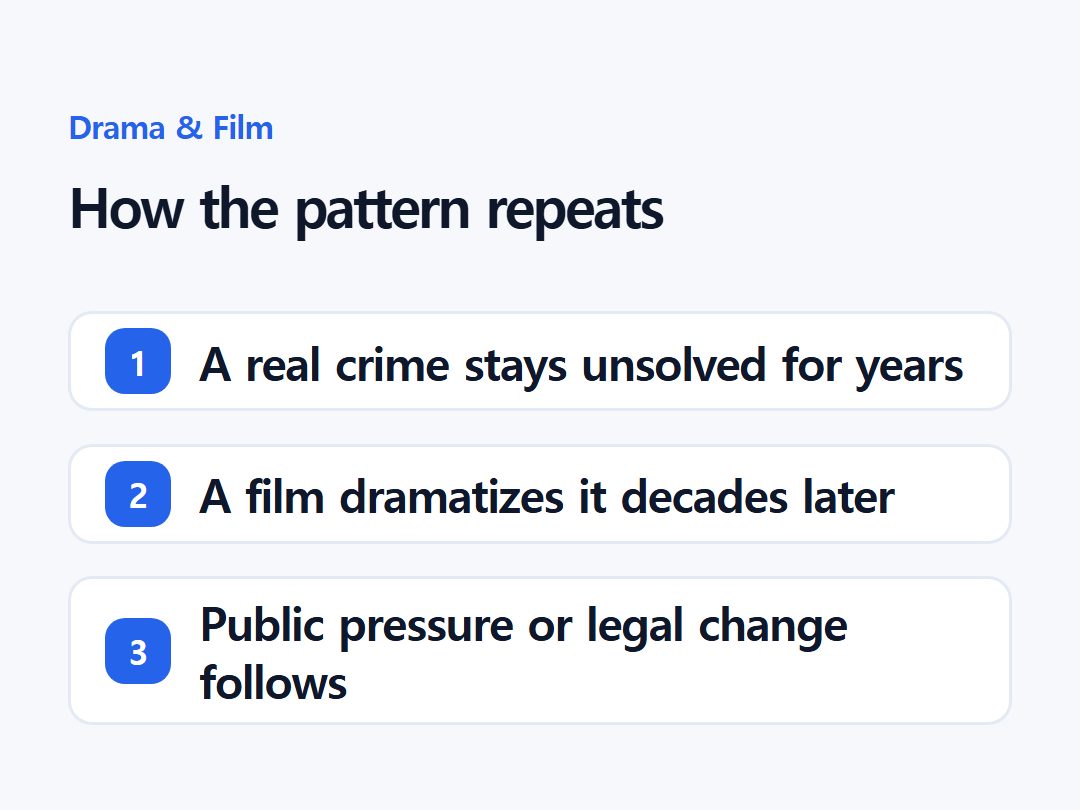
Silenced (2011) dramatized real abuse of students at a school for the deaf in Gwangju, first exposed by a whistleblowing teacher in 2005. Several of the accused had already been acquitted or given reduced sentences by the time the film was made, and the case had largely faded from national attention.
The film's release changed that. It topped the Korean box office for three weeks, and public pressure led prosecutors to reopen the case.
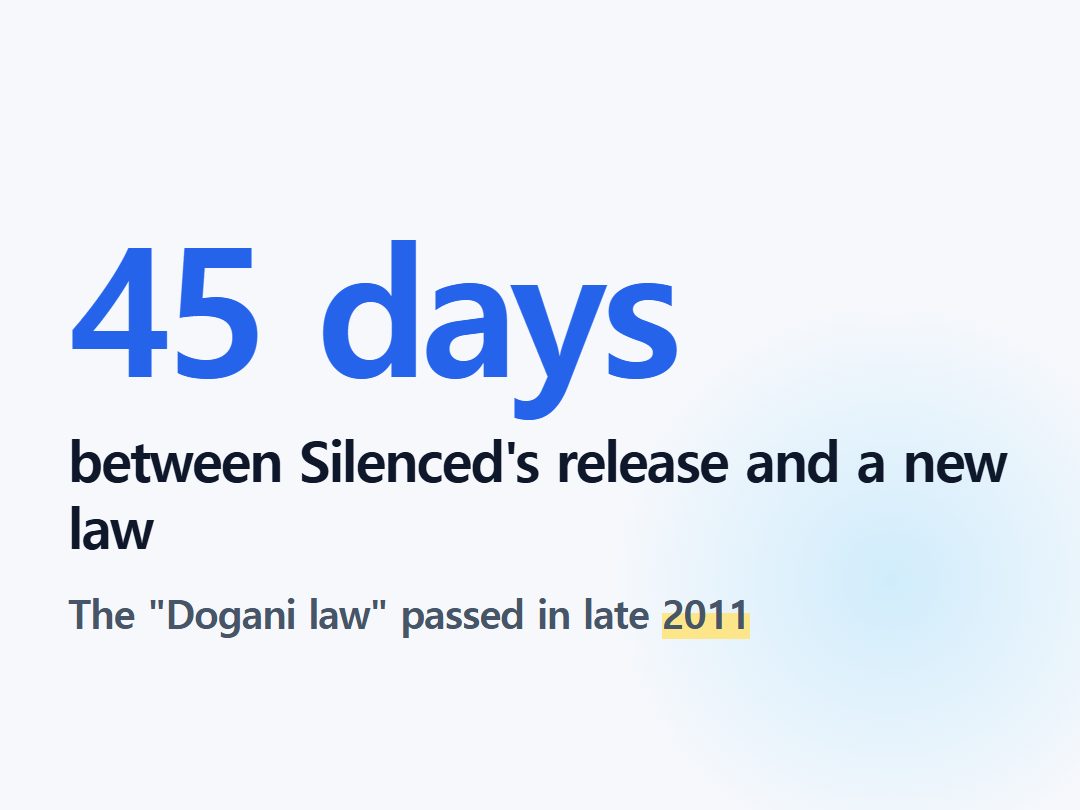
The school shut down within two months of release, and the National Assembly passed what is still called the "Dogani law" — named for the film's Korean title — about a month and a half later, removing the statute of limitations for sex crimes against disabled victims and against children under 13.
A law named after a case it arrived too late to help
A statute of limitations — a legal deadline after which a suspect can no longer be prosecuted — is the plot engine of Montage (2013), in which a mother races the clock before her daughter's murder case legally expires. That plot was not invented for drama; Korea's 25-year statute of limitations on murder was a live political argument at the time the film was released.
In 2015, the National Assembly voted 199–0 to abolish it entirely. The law is known informally as "Taewan's law," after Kim Tae-wan, a six-year-old attacked with sulfuric acid in an unsolved 1999 case. His family's final appeal was dismissed just weeks before the new law took effect — meaning the case that gave the law its name was the one case it could not reach.
The killer these films describe could watch himself on screen
Memories of Murder was fiction about an open case when it premiered in 2003: the Hwaseong murders of 1986–1991 had no identified suspect. That changed in 2019, when DNA evidence matched Lee Choon-jae, already serving a life sentence for an unrelated murder.
Lee confessed to 14 killings, including all ten Hwaseong murders, and to more than thirty rapes. His confession also cleared Yoon Seong-yeo, a man wrongly convicted decades earlier for one of the same killings.
Director Bong Joon-ho later said he had heard Lee watched Memories of Murder three times while in prison, and told reporters afterward that he "felt nothing" watching it.
Because the statute of limitations on the original Hwaseong murders had already expired before the 2015 reform, Lee was never tried for the crimes the film was built around.
Family consent does not end the argument
Hope (also released as Wish, 2013) is the rare case in this list where the real family agreed to the project. Reporting at the time said the family behind the 2008 Ansan assault case gave consent before production and attended a screening after release.
Consent did not settle the debate. Critics argued that turning a still-recent, still-painful case into an uplifting family drama only five years after the assault was premature, regardless of the family's involvement, and questioned whether any studio should profit from an ongoing recovery. The disagreement was not about accuracy — it was about timing and whether healing can be scheduled around a release date.
Courts have sided with filmmakers almost every time
When families object without giving consent first, Korean courts have generally protected the film over the objection. The clearest precedent is The President's Last Bang (2005), a dramatization of President Park Chung-hee's assassination that his son sued to block.
- 2005: a court ordered roughly four minutes of documentary footage cut, but let the film open
- 2006: an appeals court reversed course, citing the public's right to depict historical figures freely
- 2008: a final ruling required only a fictional-disclaimer title card, not further cuts
That sequence set the pattern later true-crime dramas rely on: victims and families can request injunctions, and courts sometimes order specific edits, but outright bans are rare once a film frames itself as fiction inspired by events.
Why the same handful of cases keep resurfacing decades later
Almost every case on this list happened during or just after South Korea's period of military-backed rule, which ended in 1987. Investigative resources were thin, press freedom was limited, and several major cases — including Hwaseong — went cold not only because they were difficult, but because the era's institutions were not built to solve them.
Korea's film and publishing industries only gained the freedom to revisit these cases critically after democratization, and prestige cinema needs distance to treat a crime as history rather than headline.
That gap explains why so many of these films arrive ten, twenty, even thirty years after the crime itself — long enough for the case to feel like shared national memory, but often not long enough for the people who lived it to feel the same way.
There is still no rule that says ask first
Korea has no law requiring a filmmaker to notify or seek consent from victims or their families before dramatizing a real case. The Hope production sought consent voluntarily; nothing obliges the next film to do the same.
Families who object after the fact are left with the same tools Park Chung-hee's son used in 2005 — defamation or personality-rights lawsuits that Korean courts have historically been reluctant to grant in full once a work is labeled fiction. Every new acclaimed thriller in this genre restarts the same unresolved question: who gets to decide when a real tragedy is ready to become entertainment.
Five Korean thrillers and the real cases behind them
| Film (year) | Real case | What happened to the case |
|---|---|---|
| Memories of Murder (2003) | Hwaseong serial murders, 1986–1991 | Unsolved for 33 years; DNA matched a suspect in 2019 |
| The Chaser (2008) | Yoo Young-chul killings, 2003–2004 | Killer already caught; film echoes his profile, not his name |
| Silenced (2011) | Gwangju Inhwa School abuse, early 2000s | Reopened after release; new law passed within weeks |
| Hope / Wish (2013) | 2008 assault of an 8-year-old in Ansan | Perpetrator already sentenced; case was legally closed |
| Montage (2013) | Composite of child-murder cases nearing expiry | Fictional, but tracked a real law passed two years later |
Frequently asked
What real case is Memories of Murder based on?
It's based on the Hwaseong serial murders of 1986–1991, which stayed unsolved for 33 years until DNA evidence matched suspect Lee Choon-jae in 2019.
What is the Dogani law?
It's the law named after Silenced's Korean title, passed weeks after the film's release, removing the statute of limitations for sex crimes against disabled victims and children under 13.
Does Korea require filmmakers to get consent from victims' families before making a true-crime film?
No, Korea has no law requiring filmmakers to notify or seek consent from victims or their families before dramatizing a real case.
Sources
Every factual claim above is traceable. We do not translate articles — we gather facts from multiple outlets and write them ourselves.
- True crimes inspired Bong Joon-ho's 'Memories of Murder' — Far Out Magazine
- The Killer Who Inspired Bong Joon Ho's 'Memories of Murder' Was Finally Identified — IndieWire
- Director Bong Joon Ho Comments On Recent Developments In Hwaseong Serial Killer Case — Soompi
- Special bill aims to bring Hwaseong killer to justice — The Korea Herald
- 'Silenced': the movie that helped to change Korean law — Far Out Magazine
- Silenced: A true-crime story of child sexual abuse — Korean Film Council (KOFIC)
- The Power of Film: How South Korean Films Alter Legislation Over Pressing Domestic Social Issues — International Review
- South Korea removes statute of limitations on murder — The Star
- Cho Doo-soon case — Wikipedia
- Korean court clears banned footage from President's Last Bang — Screen Daily