
Turn on a Korean drama ratings chart in almost any year since 2009 and a chaebol drama — a series built around a family-controlled business dynasty — is near the top. Boys Over Flowers (2009) set the template with a poor girl falling for a domineering heir. Reborn Rich (2022) flipped the formula into a revenge fantasy and closed with a 26.9% nationwide rating, the second-highest in Korean cable television history. Queen of Tears (2024) topped even that inside Korea with a 24.85% finale rating and became the most-watched Korean drama in Netflix's history, logging more than 682 million hours viewed worldwide.
New titles — Grand Prince, My Royal Nemesis, The Manipulated — are already lined up for 2026. The chaebol drama is not a passing trend. It has become close to a permanent genre, the K-drama equivalent of the American legal procedural.
The short version
- Chaebol dramas mirror South Korea's real economy, not just escapist fantasy.
- Top five chaebols equal about 45% of South Korea's GDP.
- Inheritance tax hits up to 60%, fueling real succession fights.
To international viewers, the appeal often reads as pure escapism: mansions, private jets, a cold heir who turns out to have a soft heart. What that reading misses is that in South Korea, the chaebol story is not really fantasy. It is a heightened version of an economic structure Korean audiences live inside every day.
Why does chaebol drama feel so real?
Chaebol (재벌) literally means "wealth clique" — a business group still controlled by the founding family, usually across several generations, even though its subsidiaries are publicly traded. This is not a marginal feature of the Korean economy.
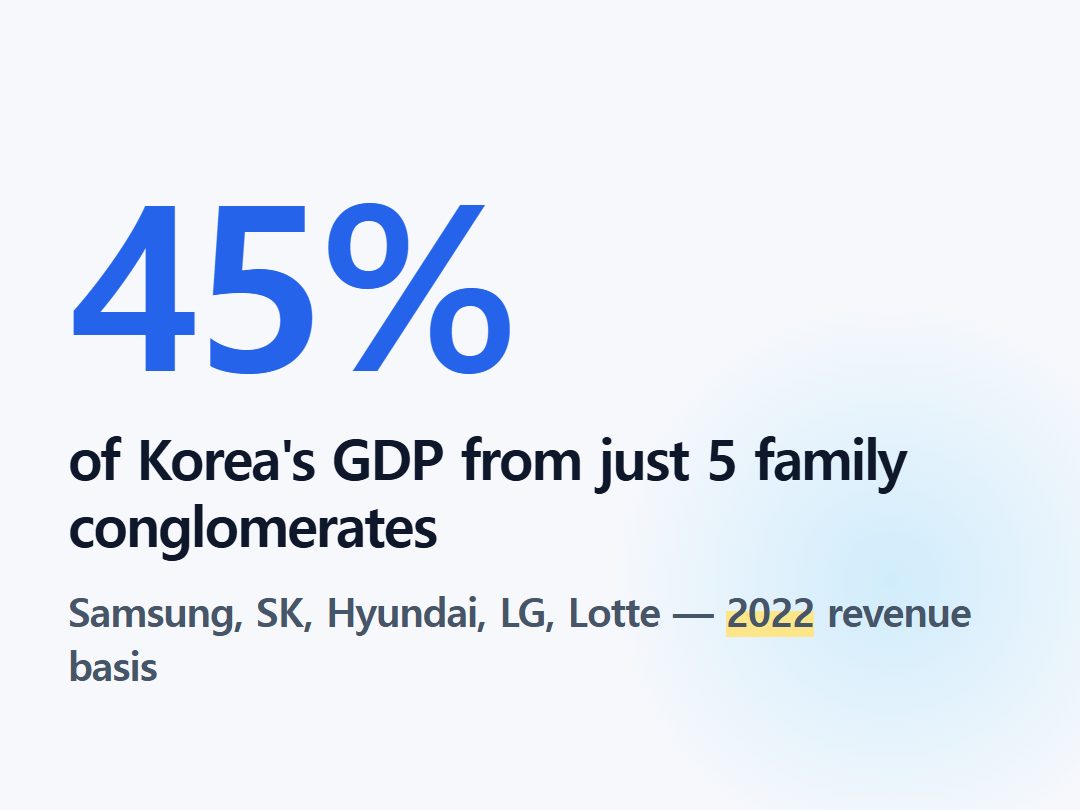
In 2022, the revenue of just the five largest chaebols — Samsung, SK, Hyundai Motor, LG, and Lotte — equaled roughly 45% of South Korea's entire GDP. Samsung alone accounts for close to a fifth of the country's exports and roughly 23% of GDP through its affiliated companies.
There is no other advanced economy where output is this concentrated in a handful of family-run firms.
When a Korean drama shows one family controlling a department store chain, a shipping line, a hospital, and a construction firm at once, it is not exaggerating for effect — it is describing how the economy is actually organized.
That concentration makes succession genuinely high-stakes, which is why succession plots feel less like invented drama and more like reportage. South Korea taxes inheritance at up to 50%, rising to as much as 60% for the largest shareholder of a company — among the highest rates in the OECD, behind only Japan.
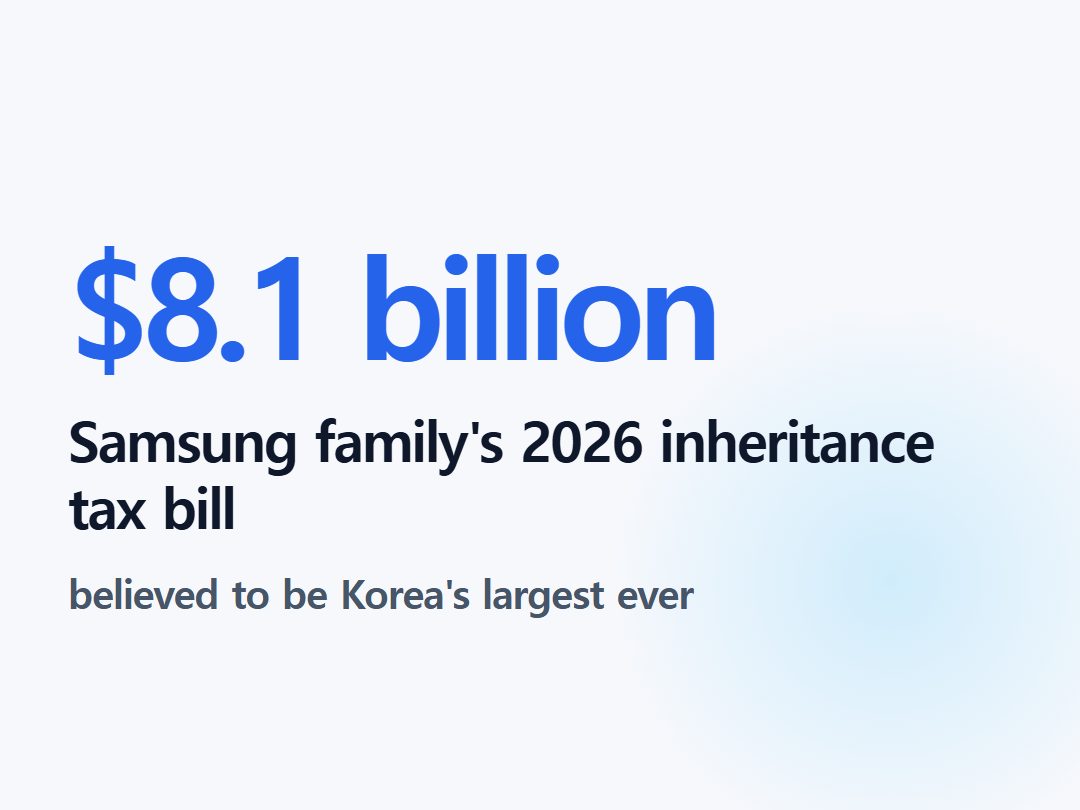
The mechanics of that tax have produced real events stranger than fiction: when Samsung's Lee Kun-hee died in 2020, his family faced a bill that took years to settle, and by May 2026 the Lee family had paid out roughly $8.1 billion (12 trillion won) in inheritance tax — believed to be the largest such payment in Korean history — and donated more than 23,000 artworks, including national treasures, to public museums to help cover it.
Fights over who inherits how much stock, and how to avoid losing control of the company in the process, are not a screenwriter's invention. They are a predictable outcome of the tax code, and Korean audiences understand the stakes in a way most foreign viewers do not.
Real chaebol families have also supplied the genre's villains.
In 2014, Korean Air vice president Cho Hyun-ah ordered a taxiing flight back to the gate because a flight attendant served her macadamia nuts in a bag instead of on a plate — the so-called "nut rage" incident, for which she was later convicted of violating aviation safety law.
It became shorthand nationwide for gapjil, the abuse of power by a superior — often a chaebol family member — over an employee or subordinate.
Samsung's own de facto leader, Lee Jae-yong, was convicted of bribery in 2017 in a scandal that helped topple a sitting president, before a decade of retrials ended in his full acquittal in July 2025.
Every plot beat that looks over-the-top in a K-drama — the heir who thinks the law doesn't apply to them, the family council that overrules a marriage, the boardroom coup dressed up as a birthday dinner — has a real precedent in the Korean business pages.
The other half of the equation is what ordinary viewers do not have. South Korea's postwar success story was built on the promise that hard work and exam scores could move a family up the ladder — the same social contract dramatized, in its more anxious form, by shows like SKY Castle. That promise has weakened.
A 2023 survey found only about 27% of Koreans believed they had a good chance of climbing the social ladder, down from a decade earlier, and the OECD has recorded South Korea with the highest relative poverty rate among its member states.
Graduates of the three elite "SKY" universities still hold a disproportionate share of the country's top jobs, from 53% of National Assembly seats to 71% of ministerial posts. Housing costs, not merit, increasingly decide who moves up.
This is the gap the Cinderella structure fills.
Scholars analyzing Boys Over Flowers have long noted that its poor-girl-meets-heir plot works as both fantasy and anxiety: the heroine only gains acceptance by continually adapting to elite tastes, a dynamic critics have described as reinforcing the very class hierarchy it appears to escape.
Watching a chaebol heir fall for someone ordinary lets viewers imagine crossing a class line that, statistically, is harder to cross in real life with every passing year.
And watching a chaebol villain get outmaneuvered, as in Reborn Rich or Vincenzo, offers something the courts often do not: a guarantee that the powerful actually face consequences.
From state-built chaebols to today's revenge dramas
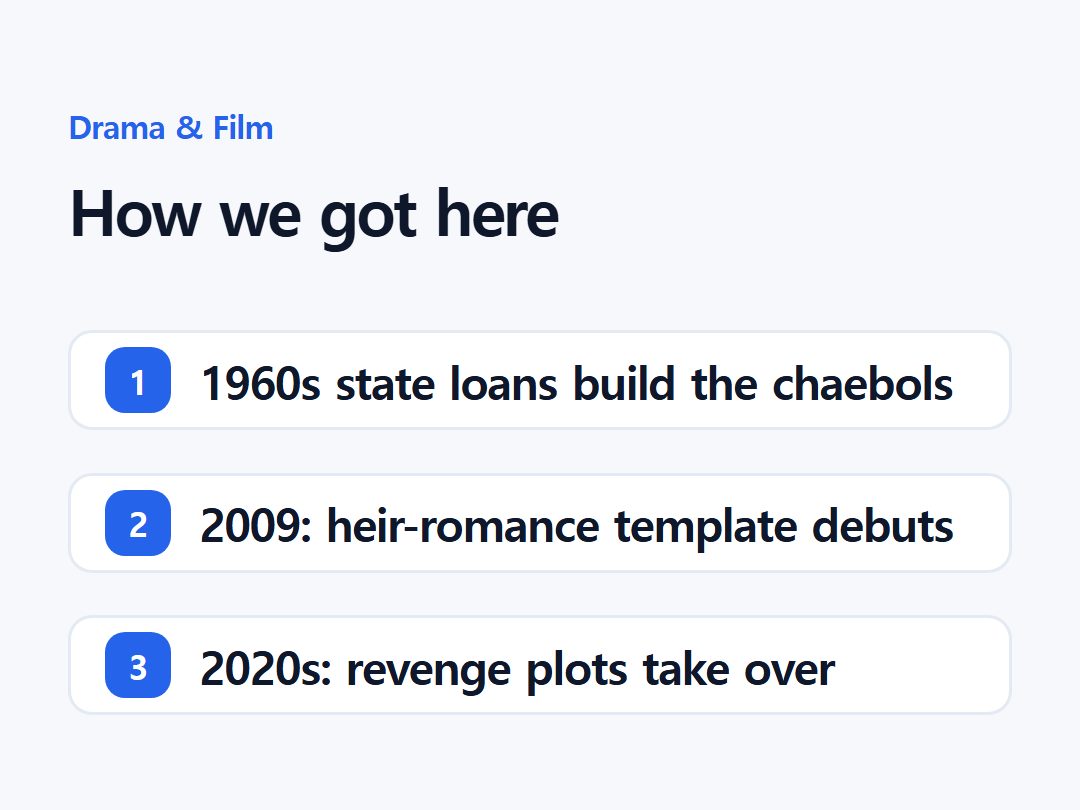
Chaebols themselves are a product of state policy, not free-market growth. Under President Park Chung-hee's export-driven industrialization from the 1960s onward, the government funneled cheap loans, subsidies, and tax breaks to a select group of firms in exchange for hitting production targets.
Those firms — Samsung, Hyundai, LG, and others — grew into the diversified conglomerates that still dominate the economy today, surviving a wave of restructuring after the 1997 Asian financial crisis largely intact in family control, if not in size.
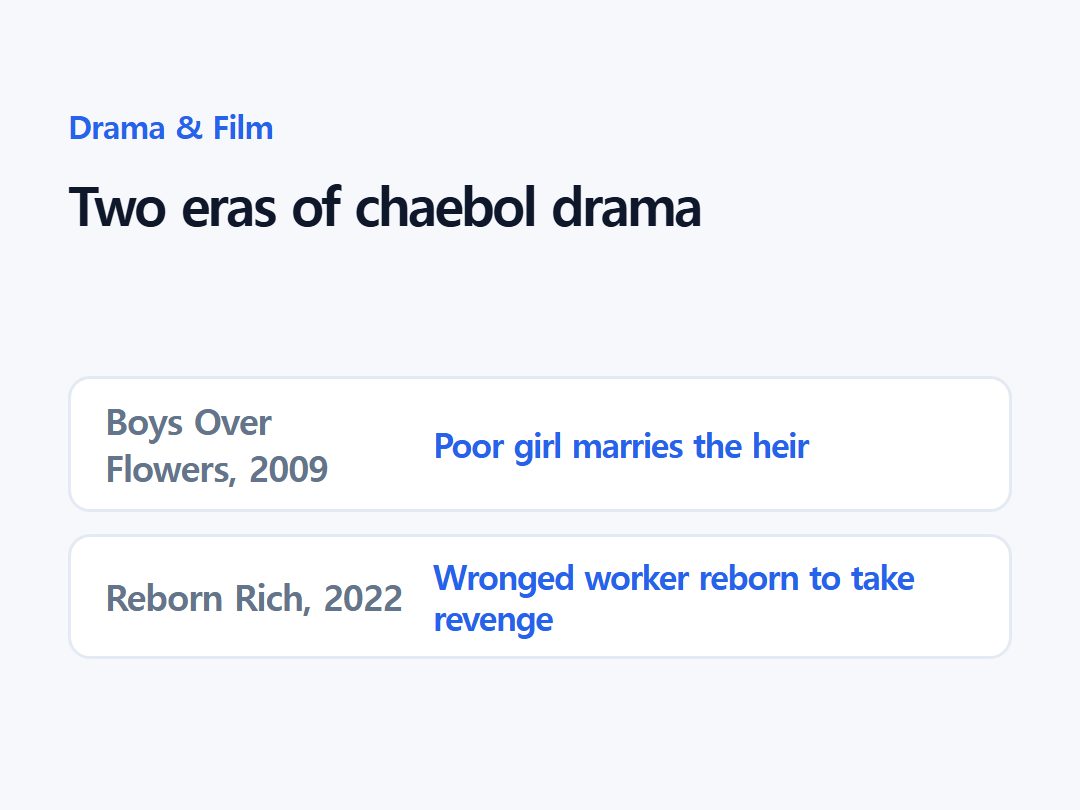
The chaebol drama as a genre took shape later, and its tone has shifted with the country's mood. Boys Over Flowers, adapted from the Japanese manga Hana Yori Dango, was a 2009 sensation that established the modern formula: an arrogant heir, a working-class heroine, a slow thaw.
Follow-up hits through the early 2010s, like Secret Garden and The Heirs, largely kept that romantic, aspirational register.
As public frustration with chaebol scandals grew through the 2010s — the nut-rage case, the Park Geun-hye bribery scandal, repeated gapjil headlines — the genre darkened. Itaewon Class (2020) and Vincenzo (2021) recast the chaebol as an obstacle to be defeated rather than a prize to be won. Reborn Rich pushed that further, giving a wronged employee a literal second life inside the family that betrayed him. Queen of Tears, in 2024, fused both modes — romance and reckoning — and became the biggest global hit of the cycle.
New inheritance tax rules and dramas are coming
The real-world material that feeds this genre is still being written.
In December 2025, the National Assembly passed a rework of the inheritance tax law, and in August 2026 the Finance Ministry proposed raising the ceiling on business-succession tax deductions from 60 billion to 100 billion won — a change critics call a tax break for the ultra-wealthy, and supporters call necessary to keep family businesses from being broken up by the tax bill alone.
A broader shift to taxing each heir's individual share rather than the whole estate is planned for 2028. How that debate resolves will shape how the next generation of chaebol heirs actually inherits their companies — and, by extension, what Korean screenwriters have to work with.
On screen, the genre shows no sign of slowing. Several chaebol-set dramas are already scheduled through 2026, ranging from further heir-and-commoner romances to darker corporate-revenge plots in the mold of Reborn Rich.
The open question is less whether chaebol dramas will keep coming, and more which register will keep winning audiences: the aspirational fantasy of marrying in, or the satisfaction of watching the family lose.
How the chaebol drama's tone shifted over time
| Era | Drama | Chaebol Portrayed As |
|---|---|---|
| 2009 | Boys Over Flowers | Prize to be won (romantic heir) |
| Early 2010s | Secret Garden, The Heirs | Aspirational romance |
| 2020–2021 | Itaewon Class, Vincenzo | Obstacle to be defeated |
| 2022 | Reborn Rich | Target of revenge |
| 2024 | Queen of Tears | Both romance and reckoning |
Frequently asked
Why do Korean dramas always feature chaebol families?
Because chaebols like Samsung and Hyundai control a huge share of South Korea's economy, so the succession fights and power abuse shown on screen reflect real business-page news, not invented drama.
What is a chaebol in Korean dramas?
A chaebol is a family-controlled business conglomerate whose subsidiaries are publicly traded but stay under the founding family's control across generations, like Samsung, SK, Hyundai Motor, LG, and Lotte.
Is Reborn Rich based on a true story?
It's fiction, but its revenge plot draws on real chaebol scandals, and the finale drew a 26.9% nationwide rating, the second-highest in Korean cable television history.
Sources
Every factual claim above is traceable. We do not translate articles — we gather facts from multiple outlets and write them ourselves.
- Reborn Rich achieves its highest viewership rating of 25% — The Korea Times
- Queen of Tears Records Highest Domestic Viewership Ratings in tvN's K-Drama History — ComingSoon.net
- [News Analysis] High inheritance tax fuels chaebol monopoly — The Korea Herald
- South Korea: revenue of chaebols as percentage of GDP — Statista
- Samsung Family Pays Off Record $8B in Korean Inheritance Tax — Tax Notes
- Cho Hyun-ah sentenced to 1 year in prison in Korean Air 'nut rage' incident — CBC News
- Samsung Chairman Lee Jae-yong absolved of all legal risks — Korea JoongAng Daily
- Korea to revamp inheritance tax for 1st time in 75 years — The Korea Herald
- Boys Over Flowers: Korean Soap Opera and the Blossoming of a New Masculinity — Popular Culture Review (Wiley)