Open the weekly bestseller chart on Naver Series or KakaoPage — the two biggest platforms for serialized Korean fiction — and a pattern jumps out almost immediately.
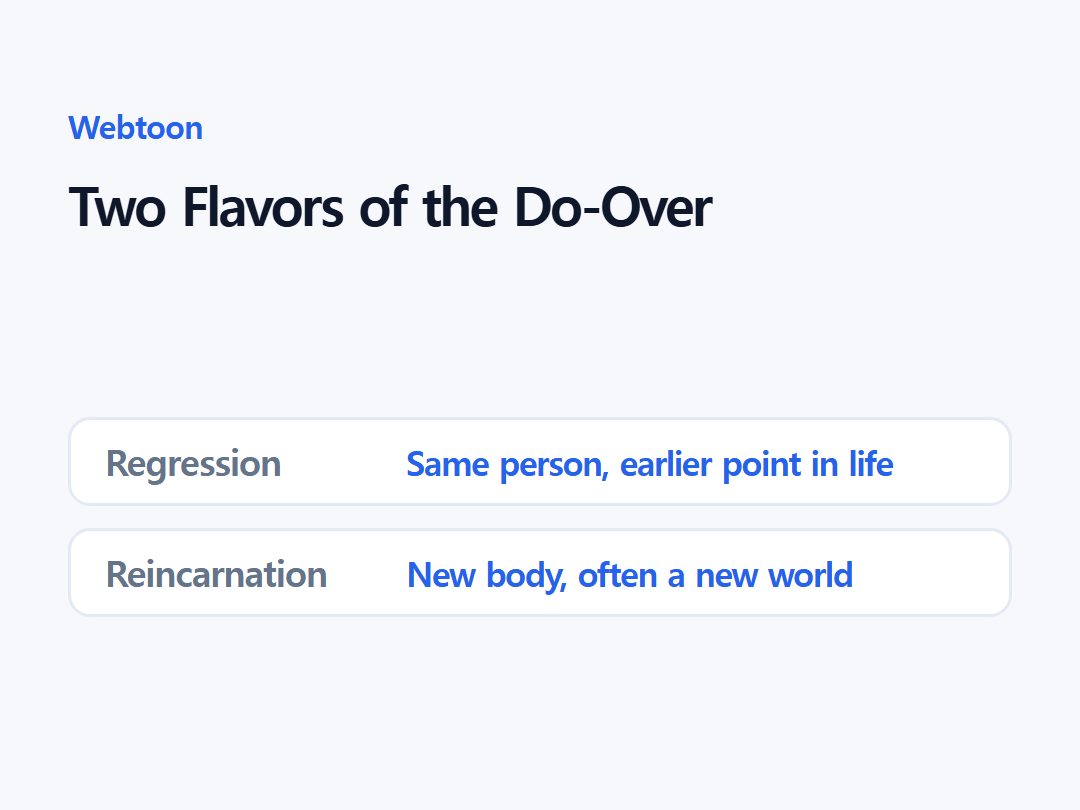
A large share of the top titles share the same opening move: the hero dies, or hits rock bottom, and then wakes up back at an earlier point in their own life, memories intact. In Korean, this is called hoegwimul (회귀물, literally "return-thing" or "regression fiction").
Its close cousin, hwansaeng (환생, reincarnation), sends the protagonist into a brand-new body instead of their own past self — sometimes as a side character or "villain" inside a story they once read.
Between them, these two setups now anchor a large share of Korea's web novel and webtoon output, from martial-arts epics to office dramas to romance.
The short version
- Regression fiction lets Korean readers rewrite failure with hindsight, control, and revenge.
- The genre traces to 2004's Hundred Blades, exploding online after 2011.
- Solo Leveling and Omniscient Reader's Viewpoint carried regression stories to global audiences.
This is not a niche quirk. It is close to a house style. Readers outside Korea encounter it constantly without necessarily clocking it as a pattern — hit exports like Solo Leveling and Omniscient Reader's Viewpoint both open with a regression, and dozens of smaller webtoons follow the same structure.
The question worth asking is not whether the trope exists, but why it became the default rather than one option among many.
Why does regression fiction feel fairer than real life?
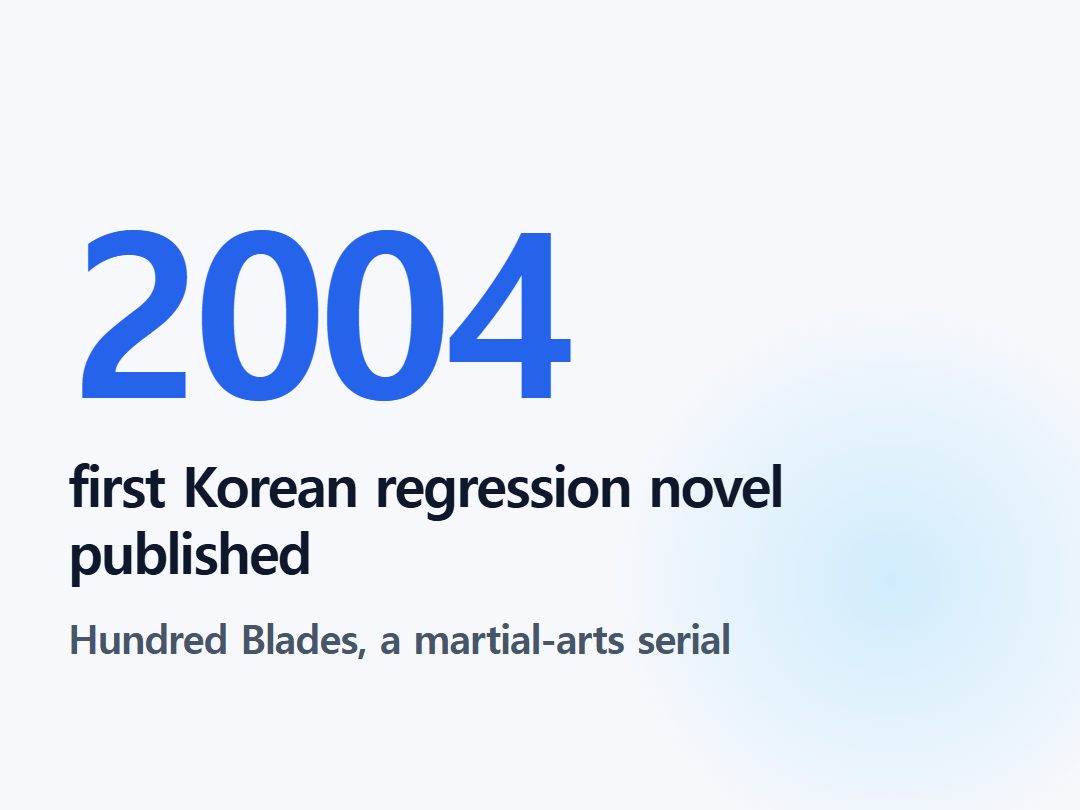
The short answer that shows up across writer interviews, fan essays, and industry commentary is that regression and reincarnation stories sell a specific emotional product: control. A regression hero already knows how the story goes wrong.
They know which ally will betray them, which monster will wipe out their guild, which stock will crash. The entire plot becomes an exercise in using that foreknowledge to fix what broke the first time.
For a reader, that is a very different kind of suspense than not knowing what happens next — it is the pleasure of watching competence applied to a problem whose shape is already understood.
That appeal reads differently once you know the market these stories are written for. Korean web fiction is overwhelmingly serialized in short daily or near-daily episodes, bought one chapter at a time on apps people read during commutes and breaks.
It is, in other words, entertainment consumed inside the same grinding schedule the stories are reacting against.
South Korea's youth job market has spent much of the last two decades defined by intense competition for a shrinking number of stable positions — a condition popularly summed up since around 2015 by the slang term "Hell Joseon" (헬조선), which fuses "hell" with Joseon, the name of Korea's last dynastic kingdom, to describe a hierarchical, seemingly rule-rigged society where hard work does not reliably translate into reward.
A related bit of slang, the "spoon class theory," sorts people into gold, silver, or "dirt" spoons depending on the wealth they were born into, implying that the biggest single factor in a young Korean's future is a starting position they never chose.
Regression fiction answers that anxiety directly. Its worlds tend to run on visible, learnable rules — leveling systems, tournament brackets, guild rankings, dungeon difficulty tiers — where effort and knowledge produce predictable results, unlike a job market where credentials do not guarantee an interview.
The hero, often someone who was overlooked, exploited, or discarded the first time through, gets to apply hindsight and come out on top of a system that finally makes sense. It is escapism, but escapism aimed at a very specific frustration: not the absence of struggle, but the absence of a fair, transparent scoreboard.
There is a second engine running alongside the control fantasy: catharsis through confrontation.
Korean social norms place heavy weight on hierarchy and deference — toward elders, bosses, seniors at work or school — which makes openly calling out someone more senior or more powerful, even when they are clearly in the wrong, socially costly in real life. Regression protagonists face no such constraint.
Because they already know who will betray them, cheat them, or humiliate them, they get to act first: expose the corrupt guild master before he can steal credit, refuse the toxic mentor before he can waste ten years of the hero's life, out-negotiate the family member who inherited everything by birth order rather than merit.
The revenge is not random cruelty; it is accountability that the real world routinely denies people lower in a hierarchy.
The genre also has a distinct, hugely popular female-oriented branch known as "villainess" regression, in which a reader or a minor character wakes up inside the body of a romance novel's doomed antagonist — the noblewoman fated to be humiliated and executed for her cruelty by the story's final act.
Rather than accept that fate, she uses knowledge of the plot to dodge her scripted death and rewrite her own arc.
Because the label of "villainess" already frees her from the passive, endlessly patient heroine role Korean romance fiction traditionally rewarded, these characters get to be ambitious, calculating, and self-interested without being punished for it by the narrative — itself a small act of genre rebellion.
The 2004 print novel that started it all
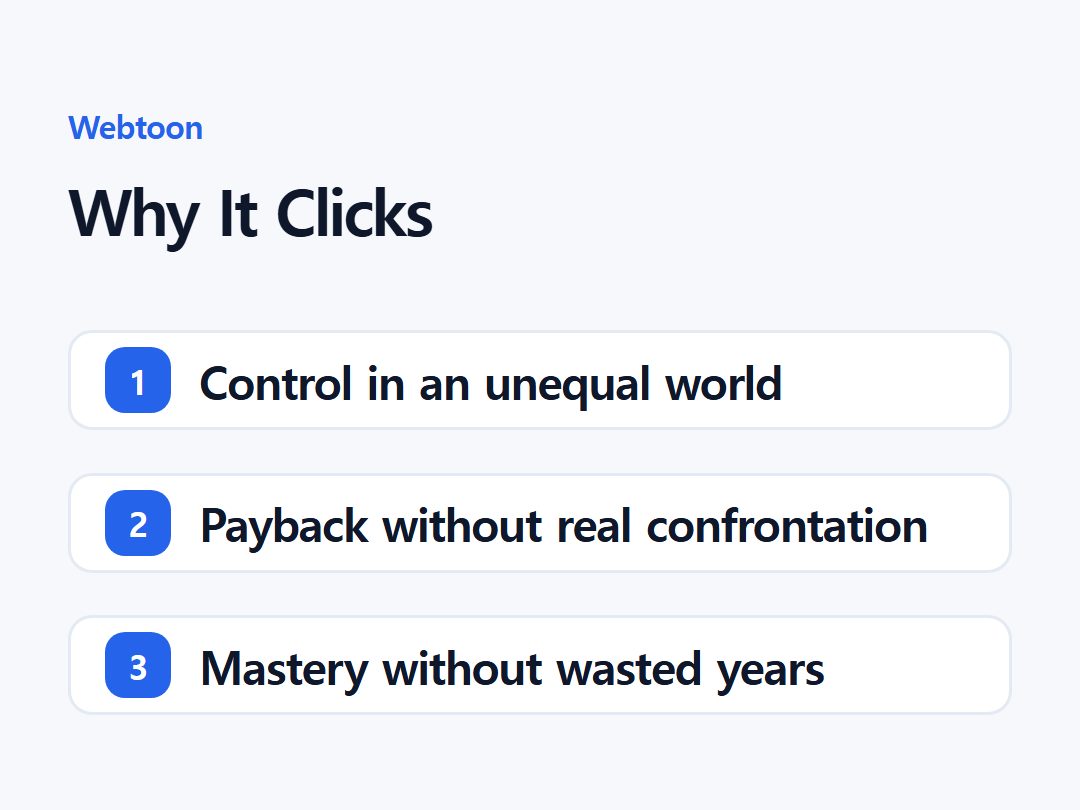
The trope has deeper roots than the current web boom. Genre historians trace the first identifiable regression novel to Korea's print-based book-rental market: a martial-arts novel called Hundred Blades, published in March 2004, followed closely by Rebirth the same year.
Neither broke wide, but 2006's Reset Life found a real audience in rental shops and is generally credited with establishing regression as a recognizable trend rather than a one-off gimmick.
The genre's real explosion came after Korean fiction moved online. In 2011, two web serials — Dragon Lord of the Heat Wave and Reincarnation of the Fist — became runaway hits and proved regression could work at web-novel scale.
The following year, 2012, produced two titles that shaped the genre's two major branches going forward: MEMORIZE, which pushed regression into the mainstream of male-oriented fantasy fiction, and The Abandoned Empress, which did the same for regression inside female-oriented romance-fantasy.
By 2015, regression releases were arriving in bulk, and a serial called Reincarnation Seat broke sales records on the platform Munpia — one of several dedicated web-fiction sites, alongside Naver Series and KakaoPage, where Korean authors publish and monetize chapters directly to readers, usually through a pay-to-read-ahead model.
The genre's crossover into global pop culture came through adaptation. Omniscient Reader's Viewpoint, serialized on Munpia starting in January 2018, had already passed 26 million views by September 2019 before its webtoon adaptation multiplied its audience further. Solo Leveling, originally a KakaoPage web novel, followed the same web novel-to-webtoon-to-anime pipeline and became one of the biggest manhwa-derived franchises internationally, helping normalize Korean manhwa as a category Western fans now actively seek out rather than treat as a spinoff of Japanese manga.
Will regression fiction's appeal survive going global?
Regression has become so dominant that it is less a standalone genre now than a default setting other genres borrow — showing up as the starting premise inside martial-arts fiction, tower-climbing stories, hunter-and-dungeon action, apocalypse survival fiction, and corporate revenge dramas alike.
Industry watchers who track weekly charts on Naver Series and KakaoPage note that regression and reincarnation titles continue to occupy top chart positions into 2026, with newer entries competing less on the premise itself than on execution: how convincingly a story handles the psychological cost of a protagonist who remembers a life nobody else did.
What remains open is how far the export pipeline goes. Korean web novels increasingly reach international readers directly, through official English translations on platforms tied to the original Korean services, well before — or entirely without — a webtoon or anime adaptation.
Whether regression's very specific emotional appeal, tied closely to Korean readers' experience of hierarchy, credential competition, and generational anxiety, translates as cleanly to readers who did not grow up inside that pressure is still being tested chapter by chapter.

How regression fiction grew from print to global webtoon
| Year | Milestone | Significance |
|---|---|---|
| 2004 | Hundred Blades, Rebirth | First identifiable regression novels, in Korea's print book-rental market |
| 2006 | Reset Life | Established regression as a recognizable trend rather than a one-off gimmick |
| 2011 | Dragon Lord of the Heat Wave, Reincarnation of the Fist | Runaway web-serial hits that proved regression could work at web-novel scale |
| 2012 | MEMORIZE, The Abandoned Empress | Shaped the genre's two major branches: male fantasy and female romance-fantasy |
| 2015 | Reincarnation Seat | Broke sales records on the platform Munpia |
| 2018 | Omniscient Reader's Viewpoint | Passed 26 million views by September 2019, then adapted into a webtoon |
Frequently asked
What does hoegwimul mean in Korean web novels?
Hoegwimul (회귀물) is Korean for "regression fiction": stories where the hero dies or hits rock bottom, then wakes up back at an earlier point in their own life with memories intact.
What is villainess regression in Korean romance novels?
It's a female-oriented branch of the genre where a character wakes up inside the body of a romance novel's doomed antagonist and uses knowledge of the plot to dodge her scripted death and rewrite her own arc.
What was the first Korean regression novel?
Genre historians trace it to Hundred Blades, published in March 2004, followed by Rebirth the same year, though 2006's Reset Life is generally credited with establishing regression as a real trend.
Sources
Every factual claim above is traceable. We do not translate articles — we gather facts from multiple outlets and write them ourselves.
- Regression / Korea — NamuWiki
- Why Do So Many Korean Webnovels Start With a Regression? — Medium (Stella&)
- All About Villainess Regression — Medium (Stella&)
- Omniscient Reader's Viewpoint — Wikipedia
- Solo Leveling: From Korean Web Novel to Global Anime in 8 Years — Otakira
- Korean Webtoons Guide: LINE, Naver, KakaoPage — Daebak
- Hell Joseon — Wikipedia
- Web novels in South Korea — Wikipedia