Every few months, a Korean webtoon gets accused of using generative AI in its art, and the reaction is always disproportionate to a simple quality complaint. Readers don't just criticize the art. They rating-bomb the series into the bottom of the platform, threaten to cancel paid subscriptions, and sometimes organize formal boycotts.
The short version
- A single AI accusation can crash a series' rating to about 2 out of 10.
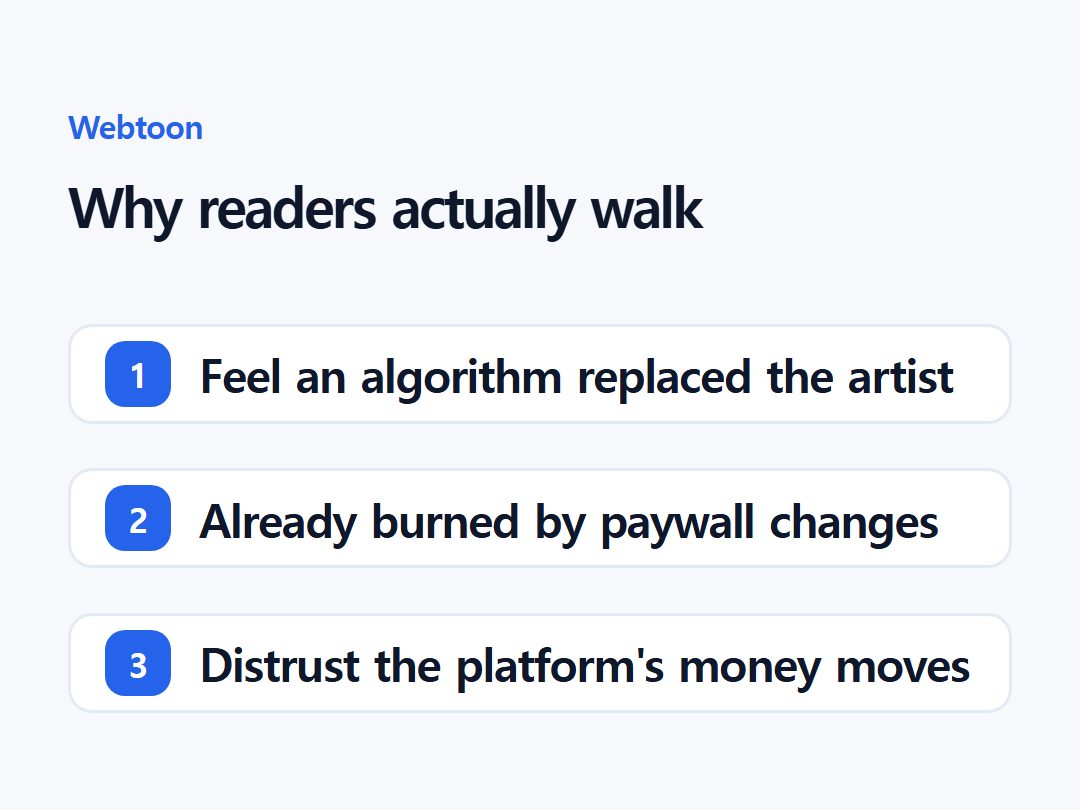
- Only 12.5% of readers actually oppose AI in principle, survey found.
- Reader anger stems from paywalls, refunds, and platform trust, not just art.
This isn't one company's scandal. It has repeated on both of Korea's biggest platforms, Naver Webtoon and Kakao Webtoon, since 2023, and it keeps catching international readers off guard because the anger looks bigger than the offense. The gap makes more sense once you see what else has been building up around it.
A single suspicion can sink a series' rating overnight
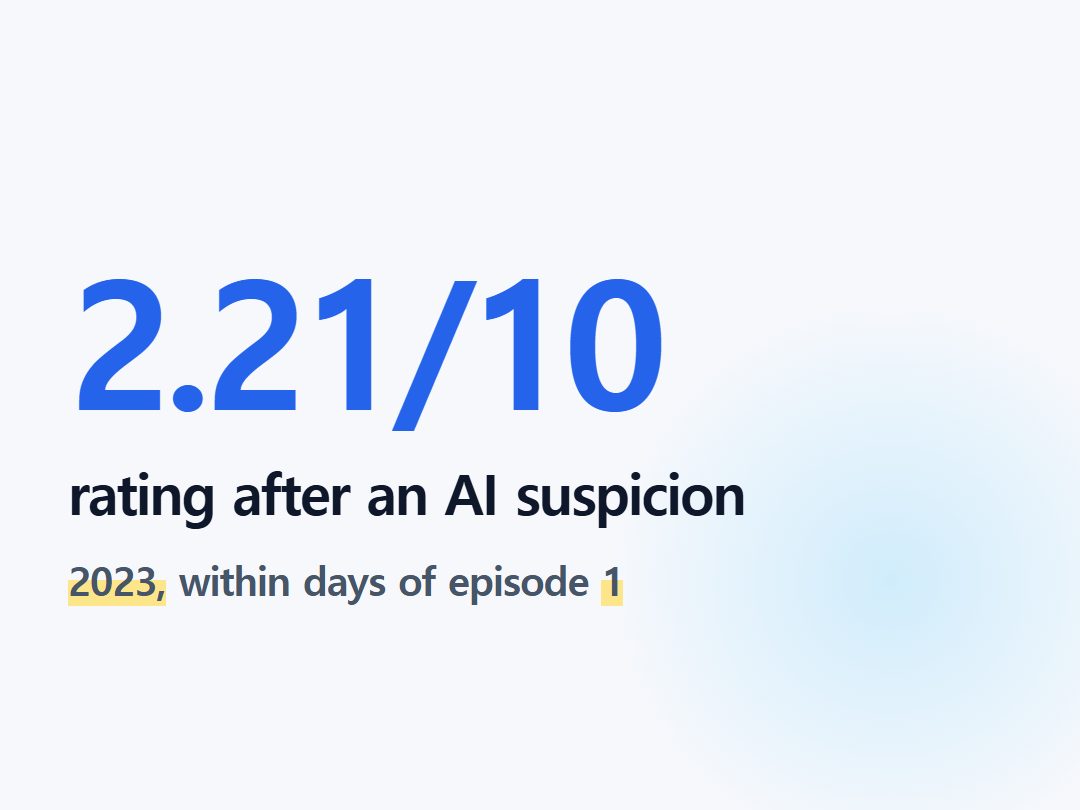
In 2023, a Naver Webtoon fantasy series was accused of using AI-generated art in its very first episode. Within days, its first two episodes were rated 2.21 and 3.25 out of 10 — far below where even a genuinely weak new series usually lands, since most low performers still cluster somewhere in the 5-to-8 range.
The production studio said AI was only used for post-production touch-up, never for drawing panels. It didn't matter. The score stuck, and the case became the reference point every later AI controversy on Korean webtoon platforms gets measured against.
General AI dislike sits at just 12.5% of readers
That makes the next number harder to square. In a 2025 industry survey — the first time Korea's content agency asked comic and webtoon readers directly whether they oppose AI adoption in principle — only 12.5% said yes.
Most readers said they actually expect practical upsides: faster releases, room for experimental new genres, easier entry for newcomers without a studio behind them. So a rating collapsing to 2 out of 10 isn't really 12.5% of readers expressing a policy view. Something underneath the art is doing the rest of the work.
Readers already suspected the platforms were quietly taking more
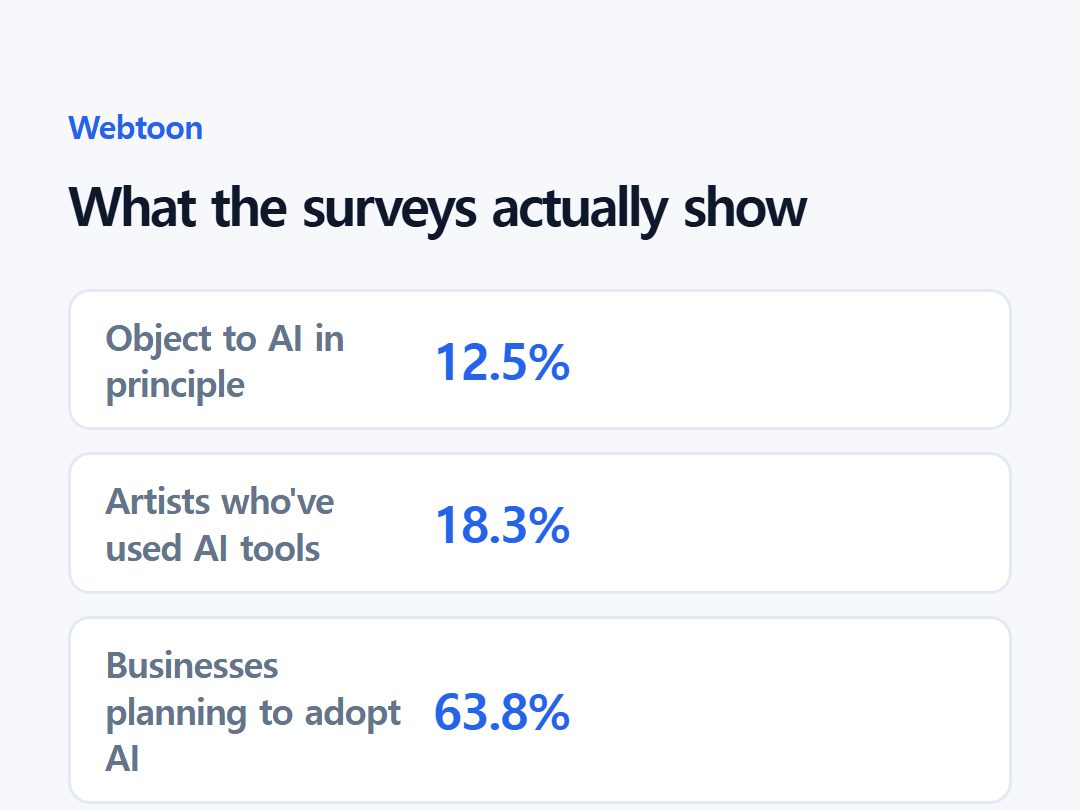
Korean webtoons were free to read for most of their history, funded by ads and later by an early-access system where readers pay in-app currency to unlock chapters before they become free. That shift alone produced years of reader confusion and resentment toward the platforms, even after most people understood that individual creators — not Naver or Kakao — decide whether their own series goes behind a paywall.
Some readers never fully accepted that explanation. Long-running community threads still describe the payment system as something Naver imposed on them, not a choice individual artists made, which is exactly the kind of grievance that resurfaces the moment a new controversy needs somewhere to attach itself.
The same friction shows up abroad. In May 2025, WEBTOON — the English-language app run by the same company behind Naver Webtoon — quietly removed a feature called Daily Pass, which had let readers unlock one free episode a day, with each unlock staying available for 14 days.
It was replaced by an ad-supported pass that expires after just three days, alongside ads now embedded inside the comic panels themselves. The company stayed silent for a full day before posting a brief in-app notice, and readers responded with a formal petition accusing it of trying to squeeze more money out of them.
"Paid for a data combination, not creativity"
That phrase is how one industry source described the emotional math readers do the moment AI involvement is suspected, in a report on the same backlash spreading into web novels. Readers who pay believe they are subsidizing a specific person's skill, not an algorithm's output — so discovering otherwise reads as a bait-and-switch, not a style complaint.
A 2026 academic study presented at the CHI conference on human-computer interaction found a similar pattern: readers value the parasocial authenticity of a human creator — the one-sided sense of closeness a fan feels toward someone they've never actually met — and treat AI-assisted work as a breach of that relationship, which pushes some creators toward staying quiet about tools they already use for efficiency.
Refunds are hard enough without an AI question on top
In August 2026, Korea's Consumer Agency published an investigation into refund practices at seven major webtoon and web novel platforms, including Naver Webtoon, Kakao Webtoon, Kakao Page, Lezhin Comics and Ridi. Consumer complaints about these services rose every year from 2023 to 2025, totaling 197 cases, and broke down roughly like this:
- Contract cancellation and penalty fees — 40.6% of complaints
- Service shutdowns cutting off paid content — 10.7%
- Unauthorized charges and auto-billing errors — 9.7%
Six of the seven platforms deduct a refund fee of 10% of the amount or ₩1,000, whichever is larger — a flat penalty that hits small purchases hardest. In one case the agency cited, a reader trying to refund roughly ₩13,000 in unused in-app currency was asked to submit a mobile-carrier contract certificate along with a written refund request just to get the money back.
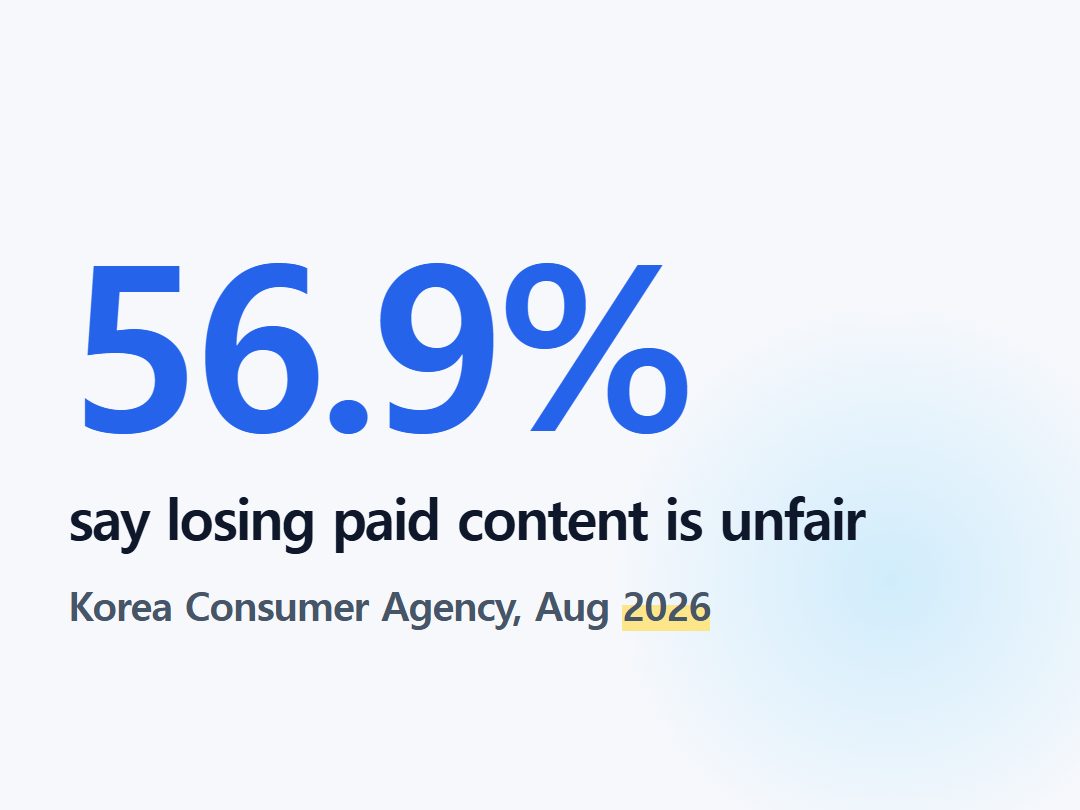
More than half of webtoon readers, 56.9%, and nearly seven in ten web novel readers, 69.8%, said it's unfair that they lose access to content they already bought once a platform shuts a service down. That is the backdrop readers bring with them before an AI rumor even starts.
How the 2023 backlash actually started
The pattern traces back to April 2023, when Naver Webtoon ran an April Fools' feature converting its entire catalog into AI-rendered art styles as a joke. Readers weren't amused, and within weeks, more than 200 amateur cartoonists launched a formal "AI Webtoon Boycott," posting protest banners across the platform's section for unpublished creators.
Their objection wasn't really about art quality. It was about Naver's terms of service, which stated that user-uploaded posts could be used for the company's own research — language artists read as permission to train AI models on their work without separate consent.
Naver said the clause wasn't written with AI training in mind, but didn't rewrite it right away. Readers' core objections, in their own words, came down to three things:
- Fear of artists losing paid work to AI
- Their art used as training data unpaid
- Visible style drift between AI-touched panels
Platforms want AI faster than the artists who work for them
A 2024 survey by Korea's Ministry of Culture, Sports and Tourism and the Korea Creative Content Agency — covering 800 professional webtoon artists and 160 industry businesses — found a wide split in appetite for the technology.
| Group | Figure |
|---|---|
| Artists who have used AI art tools | 18.3% |
| Artists who plan to use AI in future | 36.1% |
| Businesses with no AI experience planning to adopt it | 63.8% |
Artists who hadn't adopted AI cited legal and copyright risk as their top concern, at 41.3%, followed by fear that it erodes originality, at 31.3% — official-survey language for the same suspicion that drives reader boycotts.
What "hand-drawn only" contest rules actually promise
After the 2023 backlash, both major platforms wrote AI restrictions into their annual newcomer contests. Naver barred generative AI from the second round of its flagship contest, citing a lack of social consensus, while Kakao Webtoon required finalists to certify their work was drawn by a human hand and sit for an interview about their process if shortlisted.
Neither rule reaches already-running commercial series. Neither platform has published a general AI-disclosure policy covering the webtoons readers already pay to read every week — the certification only ever applied to contest entrants, not ongoing titles.
The legal question no one has answered yet
Whether AI-assisted art counts as a creator's own copyrighted work is still legally undefined in Korea. Industry officials describe a persistent "lack of social agreement" on the point, and no court or regulator has issued binding guidance specific to webtoons.
A lawmaker has proposed legislation requiring visible disclosure whenever content involves generative AI, but it has not passed as of this writing. Until it does, the only signal readers get that a series used AI is when someone notices — and by then, the reaction is rarely just about the drawing.
What Korean webtoon/web novel readers complained about, 2023–2025 (197 cases)
| Complaint Type | Share of Complaints |
|---|---|
| Contract cancellation and penalty fees | 40.6% |
| Service shutdowns cutting off paid content | 10.7% |
| Unauthorized charges and auto-billing errors | 9.7% |
Frequently asked
Why do Korean webtoon readers get so angry about AI art?
Readers believe they're paying for a specific artist's skill, so suspected AI use feels like a bait-and-switch, and years of paywall and refund frustration with the platforms make that anger explode faster than a normal quality complaint would.
Did the accused Naver Webtoon series actually use AI art?
The production studio said AI was only used for post-production touch-up, never for drawing panels, but the explanation didn't stop the first two episodes from being rated 2.21 and 3.25 out of 10.
Is AI-generated art disclosure required for Korean webtoons?
No — a lawmaker has proposed legislation requiring visible disclosure of generative AI use, but it hasn't passed, and neither major platform has published a general AI-disclosure policy for series already running.
Sources
Every factual claim above is traceable. We do not translate articles — we gather facts from multiple outlets and write them ourselves.
- "손으로 그린 웹툰만 볼래요"…네이버-카카오웹툰, AI 반감에 당혹 — Newsis
- "AI 웹툰은 도둑질의 결과"...네이버웹툰 작가들 'AI 웹툰 보이콧' — Popular Science Korea
- Webtoon industry seeks AI edge amid legal, ethical challenges — The Korea Times
- 이용자 거부감보다 기대감 컸다…웹툰에 AI 도입, 업계 인식과 '온도차' — ZDNet Korea
- 웹툰도 AI가 쉽게 만드는데...작가들이 신중한 이유 — ZDNet Korea
- "뭐야 AI로 썼어?" 들킨 순간 별점 테러…웹소설 작가들 딜레마 — Money Today
- No, you're not losing it—WEBTOON got rid of Daily Pass — The Beat (Comics Beat)
- "내 돈 내고 소장했는데 서비스 종료?"…웹툰·웹소설 플랫폼 7곳 실태 조사 — Kyeonggi Ilbo
- AI in Webtoon Creation: Challenges, Perceptions, and Design Implications — ACM CHI Conference 2026