
A drama that was streaming last year is gone this year, and no algorithm made that decision. A licence expired, a distributor changed hands, or a broadcaster pulled its catalog off a rival platform. None of that is visible to the viewer — the show just disappears.
The short version
- Streaming licences expire on schedule — shows vanish for legal reasons, not algorithms.
- KOCOWA left Viki in December 2025, moving broadcaster libraries to KOCOWA+ instead.
- Check KOCOWA+, Viki, and Tubi's CJ ENM hub before assuming a drama is gone.
International fans searching for an older title often assume Netflix or Viki has "lost" it by accident. In most cases the title has simply moved, and finding it again means knowing where Korean broadcasters and distributors actually keep their back catalogs.
A streaming licence is a rental, not a purchase
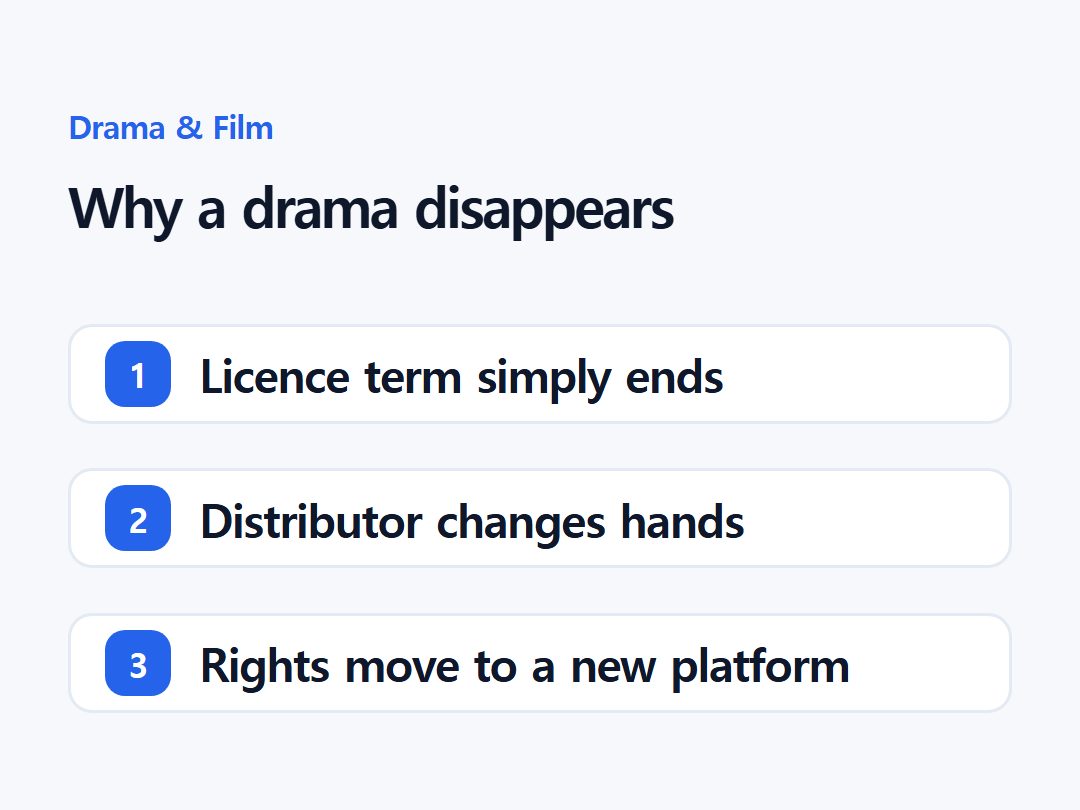
Viki's own support page states plainly that the platform licenses shows for a fixed period, not indefinitely, and that titles are removed once that agreement with the content provider ends. Viki says it renegotiates constantly, but renewal is never guaranteed.
Viki adds that some removals are entirely outside its control — music rights and syndication deals attached to a drama can force a takedown even when Viki wants to keep the show up. That single mechanic explains most of the "why did this vanish" questions fans ask.
December 2025: a broadcaster catalog moved out overnight
The clearest recent example is Viki itself. In December 2025, KOCOWA — the joint venture behind KBS, MBC, and SBS content — ended its distribution deal with Viki. Viki Pass Plus subscribers lost access to KOCOWA-sourced dramas and variety shows in a single update.
Fans were redirected to subscribe to KOCOWA+ directly for that same content. It is a useful case study: even a platform built specifically around Korean content can lose a broadcaster's entire library on short notice, because the underlying rights sit with the broadcaster, not with any streaming app.
Why a title licensed for one country won't load in another
Korean distributors typically sell streaming rights country by country rather than worldwide. A network can license a drama to one platform in the United States and a different one in the United Kingdom, or hold the title back from a market entirely if demand there looks too small to justify a deal.
This is why forum advice to "just check Netflix" often fails: the same account, same subscription tier, and same title can be available in Seoul and blocked in Berlin, because each territory represents a separate negotiation.
Older dramas are hit hardest by this pattern. A studio renewing rights for a new hit has an obvious commercial reason to negotiate every territory; renewing a decade-old series market by market is usually not worth the legal cost, so it quietly lapses in the smaller markets first.
The 2018 shutdown that scattered a decade of dramas
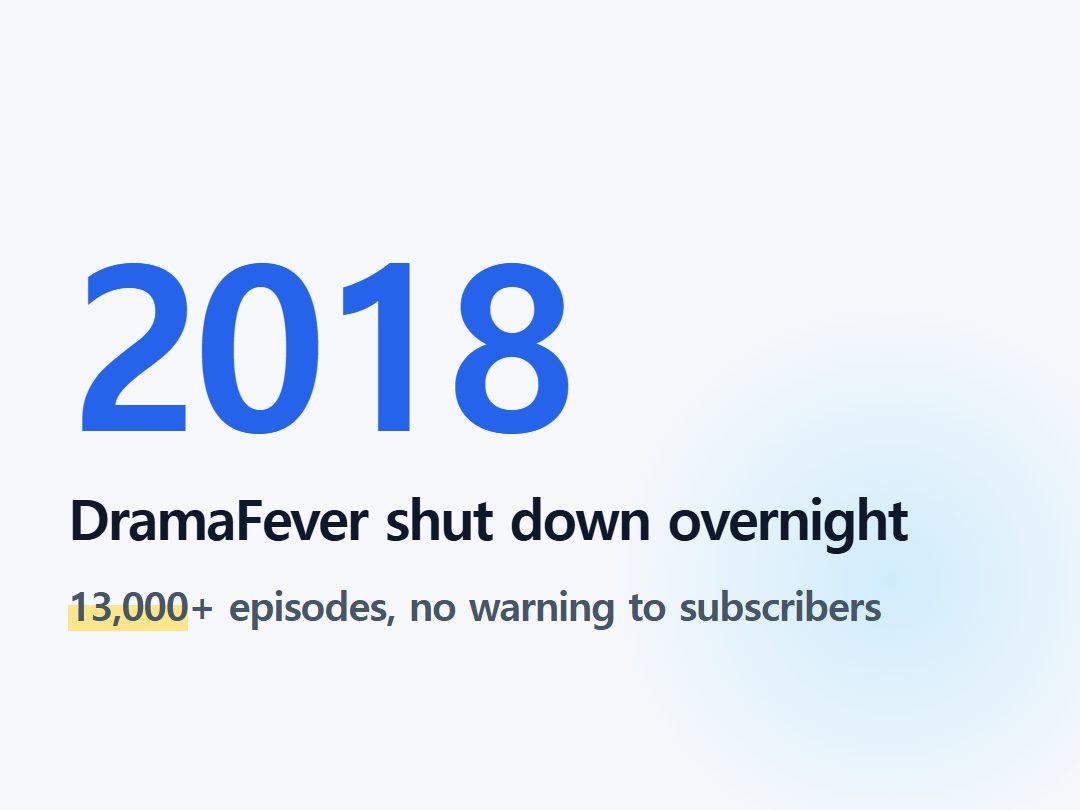
Before today's fragmented landscape, one company briefly held most of the market. DramaFever launched in 2009, was bought by SoftBank in 2014 for roughly $100 million, and was sold to Warner Bros. in 2016. By 2018 it carried over 13,000 episodes from 60 content partners across 12 countries.
Warner Bros. shut the service down on October 16, 2018, with no advance warning to subscribers, citing "business reasons" and a "rapidly changing marketplace." Content stayed briefly accessible on the VRV app until November 1, 2018, and then a decade of licensing deals had to be rebuilt elsewhere, largely on Viki and the newly formed KOCOWA.
Where KBS and SBS now run their own free archives
Rather than relying only on third-party platforms, two of the three major broadcasters stream older dramas themselves, for free, on YouTube.
- KBS Drama Classic began free VOD-style streaming of past dramas in March 2020, starting with the historical series "Jang Yeong-sil," and now hosts thousands of episodes with a paid membership tier for deeper access.
- SBS's BBACKDRA channel ("Back to SBS Drama") serves the same function for SBS's older titles, organized into full-series playlists.
- MBC does not currently run a comparable dedicated classic-drama channel at this scale.
These channels are official, ad-supported, and free — but content is Korean-only with no guaranteed English subtitles, which limits their use for international viewers to shows they already know well.
KOCOWA+ turned three broadcasters' vaults into one paid catalog
KOCOWA+ is the direct-to-consumer descendant of KOCOWA, run jointly with KBS, MBC, and SBS since it first launched on The Roku Channel in October 2020 — the first time Korean television reached that platform. It has since expanded well past the original three networks.
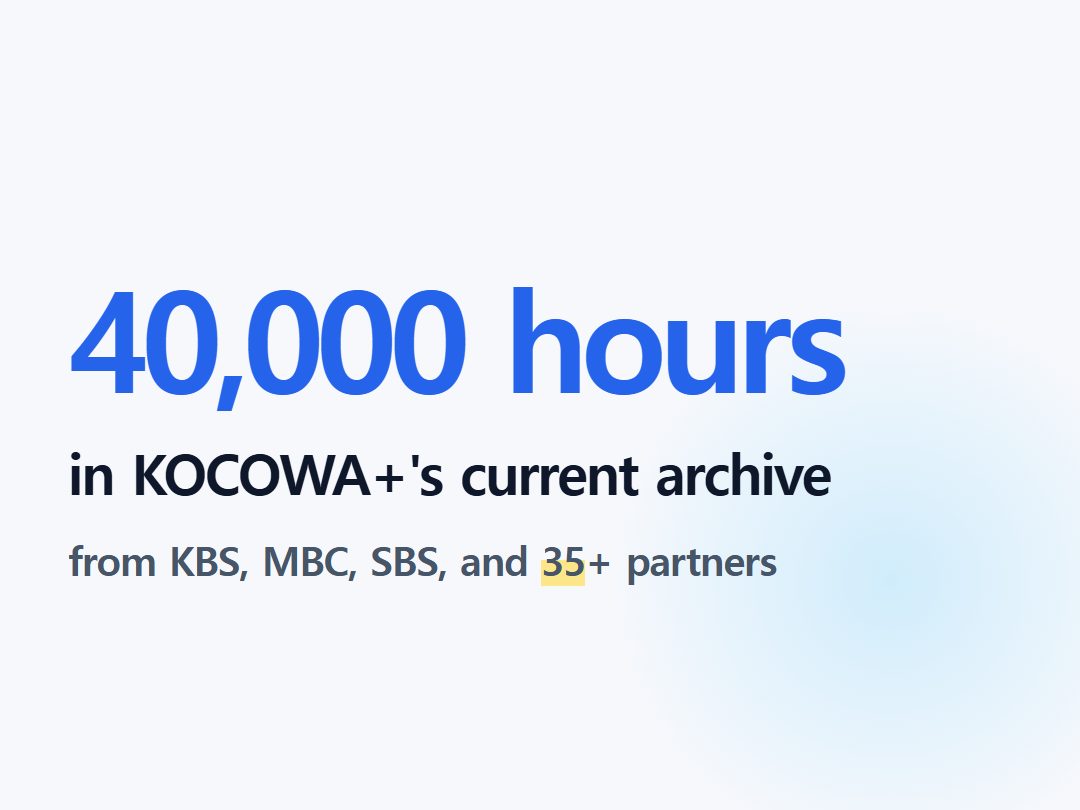
The service now says its library covers more than 40,000 hours of programming from over 35 Korean broadcasters and studios, including a complete archive of variety staples like "Running Man" and older dramas such as "Weightlifting Fairy Kim Bok-joo" and "Hwarang."
It is available across the Americas as a standalone subscription or as an add-on inside Amazon Prime Video.
A free ad-supported channel picked up titles no subscription carried
Not every route requires a subscription. In December 2022, Tubi — a free, advertising-supported service, sometimes called a FAST channel (Free Ad-Supported Streaming Television) — signed a licensing deal with CJ ENM, one of Korea's largest studios.
The deal launched with more than 75 Korean films, dramas, and K-pop series, totaling roughly 500 hours, including "Reply 1994," "A Werewolf Boy," and eight seasons of the music show "M Countdown."
Tubi's own data showed Korean-content viewership growing over 25% year-over-year before the deal, which is what prompted CJ ENM to license there rather than exclusively through a subscription platform.
Four legal routes end up with four different catalogs
No single platform carries everything, and each one draws its licences from a different source.
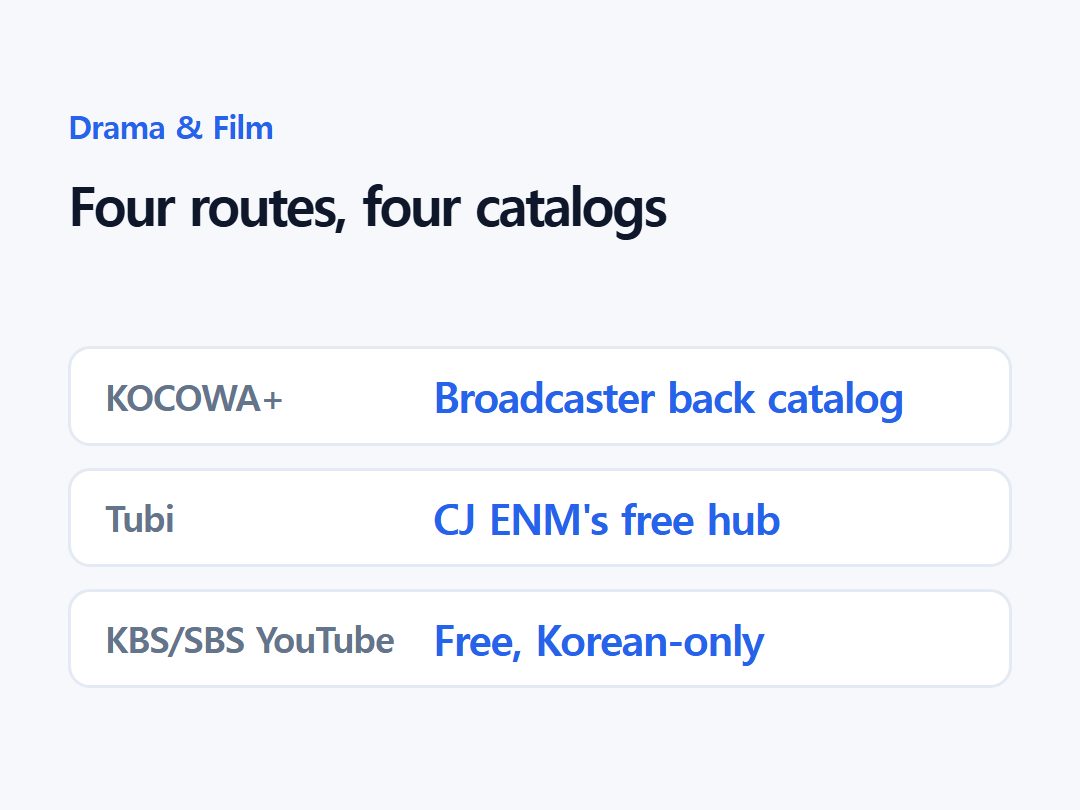
| Platform | Where its catalog comes from | Cost |
|---|---|---|
| KOCOWA+ | KBS, MBC, SBS, and 35+ partner broadcasters | Paid subscription |
| Rakuten Viki | Rotating licences from multiple studios; titles expire on schedule | Free with ads, or paid |
| Tubi (CJ ENM hub) | One studio's catalog under a fixed licensing deal | Free with ads |
| KBS Drama Classic / BBACKDRA | Each broadcaster's own archive, self-hosted | Free, Korean-only |
A title missing from one row is often sitting in another, which is why a single search on one app rarely settles the question.
A library card is an underused option, with real limits
Public libraries in the United States and several other countries offer free access to streaming apps like Kanopy and Hoopla through a library card. Neither service is built around Korean drama specifically, and what each one carries depends entirely on which titles that particular library system has licensed.
Hoopla's catalog of roughly a million titles makes an occasional K-drama more likely to turn up than on Kanopy, which leans toward independent film and documentary. Treat both as a supplementary search, not a primary source.
Access also depends on which system issued the card. One city's library may have bought a Korean film package that a neighboring county never licensed, so the same free tool produces different results for different readers.
What is still unresolved
There is no single global archive of Korean television, and there is unlikely to be one soon. Licensing remains a broadcaster-by-broadcaster, country-by-country business, and the KOCOWA–Viki split shows that even major platforms can lose an entire catalog with a few months' notice.
It is also unclear how much pre-2015 programming will ever be re-licensed at all. Older titles generate less subscription revenue than current hits, which gives distributors little commercial reason to renew rights that have already lapsed once.
Unofficial streaming sites are sometimes suggested as a workaround for titles that seem to have vanished entirely. Their catalogs are unstable, subject to takedowns, and outside the legal distribution chain the broadcasters actually license — a bookmarked link today is not a guarantee for tomorrow.
For now, the practical approach is the unglamorous one: check KOCOWA+, Viki, and Tubi's CJ ENM hub in that order, then try the broadcaster's own YouTube channel for anything still missing.
Four legal routes to older Korean dramas
| Platform | Where its catalog comes from | Cost |
|---|---|---|
| KOCOWA+ | KBS, MBC, SBS, and 35+ partner broadcasters | Paid subscription |
| Rakuten Viki | Rotating licences from multiple studios; titles expire on schedule | Free with ads, or paid |
| Tubi (CJ ENM hub) | One studio's catalog under a fixed licensing deal | Free with ads |
| KBS Drama Classic / BBACKDRA | Each broadcaster's own archive, self-hosted | Free, Korean-only |
Frequently asked
Why did my Korean drama disappear from Viki?
Viki licenses shows for a fixed period, not indefinitely, and removes titles once that agreement ends or when music and syndication rights force a takedown.
Where did KOCOWA dramas go after leaving Viki?
In December 2025 KOCOWA ended its distribution deal with Viki, and KBS, MBC, and SBS content moved to the KOCOWA+ subscription service.
Where can I watch old Korean dramas for free?
KBS Drama Classic and SBS's BBACKDRA channel stream older dramas free on YouTube, though Korean-only, and Tubi carries a free, ad-supported CJ ENM catalog.
Sources
Every factual claim above is traceable. We do not translate articles — we gather facts from multiple outlets and write them ourselves.
- Why do shows expire on Viki? — Viki Support
- KOCOWA Leaves Viki, Fans Directed to KOCOWA for Complete Korean Drama and Variety Show Access — Business Wire
- Warner Bros.' Asian Drama Hub DramaFever To Shut Down Immediately — Forbes
- Warner Bros.' DramaFever Korean-Drama Streaming Service Is Shutting Down — Variety
- With DramaFever's Demise, Other Services Step Up to Cater to K-Drama Fans — Variety
- Tubi Signs Deal with South Korean Entertainment Company CJ ENM — Variety
- KBS Drama Classic (official channel) — YouTube / KBS
- BBACKDRA - SBS OLD DRAMA (official channel) — YouTube / SBS
- KCP's KOCOWA Debuts on The Roku Channel — Business Wire