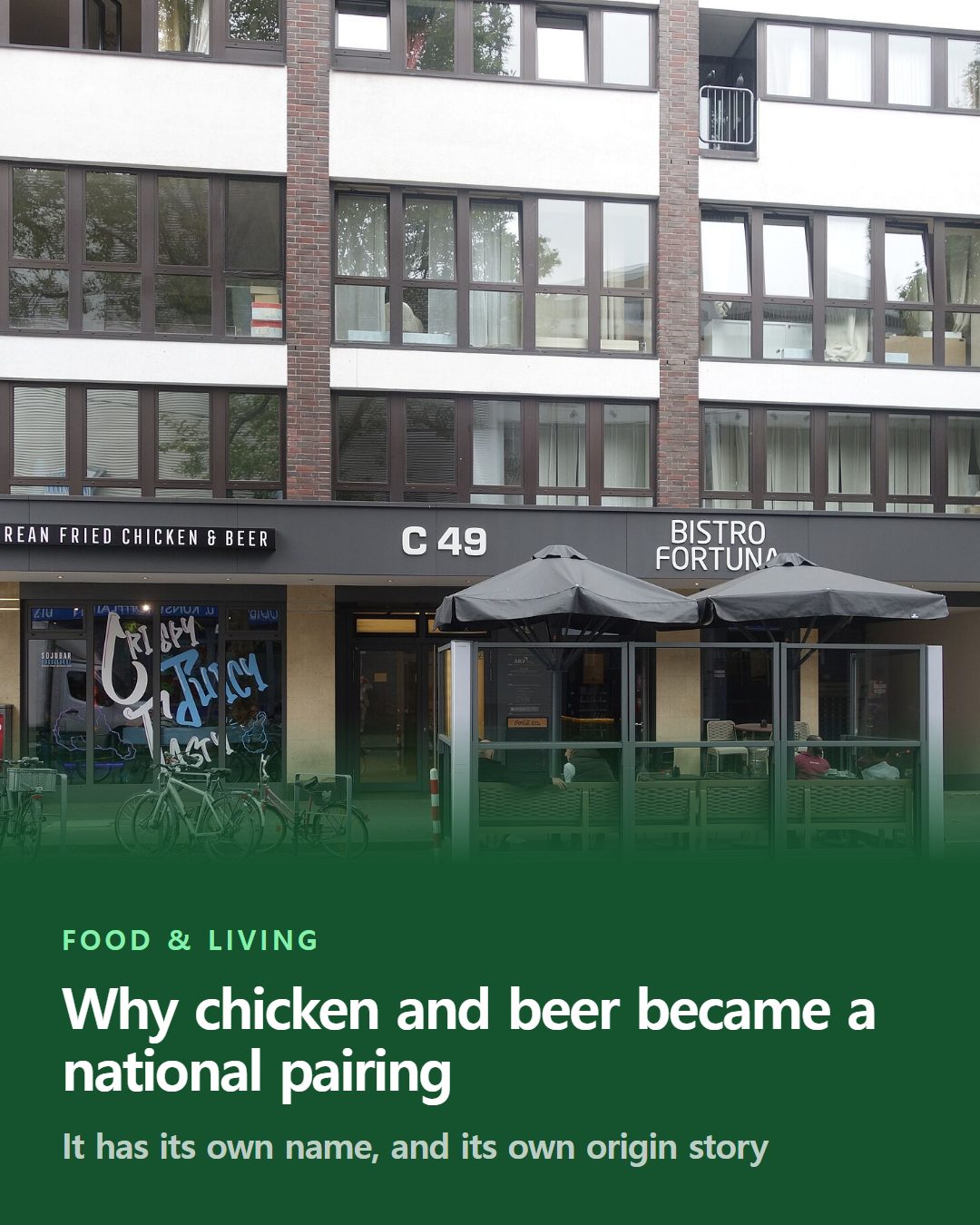
In South Korea, fried chicken and beer are not just something you happen to order together. They have a single word: chimaek (치맥), a portmanteau of chikin (chicken) and maekju (beer). Koreans do not simply "eat" chimaek — the common verb is "do" chimaek, treating it as an activity rather than a meal.
It has its own annual festival that draws over a million visitors, its own dedicated delivery apps, and, since 2013, a documented case of a single television drama exporting the habit to another country almost overnight.
The short version
- Chimaek names Korea's chicken-and-beer ritual, treated as an activity, not a meal.
- A 2013 K-drama scene drove a documented spike in Korean beer exports to China.
- Korean fried chicken chains now chase global growth as domestic drinking habits shift.
How a 2002 word turned into a national festival
Chimaek is now one of Korea's most visible food exports.
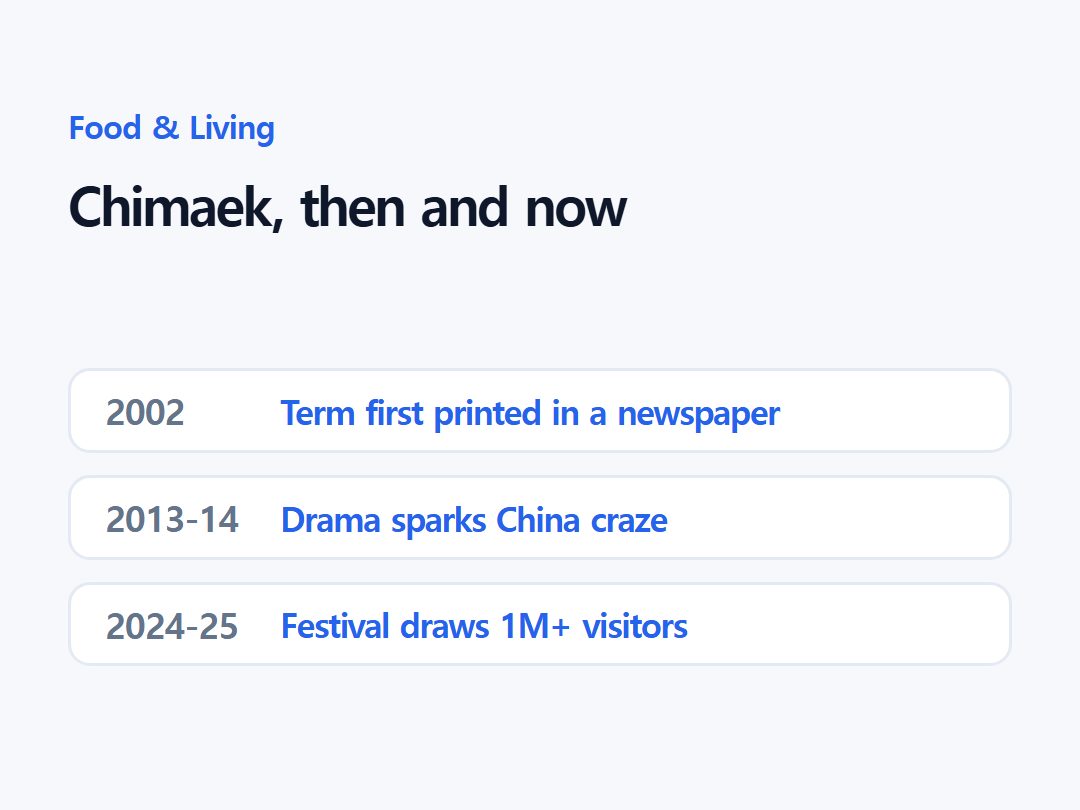
The Daegu Chimac Festival, held every July in Duryu Park in the southeastern city of Daegu, has grown from a four-day trial event in 2013 into one of Korea's largest annual food festivals, drawing more than a million visitors in recent editions, according to the Korea JoongAng Daily.
Daegu hosts it because the city is the birthplace of several major Korean fried chicken franchises, including Kyochon Chicken.
The word itself is recent by Korean standards — language researchers trace its first appearance in print to a 2002 Donga Ilbo article on new Korean drinking combinations — but the pairing it describes has since become one of the country's defining food rituals, and one that international readers usually encounter without any of the backstory.
Why did a K-drama drive Chinese demand for chimaek?
Fried chicken and beer are hardly a uniquely Korean idea. What is Korean is the fact that this specific pairing has a name, a set of social rules, and a well-documented moment when it jumped borders through popular culture rather than through trade or migration.
That moment was the 2013–2014 K-drama (a serialized Korean television drama, typically 16–20 episodes, and one of Korea's largest cultural exports) My Love from the Star.
The show's lead character, a top actress played by Jun Ji-hyun, repeatedly craved chimaek on screen, most memorably as her personal ritual for the year's first snowfall.
The drama was a hit across China, and the craving followed it there in a way that is unusually well documented in trade and business reporting, not just fan anecdotes.
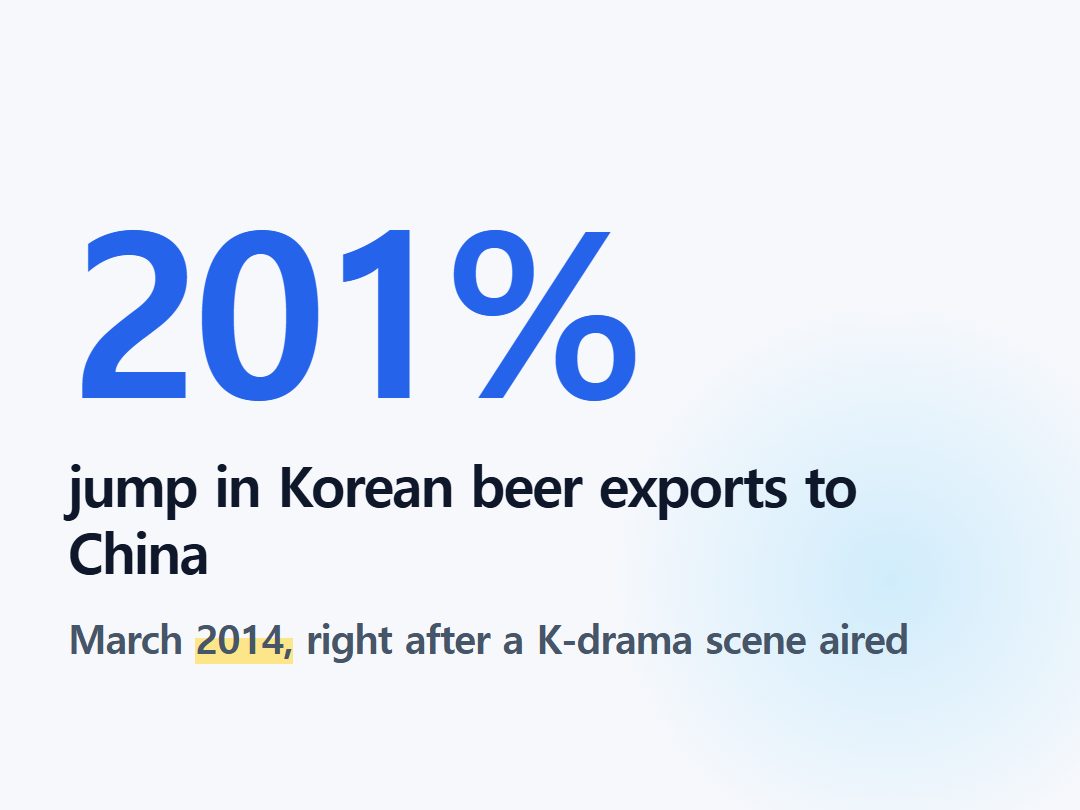
The Hollywood Reporter, citing Korean trade data, reported that Korean beer exports to China jumped roughly 201 percent year-on-year in March 2014, reaching about $1.04 million for the month, in the period right after the drama's most-discussed episodes aired.
Restaurants serving Korean-style fried chicken in Chinese cities reported sudden, unfamiliar demand for the chicken-and-beer combination specifically.
GMA News Online later reported that Chinese tour groups began requesting chimaek meals by name when visiting Korea: one tourist from Xi'an, interviewed while eating fried chicken and beer in Incheon, explained simply that she had seen the pairing on My Love from the Star and wanted to try it herself.
In one widely reported case, around 4,500 employees of a Chinese cosmetics company visiting Korea on a group trip sat down together for a chicken-and-beer dinner explicitly because of the drama's influence.
This is worth pausing on, because it is a rare instance where the mechanism of a cultural export can actually be traced: not a general sense that “Korean things are popular,” but a specific scene, in a specific drama, followed within weeks by measurable trade numbers.
It is one of the reference cases used when explaining Hallyu (the Korean Wave, the umbrella term for the international spread of Korean pop culture) as something with real economic effects rather than just soft-power rhetoric.
For readers outside Korea who only encounter chimaek as a hashtag or a delivery-app category, the missing context is that its international spread has a traceable origin point, and that origin point is a drama, not a marketing campaign.
How the 2002 World Cup fueled a chicken boom
Chimaek's Korean history is older and more layered than the 2013 drama moment suggests. Roasted chicken dishes existed in Korea earlier, but modern deep-fried chicken only became widely possible once cooking oil became commonly available in the country in the early 1970s.
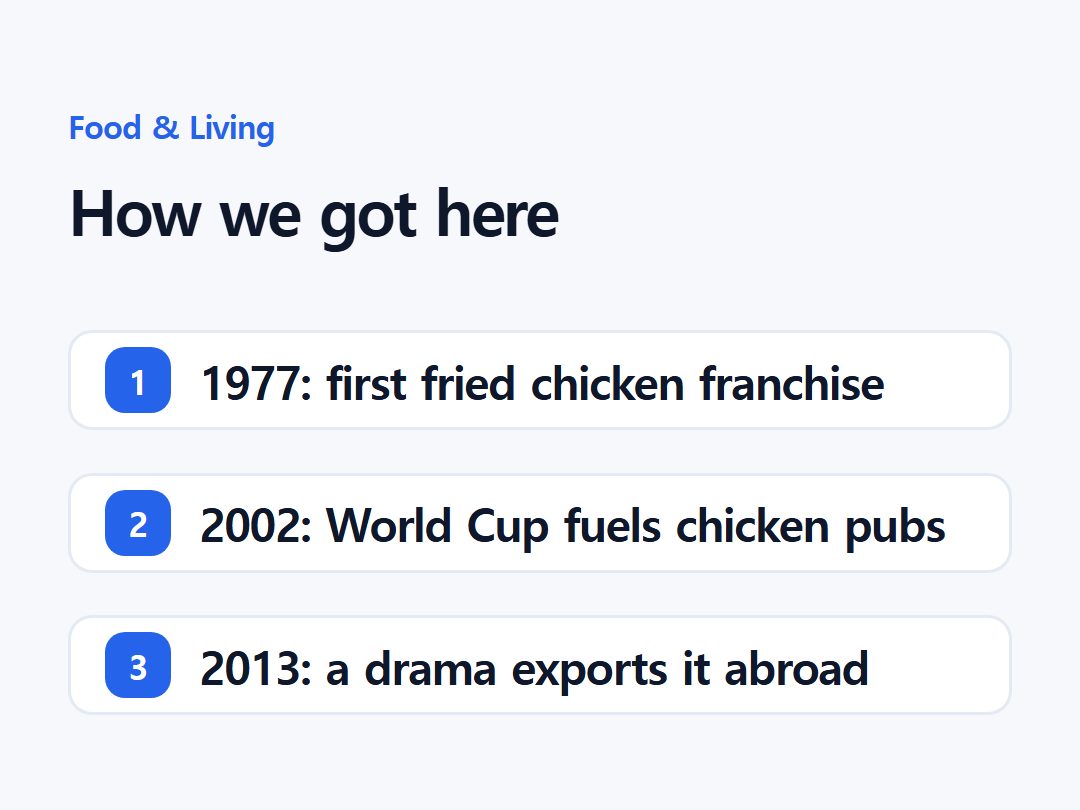
Lim's Chicken, opened in Seoul in 1977, is generally credited as the first dedicated fried chicken franchise. Pelicana Chicken, founded in 1982, was among the brands that popularized yangnyeom chicken — chicken coated in a sweet-spicy sauce after frying, now one of the two default styles alongside plain fried chicken.
The 1980s brought international competition when KFC entered the Korean market, which is credited with pushing local chains to sharpen their own crispy-frying techniques and accelerating the growth of chicken franchising nationwide.
The turning point most Koreans point to, though, is the 2002 FIFA World Cup, which South Korea co-hosted with Japan.
Fans gathered by the thousands in public squares and parks to watch matches on large screens, and chicken-and-beer pubs — known as hof, a Korean term for a Western-style beer hall — became informal viewing hubs, some running match-day promotions built around the pairing.
The chicken franchise industry's growth after 2002 was sharp: the number of fried chicken restaurants nationwide is estimated to have jumped from roughly 10,000 to 25,000 in the years following the tournament.
By 2013, industry estimates put the number of chicken restaurants in Korea above 20,000, in a market worth roughly 3 trillion won (about $3 billion at the time).
It was into this already-saturated, already-branded market that My Love from the Star aired in late 2013, and that the first Daegu Chimac Festival launched the same year — two developments that, together, pushed chimaek from a well-established domestic habit into an internationally recognized one.
Will chimaek survive as young Koreans drink less?
Two trends are worth tracking for anyone following this story going forward.
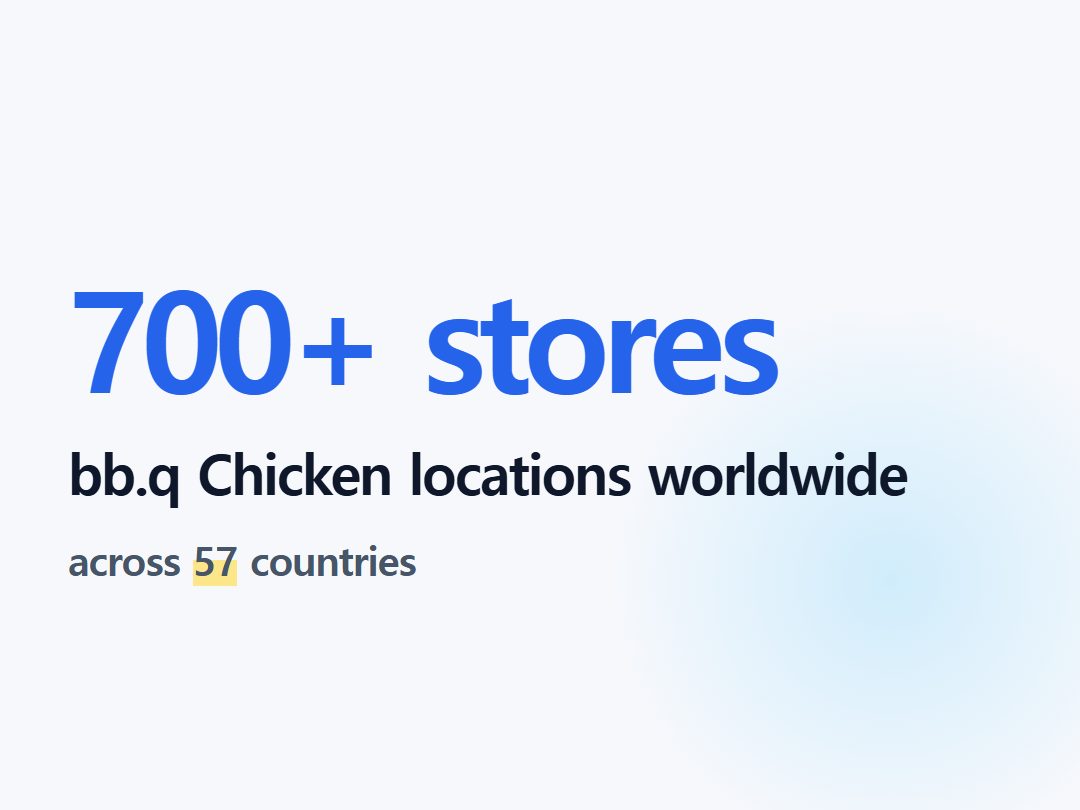
The first is the continued overseas expansion of Korean fried chicken chains themselves, now treated by the companies as a growth strategy rather than a side effect of drama fandom. bb.q Chicken has said it operates more than 700 outlets across 57 countries, including an expanding U.S. footprint that reached into more than 30 states and a flagship opening near Hollywood Boulevard in Los Angeles.
Kyochon has set a public target of 500 international stores across 25 countries, including recent openings in Taiwan and pursuit of halal certification for Middle East markets. Pelicana, the 1982-founded chain, now counts more than 3,000 locations worldwide.
As Korea's roughly 7.5 trillion won domestic chicken market matures, these companies are treating international demand — much of it traceable back to exactly this kind of pop-culture exposure — as their main avenue for growth, according to trade outlet KED Global.
The second trend cuts the other way: inside Korea, the alcohol half of chimaek is under pressure.
Spending on alcohol by Koreans in their twenties fell an estimated 20.9 percent in 2025 compared with the previous year, according to an NH NongHyup Bank report cited by the Seoul Economic Daily, part of a broader move away from heavy drinking among younger Koreans.
Sales of low- and non-alcoholic beer have risen sharply in the same period, with major brewers launching zero-proof product lines aimed at younger drinkers who still want the ritual without the alcohol.
Whether chimaek itself adapts — toward “chi-non-maek” versions built around zero-proof beer, for instance — or whether the pairing stays tied to its original form is one of the more concrete open questions in Korean food culture right now, and one that international coverage of the trend has largely missed so far.
bb.q, Kyochon, and Pelicana chase global growth
| Chain | Locations | International footprint |
|---|---|---|
| bb.q Chicken | 700+ outlets | 57 countries, including 30+ U.S. states and an LA flagship |
| Kyochon | 500-store target | 25 countries (goal), including Taiwan and pursuit of halal certification |
| Pelicana | 3,000+ locations | Worldwide |
Frequently asked
What does chimaek mean?
Chimaek (치맥) is a portmanteau of chikin (chicken) and maekju (beer), the Korean term for eating fried chicken with beer as a single activity.
Why did chimaek become popular in China?
The 2013-2014 K-drama My Love from the Star showed its lead character craving chimaek, and Korean beer exports to China jumped about 201 percent year-on-year the following March.
When is the Daegu Chimac Festival?
It's held every July in Duryu Park in Daegu and has grown from a 2013 trial event into one of Korea's largest food festivals, drawing over a million visitors.
Sources
Every factual claim above is traceable. We do not translate articles — we gather facts from multiple outlets and write them ourselves.
- Chimaek — Wikipedia
- Korean TV Drama Causes Surge in Beer Sales to China — The Hollywood Reporter
- Inspired by 'My Love From the Star', Chinese tourists feast on chicken in South Korea — GMA News Online
- My Love from the Star — Wikipedia
- Chicken, beer and folk music: Daegu Chimac Festival draws 1 million visitors — Korea JoongAng Daily
- Korean chicken chains accelerate overseas expansion — KED Global
- Young Koreans Shun Alcohol, Driving Boom in Zero-Proof Beer — Seoul Economic Daily