In April 2026, Girls' Generation's Hyoyeon told a YouTube interviewer she was still living in her SM Entertainment company dorm nearly 20 years after her 2007 debut. "Why should I leave?" she said. "I think saving is the only way to survive."
The short version
- Hapsuk means training camp, not roommates — the Korean term implies control.
- Agencies control trainees' phones, dating, diet, and curfews inside company dorms.
- 2009 reform capped contracts at seven years but left dorm rules untouched.
The answer sounds sentimental at first, but it is actually financial. That gap, between how dorm life gets described and what it is structurally for, is the subject of this piece.

Hapsuk means training camp, not roommates
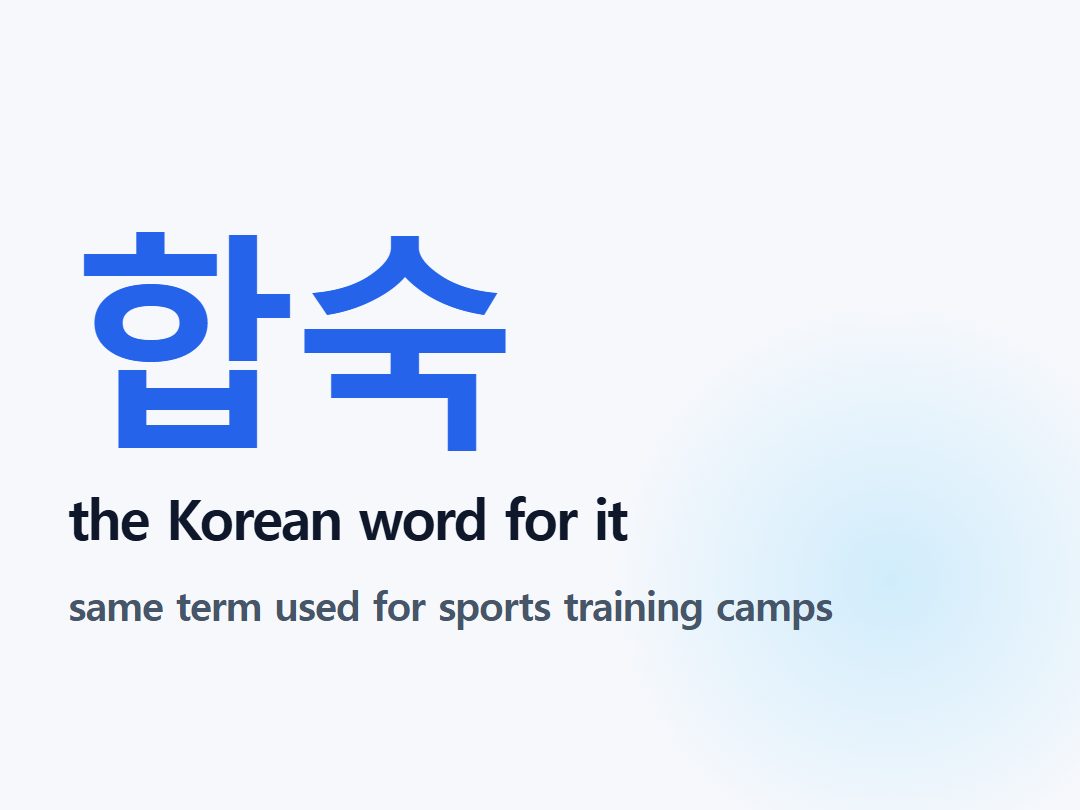
Korean media does not call idol group housing a dormitory in the college sense. The word is hapsuk (합숙), "group lodging," and it is the same term used for the residential training camps school and national sports teams are sent to before a competition.
Standard Korean dictionaries even keep a separate word, gisuk (기숙), for simply living away from home in a dorm. Hapsuk specifically means staying together as a group for a shared training purpose. Korean fans hear that training-camp connotation by default.
International fans, meeting "idols live together" only in translation, tend to import a different frame instead: roommates, a boarding school, a found family. The Korean term was never describing that.
A company apartment run by staff, not a shared flat
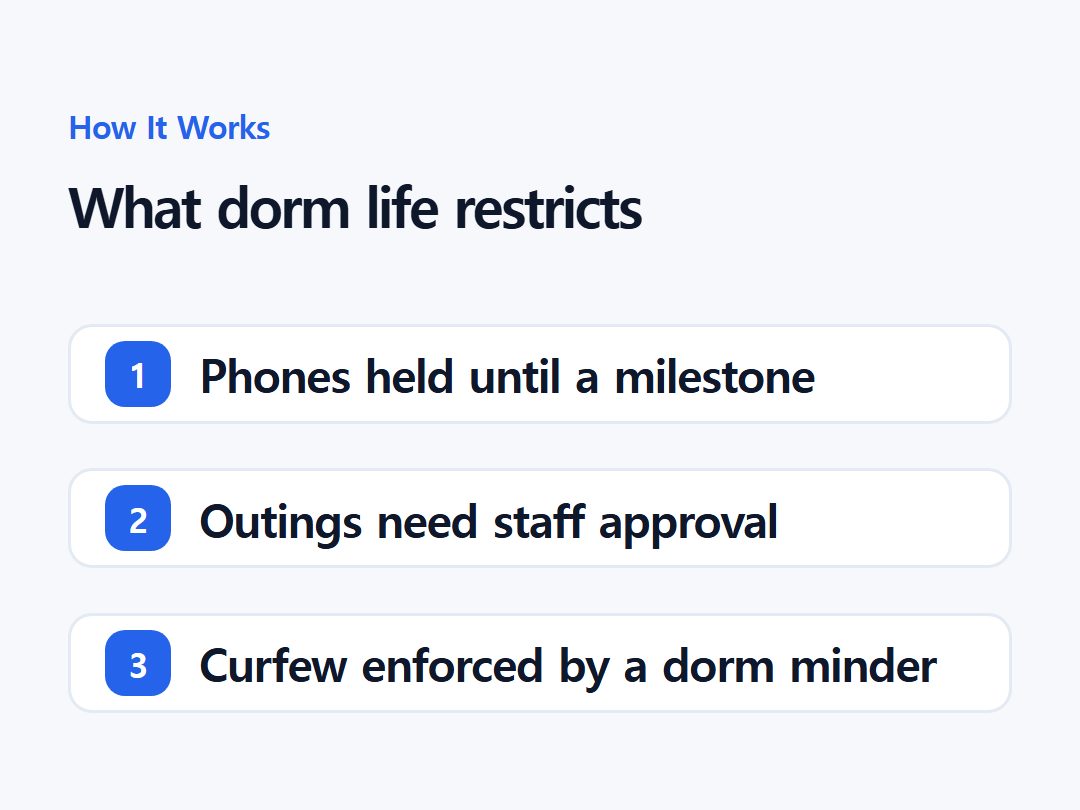
Idol group housing is agency property, not a lease members split among themselves. Rooms typically hold two to four people grouped by seniority, and a staff member sometimes called a sagam (dorm minder) oversees the unit and enforces house rules.
One account of agency dorm logistics described a roughly 120-square-metre unit shared by a five-member group and a manager, with staffing running near one manager per five or six idols. Dorms cluster close to agency offices, such as Cheongdam-dong and Gangnam near SM, so a manager can reach every member's room within minutes.
Trainees lose phone access before they get a stage name
For trainees, people training under an agency for years with no guarantee of debut, company control starts with communication. Girl group GFriend's members have said they only received personal phones after their first outright win on a music chart show.
Former Blackswan member Youngheun described reporting routine errands to staff: "We had to report when we were getting our nails done and going to the convenience store in front of our house." BLACKPINK's Rosé said in a 2017 talk-show appearance that male and female trainees at her agency "weren't even allowed to look at each other or say hi."
- Phones held until a trainee hits a set milestone, such as a chart-show win
- Male and female trainees kept apart at meals and in hallways
- Outings need advance staff approval; unscheduled visitors are turned away
- A dorm minder tracks who leaves the building and when they return
Dating bans protect a sales model, not morals
Post-debut dating restrictions are common, and agencies defend them in openly commercial terms. JYP Entertainment founder Park Jin-young has said the ban at his label runs three years after debut: "It's only for three years. After that they are free to bring boyfriends over."
The logic is about revenue. Fans buying tickets and photo cards are, in part, buying the sense that an idol is emotionally available, and a public relationship complicates that image during a group's most commercially fragile early years.
Weight is managed like a production spec
Diet control follows the same investment logic as everything else in the dorm. TWICE's Momo has said she was once told to lose seven kilograms in a week; BTS's RM and V have separately described sneaking food past staff who tracked what trainees ate.
Weekly or even daily weigh-ins remain standard at many agencies. The stated purpose is stage readiness, but the practical effect matches every other dorm rule: one set of numbers, monitored centrally, for everyone under one roof.
Why the same arrangement reads as family abroad and control at home
None of this means idols dislike living together. Many members describe real closeness, and Hyoyeon's own account is genuinely warm. But warmth is a side effect of the arrangement, not its purpose, and Korean audiences, primed by the word hapsuk and two decades of trainee testimony, tend to read group housing as a management tool first.
The efficiency case is straightforward from an agency's side. Housing an entire group at one address lets a single manager wake everyone, deliver everyone to practice, and enforce one curfew instead of chasing individual schedules across a city.
It also means one location to secure, one place for a dorm minder to monitor diet and phone use, and one address where a scandal, a leaked photo, a late-night sighting, can be contained before it reaches the group's image.
Even Hyoyeon's own framing supports this reading. She credits the arrangement with meals and a place to rest during unpredictable income years, not friendship, and recalls her company promising care "like a second mother" when she signed. That is a bond expressed through housing she does not control.
SM Entertainment built the control into the model from the start
The trainee system, years of company-funded training before a possible debut, traces to Lee Soo-man, who set up what became SM Entertainment in the late 1980s after studying in the United States and returning influenced by American music-video production.
SM's early roster included rapper Hyun Jin-young, whose split from the label over money and creative control became a formative lesson inside the company, according to accounts of SM's history.
The response, by most tellings, was not better contracts alone but a shift to managing training, image, and daily life directly rather than treating artists as outside talent the company simply booked. Housing became part of that management, not separate from it.
A 2009 lawsuit fixed contract length, not curfews
The industry's clearest reckoning with its own contracts came in 2009, when three members of TVXQ, Kim Jaejoong, Park Yoochun, and Kim Junsu, sued SM Entertainment to void their 13-year exclusive contracts. The Seoul Central District Court granted a partial injunction that October, ruling the terms "grossly incompatible with Korean labor and contract law."
South Korea's Fair Trade Commission responded that year with a standard exclusive contract capping agency deals at seven years, the rule fandom now calls the "seven-year itch," since many groups' futures are decided around that anniversary. Roughly ten agencies revised existing contracts to match.
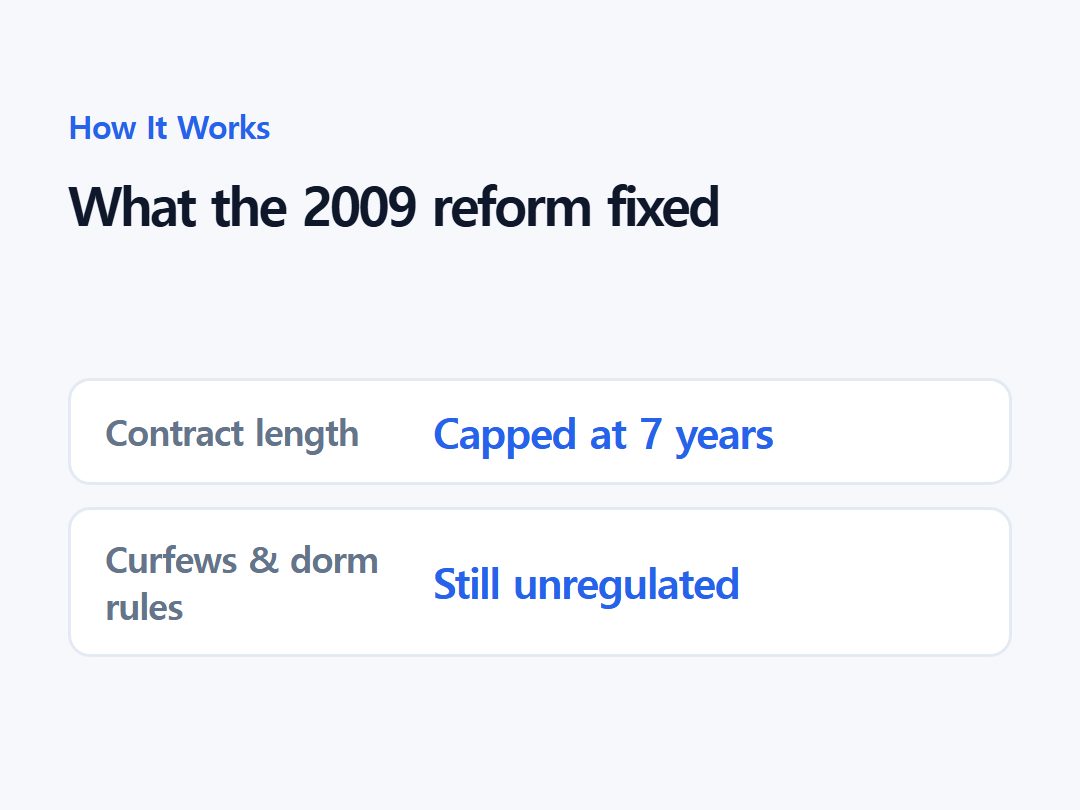
But the reform addressed money and duration, not daily life. Curfews, phone confiscation, dating bans, and dorm placement were never part of what the Fair Trade Commission regulated. They remain workplace policy, set unilaterally by each company.
| What the 2009 reform touched | Before | After |
|---|---|---|
| Exclusive contract length | Up to 13-15 years | Capped at 7 years |
| Revenue disclosure | Often undisclosed | Standardized minimum terms |
| Curfews, phone rules, dorm placement | Agency's sole discretion | Still agency's sole discretion |
Training costs used to make leaving expensive too
A second lever kept trainees inside the system: debt. Agencies historically billed trainees for vocal coaching, styling, and housing, then recouped those costs from future earnings, treating years of training as a personal loan that only cleared once a group turned a profit.
That is changing. Newer standard-contract rules push agencies to book training costs as company investment rather than personal debt, with mandatory settlement reports meant to stop costs from accumulating invisibly. Major labels reportedly adopted this approach before regulators required it; smaller agencies, where recoupment practices persisted longest, are the main target of the newer rules.
The debt system mattered here because it discouraged trainees from questioning dorm rules or curfews. Leaving early meant leaving with a bill.
No regulation covers what happens inside the dorm
The seven-year cap and the debt reforms both address money. Nothing in Korean entertainment law currently limits curfews, phone confiscation, or how long an agency can require someone to live in company housing. Those stay internal policy at every label, large or small.
Agencies also point to a genuine safety case for keeping members together. Obsessive fans have tracked idols' cars, and in one widely reported incident, physically confronted members of boy group The Boyz inside a dorm meant to be staff-and-member-only access. That risk is real, and it complicates any reading of hapsuk as purely a leash.
Some change is visible. BLACKPINK's four members reportedly have separate bedrooms rather than a shared one, and industry commentary, from music critics to psychologists, has started questioning publicly whether years of enforced togetherness serves anyone besides the company.
- Separate bedrooms now offered in some group dorms
- Phone restrictions loosening at several major agencies
- Senior idols increasingly moving out after five-plus years with an agency
None of that is written into any standard contract. It stays discretionary and reversible, decided by the agency rather than negotiated by the people living there.
Dorm control: then and now
| Rule | Historically | Recent changes |
|---|---|---|
| Phones | Held until a milestone, like a first chart-show win | Restrictions loosening at several major agencies |
| Bedrooms | Shared by two to four members | Some groups, like BLACKPINK, reportedly have separate bedrooms |
| Living out | Expected to stay in company housing | Senior idols increasingly moving out after five-plus years |
Frequently asked
Why do K-pop idols live together in company dorms?
Housing an entire group at one address lets a single manager handle wake-up, practice schedules, and curfews, and gives agencies one location to monitor diet, phone use, and image.
What does "hapsuk" mean in Korean?
Hapsuk (합숙) means "group lodging" for a shared training purpose, the same word used for sports teams' training camps, not the casual roommate sense that "dorm" carries in English.
Do K-pop trainees get to keep their phones?
Often not right away; GFriend's members have said they only received personal phones after their first outright win on a music chart show.
Sources
Every factual claim above is traceable. We do not translate articles — we gather facts from multiple outlets and write them ourselves.
- How long do K-pop agencies house idols? Girls' Generation's Hyoyeon says, 'why leave?' after 19 years — The Korea Times
- K-pop trainee rules: no dating, no phones, weekly weight checks — South China Morning Post
- Is the '7-year itch' a thing of the past? — The Korea Herald
- NewJeans Danielle's Dispute Is The Latest In A Long Line Of K-Pop Lawsuits — Forbes
- K-pop Idols - Dormitory Culture & Co-Living in Korea — Creatrip
- 합숙 (hapsuk) - definition and usage — Namuwiki
- South Korea Enforces 'K-Pop Prevention of Unfair Practices' Standard Contracts — Lawzana