In late December 2025, a trade body representing Korean talent agencies said it would push the government to take legal action against seventeen celebrities for running management operations without registering them. The list included A-list actors Gang Dong-won, Song Kang-ho and Lee Ha-nee.
The short version
- Korean law requires anyone managing an actor to register as an agency.
- Seventeen celebrities, including A-listers, face action for skipping that registration.
- Actors who go independent still found a new agency, not solo representation.
None of the seventeen were accused of fraud or contract abuse. Their offense was structural: they had been managing their own careers without filing the paperwork Korean law requires of anyone running a talent-management team.
That detail says something international readers usually miss. In Hollywood, an actor can work with a personal agent, a manager and a publicist as three separate individuals, none of whom has to be a company. Korean law does not really allow that. Even a star handling his own affairs is expected to do it through a registered agency — his own, if necessary, but an agency all the same.
This is the gap that explains a lot of confusion for outside observers: the same word, agency, describes both the sprawling label that debuts a K-pop group and the small firm that books an actor's next film. The two exist for different reasons, but for actors, neither the law nor the casting system leaves much room to skip one.

A law, not just tradition, requires it
South Korea's Popular Culture and Arts Industry Development Act requires anyone managing a performer's career alongside more than one other staff member to register that operation as an "arts management business" with the Ministry of Culture, Sports and Tourism through their local government office.
The registration system was introduced after a wave of exclusive-contract disputes, and separately after fatal accidents involving entertainers in 2009, and it has been enforced since 2014. Company representatives must complete ethics and management training before they can register.
What agencies are actually paid to do
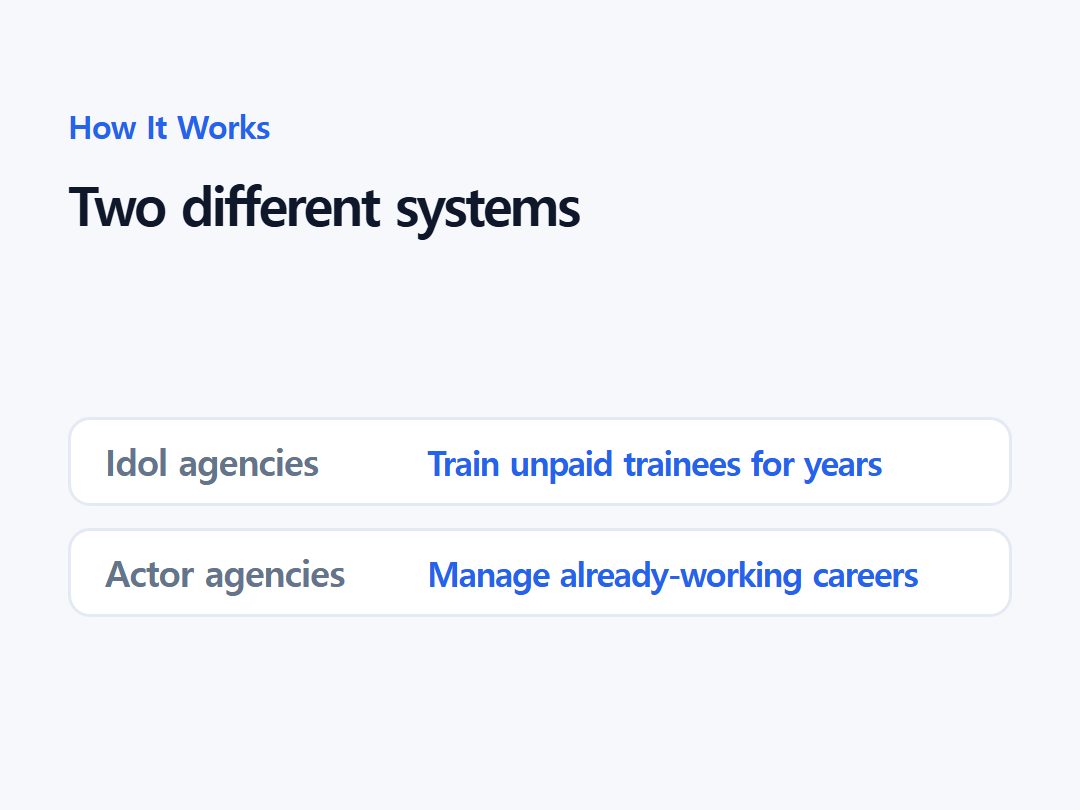
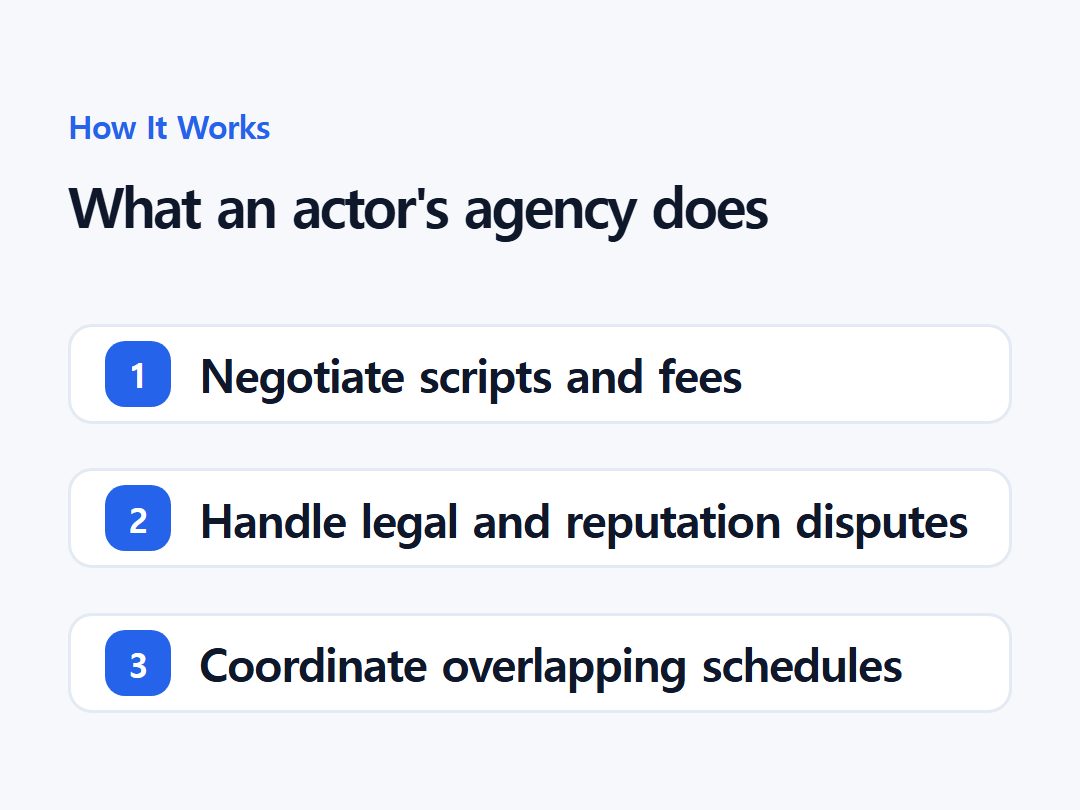
For actors specifically, an agency's core job differs from what an idol's label does. Idol agencies raise trainees for years before debut; an actor's agency instead runs the business side of a career that is usually already underway. That covers several distinct functions:
- Fielding script offers and negotiating fees with production companies
- Coordinating overlapping shooting schedules across drama, film and endorsement work
- Handling reputation management and legal disputes on the actor's behalf
When online posts about actor Park Bo-gum turned defamatory, it was his agency, The Black Label, that pursued legal action, later confirming to press that offenders had been fined or referred to prosecutors. Managing that kind of dispute, not just booking work, is part of what an actor pays a percentage of earnings for.
Casting increasingly runs through agency rosters
Agencies also shape who gets cast in the first place, through a practice Korean trade press calls "agency packaging" — a production builds several roles in one drama around actors who already share the same agency.
The Korea Times reported in April 2026 that SBS's "Phantom Lawyer" cast Yoo Yeon-seok and Kim Kyung-nam, both signed to King Kong by Starship. JTBC's "The Practical Guide to Love" cast three actors from BH Entertainment, and SBS's "Good Partner 2" built its cast around three Artist Company actors.
A production official defended the pattern to the paper: "Promoting affiliated actors is a win-win for everyone."

Screenwriters and insiders say packaging narrows auditions
Not everyone agrees. The same report quoted an unnamed industry insider warning that "the structure itself limits audition opportunities," adding that actors sometimes sense a role has already been informally filled before they walk into the room.
Screenwriter Im Sung-han, who wrote "Doctor Slump," said agencies sometimes push to "squeeze in" their own rookies, and argued that finding the actor who actually suits a role should matter more than which company represents them. No regulator has stepped in on packaging the way the Fair Trade Commission once did on idol contract length — for now it is a casting norm, not a rule.
Going independent still means starting an agency
Because the law treats a management team as a company, Korean actors who outgrow their agency rarely end up representing themselves. The more common path is founding a new, smaller agency — their own, or one run with a trusted manager — rather than going without one.
- Actor Lee Byung-hun and manager Son Seok-woo founded BH Entertainment in June 2006
- Actors Jung Woo-sung and Lee Jung-jae founded Artist Company in May 2016
- Both followed the same route: leave a larger agency, register a new one, keep working
BH Entertainment set the template other actors followed
BH Entertainment began as effectively a one-man company built around Lee Byung-hun himself, before growing into a roster of dozens of actors and, since 2018, operating as a Kakao Entertainment subsidiary.
Artist Company, co-founded a decade later by Jung Woo-sung and Lee Jung-jae, explicitly followed that precedent: two established stars pooling resources into a company, complete with its own CEO, rather than each hiring an individual manager.
The pattern has repeated often enough that it now functions as an informal career stage — sign with a large agency early, then, once established, either renew or start a smaller one.
Actor contracts skip the trainee-debt structure idols face
This is where actor and idol agencies diverge structurally, even though Korean uses the same word, gihoeksa (기획사), for both. Idol agencies scout teenagers and cover years of unpaid vocal, dance and language training, recouping that spending from group earnings after debut.
Actors typically sign with an agency as adults who are already working or already trained, without that multi-year investment-and-debt period built into the contract.
South Korea's Fair Trade Commission maintains a separate standard exclusive-contract template for actors, distinct from the singer-focused one, and revised it in 2011 with input from the Korea Entertainment Management Association to add protections for minor performers. The relationship an actor's contract describes — representation of existing work — is simply a different transaction from what an idol signs.
What Hollywood crossovers reveal about the gap
The clearest illustration of why this infrastructure matters comes from Korean actors trying to work in the opposite direction. The Associated Press reported in December 2025 that established crossover stars like Park Hae-soo and Lee Byung-hun maintain representation in both South Korea and the United States, but that most aspiring Korean actors trying to break into Hollywood have no equivalent.
Casting director Julia Kim, who worked on "Minari" and "KPop Demon Hunters," told the AP she regularly fields basic questions from unrepresented Korean talent — whether to anglicize their name, whether they are supposed to pay an agent, even whether it is acceptable to look into the camera during a self-taped audition. Those are the kinds of questions an agency exists to have already answered.
Firms like the Los Angeles-based Upstage Entertainment have started building that missing bridge, helping Korean actors navigate a US casting system with different norms, down to audition-tape backgrounds and headshot style.
But the AP found that dual representation — an agency at home and one abroad — remains rare outside a handful of established names. That is exactly the gap a system built around domestic agencies was never designed to close on its own.
What the packaging debate still hasn't settled
Korea's actor-agency system solves the representation problem by making an agency close to mandatory — a working actor without one operates outside both the law and the industry's casting habits. What it has not settled is whether that same system is fair to actors who aren't already signed to one of the handful of firms building today's biggest drama casts.
Screenwriters and casting insiders keep raising the packaging question in trade press, but no legislation has followed it the way the Fair Trade Commission's standard contract followed earlier disputes over how trainees were treated. Until that changes, which agency an actor belongs to remains almost as decisive as talent in deciding which roles they're offered.
Actor Agencies vs. Idol Agencies
| Aspect | Idol Agency | Actor Agency |
|---|---|---|
| Who signs | Teenage trainees | Adults already working or trained |
| Training investment | Years of unpaid vocal, dance, language training | No multi-year investment-and-debt period |
| Core job | Raise trainees for years before debut | Book work, negotiate fees, manage reputation |
Frequently asked
Why do Korean actors need an agency?
South Korea's Popular Culture and Arts Industry Development Act requires anyone managing a performer's career alongside more than one other staff member to register as an agency, so even a star handling his own affairs needs one.
What is 'agency packaging' in Korean dramas?
It's when a production builds several roles in one drama around actors who already share the same agency, a pattern screenwriters say can narrow audition opportunities for outsiders.
Can Korean actors go independent without an agency?
Rarely — because the law treats a management team as a company, actors who outgrow their agency usually found a new, smaller one instead, as Lee Byung-hun did with BH Entertainment and Jung Woo-sung and Lee Jung-jae did with Artist Company.
Sources
Every factual claim above is traceable. We do not translate articles — we gather facts from multiple outlets and write them ourselves.
- Entertainment association to urge government to take legal action against nonregistered agencies — Korea JoongAng Daily
- 'Agency packaging' raises concerns over fair competition in K-drama industry — The Korea Times
- Park Bo-gum's agency says malicious posters were fined, referred to prosecutors — Korea JoongAng Daily
- Fostering Artistic Independence: South Korean Actors Who Established Their Own Agencies — allkpop
- More South Korean actors seek Hollywood dream after global success of Korean entertainment — Associated Press (via WRAL)
- 청소년 연예인 인권보호를 위한 대중문화예술산업발전법 시행 (Standard exclusive contract revision, actor and singer tracks) — Korea.kr (Government of South Korea)