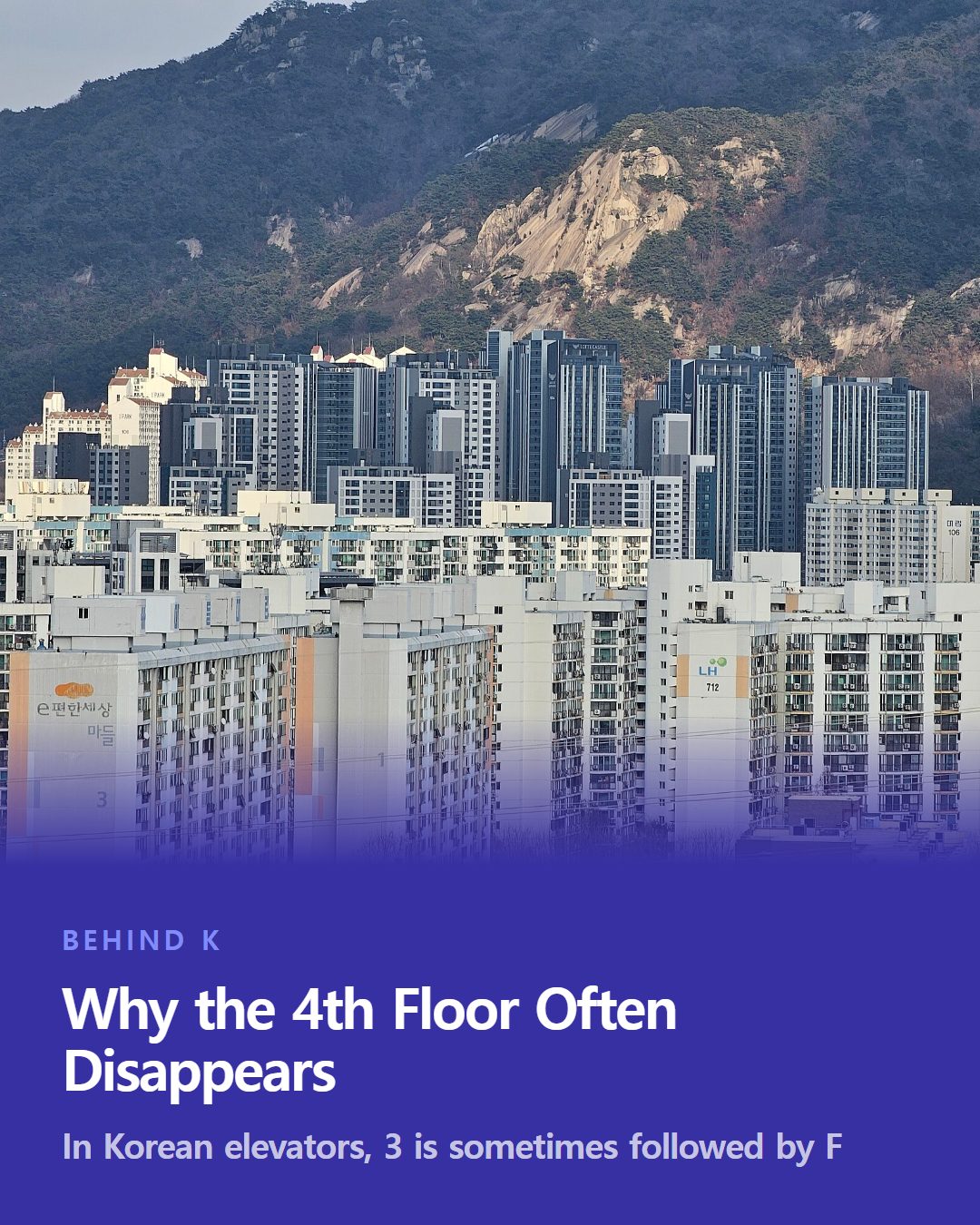
Ride an elevator in a Korean hospital, an older apartment block, or plenty of newer buildings too, and the panel often reads 1, 2, 3, F, 5, 6. The letter F stands in for "four" — not because the fourth floor doesn't exist, but because the building would rather not print the number.
Some buildings skip the floor altogether, going straight from the third floor to the fifth. Room numbers follow the same pattern: a 4호 (room 4) is frequently missing from hospital wards.
The short version
- Korean buildings often skip or relabel the 4th floor as 'F'.
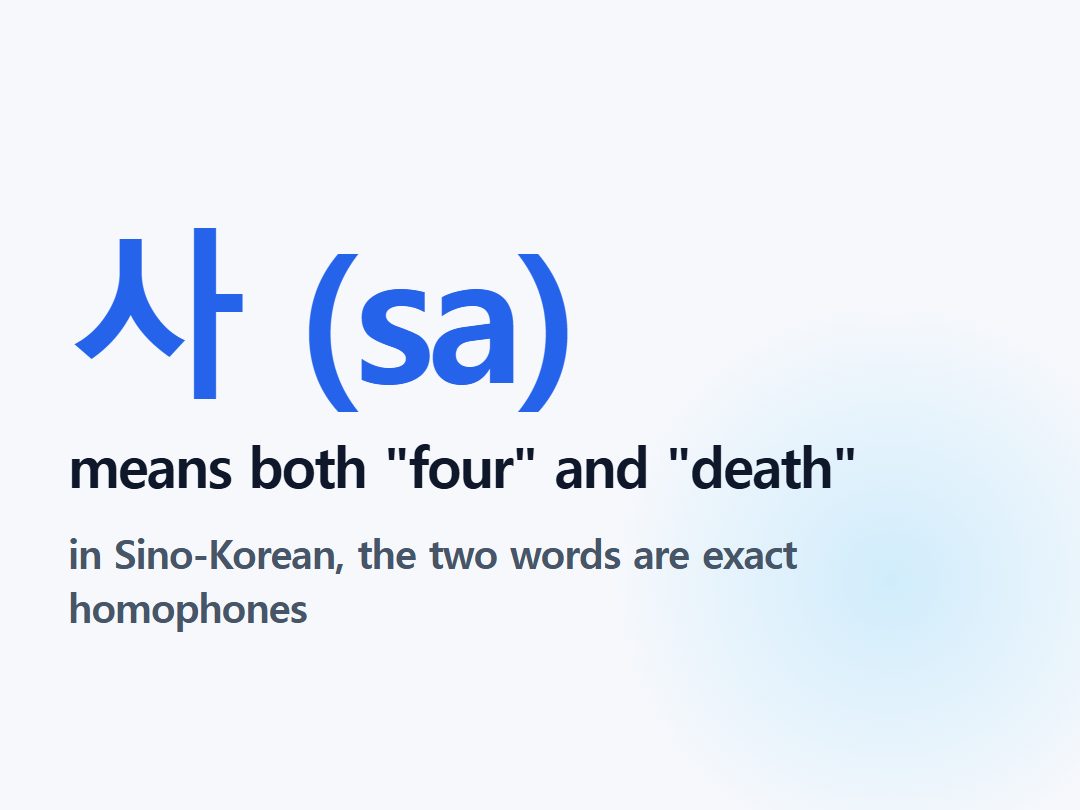
- Sino-Korean 'four' (사) sounds identical to 'death' (사), with no tone to separate them.
- Hospitals keep the taboo most; modern luxury buildings increasingly just print the 4.
International visitors sometimes read this as a quirky design choice, on the level of a hotel skipping room 13. It is closer to that Western habit than it might first appear, but the mechanism behind it is more specific, and it runs deeper into everyday Korean life than a single unlucky number usually does in English-speaking countries.
Why does 'four' sound like 'death' in Korean?
The root of the practice is not folklore — it's phonetics. Korean uses two separate number systems side by side: native Korean numbers (hana, dul, set...) for counting age or objects, and Sino-Korean numbers, borrowed from Chinese characters (hanja) centuries ago, used for dates, money, addresses, and floor numbers.
In the Sino-Korean system, the word for "four" is 사 (sa). The Sino-Korean word for "death," written with a different hanja character (死) but pronounced identically, is also 사 (sa). Spoken aloud, with no character visible to distinguish them, the two words are the same syllable.
This kind of coincidence — where unrelated words happen to sound alike because they share a syllable from classical Chinese — is common enough in Korean, Chinese, and Japanese that linguists have a term for the discomfort it causes: 해음현상 (haeeum hyeonsang), roughly "homophone taboo." The fear of the number itself has a name too, adapted into English as tetraphobia.
It is not unique to Korea.
In Mandarin, "four" (四, sì) and "death" (死, sǐ) are close but distinguished by tone; in Japanese, "four" is often read shi, an exact match for the Japanese reading of "death." Korean is arguably the strictest case of the three, because the Sino-Korean pronunciation collapses the two words into one sound with no tonal distinction left to tell them apart.
What makes this more than trivia is where the avoidance actually shows up.
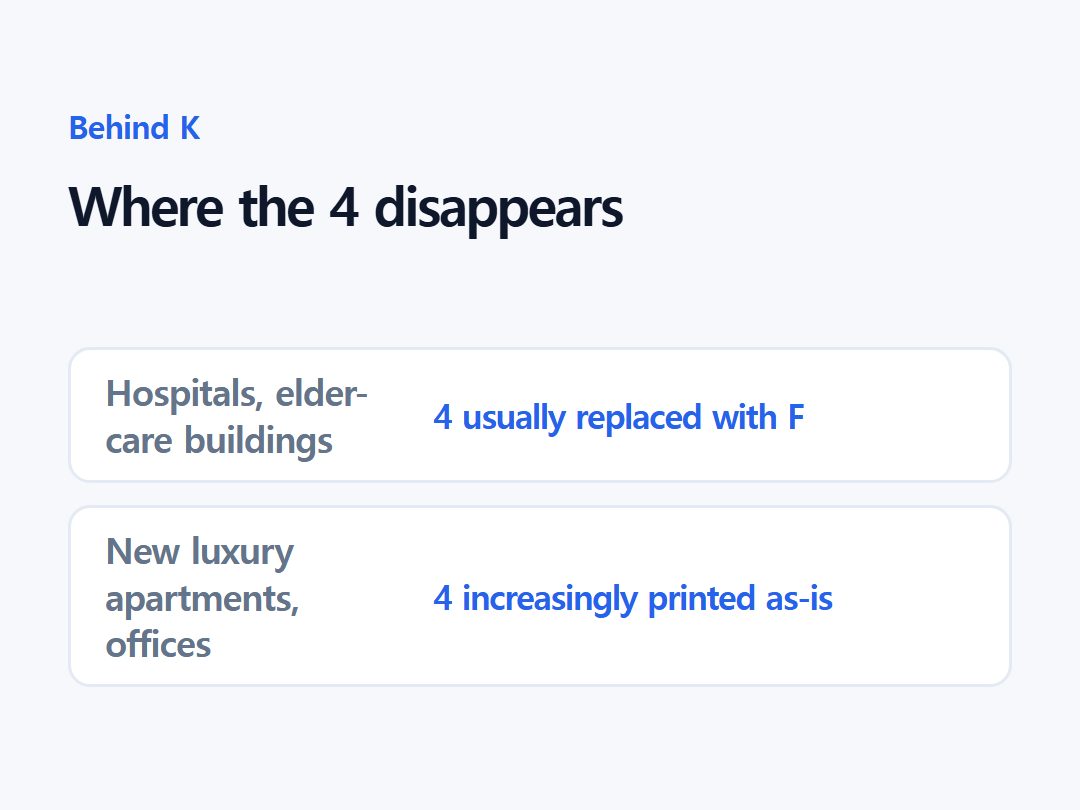
It is heaviest in exactly the settings where the association with death feels least abstract: hospitals, funeral-adjacent facilities, and buildings housing patients or the elderly are the most consistent about labeling the fourth floor as F or removing it from the sequence entirely.
Ordinary office buildings and newer luxury apartments are more likely to print the 4 plainly, partly because skipping it creates real administrative friction — mail, addresses, and fire-safety numbering all still have to work — and partly because image-conscious modern developments have started treating the superstition as old-fashioned.
The result is a visible generational and functional split: the more a space is tied to health, aging, or formality, the more likely the 4 is missing.
The same avoidance extends past floor numbers. Gifts in Korea are traditionally not given in sets of four — cash gifts for weddings or birthdays tend to land on round numbers like 30,000 or 50,000 won rather than 40,000.
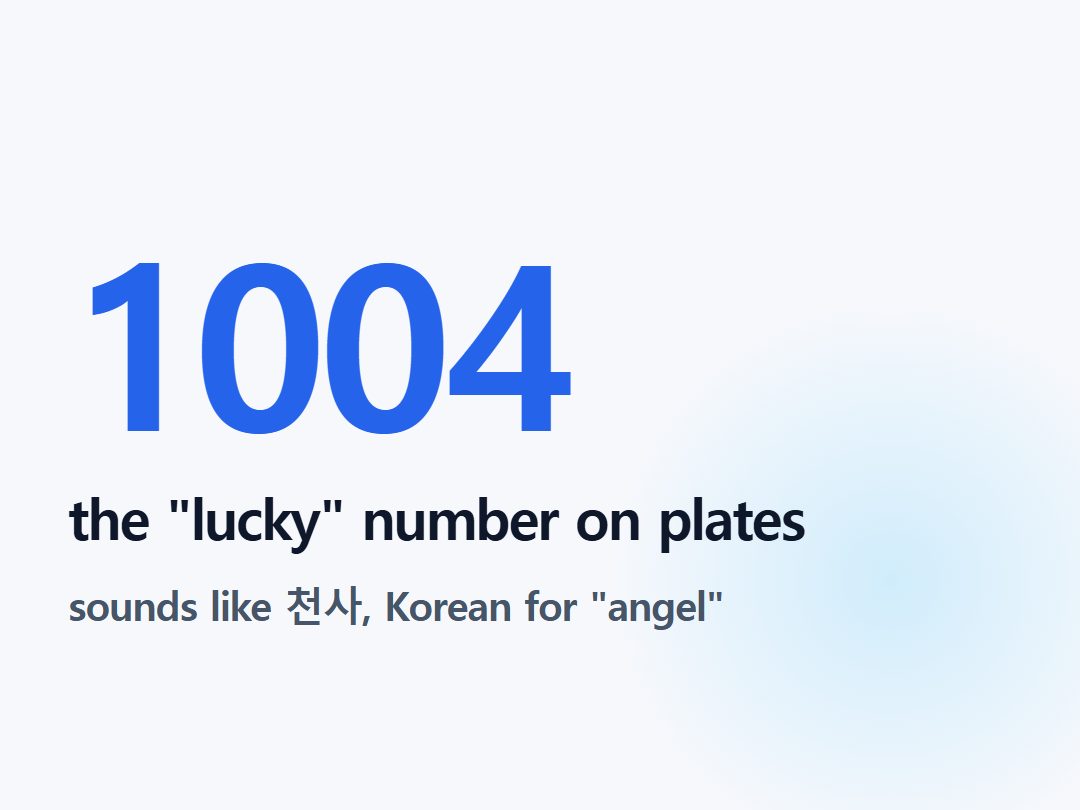
License plates and phone numbers containing repeated 4s are considered less desirable, to the point that vehicle number plates with the digits 1004 — which reads as a near-homophone for 천사, "angel" — are treated as a lucky, sought-after plate, the mirror image of the same phonetic logic working in the opposite direction.
How the taboo reached Korea during Japanese rule
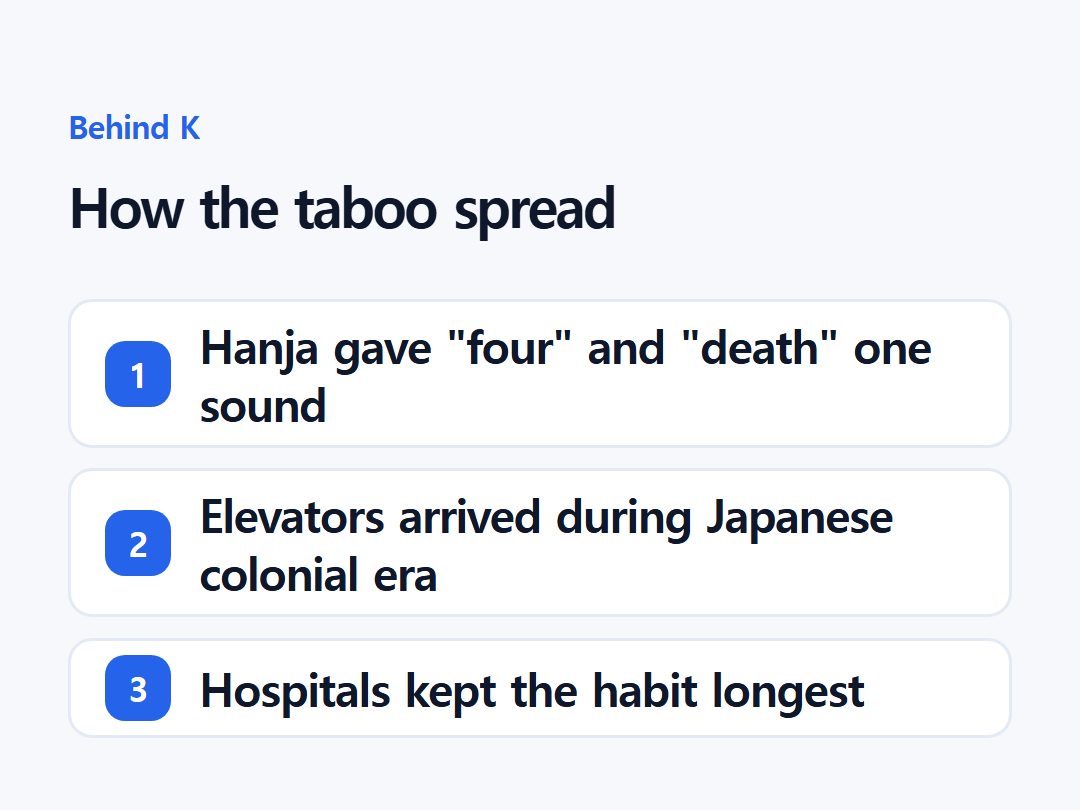
The taboo is built on hanja, the Chinese characters that formed the basis of the Korean writing system for most of its history before Hangul, the native Korean alphabet, became the everyday standard in the 20th century.
Even after Hangul took over, Sino-Korean vocabulary — words borrowed from Chinese roots — stayed embedded in formal and technical language, including numbers used for addresses, dates, and money.
That borrowed vocabulary is what carried the sa/sa collision into modern Korean; it is a side effect of the writing system's history, not a belief invented independently in Korea.
Korean-language reference sources trace the modern building-numbering version of the taboo specifically to the early 20th century, describing it as a practice that spread into Korea during the Japanese colonial period (1910–1945), alongside the same tetraphobia already established in Japan.
Elevators and multi-story buildings were themselves a relatively recent import to the Korean peninsula at that point, so the numbering convention that came with them — skip or relabel the fourth floor — arrived largely pre-formed rather than developing independently over centuries the way the underlying word taboo did.
Once the practice took hold in hospitals in particular, it proved durable.
A hospital is a setting where the death association is not abstract wordplay to be waved off — patients and families are already thinking about mortality, and a small, essentially costless accommodation (printing an F instead of a 4) removes one unnecessary reminder.
That logic gave the taboo a functional home that outlasted the colonial period that introduced it, independent of whether any individual staff member or architect personally believed the superstition.
The taboo is fading, but only in parts
The practice is visibly eroding, but unevenly.
Korean-language sources on the subject note that skipping or relabeling a floor creates real friction — it complicates addresses, confuses children and foreign visitors unfamiliar with the convention, and offers no functional benefit — and that newer buildings marketed on a modern, international image increasingly print the 4 without alteration.
High-end apartments and hotels aimed at a global or younger clientele are among the first to drop the F substitution, while hospitals, older residential buildings, and facilities serving elderly or ill patients remain the most likely to keep it.
What's left unresolved is less about whether the taboo is "true" — everyone involved knows it is a homophone accident, not a real curse — and more about how long institutional habit outlives the belief that created it.
Korean commentators increasingly describe the F-for-4 elevator button not as active superstition but as inertia: once a numbering convention becomes standard in an industry, there is no strong reason to reverse it, even for people who don't personally think a floor number can hurt anyone.
For an international visitor, the practical takeaway is simple — if the elevator panel in a Korean building looks like it's missing a floor, it almost certainly isn't. It just isn't willing to say the number out loud.
Where the 4th floor is skipped vs. printed
| Building type | Typical 4th-floor practice |
|---|---|
| Hospitals, funeral-adjacent facilities, elderly/patient care buildings | Most consistent about labeling it F or removing it entirely |
| Older residential buildings | Most likely to keep the F substitution |
| Ordinary office buildings | More likely to print the 4 plainly |
| High-end apartments and hotels for global or younger buyers | Among the first to drop F and print the 4 |
Frequently asked
Why do Korean elevators skip the 4th floor?
The Sino-Korean word for "four" (사) is pronounced identically to the word for "death," so buildings label the floor F or skip it, especially hospitals and elder-care facilities.
What does the F mean on a Korean elevator button?
F stands in for "four" — it's used instead of printing 4 because of the homophone taboo linking the number to death.
Is the number 4 unlucky in Korea?
Yes, it's linked to tetraphobia because Sino-Korean "four" and "death" are the same sound, though newer, image-conscious buildings increasingly print the 4 anyway.
Sources
Every factual claim above is traceable. We do not translate articles — we gather facts from multiple outlets and write them ourselves.
- Tetraphobia: Fear of the Number 4 in South Korea — Transparent Language Korean Blog
- The Number 4 in Korean Culture — Korea.net (Korean Culture and Information Service)
- Why Koreans Fear the Number 4: Tetraphobia in Korean Culture — K-Saju
- 4자 금기 (Taboo of the number 4) — Namuwiki
- 4자 금기 (Taboo of the number 4) — Korean Wikipedia
- Unlucky floor numbers in elevators — Elevator Wiki