Walk through any shopping district in Seoul on a weekend and you will see it within minutes: two people in identical jackets, identical sneakers, or the same graphic T-shirt in different sizes. Korean fashion has a name for this — 커플룩 (keopluk, literally "couple look") — and it is not a niche trend.
Instagram posts tagged with the Korean hashtag for "couple look" number in the millions, and dedicated "couple item" sections are a standard fixture in Korean clothing stores, from beachwear to winter snowboard suits.
A related, subtler term, 시밀러룩 ("similar look"), covers coordinated-but-not-identical outfits, such as the same color palette rather than the same garment.
The short version
- Couple look signals a relationship to others, not affection to your partner.
- It replaces PDA, which remains socially restrained in Korea.
- Practice began with wedding attire, spread to dating couples in the 2000s.
To international readers, this often reads as an especially romantic or sentimental habit. That framing misses the more useful explanation. Couple look is best understood as a social signal, not a style preference — a way of making a private relationship legible to other people, both offline and on social media, in a culture where saying "we're dating" out loud or showing it through touch is not always the default.

Why do Korean couples avoid PDA and match instead?
The starting point for understanding couple look is what it is replacing. Public displays of affection remain fairly restrained in South Korea compared to many Western countries.
Holding hands or linking arms is common and unremarkable, especially among younger couples in cities, but kissing or more overt physical affection in public is still widely seen as inappropriate, even by university-age Koreans.
Surveys on the topic have repeatedly found that a large share of Koreans avoid PDA altogether, and that what bothers people most is not the affection itself but the sense of being watched and judged for it.
This reticence is generally traced to Confucian-influenced social norms that prioritize group harmony and not drawing attention to oneself over individual self-expression — the same broader value system that shapes workplace hierarchy and family etiquette in Korea.
If touch is a muted channel for showing a relationship is real, visual signals fill the gap.
Matching outfits, matching phone cases, and — especially — matching "couple rings" (a category of jewelry distinct from wedding or engagement rings, worn from early in a relationship) do the work that a kiss on a street corner might do elsewhere: they announce, without anyone having to say anything, that two people are together.
A couple wearing the same jacket in the same subway car is legible at a glance, to strangers and friends alike, in a way that a private inside joke or a quiet hand-hold is not.
This signaling extends well beyond clothing into daily digital life.
Many Korean couples display a running day-counter on their KakaoTalk profile — the number of days since they started dating — which functions simultaneously as a private countdown to milestones and a public notice to every contact in their phone that they are in a relationship.
Instagram hashtags such as #커플그램 ("couple-gram") and #100일 ("100 days") serve the same purpose on a larger stage.
Once two people agree they are officially dating — a status Korean couples tend to define explicitly and quickly, rather than letting a relationship stay ambiguous — that status becomes something to display, not just something to feel.
Seen this way, couple look sits inside a larger system of relationship milestones that also includes 100-day and 200-day anniversaries (celebrated with gifts and dinners well before the one-year mark that Western couples typically wait for), couple rings, and matching accessories.
Foreign residents interviewed by Korean English-language outlets have repeatedly flagged this as one of the most surprising features of dating in Korea: a Canadian resident noted that coordinated outfits are essentially absent from Canadian dating norms outside of twins, while a Turkish exchange student described Korean couple culture as "on another level" compared to her home country, singling out how quickly couples adopt matching rings.
None of this is really about taste in clothes. It is about conformity to a recognizable, socially readable template of what a "proper couple" looks like — a template that, once adopted, reassures both partners and everyone around them that the relationship is legitimate and current.
That collectivist framing also explains why couple look does not read as excessive within Korea the way it might elsewhere.
In a culture where group identity and fitting a shared norm are generally valued over standing out as an individual, a matching hoodie is not read as a loss of personal style — it is read as evidence that a couple is functioning as a unit, which is itself a mildly positive social trait rather than an embarrassing one.
It also helps to understand who this signal is aimed at. It is not primarily aimed at the partner — most couples already know they are together.
It is aimed outward, at friends, classmates, coworkers, and the wider social circle who would otherwise have to be told directly, or who might notice separately and start asking questions. A matching outfit worn to a group outing answers that question before it can be asked.
The same logic applies to the KakaoTalk day-counter: it is less a private ritual than a running announcement visible to every contact in a person's phone.
Understood this way, couple look is closer to a wedding ring than to a matching Halloween costume — a small, constant, low-effort piece of evidence that a relationship exists and is current, deployed precisely because Korean social norms make it awkward to state that fact outright or demonstrate it through touch.
From wedding tradition to everyday couple fashion
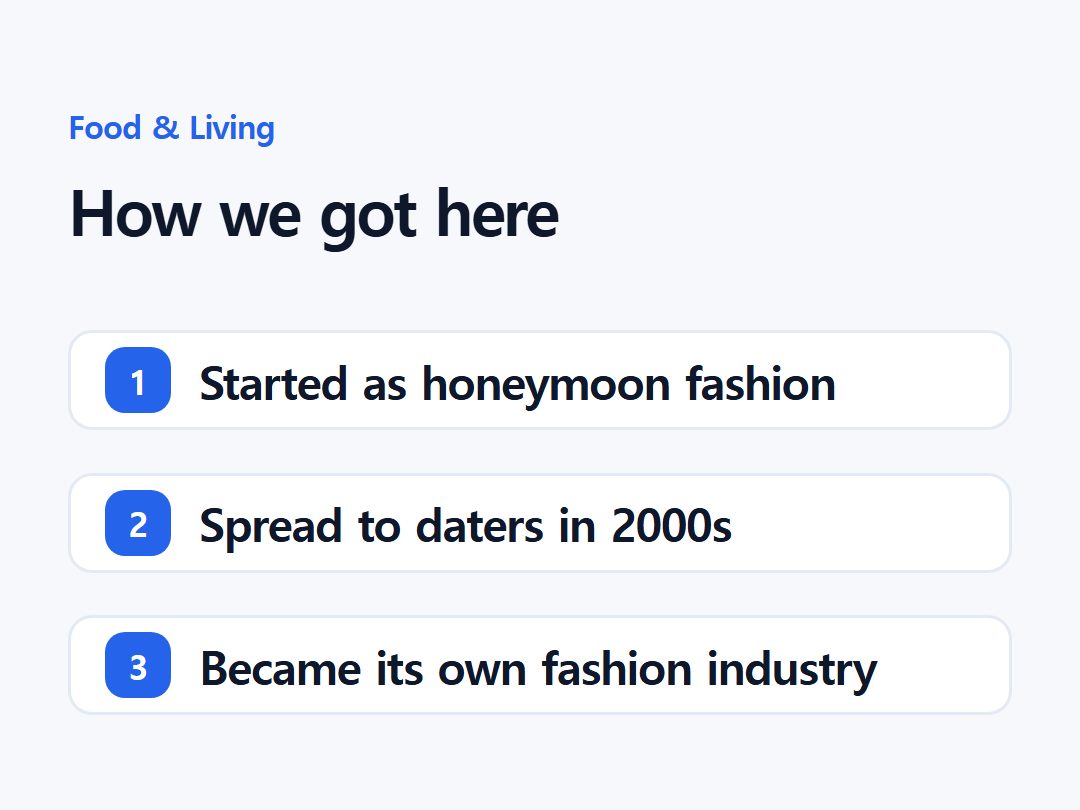
The practice has roots in Korean wedding culture. Newlyweds historically marked their honeymoon with coordinated attire — traditionally a suit for the groom and hanbok (traditional Korean dress) for the bride — as a visible way of announcing new-couple status to strangers while traveling.
Over subsequent decades that pairing shifted from formal dress to ordinary coordinated outfits, and the custom of "newlyweds in matching clothes" being spottable in any tourist crowd is still referenced today.
Non-married couples adopted the same logic from the 2000s onward, as the practice moved from a wedding-specific tradition into everyday dating culture.
Fashion brands responded by building it into their business: many Korean clothing companies now release seasonal "couple" lines, and a genuine cottage industry has grown around matching items — couple socks, couple swimwear, couple tracksuits, couple snowboarding gear — sold specifically in twinned sizes.
Jewelry brands compete for the couple-ring market as a category separate from engagement and wedding rings.
Even software followed: apps such as Between, built specifically for Korean couples to manage a shared calendar, photo album, and private messaging space, turned relationship-tracking into its own product category.
Social media accelerated all of this rather than starting it. As Instagram and KakaoStory made it easy to broadcast daily life, sharing coordinated outfits became a natural extension of a habit that already existed — turning a private fashion choice into a public post with its own hashtag ecosystem, and giving brands a ready-made marketing angle for couple-targeted discounts.
Will backlash push couples toward subtler looks?
Couple look has not disappeared, but it is not static either. Some commentary inside Korea has pushed back on what critics call a "show-off culture," arguing that hashtag-driven displays of relationship milestones create unrealistic comparisons between couples.
Whether that criticism dents the trend's popularity, or whether it simply shifts from full matching outfits toward the subtler 시밀러룩 style, is not yet settled.
It is also worth watching whether Korea's own PDA norms loosen further among younger, more urban generations — since couple look functions partly as a substitute for public affection, a genuine loosening of those norms could reduce the practical need for visual signaling over time, even as the commercial couple-item industry built around it continues to grow.
How Couple Look Evolved
| Era | What Happened |
|---|---|
| Traditional weddings | Newlyweds wore matching honeymoon attire — suit for groom, hanbok for bride |
| Later decades | Newlywed pairing shifted from formal dress to ordinary coordinated outfits |
| 2000s onward | Non-married couples adopted matching outfits as everyday dating culture |
| Social media era | Instagram and KakaoStory turned coordinated outfits into hashtag-driven posts |
Frequently asked
What is couple look in Korea?
Couple look (커플룩) is when Korean couples wear identical or matching outfits, like the same jacket or T-shirt, as a public signal that they're dating.
Why do Korean couples wear matching outfits?
Because kissing and overt PDA are still seen as inappropriate in public in Korea, matching outfits act as a visual substitute that announces a relationship without anyone having to say anything.
What's the difference between couple look and similar look (시밀러룩)?
Couple look means wearing identical items, while 시밀러룩 ("similar look") means coordinated-but-not-identical outfits, such as sharing a color palette rather than the same garment.
Sources
Every factual claim above is traceable. We do not translate articles — we gather facts from multiple outlets and write them ourselves.
- Quirks of Korean dating explained (2): Twinning outfits — The Korea Herald
- Quirks of Korean dating explained (3): Crazy for love milestones — The Korea Herald
- Public displays of affection: where to draw the line? — The Korea Times
- Made For Each Other: 9 Trendy Couple Styles You Can Find In Korea — Soompi
- Couples in South Korea Wear Matching Outfits For More Than One Reason — Koreaboo
- Couple culture in Korea, from matching outfits to relationship holidays — Tatler Asia


