A character's eyes flood red a beat before the first tear drops. International viewers often assume it's a lighting trick or color grading. It isn't.
The short version
- Eye reddening before tears is real blood flow, not a camera trick.
- Menthol tear sticks trigger both redness and real tears within seconds.
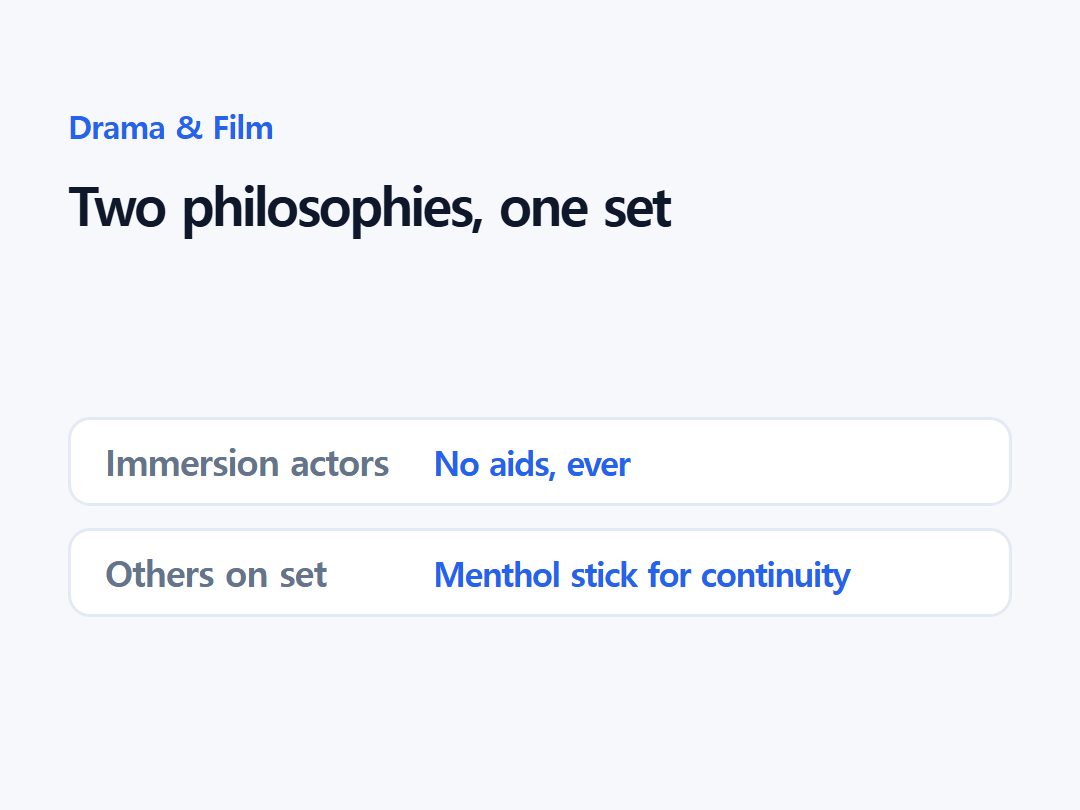
- Song Hye-kyo and Hyun Bin refuse tools, relying only on immersion.
Korean sets rely on a mix of real physiology, drugstore chemistry, and decades of acting training to produce that reddening. Some actors lean on tools. Others have built entire reputations refusing them. Both approaches are documented, and the gap between them explains a lot about how Korean melodrama actually gets made.
The redness shows up before the tears do
The reddening is not makeup — it is blood flow. Tears have to come from somewhere, and that fluid is drawn from the blood supply feeding the lacrimal glands near the eyes.
University of Virginia physiologist Jeremy Tuttle has explained the mechanism plainly: the vessels feeding those glands dilate to keep up with demand, and if the crying intensifies, the blood vessels on the surface of the eye widen too — turning the white of the eye visibly bloodshot.
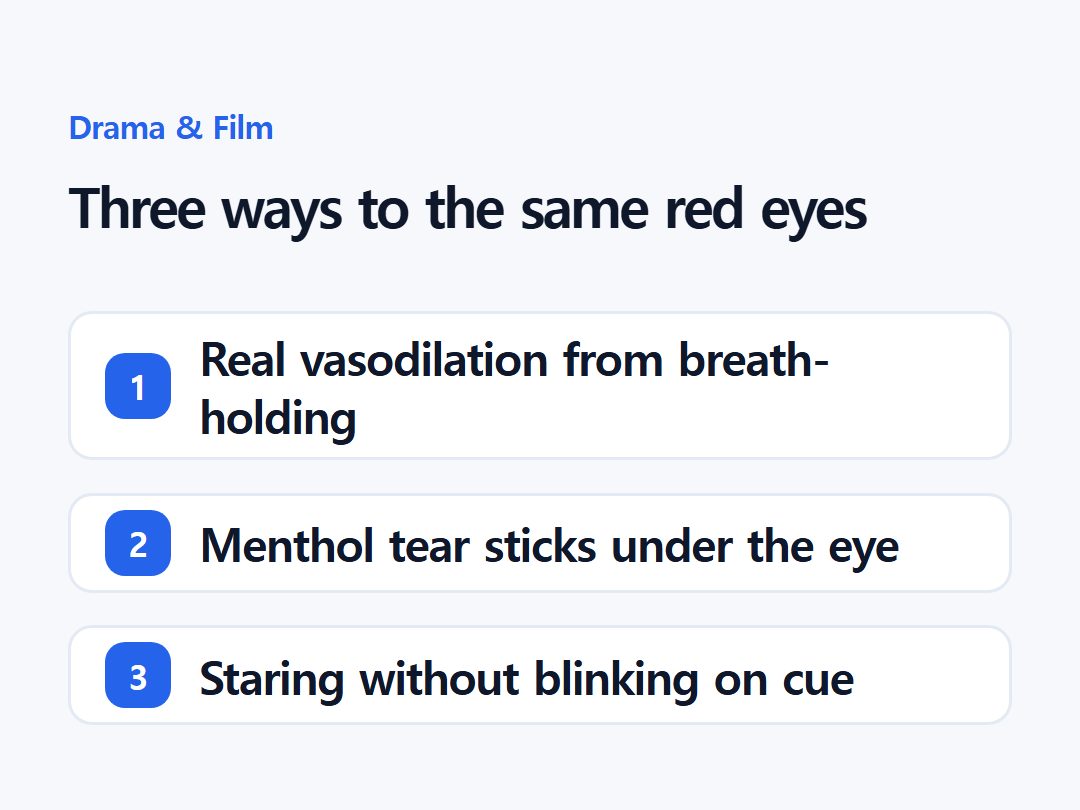
Holding a breath while fighting back tears adds a second push. That breath-holding raises pressure in the veins draining the head and neck, so the same capillaries around the eyes swell before a single tear actually falls.
Menthol turns irritation into tears on command
When a director needs the identical tear at the identical second across five or six takes, biology is unreliable. That's the gap a small wax tube called a tear stick fills.
The chemistry is simple. Applied just under the eye, body heat releases menthol vapor from the wax, and the vapor irritates the eye enough to trigger real tears within seconds — not liquid dropped in from outside.
The same irritation that produces the tears produces the redness. A performer who applies a tear stick gets both effects — bloodshot eyes and a real tear line — from one inexpensive tool that washes off with soap and doesn't touch the eye directly the way liquid eye drops do.
Staring without blinking costs nothing and leaves no residue
Not every actor reaches for a chemical aid. A cheaper version of the same trick is purely mechanical: hold the eyes open, stop blinking, and fix on one point until the eyes start to strain.
Forcing the eyes to stay open dries and irritates the surface, pulling the same reddening response the body produces during real crying — redness first, tears after. Acting-technique guides list it alongside sense-memory recall and emotional substitution as one of the standard ways to reach tears on cue.
- Recall a specific memory tied to the emotion needed
- Fix the eyes on one point without blinking
- Let the resulting strain pull real tears rather than performing them
Because it needs no product, this version leaves nothing for a makeup team to clean between takes — useful on a drama schedule where a scene often has to be shot in a single pass.
The technique isn't a K-drama invention
Menthol sticks and tear puffers are standard equipment across film and television production worldwide, not something unique to Korean sets. Industry reporting on Hollywood crying scenes describes the same wax-based menthol stick, the same puffer device, and even cruder tricks like pulling a nostril hair to force a reflexive tear.
What changed is scale. Korean television produces far more scripted drama per year, on tighter weekly turnarounds, than most film industries — and a technique built for occasional theatrical close-ups becomes routine equipment once a crying scene has to be delivered reliably every few episodes.
So the reddening itself has no national origin. What is specifically Korean is how often the genre calls for it, and how visible the result is once it airs.
Song Hye-kyo won't let anyone near her during a crying take
Song Hye-kyo has described the opposite discipline: staying entirely inside the emotion instead of managing how it looks. Discussing her drama Now, We Are Breaking Up, she said she has never once thought about her facial expression while crying — thinking about how her face looks would break the immersion.
She has asked crew, including makeup artists, to stay away from her during those scenes since her breakout drama Autumn in My Heart. By her own account, she only finds out what her crying face looked like after watching the broadcast.
Critics have pointed to that restraint as the reason her tears read as controlled rather than theatrical: a calm, measured tone that suddenly breaks, instead of sobbing from the first line of a scene.
Hyun Bin built his reputation on refusing the aids entirely
Hyun Bin has publicly rejected the tools altogether. Early in his career he said he had never used eye drops for a crying scene, tracing the habit to advice he received on his very first project — that tears should come from the actor's own immersion in the scene, not from a bottle.
That stance has followed him through two decades of leading roles and is regularly cited in Korean entertainment coverage as a mark of his craft, a deliberate contrast to actors who use tear sticks to manage a tight shooting schedule.
The two approaches, chemical aid and pure immersion, are not a hierarchy of talent. They are different answers to the same production problem: a scene has to be reshot, and the eyes have to redden on schedule, not whenever the nervous system cooperates.
Why Korean dramas lean on this trick harder than most
Korean melodrama runs on the close-up. A single crying scene is often shot from three or four angles, and each one needs the same emotional beat to look consistent once it's cut together.
That repetition is exactly what wears down an actor's ability to produce real tears take after take. A menthol stick or a no-blink stare gives a director a tool that works on the fifth take as reliably as the first, without waiting for a performer to rebuild genuine emotion from scratch each time.
The genre's visual grammar amplifies the effect. High-definition cameras and tight framing on the eyes, a signature of Korean broadcast drama, make the reddening far more visible than it would be in a wider theatrical shot — part of why international viewers notice it at all.
New actors struggle with this before they learn either method
Producing tears on demand is a trained skill, not an instinct, and newcomers without stage experience are the ones who most often can't do it. Acting-technique resources describe the physical shortcuts, menthol or the no-blink stare, explicitly as backup for exactly this situation: when time runs out and the emotion hasn't arrived on its own.
That's also why the two philosophies coexist on the same sets. A veteran lead might work entirely through immersion, while a supporting actor two takes into a twelve-hour shooting day reaches for a tear stick — and the finished episode gives no indication of which happened.
What the industry still won't confirm
No Korean studio or agency publishes which actors use tear sticks and which don't. The information exists only in scattered interviews, fan observation, and occasional behind-the-scenes footage.
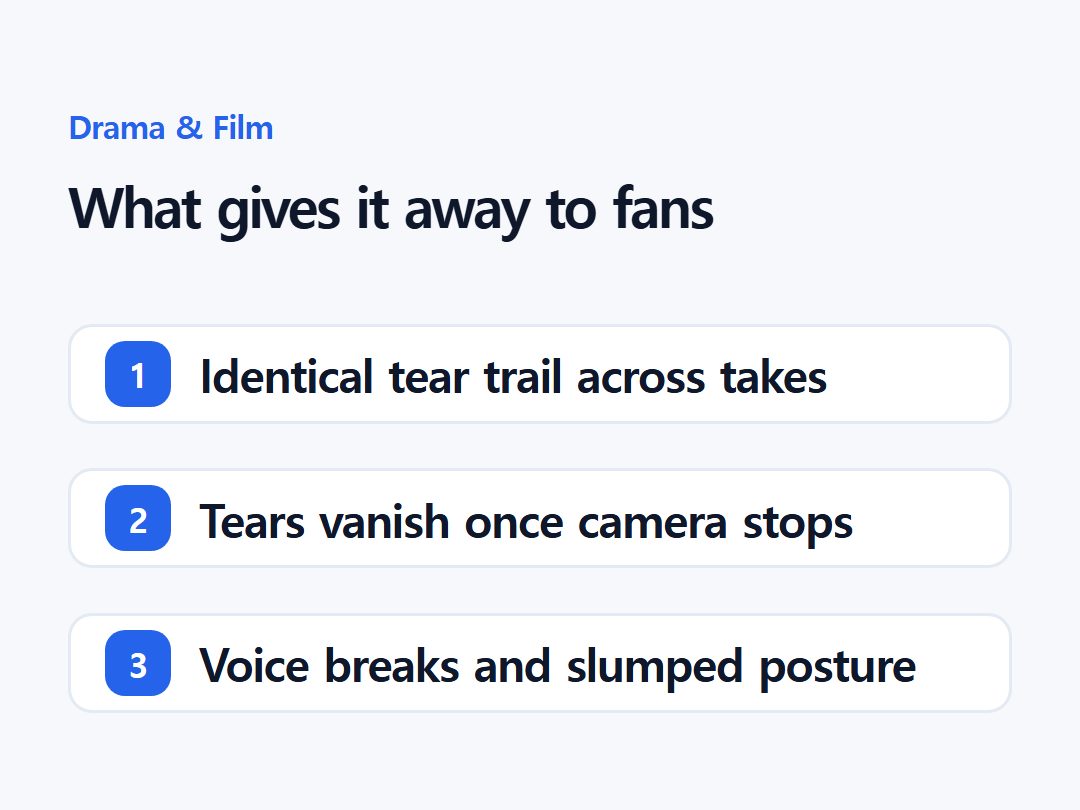
Fans online point to informal tells: a perfectly repeated tear trail across many takes suggests a product, while tears that vanish the moment the camera stops rolling suggest menthol vapor rather than sustained emotion. Neither is confirmable from a finished broadcast.
What is confirmed is narrower but real: the reddening itself is a genuine physiological response, not a camera or color-grading effect, and it can be triggered chemically, mechanically, or through pure emotional immersion — sometimes more than one of the three within a single scene.
Three ways Korean actors produce on-cue tears and reddened eyes
| Method | How it works | Example |
|---|---|---|
| Tear stick (menthol) | Body heat releases menthol vapor that irritates the eye, triggering tears and redness within seconds | Standard prop on tight shooting schedules |
| No-blink stare | Holding the eyes open without blinking dries and strains them, producing redness first, then tears | Used when no product is on hand |
| Pure emotional immersion | Actor relies only on genuine feeling; no tools, no crew intervention | Song Hye-kyo, Hyun Bin |
Frequently asked
Why do K-drama actors' eyes turn red before they cry?
Blood vessels feeding the tear glands dilate to supply fluid, and if crying intensifies, surface vessels widen too — a genuine physiological response, not a lighting or color-grading effect.
What is a tear stick and how does it work?
It's a small wax tube applied under the eye; body heat releases menthol vapor that irritates the eye enough to produce real tears and redness within seconds.
Which K-drama actors don't use tear sticks or eye drops?
Hyun Bin has said he has never used eye drops for a crying scene, and Song Hye-kyo asks crew to stay away during takes, relying entirely on emotional immersion.
Sources
Every factual claim above is traceable. We do not translate articles — we gather facts from multiple outlets and write them ourselves.
- Why do your eyes go red when you cry? — The Irish Times
- Tear Stick: Creating Realistic Tears for Performance — SFXzone
- How Do Actors Cry? The Secret To Triggering On-Screen Tears — Toronto Film School
- The secrets behind on-screen movie tears — Deseret News
- '지헤중' 송혜교, 눈물 연기로 보여준 절제의 미학 — Sports Khan
- 송혜교 "눈물 연기할 때 표정 생각 안 해.. 내 표정 방송보고 알았다" — Daum News
- Hyun Bin's tears are 100% all-natural — Dramabeans