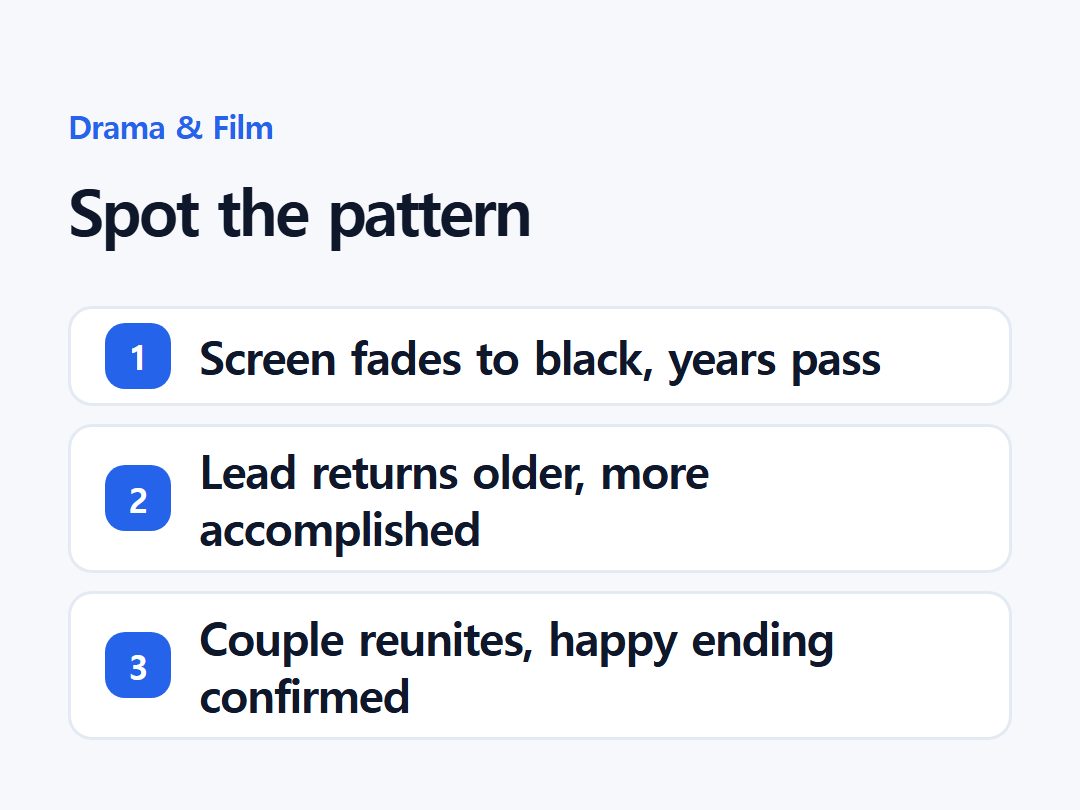
If you have watched more than a handful of Korean dramas, you have seen this scene: the screen fades to black, white text reads something like "2 Years Later," and the leads reappear — a little older, a little more successful, and, almost always, together.
It happens in period epics and office romances, in revenge thrillers and campus dramas. It is so consistent that it barely registers as a choice anymore. It is simply how a Korean drama ends.
The short version
- Korean dramas use time-skip epilogues to confirm happy endings, not just imply them.
- Twenty-Five Twenty-One (2022) broke the pattern, sparking years of fan debate.
- Live-shoot production let writers gauge audience reaction before writing the ending.
The convention shows up across the genre's biggest hits. Boys Over Flowers (2009) jumps four years ahead so its male lead can return from studying in America and propose. Mr. Sunshine (2018) leaps two years past a national tragedy to show its heroine training a new generation of soldiers in a liberated Korea. Itaewon Class (2020) uses three separate time jumps — two years, seven years, and a final leap to the 2000s — to carry its protagonist from prison release to business success.
Even Reply 1988 (2015–2016), a drama built almost entirely on nostalgia rather than plot, closes by jumping forward to show its couple married and being interviewed in their own home.
The fantasy drama Goblin (2016–2017) uses the same tool differently, tracking its heroine across several separate jumps from her teenage years into adulthood, using each leap to visibly age her and mark how much time — and healing — has passed.
Twenty-Five Twenty-One broke the ending's usual promise
For viewers outside Korea, the time-skip epilogue can read as a structural tic — a slightly clichéd way to wrap up a story that has already technically ended. But inside the genre, it functions less like a writing habit and more like a promise.
Korean broadcast dramas are built for a mass, multi-generational audience watching live, twice a week, over roughly sixteen to twenty episodes.
Unlike a prestige Western series that can end on ambiguity and let critics debate it for years, a mainstream Korean drama is expected to close its account with the audience in full.
The time-skip epilogue is how it does that: it does not just imply the leads end up happy, it shows it, dated and confirmed, with no room for a “but what happened after” argument.
That is also why the device survives even when a plot has already technically finished. A proposal in the present tense leaves room for doubt — will the wedding actually happen, will the career survive, will the family accept it? A proposal shown four years later, already followed through on, does not.
The epilogue exists to close every loose thread the live episodes could not fully resolve, converting a possible happy ending into a documented one.
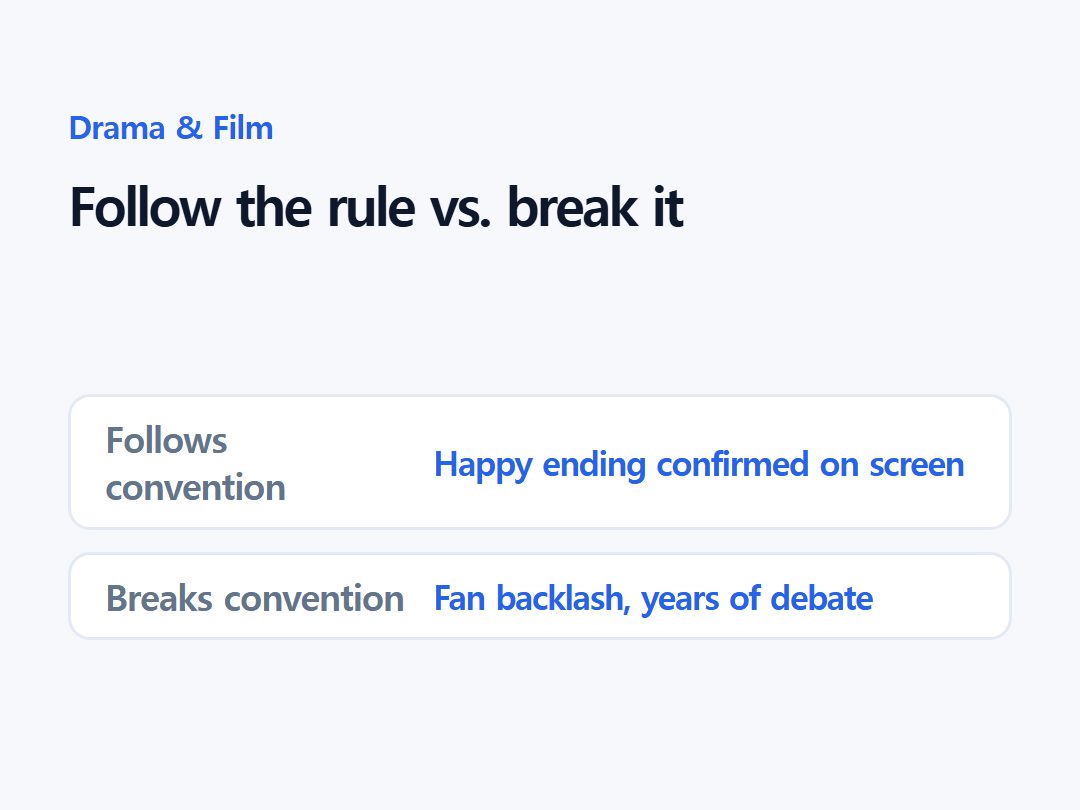
The clearest proof of how much weight this convention carries is what happens when a show uses the same structure to deny the payoff. Twenty-Five Twenty-One (2022), one of the most popular romances of its year, ends with the expected seven-year time jump — except the two leads have not ended up together.
One is shown congratulating the other, now married to someone else, during a live television broadcast.
The reaction was not mild disappointment; entertainment outlets described the finale as one of the most divisive in recent K-drama history, and years later, fans still revisit the ending every anniversary of its broadcast to relitigate it.
The backlash was not really about the plot outcome itself — bittersweet endings exist elsewhere in the genre — but about the fact that the show used the visual grammar of a happy-ending epilogue and then withheld the happy ending.
Viewers had been trained by hundreds of other dramas to read “years later, older, more accomplished” as shorthand for “they made it.” When that shorthand was inverted, it felt like a broken contract rather than a bold narrative choice.

Why were Korean dramas filmed so close to air?
The convention is rooted in how Korean terrestrial dramas have historically been made and consumed.
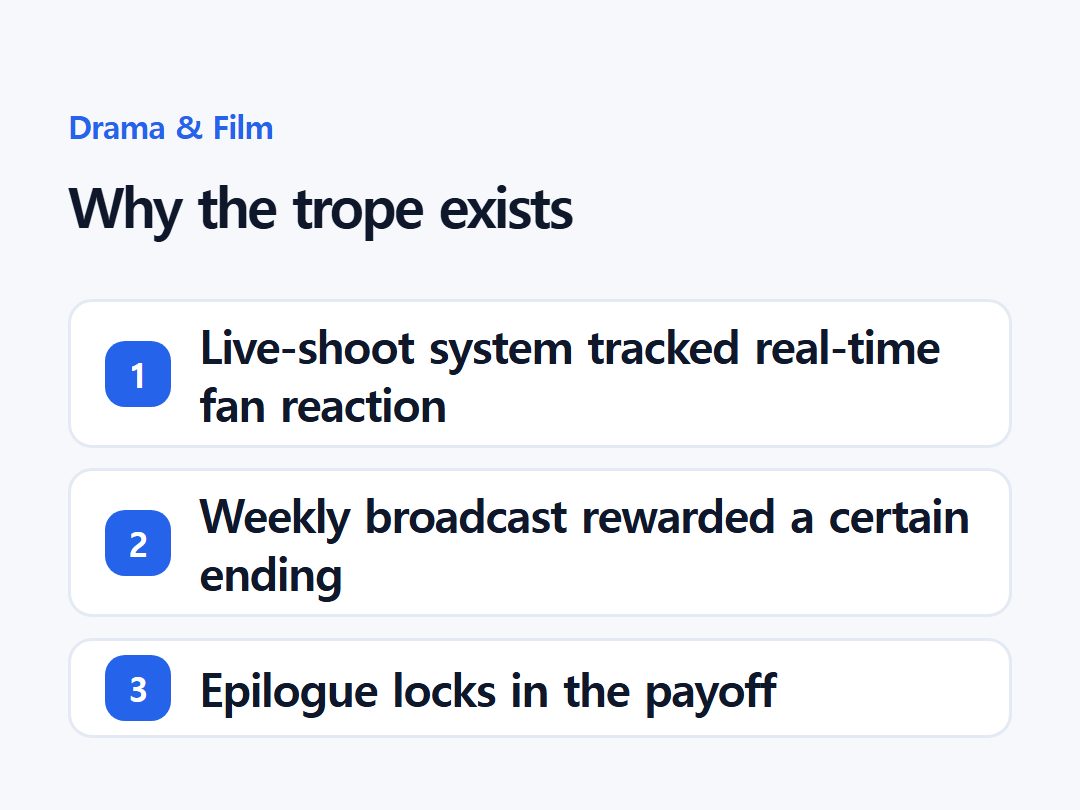
For decades, most dramas aired on KBS, MBC, or SBS were produced under a “live-shoot” system: episodes were still being written, filmed, and edited in the same week they aired, sometimes with scripts arriving on set page by page.
This system, well documented by industry outlets and Korean entertainment writers, gave production teams an unusual ability to respond in real time to audience reaction — adjusting pacing, expanding a popular side character, or accelerating a couple's storyline based on ratings and online comment sections as the show was still airing.
Industry reporting on the system also notes its cost: actors and crews describing overnight shoots, scripts arriving page by page days before filming, and, in at least one widely cited case, a broadcaster having to extend a news segment because an episode was not edited in time to air.
That responsiveness shaped how endings got written.
Because writers could gauge exactly how invested an audience had become in a couple's success by the final stretch of episodes, the safest and most reliably satisfying way to close the show was to answer every remaining question directly, rather than leave anything to interpretation.
A jump forward in time, shot and inserted right at the end of production, let writers deliver that certainty in a single scene without having to sustain years of plot to earn it.
It became a low-risk, high-payoff device — and once several major hits used it successfully, it hardened into an expected genre marker rather than a case-by-case creative decision.
The industry has since moved, unevenly, toward pre-produced dramas — shows filmed substantially or entirely before broadcast, a shift that outlets covering the industry trace back to hits like Descendants of the Sun (2016), which was shot in advance specifically to control quality and avoid the chaos of live production.
Pre-production gives writers a finished script before a single episode airs, removing the same-week feedback loop that made the live-shoot system so responsive to audience mood. Even so, the time-skip epilogue did not disappear with it.
By the time pre-production became more common, the convention was no longer just a production shortcut — it had become part of what audiences expected a Korean drama ending to look like, regardless of how the show was actually filmed.
In that sense the epilogue outlived the specific production conditions that made it useful in the first place, surviving as a genre signature rather than a practical necessity.
Will streaming end the time-skip epilogue tradition?
What remains unsettled is whether the convention holds in an era where Korean dramas are made as much for global streaming audiences as for the domestic weekly broadcast slot that originally shaped it.
Streaming removes the same-week audience feedback that made the epilogue such a useful tool for closing the loop with viewers, and platforms increasingly reward shows that generate ongoing discussion over shows that tie every thread off neatly.
Twenty-Five Twenty-One is itself an early example of a show using the format's familiar shape to provoke exactly that kind of prolonged debate rather than to deliver closure.
Whether more dramas follow that path — keeping the visual ritual of the time-skip while deliberately withholding what it usually promises — or whether the genre keeps the epilogue as a reliable, uncontroversial happy-ending stamp, is still an open question.
For now, the safest bet for an international viewer watching a Korean drama's final episode is still this: when the screen fades to black and a date appears, assume the writers are about to confirm, not complicate, how the story ends. It is the exception, not the rule, that gets people talking years later.
How major K-dramas have used the time-skip epilogue
| Drama | Year | Time Jump Used | What the Epilogue Shows |
|---|---|---|---|
| Boys Over Flowers | 2009 | 4 years | Male lead returns from studying abroad and proposes |
| Mr. Sunshine | 2018 | 2 years | Heroine trains a new generation of soldiers in liberated Korea |
| Itaewon Class | 2020 | 2 years, 7 years, and a leap to the 2000s | Protagonist goes from prison release to business success |
| Reply 1988 | 2015–2016 | Jump forward (unspecified) | Couple shown married, interviewed in their own home |
| Goblin | 2016–2017 | Several separate jumps | Heroine ages from her teenage years into adulthood |
| Twenty-Five Twenty-One | 2022 | 7 years | Leads do not end up together — subverts the convention |
Frequently asked
Why do Korean dramas always end with a time jump?
Because Korean broadcast dramas are built to close every loose thread for a live, multi-generational audience, and a time-skip epilogue shows the happy ending already confirmed instead of just implied.
What does the time skip in Twenty-Five Twenty-One mean?
It used the genre's familiar seven-year jump but showed the leads not ending up together, subverting the epilogue's usual promise and sparking major backlash.
Why were old Korean dramas filmed so close to their air date?
Many KBS, MBC, and SBS dramas used a live-shoot system where episodes were written and filmed the same week they aired, letting writers adjust the story based on real-time audience reaction.
Sources
Every factual claim above is traceable. We do not translate articles — we gather facts from multiple outlets and write them ourselves.
- 15 K-Dramas With Perfect Endings, Ranked — Collider
- 10 K-Dramas With Time Jumping, Ranked (According To IMDb) — ScreenRant
- Twenty-Five Twenty-One turns 3: Kim Tae-ri, Nam Joo-hyuk's bittersweet ending wasn't a twist, we just skipped clues — Gulf News
- "Twenty Five, Twenty One" Ending Labeled 'The Worst Of All Time,' Fans Voice Their Disappointment With The Show's Creators — JazmineMedia
- The perils of the live-shoot drama system — Dramabeans
- Will Korean dramas break away from 'live-shoot' system? — The Korea Herald
- Korean Dramas Adopt Pre-Produced Format to Mixed Results — Variety