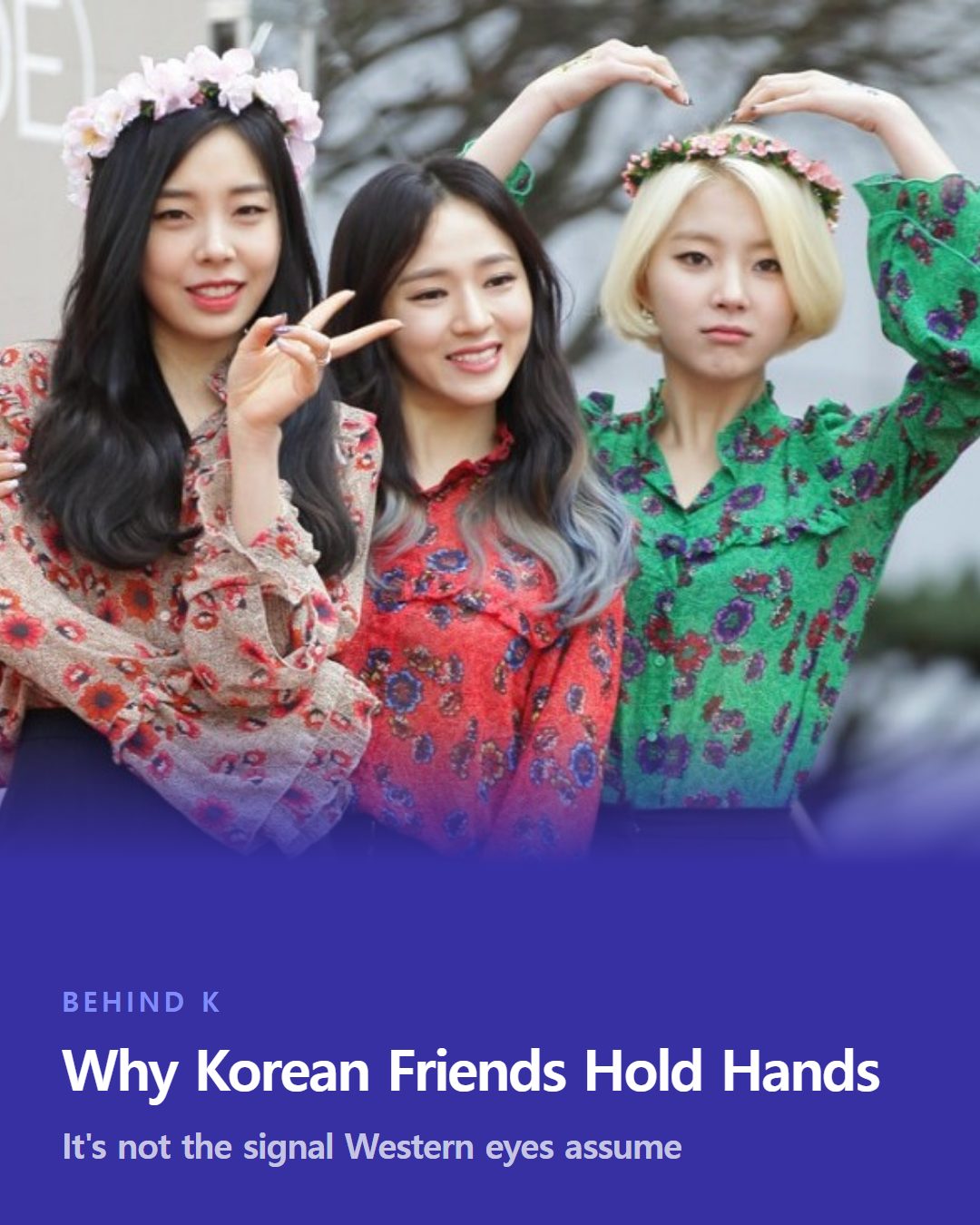
Watch enough K-dramas, variety shows, or fan-shot footage of K-pop idols and a pattern shows up fast: two men walk down the street with an arm slung over each other's shoulders. Two women stroll hand in hand, swinging their arms.
A group of male friends sits pressed shoulder to shoulder, one resting his head on another's arm. To many international viewers, especially those from the United States or Northern Europe, this reads as a signal — a hint of romance, repressed attraction, or at minimum something worth shipping.
It is none of those things. It is called skinship, and understanding it is one of the more useful pieces of cultural context for reading Korean media accurately.
The short version
- "Skinship" means non-sexual touch between close same-sex friends in Korea, not romance.
- The term began in Japan in 1953 describing mother-child bonding, later broadened to friendships.
- Actual Korean romantic couples show less public affection than platonic same-sex friends do.

This is daily life, not an event
There is no single event behind this — it is a standing feature of daily life in South Korea, which is exactly why it is easy to miss. Same-sex friends holding hands, linking arms, sitting in each other's laps, or resting against one another in public is common and unremarkable among Korean teenagers and adults alike.
It shows up constantly in exported Korean content: idols walking off stage with arms around each other, drama leads sharing a bed platonically during a trip, variety show hosts draped over one another mid-laugh. None of it is coded as romantic within Korea. Outside Korea, without the context, it frequently is.
What does 'skinship' actually mean?
The Korean term for this is skinship — a Konglish word (an English-derived term coined and used in East Asia but not in native English) describing non-sexual physical affection between people who are close: family members, and just as often, friends of the same sex. It covers hand-holding, linked arms, head-resting, and casual touch that in Korea signals comfort, trust, and closeness rather than attraction.
The gap for international readers is specific: in much of the West, unscripted physical touch between same-sex friends — particularly men — is limited by social convention to a handshake or a brief hug, because such touch has historically been read as a signal of romantic or sexual interest.
Korean social norms do not carry that same association. A Korean man holding his friend's hand while crossing the street is not communicating anything about his orientation or his feelings toward that friend beyond ordinary closeness.
Skinship between women reads slightly less foreign to Western eyes, since female friends holding hands is somewhat more tolerated globally, but the underlying logic is the same: touch is a marker of friendship, not romance.
There is a second layer here that is genuinely counterintuitive, and worth sitting with rather than skipping past. Some cultural analysts have pointed out a paradox: platonic same-sex touch is arguably easier to read as non-romantic in Korea precisely because open acceptance of same-sex relationships is still limited.
Where LGBTQ visibility is higher, as in much of the West, any same-sex touch carries a live possibility of romantic meaning, so it gets policed more carefully by the people doing it. Where that visibility is lower, casual touch between friends is not assumed to carry that meaning at all, so it circulates more freely.
This does not mean Korea is more accepting of LGBTQ people — survey research on South Korean attitudes toward same-sex relationships and marriage over the past two decades shows acceptance has grown among younger Koreans but remains contested and far from settled nationally.
Skinship exists alongside that tension, not because of social progress on queer rights, but somewhat independently of it.
It is also worth noting what skinship is not. It is not unlimited, and Koreans themselves recognize an informal line between platonic touch and something that would read as romantic or would make onlookers or the people involved uncomfortable — the boundary just sits in a different place than it does in the West.
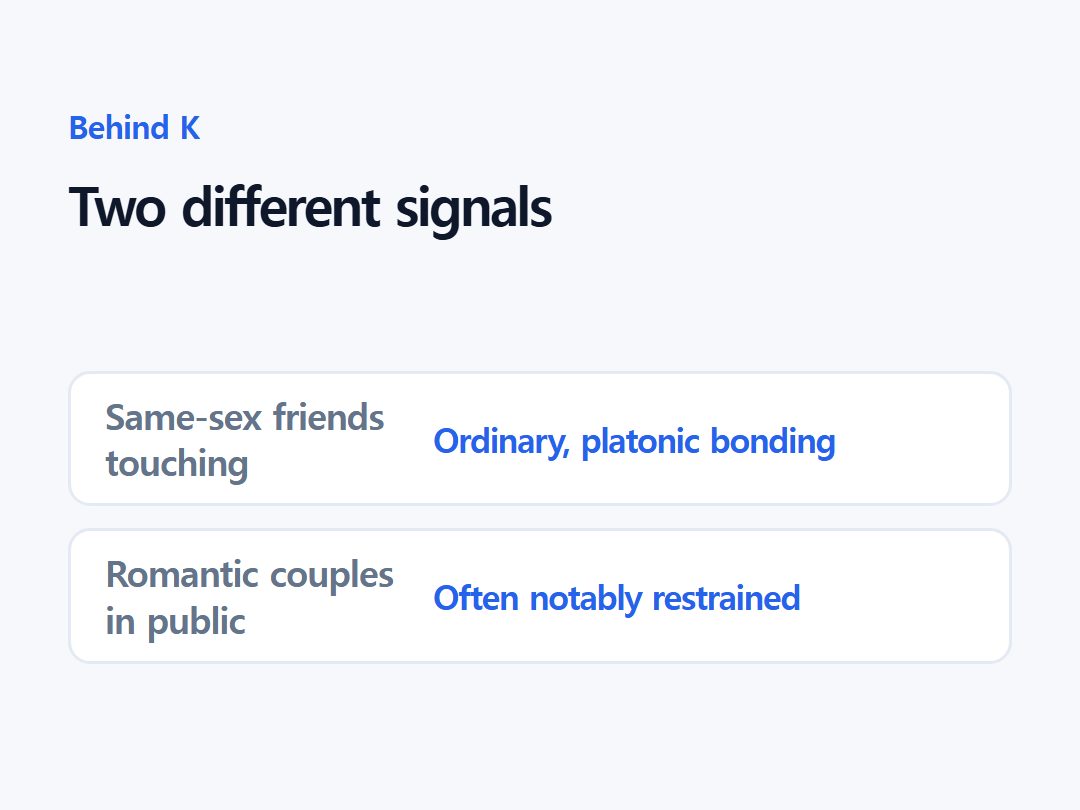
And perhaps counterintuitively, actual romantic couples in Korea tend to be more physically restrained in public than same-sex friends are: overt kissing or prolonged embraces between partners are less common and can draw disapproval, particularly from older generations, even as friends walking arm in arm draws no attention at all.
For readers encountering Korean pop culture, the practical takeaway is simple: when a drama shows two male leads sharing a room without a plot reason, or a K-pop group's members are shown holding hands backstage, that is not a coded romantic gesture, a queerbaiting tactic, or fan service dressed up as friendship. In the vast majority of cases, it is simply how close friends in Korea behave around each other, filmed.
Where the word and the habit began
The word itself has a Japanese origin.
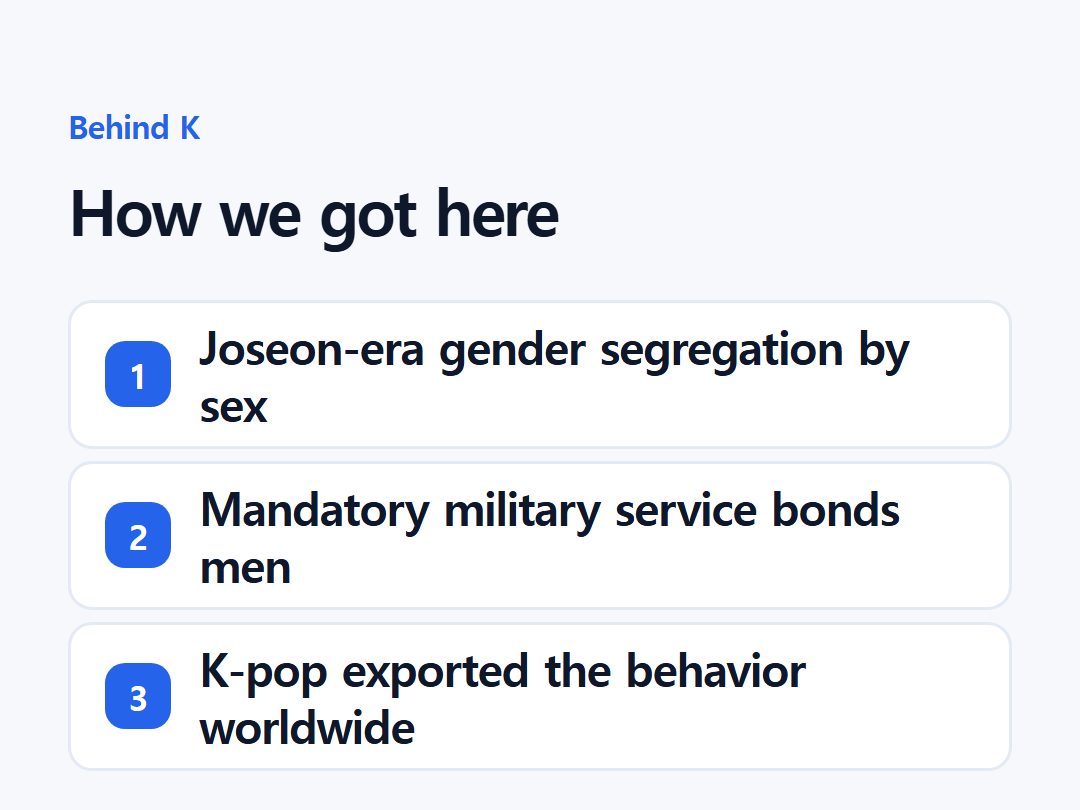
Multiple etymology sources trace "skinship" to Japanese pediatrician Nobuyoshi Hirai, who is said to have picked up the term at a 1953 WHO-linked childcare seminar — possibly as a mishearing of "kinship" — and popularized it in Japan to describe close physical bonding between mother and child.
The word later broadened to cover family and friend affection generally, and spread into Korean via the two countries' overlapping postwar media and academic exchange, eventually being folded into everyday Korean vocabulary as 스킨십 (seukinsip).
The social pattern the word describes is older than the word.
Confucian social organization in Korea, especially through the Joseon dynasty (1392–1897, Korea's last and longest imperial dynasty, whose norms around gender, hierarchy, and propriety still shape etiquette today), enforced strict separation between men and women outside the family.
Boys and girls were raised, schooled, and socialized largely apart. That segregation did not eliminate physical affection — it redirected it.
With cross-sex touch heavily restricted, close same-sex peer bonds, including physical ones, became the primary outlet for platonic intimacy, and scholars researching Korean social bonds have described this as a kind of esprit de corps within gender lines that has persisted well past the Joseon period.
Modern institutions reinforced the pattern rather than erasing it.
Gender-segregated schooling remained standard, and mandatory military service for Korean men (nearly all Korean men serve roughly 18–21 months, typically starting in their early twenties) places young men in close, all-male units for an extended period, a setting where physical camaraderie is normalized as part of unit cohesion.
Same-sex friend groups formed in school or the military often remain a person's closest social circle for life, and the physical ease that comes with those bonds carries into adulthood.
What changed in the 2000s and 2010s was visibility, not the behavior itself. As K-pop and Korean dramas found large international audiences, footage of ordinary Korean same-sex affection reached viewers who had no prior context for it — and read it through their own culture's touch norms instead.
That mismatch is where a lot of the fan-driven speculation and cross-cultural confusion around Korean celebrities' relationships with each other originates.

Does skinship signal LGBTQ acceptance?
Two things remain genuinely unsettled.
First, how Korean public figures and content navigate skinship for a global audience that reads it differently — some idols and agencies have grown more conscious of how casual physical affection lands overseas, occasionally leaning into it as part of fan-facing content, which adds a layer of media strategy on top of what was originally just unselfconscious behavior.
Second, and more substantively, how Korean attitudes toward LGBTQ people evolve independently of skinship. The two are not the same conversation, and conflating them — assuming that widespread platonic same-sex touch signals broad social acceptance of queer relationships — is itself a misreading.
Survey data on South Korean opinion continues to show a generational divide, with no national marriage equality law in place. Skinship explains a gesture. It does not settle the larger question of how Korean society treats sexual orientation, which remains a separate and still-developing story.
How skinship developed in Korea
| Period | What happened |
|---|---|
| 1953, Japan | Pediatrician Nobuyoshi Hirai coins "skinship" at a WHO-linked seminar to describe mother-child bonding |
| Joseon dynasty (1392–1897) | Confucian gender segregation redirects platonic touch into close same-sex friendships |
| 20th century | Gender-segregated schooling and mandatory military service normalize same-sex physical closeness |
| 2000s–2010s | K-pop and K-dramas expose skinship to global audiences who misread it as romantic |
Frequently asked
What does skinship mean in Korean culture?
Skinship is non-sexual physical affection, like hand-holding, linked arms, or resting on each other, between close family or friends, especially same-sex friends. It signals comfort and trust, not romantic attraction.
Why do Korean guys hold hands or touch each other so much?
Confucian-era gender segregation historically restricted cross-sex touch, so close physical bonds developed between same-sex friends instead. Gender-segregated schools and mandatory military service later reinforced this into adulthood.
Where does the word skinship come from?
It originated in Japan, reportedly coined by pediatrician Nobuyoshi Hirai at a 1953 WHO-linked childcare seminar to describe mother-child bonding, then spread into Korean as 스킨십 and broadened to cover friends.
Sources
Every factual claim above is traceable. We do not translate articles — we gather facts from multiple outlets and write them ourselves.
- I Love You, Man — Ask a Korean
- Skinship — Korean Culture Lessons (Lesson #3) — University of South Carolina Beaufort
- Touching the Opposite Sex in Korea — Seoulistic
- Young Generation's Perceptions of Same-Sex Sexuality and Attitudes Toward Same-Sex Marriage in South Korea — SAGE Open
- Skinship: Why Japan's Favorite Word for Intimacy Was Never English to Begin With — Side Street 路地裏
- skinship — Wiktionary