A viewer who moves from a Korean crime film straight into a Korean television drama often notices the tonal whiplash immediately. In The Roundup (2022), the villain played by Son Suk-ku cuts off a captive's ear and stabs him to death within the film's first act — and the film was still cleared for a 15-and-up rating.
A Korean television drama built around the same premise, a serial killer or a gang boss, will almost always cut away from the act itself, imply it through sound and editing, or fold it into a romance subplot rather than linger on it. Local critics have flagged this same gap.
Cultural critic Kim Hern-sik and film critic Hwang Young-mee both told The Korea Herald that Korea's film ratings board has effectively been grading violence "on a curve," waving through content that would have drawn a harsher rating a decade earlier, precisely because it is being compared only to other films — not to what is allowed on a television screen.
The short version
- Korean movies and TV dramas answer to two completely different regulators.
- Advertiser-funded broadcast dramas avoid graphic content to protect sponsor relationships.
- Netflix Korea shows are classified as film, not broadcast, so go darker.
That comparison is the point. Korean movies and Korean dramas are not made under the same rules. They are reviewed by two different regulators, paid for by two different business models, and watched by two different audiences. The gap in tone is not a matter of which side has more daring writers. It is engineered into the system.
Why are Korean dramas less violent than films?
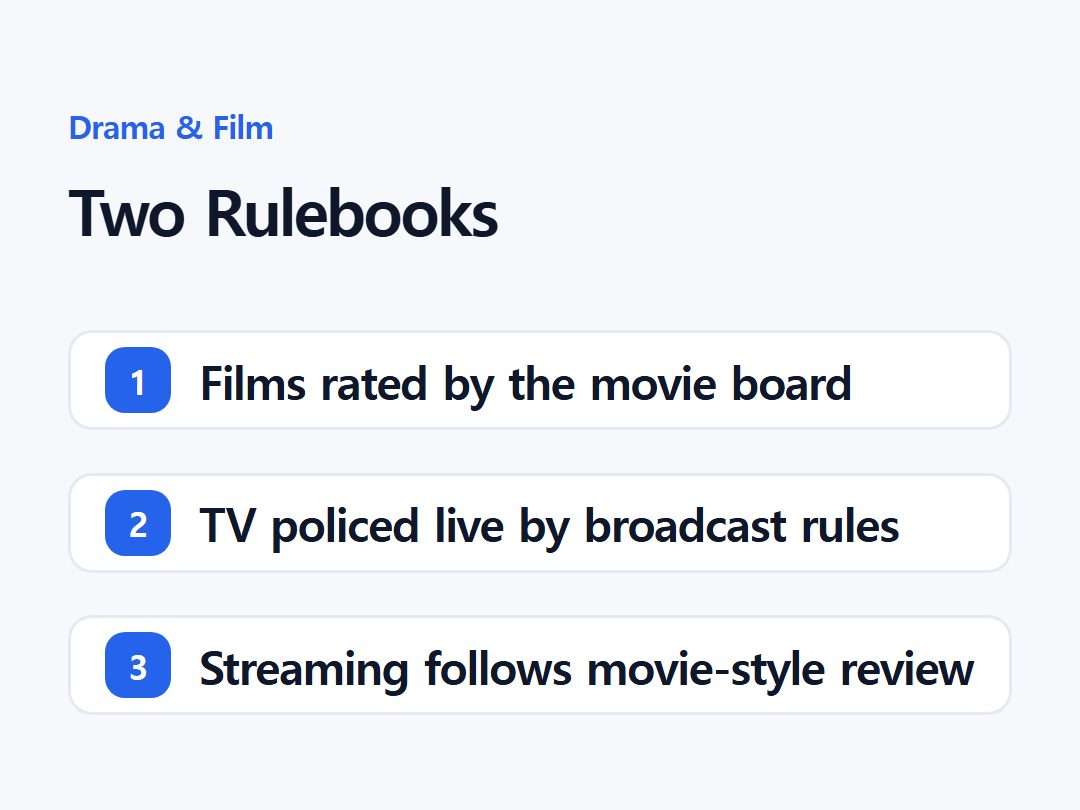
Films in South Korea are classified by the Korea Media Rating Board (KMRB), the body that assigns theatrical age ratings — All Ages, 12+, 15+, Restricted (18+, called 청소년관람불가), and, rarely, a limited-release-only tier for the most extreme material. Once a film clears its rating, a viewer old enough simply buys a ticket.
The KMRB's role ends there; it does not monitor what happens on screen after admission, and it does not answer to advertisers.
Broadcast television answers to a completely different regulator, the Korea Communications Standards Commission (KCSC), which reviews programming against public-airwave standards rather than a one-time purchase decision.
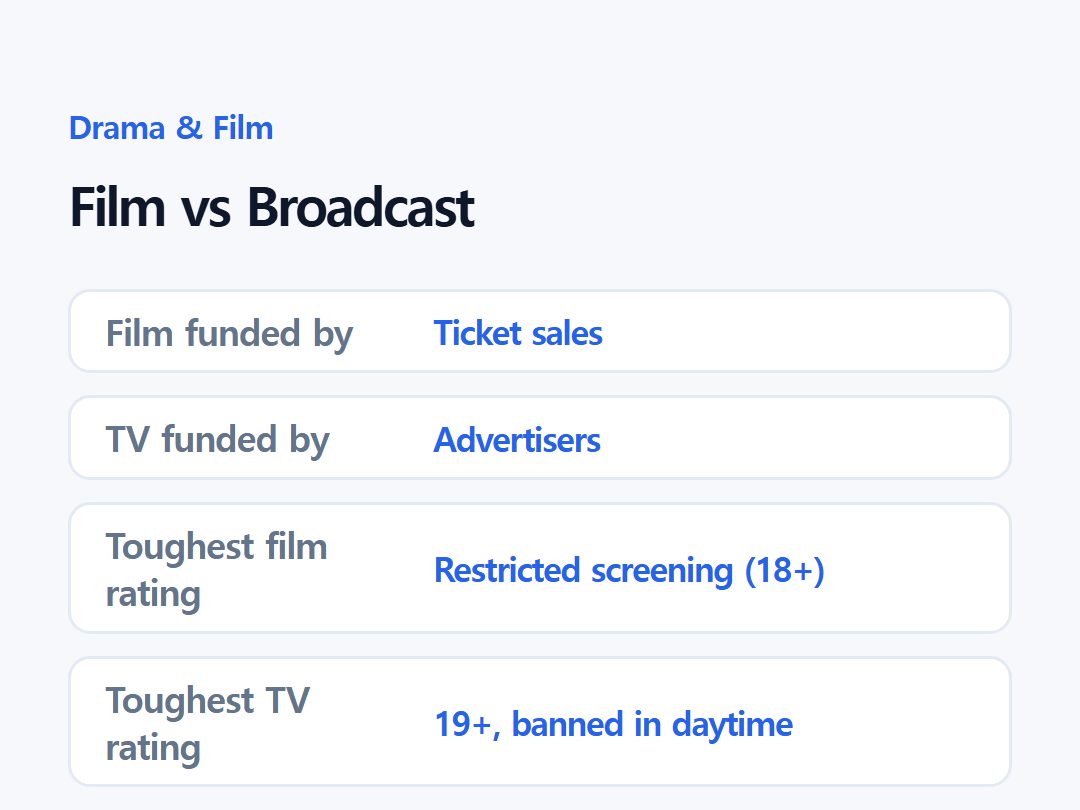
Korean TV ratings — All, 7, 12, 15, and 19 — carry an obligation films don't have: a 19-rated broadcast is legally banned from airing between roughly 7–9 a.m. and 1–10 p.m. on weekdays (7 a.m.–10 p.m. on weekends), because unlike a theater, a television set can be on in a living room with children present at any hour.
The KCSC's standards were also built for an advertiser-funded medium. Broadcasters depend on sponsors, and sponsors want the widest possible audience, not the narrowest.
South Korea's Broadcasting Act allows product placement (PPL) inside entertainment programs, but only under tight limits — no more than 30 seconds per product and 5% of total runtime — and networks that alienate advertisers with graphic content risk losing the revenue the entire drama format is funded on.
A show that needs a skincare brand, a car company, and a phone maker all comfortable with their logo appearing on screen is not going to greenlight the ear-cutting scene from The Roundup.
Streaming complicates this in a way that international readers, who mostly encounter Korean content through Netflix, often don't realize. Netflix Korea originals are not broadcast — they are streamed — so they fall under the KMRB's film-and-video review process, not the KCSC's live-broadcast rules.
That is a structural reason, not a creative one, why a Netflix Korean series can go further than a network drama airing on KBS, MBC, or SBS: it is legally classified more like a movie than like television, and it isn't chasing advertiser approval, since subscribers already pay for access.
The three-way split — ticket-funded theatrical film, advertiser-funded broadcast drama, subscription-funded streaming series — maps almost exactly onto how graphic each format is willing to be.
Audience self-selection reinforces all of this. A theatrical release requires an adult to actively choose a specific film, pay for it, and sit through it in a dedicated space — the KMRB's ratings exist mainly to keep minors out of an 18+ screening, not to soften what plays inside it once they're excluded.
A prime-time drama, by contrast, is designed to be walked in on: grandparents, teenagers, and children can all be in the same room when it airs. Genuinely graphic content is a liability for a format built around that kind of casual, shared, multi-generational viewing.
When did Korean movies start showing more violence?
None of this is recent. South Korean film was under direct state censorship for most of the twentieth century — first colonial-era review boards, then decades of military-government control under the 1962 Motion Picture Law, which forced studios to submit films for approval before release.
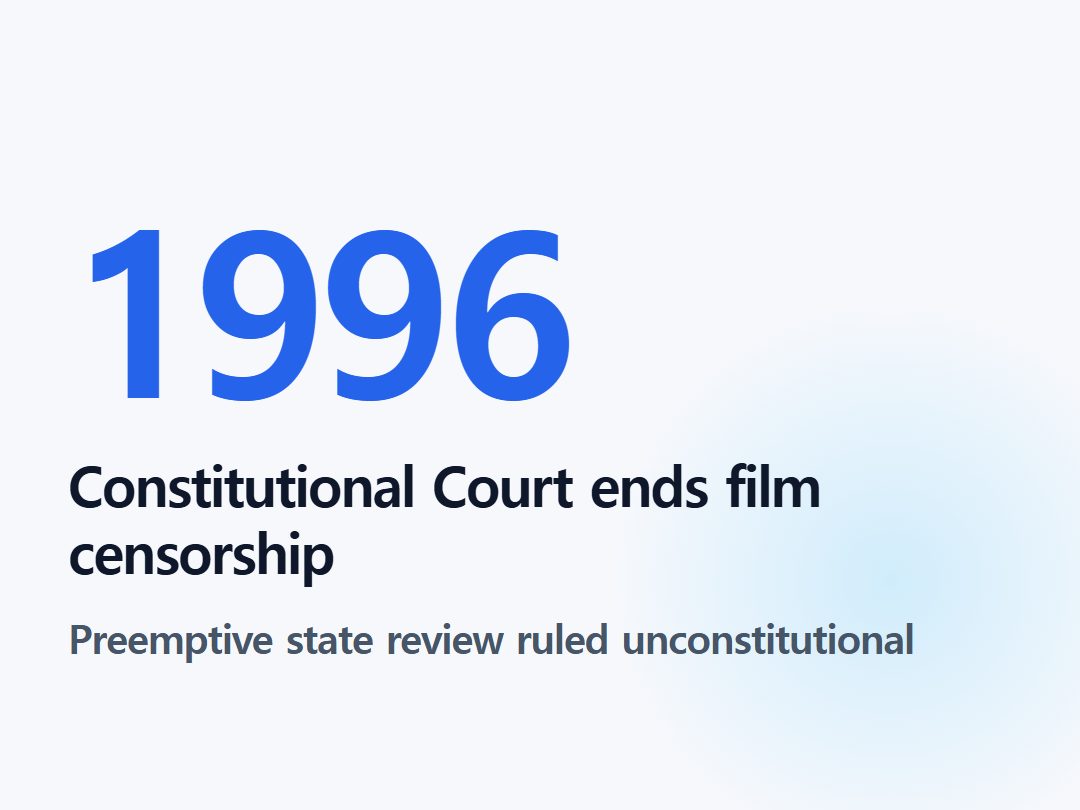
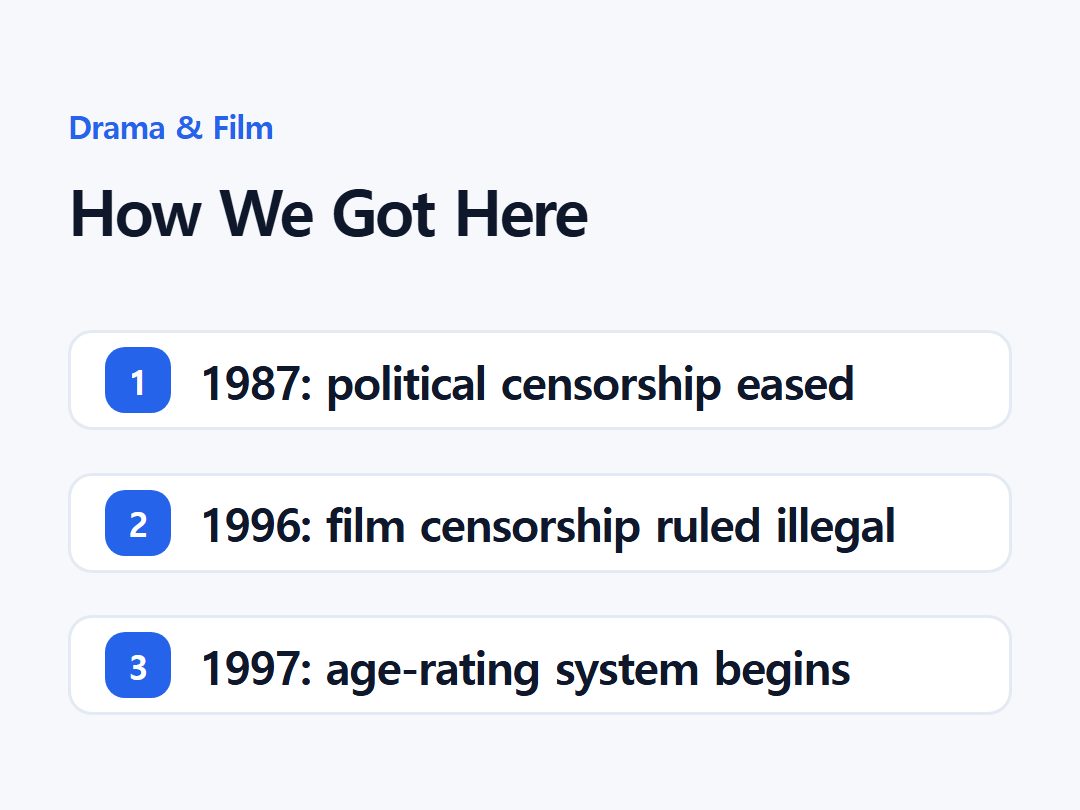
Political liberalization from 1987 loosened some of that grip, but the decisive break came in 1996, when South Korea's Constitutional Court ruled that mandatory government pre-screening of films was unconstitutional. The old censorship board was dissolved.
In its place, the 1997 Motion Picture Promotion Act introduced the age-based classification system that, with revisions, is still in use today — the KMRB inherited and formalized this role by 1999.
That legal shift is widely credited by film historians as the trigger for what's now called New Korean Cinema: the wave of directors — Kim Ki-duk, Lee Chang-dong, Park Chan-wook, and later Bong Joon-ho — who came up in the late 1990s and 2000s making films that would have been unreleasable under the old preliminary-review system.
Once the state stopped pre-approving scripts and final cuts, Korean filmmakers could build a reputation on precisely the unflinching, morally bleak material — organized crime, revenge, institutional corruption — that now defines Korean cinema internationally.
Broadcast television never went through an equivalent deregulation, because it was never treated as the same kind of medium. Public airwaves in Korea, as in most countries, carried a higher public-interest obligation than a movie ticket, and that obligation stayed with a separate regulator even as film was cut loose.
The Korea Communications Standards Commission's current framework dates to 2000, refined but not fundamentally loosened since.
Even the industry's own commercial rules changed on a different track: a 2010 deregulation loosened how much product placement broadcasters could show, but it addressed advertising, not violence or sexual content — the content ceiling for dramas stayed where it was even as the money around them grew.
The ratings debate isn't over, and streaming complicates it
The line the streaming era drew is still moving.
Korean critics who track the ratings board's decisions — Kim Hern-sik, Chung Deok-hyun, and others quoted in Korean press coverage of recent action and crime films — have openly questioned whether the KMRB's tolerance for graphic violence has drifted further than the board's own stated criteria intend, partly because Korean audiences, especially viewers in their 20s and 30s raised on international streaming content, have grown less reactive to on-screen violence than earlier generations.
That's an unresolved domestic debate, not a settled one, and it could tighten ratings for future films rather than loosen them further.
On the drama side, the more interesting open question for international viewers is what happens as Netflix and other streamers commission more Korean originals directly, rather than licensing shows already made for domestic broadcast.
Because those originals are reviewed as film-and-video content rather than live broadcast, they have more room to explore the same bleak material Korean cinema built its reputation on — school violence, institutional cruelty, revenge — without the advertiser and airtime constraints that shape a network drama.
Whether that pulls the broadcast side toward looser standards over time, or simply cements two permanently separate tones for "Korean film" and "Korean drama" as international audiences understand them, is still playing out.
Film, broadcast, and streaming each follow different rules
| Format | Regulator | Paid for by | Content ceiling |
|---|---|---|---|
| Theatrical film | KMRB | Ticket sales | Age-gated at the door (All Ages–15+, 18+ Restricted); unrestricted once admitted |
| Broadcast TV drama | KCSC | Advertisers | 19-rated shows banned ~7–9 a.m. and 1–10 p.m. weekdays; must stay sponsor-safe |
| Streaming series (e.g. Netflix Korea) | KMRB (film-and-video review) | Subscriptions | No live-broadcast airtime rules; most creative latitude |
Frequently asked
Why are Korean dramas less violent than Korean movies?
Films are rated once by the KMRB and then left alone, while TV dramas answer to the KCSC's advertiser-funded broadcast standards, which restrict graphic content and ban 19-rated shows from most daytime and evening hours.
Why can Netflix Korean shows be more violent than network Korean dramas?
Netflix Korea originals are streamed, not broadcast, so they fall under the KMRB's film-and-video review instead of the KCSC's live-broadcast rules, and they don't need advertiser approval since subscribers already pay for access.
When did Korean movies start showing more violence?
After 1996, when South Korea's Constitutional Court ruled mandatory government pre-screening of films unconstitutional, ending state censorship and leading to the 1997 age-rating system that enabled the bleak, unflinching style of New Korean Cinema.
Sources
Every factual claim above is traceable. We do not translate articles — we gather facts from multiple outlets and write them ourselves.
- Korean cinema sees more blood, guts and gore — The Korea Herald
- Film censorship in South Korea — Wikipedia
- Korea Communications Standards Commission — Wikipedia
- A Short History of Korean Film — KoreanFilm.org
- Korea Media Rating Board — NamuWiki
- South Korea's television rating system — NamuWiki
- Controversy Of Product Placement (PPL) In Korean Television — Creatrip